
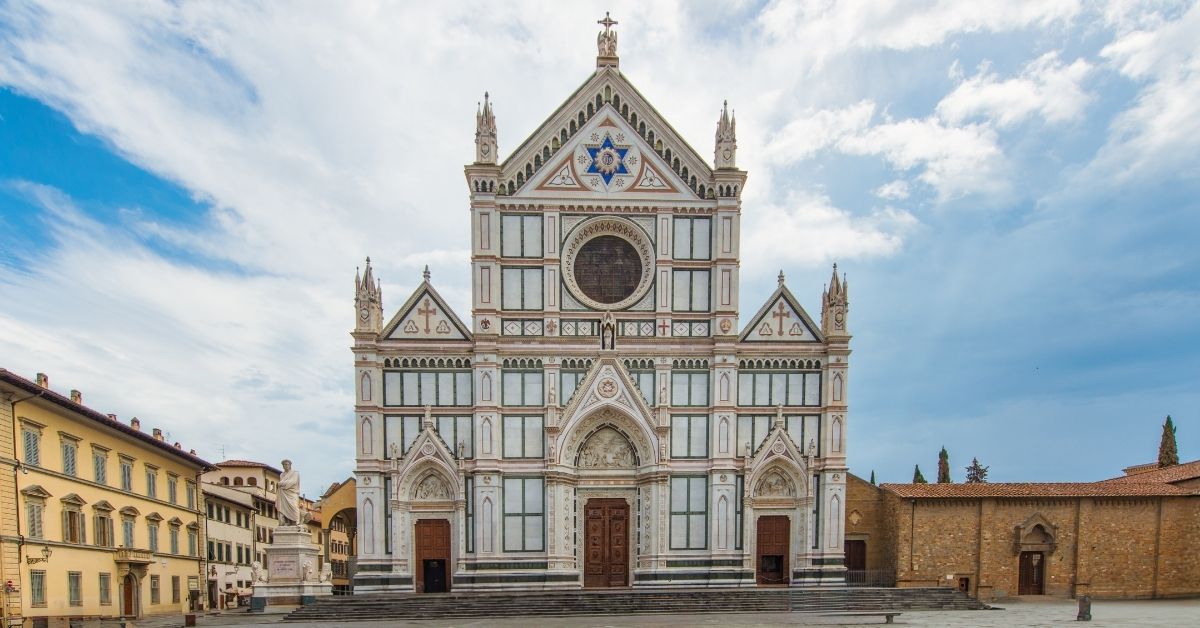
Between the crowds at the Uffizi and the line for David, it’s easy to forget that some of Florence’s greatest treasures are hiding in plain sight—behind unassuming church doors. My wife and I learned this years ago on our first trip. We rushed past a plain facade to see some famous painting, only to realize later that we’d walked right by a masterpiece. Don’t make that mistake.
The churches of Florence are not just places of worship. They are free museums, architectural textbooks, and quiet refuges from the chaos of tourists. You don’t need to be religious to feel something when you stand inside a Brunelleschi dome or sit in a chapel where Michelangelo prayed. This list covers the five that will give you the richest experience for your time and money.
Before we start, a quick note on practicality. Cover your shoulders and knees. I’ve watched sunburned tourists get turned away at the door, and it’s a sad sight. Also, try to visit in the morning or late afternoon. Midday crowds are thick, and the marble floors won’t cool you down.
Now, let’s walk into some art.
Santa Maria del Fiore – The Duomo
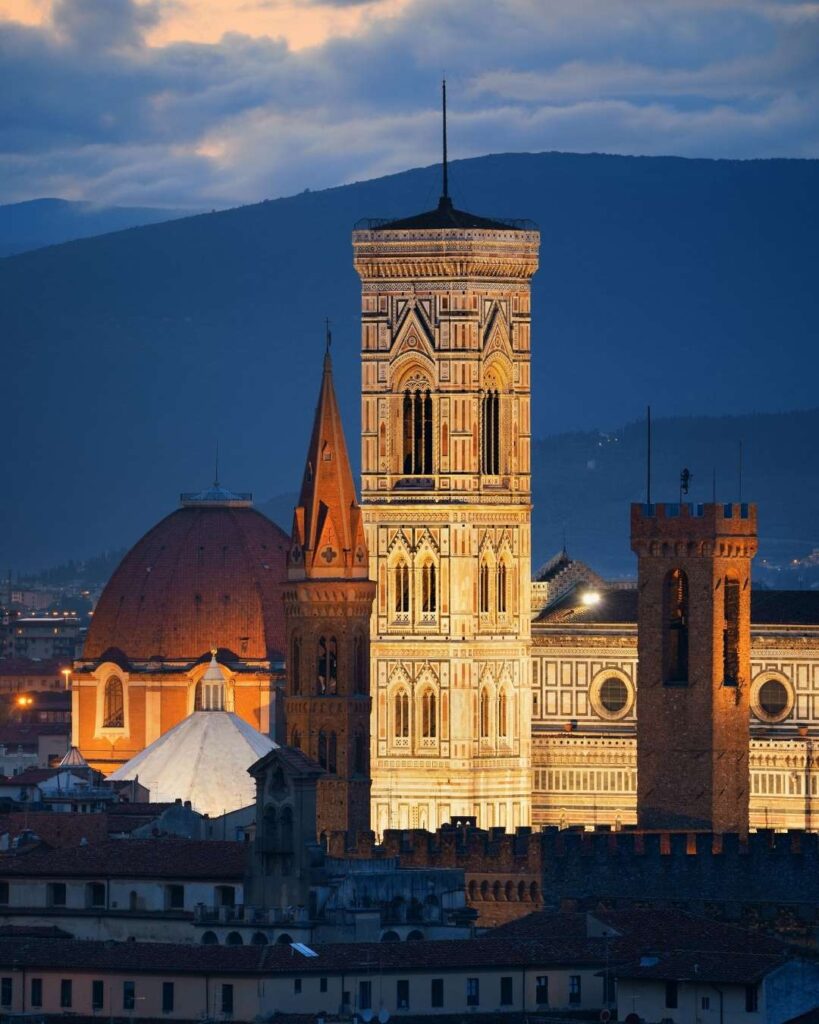
You can’t miss it. The red dome dominates every postcard and every skyline. But here’s what most visitors miss: the inside of the cathedral itself is free and surprisingly quiet compared to the square outside. My wife and I slipped in one Tuesday morning with no line at all. We sat in a back pew and just looked up.
The dome is the real story. Brunelleschi figured out how to build it without scaffolding by using a double shell and herringbone brickwork. It was a miracle of engineering in the 1400s, and it still feels like one today. The interior frescoes by Vasari and Zuccari are dizzying—a swirling vision of the Last Judgment that covers the entire ceiling. You’ll crane your neck until it hurts, and you won’t mind.
If you’re able to climb, buy a ticket for the dome. It’s 463 steps up a narrow staircase. You’ll be breathing hard and brushing against ancient brick walls. But then you emerge on top with Florence laid out at your feet like a painting. The red roofs, the river, the hills—it’s worth every step.
Don’t skip the crypt downstairs. You’ll find the remains of the older church of Santa Reparata, along with some mosaic floors from Roman times. It’s cool, dark, and nearly empty when the crowds are upstairs.
Practical tip: The cathedral is free. The dome climb requires a paid ticket and a reservation. Book at least a few days ahead in peak season.
Basilica of Santa Croce – The Temple of Italian Glories
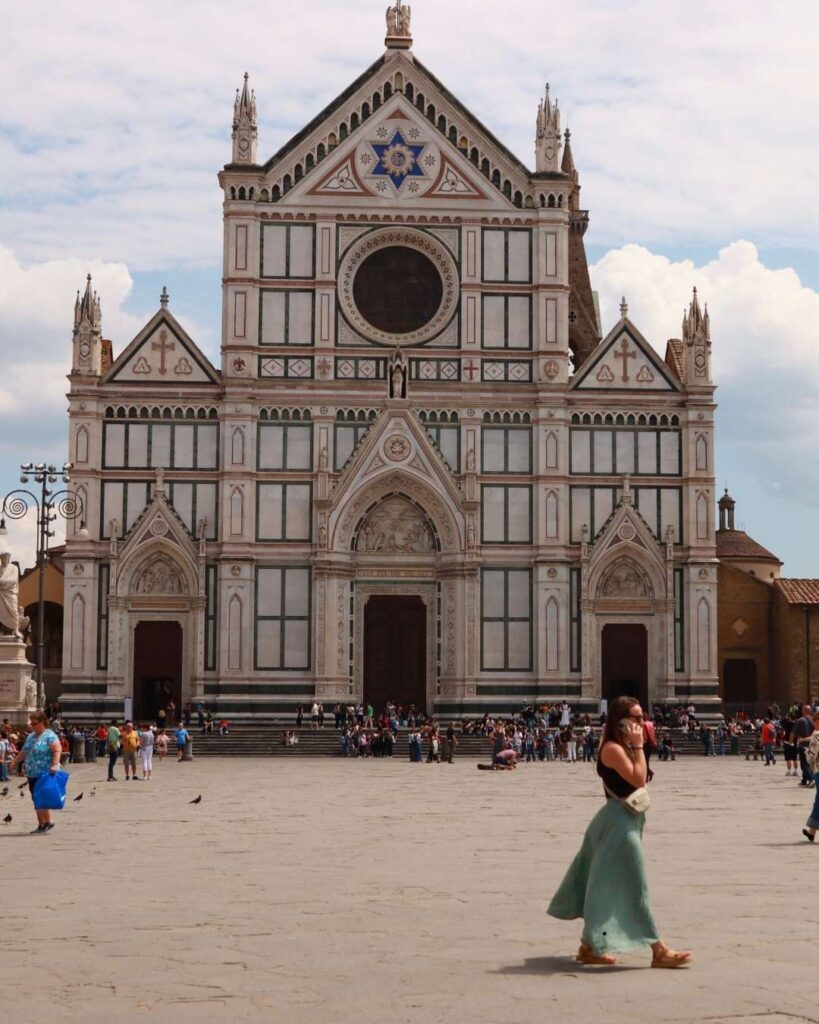
This one feels different. Santa Croce is a Franciscan church, which means it keeps things simpler than the Dominicans down the street. But don’t let the modesty fool you. This is where Florence buries its heroes.
Michelangelo is here. Galileo is here. Machiavelli is here. Rossini, the composer, is here. Walking among their tombs is like flipping through a history book of genius. My wife stood in front of Michelangelo’s tomb for a full minute without speaking. That never happens.
The real art, though, is in the chapels to the right of the altar. Giotto painted frescoes here in the early 1300s, and you can see him figuring out how to make people look real and emotional for the first time since ancient Rome. The Bardi Chapel shows the life of St. Francis. The Peruzzi Chapel shows John the Baptist. They are worn and damaged, but that only makes them feel more honest.
Also look for Donatello’s wooden crucifix. It hangs above the door to the refectory. The story goes that Donatello and Brunelleschi had a friendly argument about who could make a better crucifix. Brunelleschi’s is in Santa Maria Novella. Donatello’s is here. You can compare and decide for yourself.
Before you leave, walk through the leather school in the old cloister. Monks started it after World War II to give orphans a trade. Now you can watch artisans tool leather and buy high-quality bags or wallets. It’s expensive but beautiful.
Practical tip: Santa Croce charges an entry fee. The audio guide is worthwhile because the signage is minimal.
Santa Maria Novella – The First Great Basilica
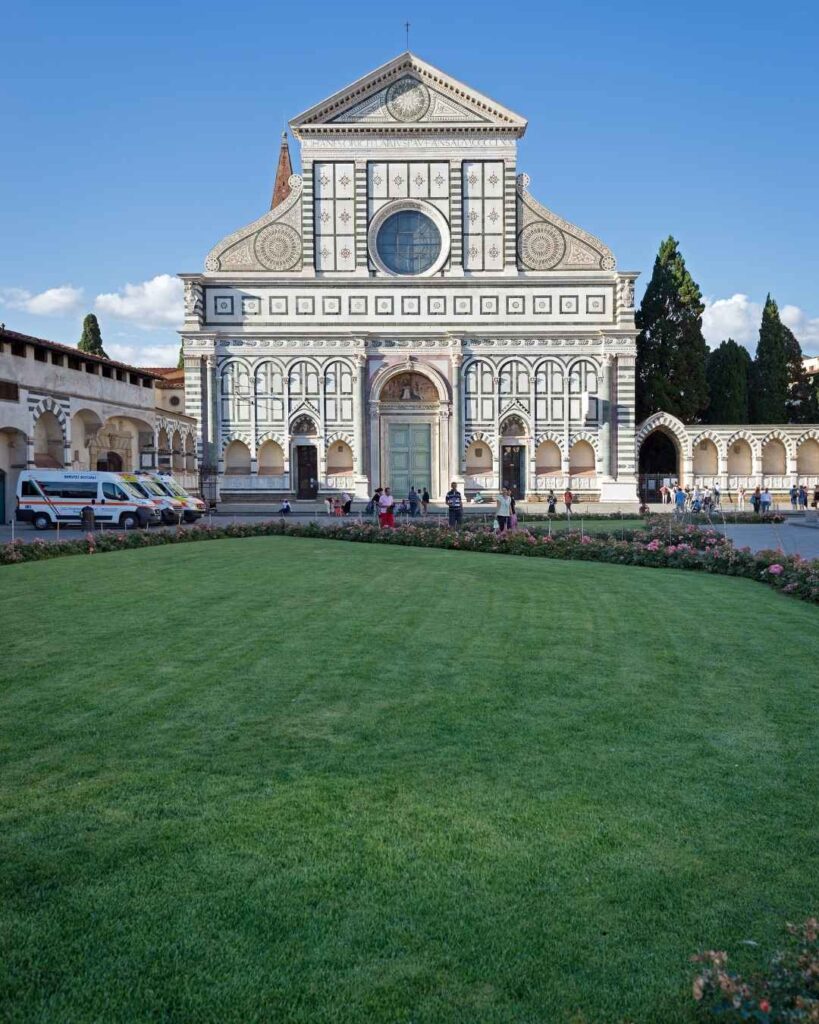
This church is easy to overlook because it sits near the train station in a busy square. Don’t overlook it. Santa Maria Novella is where Renaissance painting woke up.
The facade is a lovely sandwich of green and white marble designed by Alberti. But step inside and walk about halfway down the left aisle. Stop at the crucifix by Brunelleschi. Then turn around and look at the wall above you.
That’s Masaccio’s Holy Trinity. Painted around 1425, it’s the first painting to use mathematical perspective. The ceiling of the little chapel in the fresco recedes so perfectly that your eye believes it’s real space. God the Father stands behind a crucified Christ, and Mary and John kneel below. A skeleton lies at the bottom with an inscription that translates to, “I was once what you are, and what I am you will become.” It hits hard.
The main attraction for most visitors is the Tornabuoni Chapel behind the altar. Ghirlandaio covered the walls with scenes from the lives of Mary and John the Baptist. The frescoes are crowded with Florentine nobles and merchants dressed in their finest. It’s like a Renaissance fashion magazine painted in plaster. And yes, a young Michelangelo reportedly learned by watching Ghirlandaio work here.
Take time for the cloisters and the Spanish Chapel. The Spanish Chapel has a famous fresco of the Triumph of St. Thomas Aquinas that feels like a medieval diagram turned into a painting. It’s strange and wonderful.
Practical tip: Paid entry. This church is rarely as crowded as Santa Croce, so it’s a good choice for a rainy afternoon.
San Lorenzo – The Medici Church
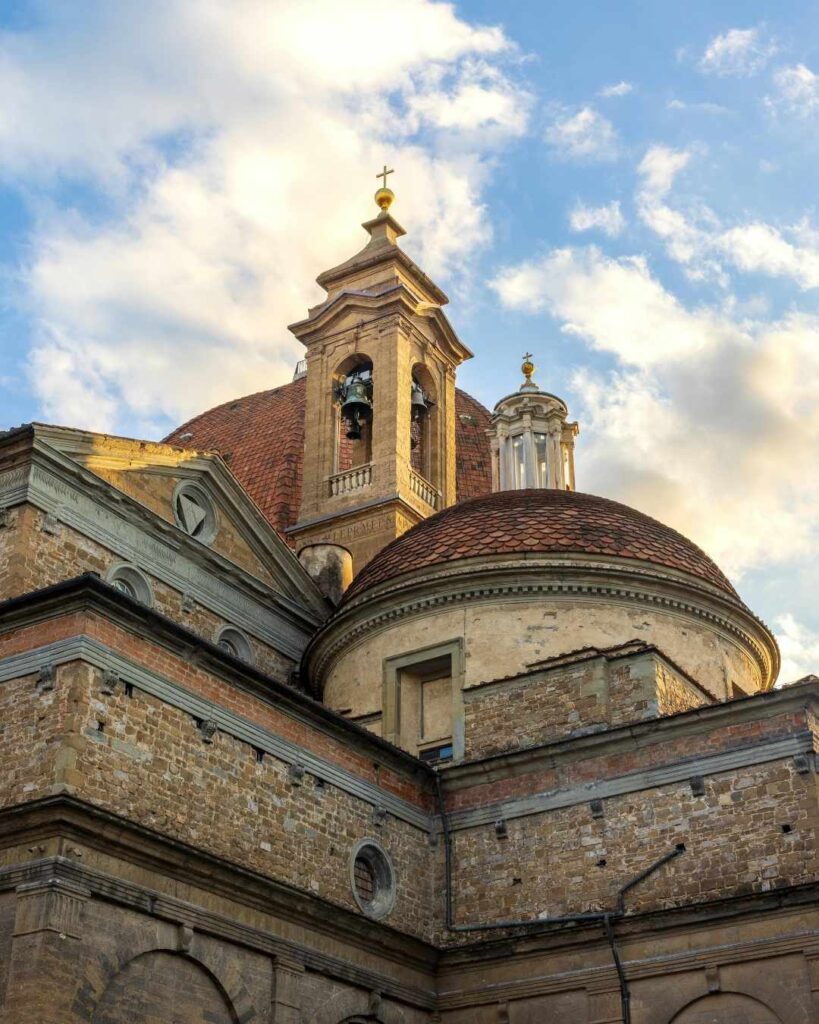
San Lorenzo feels unfinished from the outside. The rough brick facade was never completed because the Medici kept changing their minds. But that roughness makes the inside feel like a surprise.
Brunelleschi designed the interior in his clean, mathematical style. Gray stone, white plaster, perfect proportions. It’s calming after the visual noise of the Duomo. Donatello spent his last years here and made two bronze pulpits for the nave. Look closely at the reliefs. They show the passion of Christ with such raw emotion that you forget you’re looking at bronze.
But the real reason to come is the Medici Chapels attached to the back. You buy a separate ticket, and it’s worth every euro.
The Chapel of the Princes is over the top in the best way. Every surface is covered in colored marble, lapis lazuli, and jasper. Six massive sarcophagi wait empty for Medici grand dukes who were never buried here. It’s gaudy and glorious.
Then you walk into Michelangelo’s New Sacristy. It’s the opposite. Simple, dark, and heartbreaking. Michelangelo built tombs for two young Medici princes and sculpted the figures of Day and Night, Dawn and Dusk. They slouch and twist in ways that feel exhausted. Above them, the princes sit in empty niches. One friend told me it’s the most melancholy room in Florence. I believe him.
Upstairs is the Laurentian Library, also by Michelangelo. You need a separate reservation to see it, but the staircase alone is worth the effort. It looks like hot wax dripping down into the room. Stairs weren’t supposed to move like that in the 1500s.
Practical tip: The church itself is free. The Medici Chapels are a paid ticket. The Laurentian Library requires a separate reservation and is not always open to casual visitors.
San Miniato al Monte – The Sunset Church
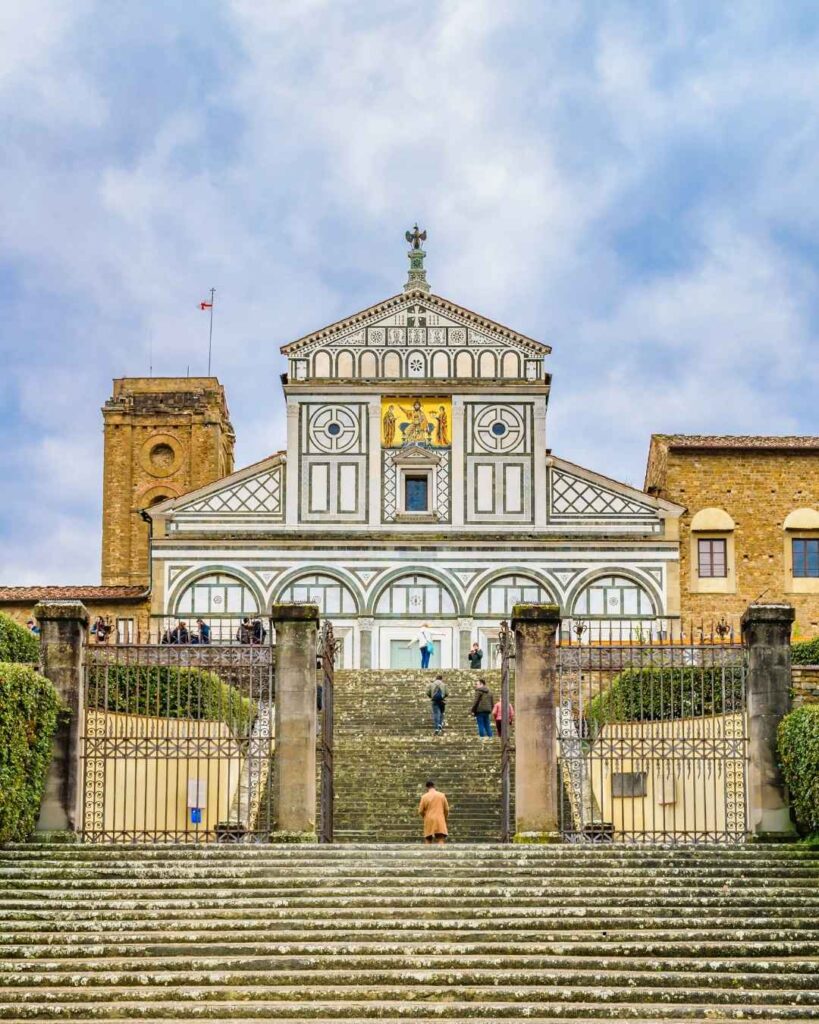
This one is for the evening. Save it for last.
San Miniato sits on a hill just above Piazzale Michelangelo. The walk up is steep but manageable. You’ll pass cypress trees and old stone walls. By the time you reach the church, you’ll be a little out of breath, and the view will already be opening up behind you.
The church itself is Romanesque, which means it feels older and more solid than the Renaissance buildings below. It was started in 1018 and finished a couple hundred years later. The facade is white and green marble with geometric patterns. Inside, the floor is a beautiful inlay of marble zodiac signs and animals.
Look up at the apse. The mosaic shows Christ between the Virgin and St. Minias, an Armenian prince who was beheaded here in the 200s. Legend says he picked up his own head and walked across the Arno. That’s the kind of story you get with early Christian martyrs.
My wife and I sat on the steps in front of the church as the sun went down. The whole city turned gold and then pink. The Duomo glowed. The hills behind us went dark. And then, from inside the church, we heard the monks begin to sing.
The Olivetan monks do Gregorian chant at 5:30 PM most days. You can sit in the back of the church and listen. It’s not a performance. It’s their evening prayer. They sing slowly and without hurry. The sound bounces off the old stone and fills every corner. I’m not a particularly religious person, but I cried a little. Don’t tell anyone.
Practical tip: Free entry. Take bus number 12 from the station if you don’t want to walk. Arrive by 5:00 PM if you want a seat for the chant. And bring a light jacket even in summer. It gets cool on the hill at sunset.
How to See All Five
You can see all five in two days without rushing. Do Santa Croce and the Duomo on the first morning while you have energy. Walk to San Lorenzo in the afternoon. On day two, start at Santa Maria Novella, then take a long lunch. Head up to San Miniato by late afternoon and stay for sunset.
If you only have one day, skip San Lorenzo or Santa Maria Novella depending on your taste. Love Michelangelo and the Medici? Choose San Lorenzo. Love painting and perspective? Choose Santa Maria Novella. But don’t skip San Miniato. It’s the one you’ll remember when you’re home and tired of looking at photos.
A Final Thought
Churches in Florence can start to blur together after a while. Domes, frescoes, tombs. My wife and I felt it on our third day. Everything began to look the same. So we did something simple. We sat down in the back of Santa Croce, put away the guidebook, and just looked. No checklist. No photo. Just the light coming through a high window and the smell of old stone.
That’s the real gift of these places. They slow you down. They ask you to be quiet. And in a city as beautiful and busy as Florence, quiet is the rarest thing of all.
So go see the famous art. Climb the dome. Find the tombs. But also leave time to sit and listen. You’ll be glad you did.
Again, feel free to go through the list below of my Italy recommendations that I have crafted after years of travel to this beautiful country:
- Packing List: Things Not to Go to Italy Without
- Must-Do Things: Unforgettable Experiences
- Where to Stay: Best Hotels in Italy.
- Where to Stay in Rome: Rome’s Best Neighborhoods
- Where to Stay in Florence: Picking the Best Area
- Where to Stay in Venice: Venice’s Best Districts
- Italy’s Cobblestone Streets: Best Shoes For the Job
- Backpack or Suitcase?: Italy Luggage Guide
- Travel Insurance: Always Be Covered
- E-Sim: Be Connected At All Times