
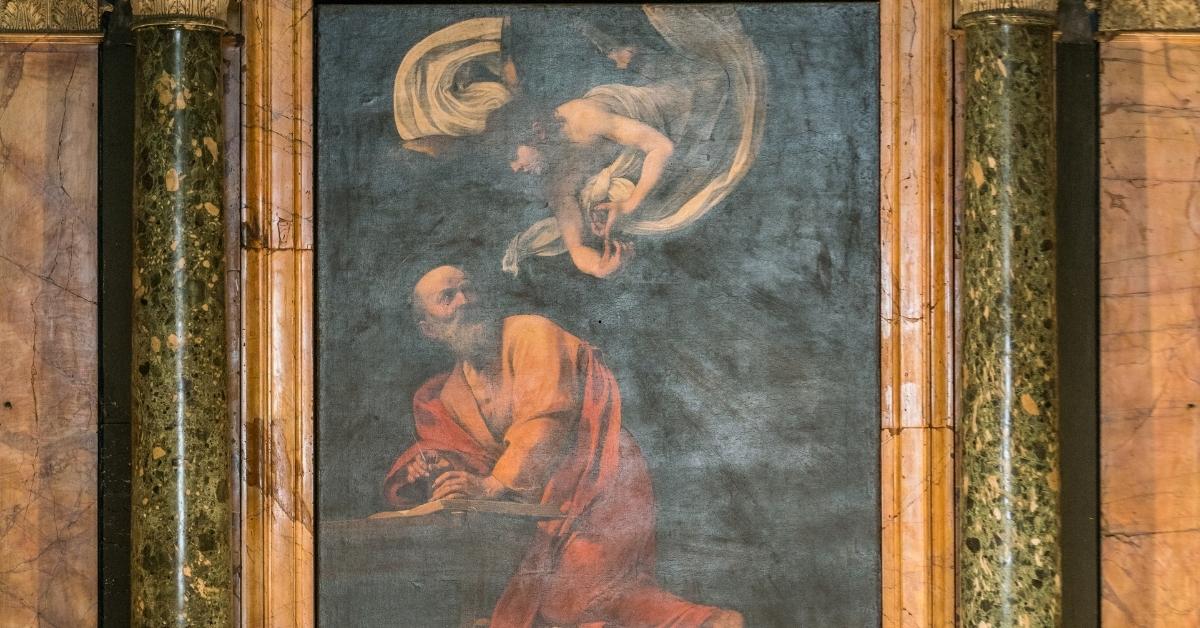
There is a moment that happens when you stand in front of a Caravaggio painting for the first time. It is not the subject matter that stops you cold. It is the light. That singular, theatrical, almost blinding light that seems to emerge from somewhere beyond the canvas, cutting through an abyss of shadow so deep that you feel as though you are peering into a room where the electricity has just flickered off, leaving only a single candle to reveal the truth of what is happening inside. I remember dragging my wife through the Cerasi Chapel in Rome, warning her that she was about to see something that would ruin Renaissance art for her forever. She thought I was exaggerating. She was wrong.
Before Caravaggio arrived on the scene in the late sixteenth century, art was defined by Mannerism, a style that prized elegance, artificiality, and idealized beauty. Figures were elongated, poses were graceful, and saints drifted through heavenly realms with a kind of detached serenity. It was beautiful, certainly, but it was also safe. Caravaggio threw safety out the window. He dragged Biblical figures off their pedestals and placed them in taverns, in dusty rooms, on dirty streets. He gave them dirty feet, weathered faces, and the kind of muscular, fleshy bodies that belonged to the working class, not to heaven. But it was his manipulation of light that truly set him apart. He did not just paint light; he weaponized it. He used it to tell stories, to expose souls, and to create a dramatic intensity that the world had never witnessed before.
This is the technique known as Tenebrism, derived from the Italian word tenebroso, meaning murky or shadowy. It is distinct from the softer chiaroscuro employed by artists like Leonardo da Vinci, who used gradual transitions between light and shadow. Tenebrism is violent. It is aggressive. It plunges the majority of the canvas into impenetrable blackness, reserving illumination only for the most crucial elements of the composition. And no one, not before and not since, has ever wielded this technique with the sheer mastery of Michelangelo Merisi da Caravaggio. He was, quite simply, the King of Light and Darkness. Here are five paintings that prove it beyond any reasonable doubt.
The Calling of Saint Matthew
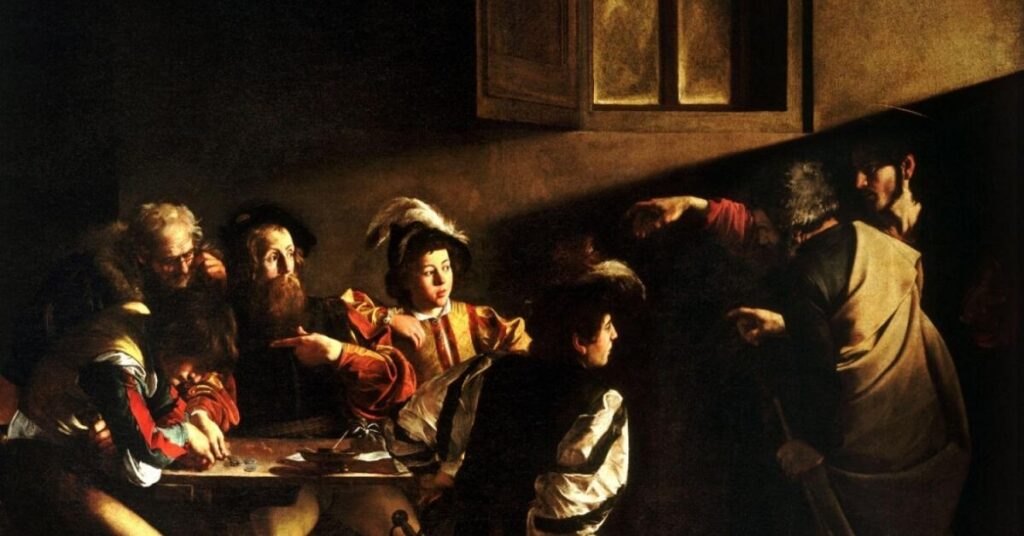
Let us begin in the Contarelli Chapel in Rome, where Caravaggio painted what many scholars consider the single greatest narrative painting in the history of Western art. The scene is drawn from the Gospel of Matthew, depicting the moment when Christ calls the tax collector Matthew to become one of his disciples. But this is not the serene, celestial summons you might expect. Instead, Caravaggio places us inside a dim, grimy tax office. Matthew sits at a table with his fellow tax collectors, counting coins and going about their mundane, corrupt business. The room is drab. The men are ordinary. And then, from the right side of the canvas, Christ enters.
This is where the genius of Caravaggio becomes undeniable. Look closely at the source of light in this painting. There is a window high on the left wall, but the light does not actually come from that window. It comes from behind Christ himself. The light enters the room with him, a divine radiance that cuts through the darkness with surgical precision. It is the light of grace, physically manifesting itself in the world. And watch how it behaves. The beam of light bypasses the tax collectors at the far end of the table entirely. It sweeps across the faces of the men in the middle, illuminating their curiosity and confusion. But it stops short of Matthew, who sits at the far left, hunched over his coins. Matthew is still in shadow when Christ points at him. The light does not reach him until the very moment of the calling, until the moment he looks up and points to himself in disbelief.
There is a profound detail here that too many people overlook. Christ’s hand, extended toward Matthew, echoes the famous gesture of God reaching toward Adam in Michelangelo’s Sistine Chapel ceiling. Caravaggio is making a deliberate connection between the creation of humanity and the salvation of a single sinner. But unlike Michelangelo’s idealized, ethereal touch, Caravaggio’s light does the work. The light acts as the bridge between the divine and the profane. It selects Matthew, singles him out, and transforms him. The darkness surrounding the other tax collectors suggests that they are not yet ready for this grace. They remain in their world of shadows, oblivious to the momentous event unfolding inches away from them.
The Crucifixion of Saint Peter
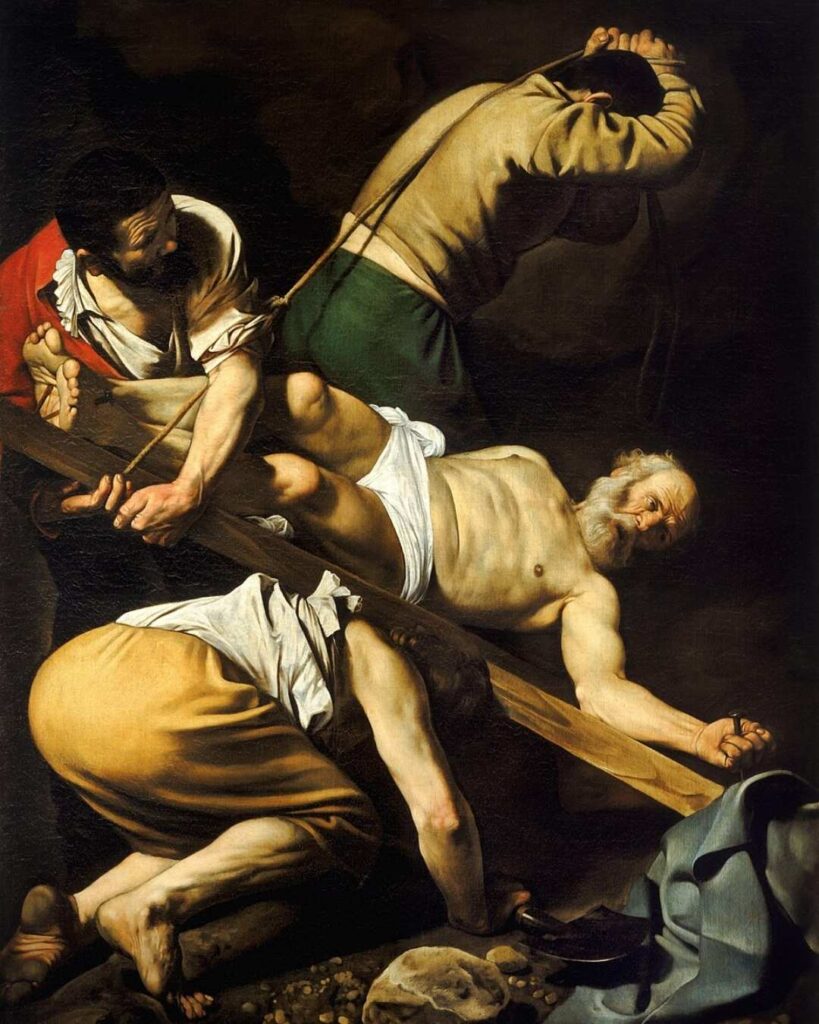
If The Calling of Saint Matthew shows us light as divine grace, then The Crucifixion of Saint Peter shows us darkness as existential dread. This painting, also housed in the Cerasi Chapel, is a brutal and unflinching depiction of martyrdom. Peter, the first Pope, is being crucified upside down at his own request, believing himself unworthy to die in the same manner as Christ. But Caravaggio does not give us a noble, heroic death. He gives us something far more unsettling: manual labor.
Three men are hoisting the heavy wooden cross into position. Their faces are contorted with effort. Their muscles strain. Peter’s body is twisted awkwardly, his feet nailed to the wood while his hands grip the cross in a desperate, almost pathetic gesture. There is no halo. There are no angels descending from the clouds to welcome him into paradise. There is just the grim, sweaty business of execution.
And then there is the darkness. Look at the background. It is not merely dark; it is an abyss. There is no sky, no landscape, no architectural detail to provide context. Just pure, unrelenting, infinite blackness. Caravaggio has stripped away every distraction, every comfort, every hint of the celestial. He has created a void, a vacuum into which Peter is being slowly raised. This darkness represents the loneliness of death, the terrifying absence of everything familiar. It is the moment when faith is tested to its absolute limit.
But look closely at Peter’s face. Despite the brutality of the scene, despite the crushing weight of the darkness, there is a sliver of light that catches his features. He is not looking at the men who are killing him. He is looking somewhere beyond them, toward a source of light that we cannot see. This is the miracle of the painting. The darkness envelops the body, but the light illuminates the face of faith. Peter is terrified, certainly, but he is not broken. The light tells us that he still believes, that even in the depths of this terrible void, he can see the promise of redemption.
The Conversion of Saint Paul
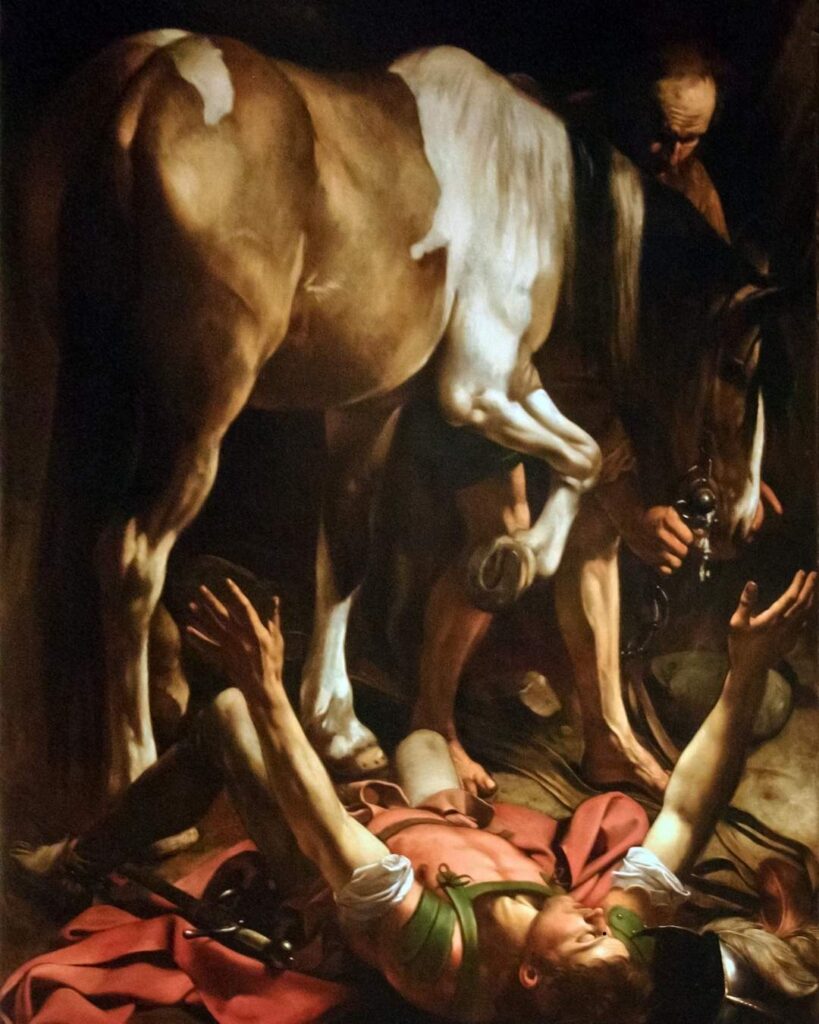
The companion piece to The Crucifixion of Saint Peter is equally revolutionary, and perhaps even more audacious in its use of light. Caravaggio was tasked with depicting the conversion of Saul of Tarsus, a zealous persecutor of Christians who was struck blind by a divine light on the road to Damascus and subsequently became the Apostle Paul. Traditionally, artists had depicted this scene as a grand spectacle. You can imagine the typical Renaissance version: Saul on a magnificent horse, accompanied by soldiers, with a dramatic beam of light descending from the heavens and a vision of Christ appearing in the clouds. Caravaggio threw all of that away.
Instead, he gives us a man on his back. Saul has been knocked off his horse, and he lies sprawled on the ground, his arms outstretched, his eyes closed. The horse is a massive, looming presence in the background, a dark shadow that dominates the upper half of the canvas. But the real action happens at the bottom. Saul is crushed by the weight of the divine, physically flattened by an encounter that he never expected. And the light, that extraordinary Caravaggio light, does not come from the sun. It does not come from the sky. It emanates from somewhere unseen, shining directly onto Saul’s face and body.
Here is where Caravaggio’s genius becomes almost theological. Saul is not looking at the light. He is blind. The light is not something he can see with his eyes. It is something that shines through him, illuminating him from the inside out. This is the internal light of conversion, the overwhelming force of grace that transforms a man from a persecutor into a believer. The horse, which in traditional depictions would have been a noble steed, is reduced to a dark, almost menacing silhouette. It represents Saul’s former life, his pride, his certainty. And it looms over him, crushing him into the dirt.
The darkness of the horse and the background presses down on Saul, pinning him to the bottom of the frame. But the light on his face, his chest, his outstretched arms tells us that he is being lifted up in a different way. He is being transformed. Caravaggio does not show us the moment of conversion as a gentle awakening. He shows it as an assault, a violent and overwhelming encounter that leaves Saul helpless and blinded. This is not gentle persuasion. This is the brute force of divine intervention.
Judith Beheading Holofernes
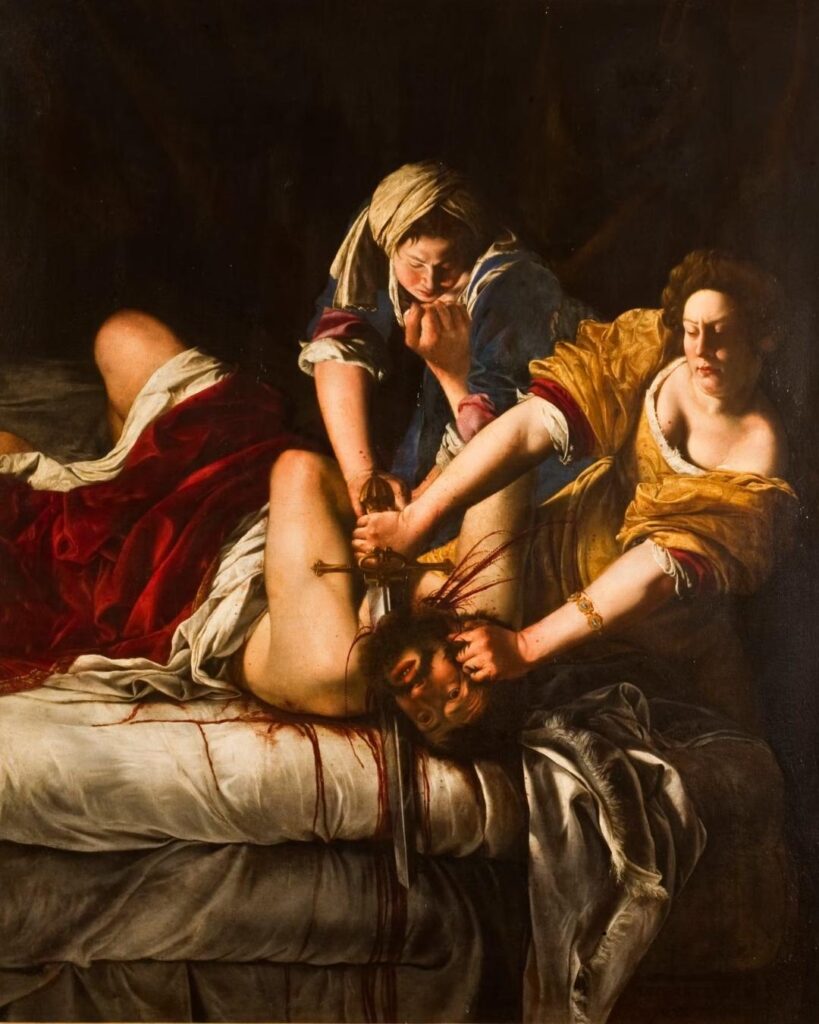
We move now to one of the most shockingly violent paintings in the history of art. The story comes from the Book of Judith, in which a beautiful Jewish widow infiltrates the camp of the Assyrian general Holofernes, gets him drunk, and cuts off his head to save her people. Previous artists had depicted this moment with a certain degree of decorum. Judith was often shown as a serene figure, looking away from the act, as if she were merely pruning a branch rather than committing a gruesome murder.
Caravaggio will have none of that. He places us directly in the moment of the kill. Judith, her sleeves rolled up, grips Holofernes’s hair with one hand and plunges a sword into his neck with the other. Her expression is not one of horror or revulsion. It is one of grim determination. The old maid, Abra, stands beside her, holding a sack to catch the head, her face etched with concentration. And Holofernes, still in his bed, is caught in the throes of death, his mouth open in a silent scream, blood spurting from the wound in a thick, viscous arc.
And then there is the light. A stark, cold, merciless spotlight illuminates the scene. It hits Judith’s arms, emphasizing the tension in her muscles as she pushes the sword deeper. It catches the face of the old maid, highlighting her age and her complicity in the act. It blazes across Holofernes’s head and chest, revealing every detail of the violence. The rest of the canvas is pitch black. There is no background, no setting, no context. Just the bed, the bodies, and the light.
This is Caravaggio’s film still effect. By plunging the background into darkness, he forces our eyes to focus on the mechanics of the killing. We cannot look away. We have to see every detail, every drop of blood, every strained muscle. The darkness acts as a curtain, allowing the violence to unfold in stark, unflinching close-up. There is no moralizing, no judgment, no softening of the brutality. It is just the cold, hard truth of what it takes to kill a man.
But there is something more subtle happening here as well. Look at how the light treats Judith. She is partially illuminated, but she is not glowing with virtue. The light is cold, not warm. It reveals her determination, yes, but it also reveals her humanity. She is doing what must be done, but she is not enjoying it. Holofernes, meanwhile, is plunging into the darkness of death. His body is already becoming part of the void. The light is abandoning him.
David with the Head of Goliath
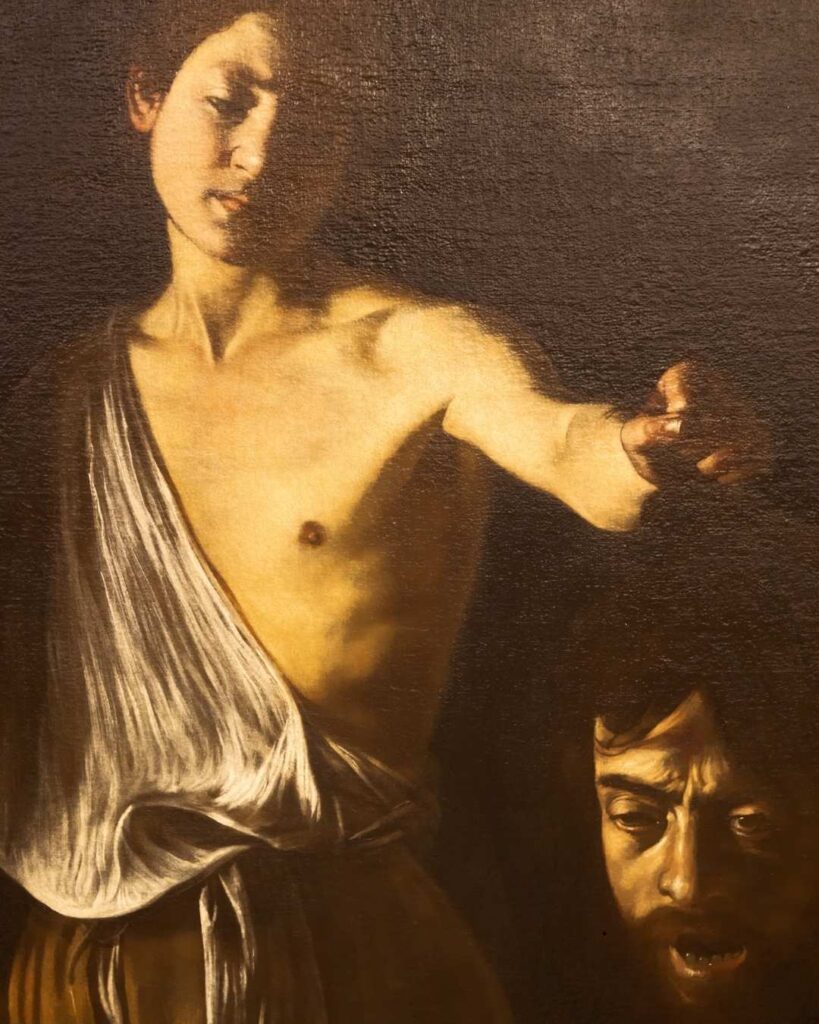
And finally, we come to the most personal and haunting of all Caravaggio’s works. This painting was created in 1606, while Caravaggio was a fugitive fleeing Rome after committing murder. He had killed a man named Ranuccio Tomassoni in a brawl, and he was desperate for a papal pardon. In this context, the painting takes on an entirely different meaning.
The scene is the young David, the future king of Israel, holding the severed head of the giant Goliath. But this is not the triumphant, celebratory David of Michelangelo’s famous sculpture. This David is young, almost adolescent. He is not rejoicing. He looks down at Goliath’s head with a mixture of sorrow, pity, and something that looks almost like regret. His expression is one of profound melancholy.
And then there is the head. Caravaggio painted it as a self-portrait. The decapitated head of Goliath is Caravaggio’s own face, his own features, his own expression of despair. He is the giant who has been slain. He is the condemned man, the sinner, the one who has been judged and found wanting. The light in this painting is merciless. It shines directly on David’s torso and face, illuminating his youthful beauty and his sad expression. And it blazes across Goliath’s severed head, exposing every detail of Caravaggio’s own tortured face.
The background is once again a void, a darkness that seems to swallow everything beyond the two figures. The light creates a stark separation between the living and the dead. David is in the light, but he does not seem to want to be there. Goliath is in the shadows, but he is also in the light, caught in the glare of his own condemnation. This is a painting about guilt, about the weight of sin, about the knowledge that you have done something terrible and cannot undo it.
My wife, standing beside me in the Borghese Gallery, turned to me and whispered that she had never seen a painting that felt so much like a confession. And she was right. Caravaggio is not just painting David and Goliath. He is painting himself, his own guilt, his own fear of damnation. The light exposes the truth of his soul. It reveals the regret in David’s eyes and the despair in Goliath’s face. There is no redemption here, no easy answer. Just the cold, hard reality of a man who has committed murder and cannot escape the consequences.
The Legacy of the King
Caravaggio died in 1610 under mysterious circumstances, still a fugitive, still desperate for forgiveness. He was only thirty-eight years old. But in his short life, he had changed the course of Western art forever. His influence spread across Europe, inspiring generations of painters who came after him. Rembrandt, Georges de La Tour, and even modern filmmakers like Martin Scorsese owe a debt to his revolutionary use of light and darkness. He taught us that light could be a narrative tool, a psychological weapon, a moral compass.
What made Caravaggio the King of Light and Darkness was not simply his technical skill, though that was undeniable. It was his understanding that light and darkness are not opposites. They are two sides of the same coin, intertwined, inseparable. He understood that you cannot have grace without sin, redemption without despair, faith without doubt. And he used light to explore these contradictions, to expose the complexities of the human condition in all its beauty and brutality.
He found the sacred not in heaven, but in the dramatic interplay between the spotlight and the shadow of the everyday world. He gave us saints with dirty feet, martyrs with terrified faces, and a God who entered the world not as a distant, celestial king, but as a beam of light cutting through the darkness of a tax collector’s office. He showed us that grace is not reserved for the perfect, but for the broken. And he did it all with a mastery of light that has never been equaled.
That is why, when you stand in front of a Caravaggio painting, you cannot look away. The light grabs you, holds you, and refuses to let you go. And the darkness, that infinite, abyssal darkness, makes you understand that you are standing on the edge of something profound. Caravaggio is the King of Light and Darkness because he understood that they are the same thing. They are the tools we use to tell the truth about ourselves. And no one, before or since, has ever told that truth with such breathtaking power.
NOTE BEFORE YOU GO: Italy rewards travelers who go prepared. And it is easy to ruin your trip. I have a checklist for you, of things you should never go to Italy without. CHECK IT OUT HERE. Also, if you enjoy my work and wouldn’t mind supporting me, you can book your accommodation through my link: BOOKING.COM. This are affiliate links. I may earn a commission on qualifying sales or bookings, at no extra cost to you. Thank You!