
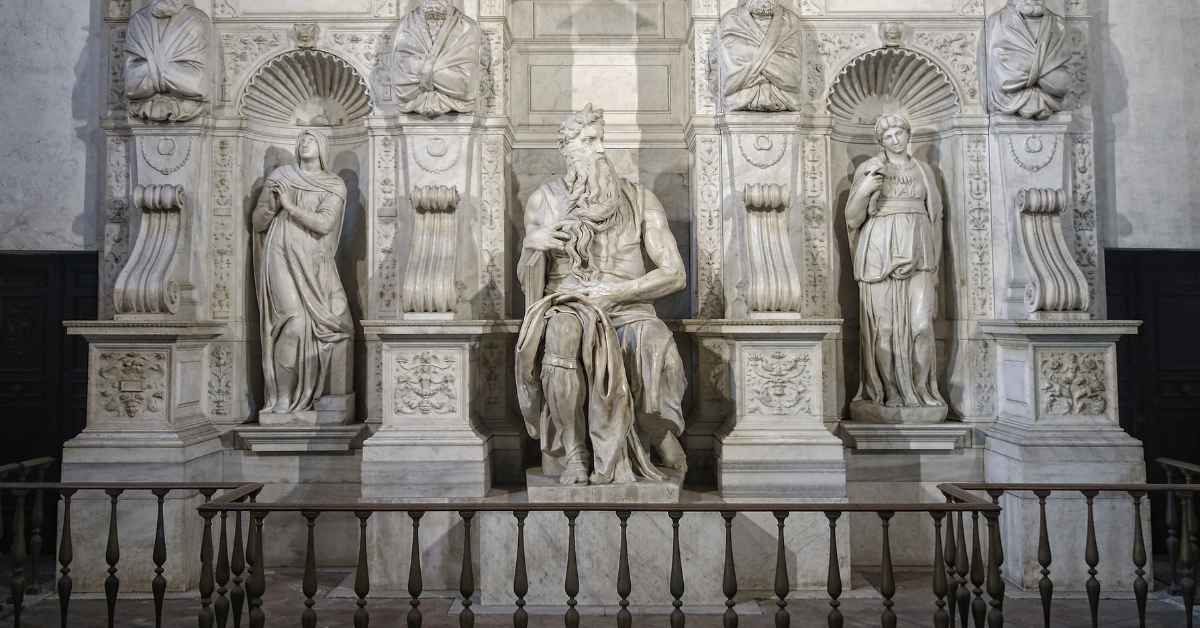
Michelangelo’s Moses is one of the most powerful sculptures ever carved, and it is also one of the most tragic. It sits today in a quiet church in Rome, the centerpiece of a monument that was never finished, a fragment of a dream that consumed forty years of the artist’s life.
Most visitors walk past it on their way to the Colosseum. They do not know that the statue was meant to be part of a tomb that would have dwarfed anything built since antiquity.
They do not know that the horns on Moses’s head come from a translation error that changed the history of art. And they do not know that Michelangelo himself is said to have struck the statue in frustration, demanding that it speak.
This is the story of the Moses. The commission that went wrong, the biblical story behind the sculpture, the hidden symbolism in every detail, and the reason why this statue still has the power to stop you in your tracks.
Before you read further, remember that Italy rewards travelers who come prepared. I’ve found a few things especially useful on an Italy trip, and they’re worth having and/or knowing beforehand. See the checklist here. Also, if you want me to plan an Italy trip for you that you will never forget, drop me a message here
Who Commissioned Moses and Why Was the Sculpture Created?
The Moses was commissioned by Pope Julius II, one of the most ambitious and difficult popes in the history of the Catholic Church. Julius was a warrior pope, a man who led armies into battle and who was determined to restore the power and glory of the papacy.
In 1505, Julius summoned Michelangelo to Rome and asked him to design a tomb for him. The pope wanted something monumental, something that would secure his place in history and rival the tombs of the ancient emperors.
Michelangelo, who was thirty years old and already famous for his Pietà, threw himself into the project with characteristic intensity. He spent months in the quarries of Carrara, selecting the marble for the tomb. He designed a structure that would have been one of the wonders of the Renaissance.
The tomb was to be a free-standing monument, more than seven meters wide and eleven meters deep. It was to contain forty life-sized statues, arranged in three levels. The lower level was dedicated to the human world, the middle level to the prophets and saints, and the top level to the divine.
The Moses was intended for the middle level. It was to be one of the central figures, a prophet who stood between the human and the divine. It was to be part of a monument that would have been unlike anything built since classical times.
But the tomb was never finished. And the story of why is one of the great tragedies of art history.
Pope Julius II’s Ambitious Tomb and the Project That Went Wrong
The tomb project went wrong almost immediately. Julius II, despite his enthusiasm for the tomb, was distracted by other ambitions. He wanted to rebuild St. Peter’s Basilica, and he wanted to paint the ceiling of the Sistine Chapel.
Michelangelo was pulled away from the tomb and ordered to work on other projects. He spent four years painting the Sistine Chapel ceiling, a job he did not want and initially refused. The tomb was put on hold.
Then Julius died in 1513. Michelangelo, who had spent years on the project, was left with a half-finished monument and a new pope who had different priorities. The heirs of Julius II wanted the tomb completed, but they did not want to pay for the original design.
Over the next forty years, the tomb was scaled back again and again. The free-standing monument became a wall tomb. The forty statues became a handful. The Moses, which had been designed for a grand architectural setting, was placed in a smaller, simpler monument.
The final version of the tomb was installed in San Pietro in Vincoli in 1545, more than thirty years after Julius died. Michelangelo, by then in his seventies, had long since moved on to other projects. The tomb he had dreamed of building was never realized.
The Moses is the greatest surviving sculpture from the tomb. It is a fragment of a dream, a reminder of what might have been.
Michelangelo’s Moses: The Biblical Story Behind the Sculpture
The Moses depicts a specific moment from the Book of Exodus. Moses has ascended Mount Sinai and received the Ten Commandments from God. He has been on the mountain for forty days and forty nights.
When he descends, carrying the stone tablets, he finds the Israelites worshipping a golden calf. They have abandoned the God who brought them out of Egypt and have turned to an idol.
Moses is filled with rage. He throws down the tablets, shattering them at the foot of the mountain. He destroys the golden calf, grinds it to powder, and forces the Israelites to drink the water mixed with the powder.
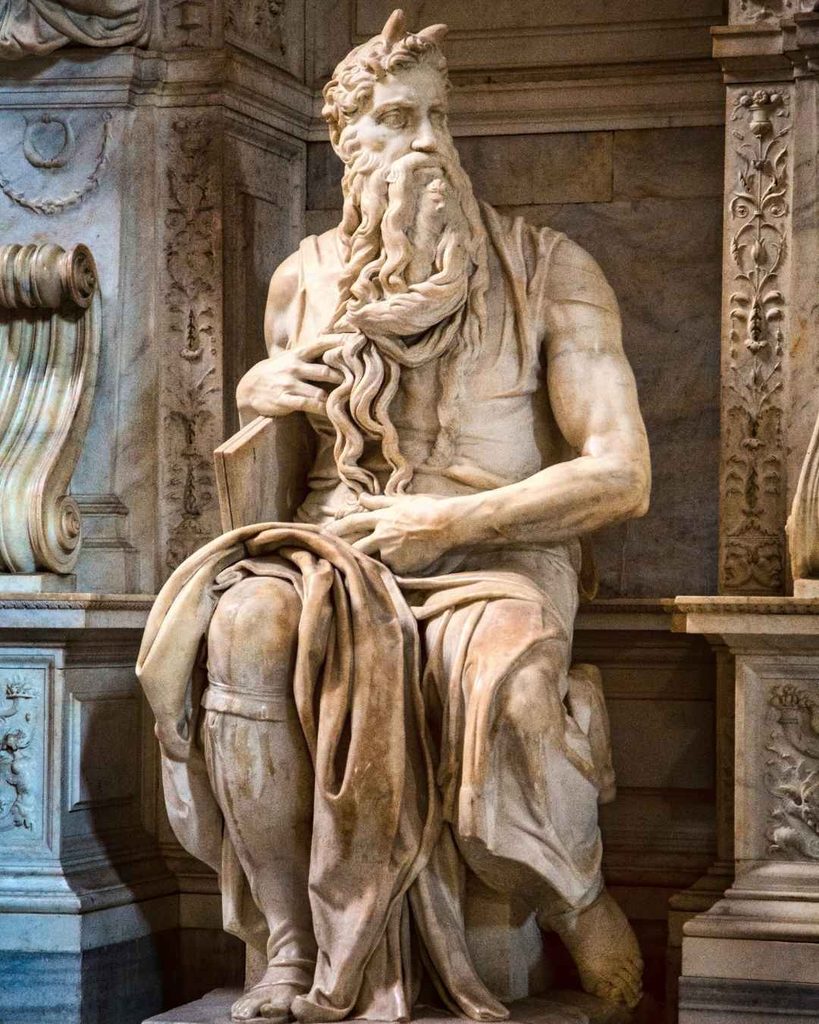
Michelangelo chose to depict the moment just before the explosion. Moses is seated, his body tense, his gaze fixed on something we cannot see. He is holding the tablets, but his grip is not steady.
The tension in the sculpture is almost unbearable. Moses is not calm. He is a man who is about to erupt, who is holding himself back with every ounce of willpower. It is a portrait of rage controlled, of power restrained.
Why Moses Has Horns: The Biblical Translation That Shaped the Statue
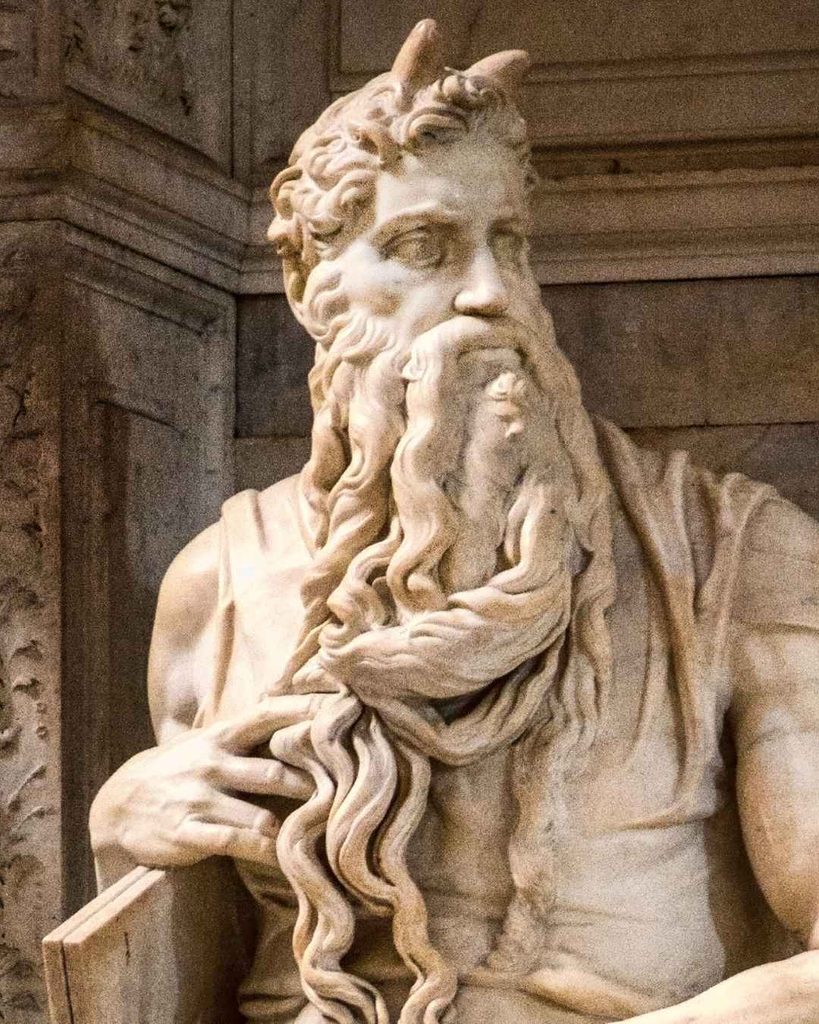
The horns on Moses’s head are one of the most discussed details of the sculpture. They are not a mistake, and they are not an insult. They come from a translation error that shaped the way artists depicted Moses for centuries.
The Hebrew text of Exodus says that when Moses came down from Mount Sinai, his face was “karan.” The word can mean “horned,” but it can also mean “radiant” or “shining.” The original Hebrew meant that Moses’s face was glowing with divine light.
But Saint Jerome, who translated the Bible into Latin in the fourth century, chose the wrong meaning. He translated the word as “horned,” and the image of Moses with horns entered the Christian tradition.
Michelangelo grew up with the Vulgate, the Latin Bible that Jerome had produced. He knew the text said that Moses’s face was horned. And he followed the tradition that had been established by earlier artists.
The horns were not meant to be demonic. In the ancient world, horns were a symbol of power and divinity. They were a sign that Moses had been in the presence of God, that he had been transformed by the encounter.
When you stand in front of the Moses, the horns are small and almost subtle. They emerge from his forehead, just above his brow. They are not the horns of a devil. They are the horns of a prophet who has seen God face to face.
The Meaning Behind Moses’ Expression, Gaze, and Body Language
The expression on Moses’s face is one of the most complex in the history of sculpture. He is not simply angry. He is a man who is trying to control his anger, who is weighing whether to act or to wait.
His brow is furrowed. His eyes are fixed on something in the distance, something we cannot see. His mouth is set in a tight line. His whole face is a study in tension.
His body is also tense. His right leg is drawn back, as if he is about to stand. His left leg is planted firmly on the ground, as if he is holding himself in place. His torso is twisted slightly, and his muscles are taut.
His right hand rests on the tablets, but his fingers are curled. His left hand is on his lap, but the fingers are spread, as if he is ready to grasp something.
The sculpture captures a moment of decision. Moses is deciding whether to rise, whether to destroy the tablets, whether to punish the Israelites. He is a man on the edge of action, frozen in the instant before he moves.
Did Michelangelo Really Strike Moses with a Hammer?
One of the most famous legends about Moses is that Michelangelo, upon finishing the sculpture, struck it with a hammer and demanded that it speak. The story is told in different versions. In some, he strikes the knee. In others, he strikes the arm. In all of them, he shouts, “Why don’t you speak?”
The story is almost certainly apocryphal. There is no contemporary account of Michelangelo doing this. The legend probably grew up after his death, as a way of expressing the extraordinary realism of the sculpture.
But the story captures something true about the Moses. The sculpture is so lifelike, so filled with tension and emotion, that it seems as if it should speak. It is a portrait of a man who is about to act, and the viewer expects him to move at any moment.
Whether or not Michelangelo actually struck the statue, the legend has become part of its history. It is a reminder that the Moses is not just a piece of stone. It is a presence, a figure that seems to have a life of its own.
Why Moses Sits Instead of Standing
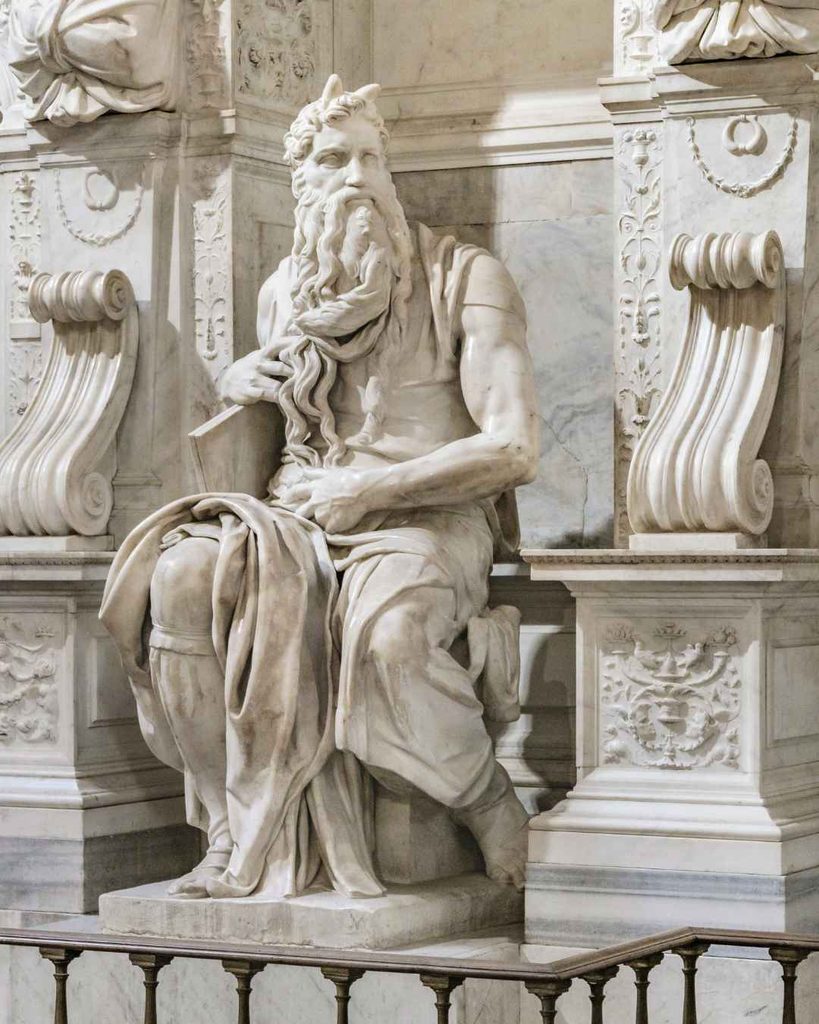
Michelangelo made a deliberate choice to depict Moses seated rather than standing. This choice has been interpreted in many ways, and it is one of the keys to understanding the sculpture.
If Moses were standing, he would be a figure of action. He would be about to move, about to strike, about to do something. By making him seated, Michelangelo made him a figure of contemplation.
Moses is not in the middle of an action. He is in the middle of a decision. He has seen the golden calf, and he is deciding what to do. His body is tense, but he is not moving. He is holding himself back.
The seated pose also gives the sculpture a sense of permanence. Moses is rooted to the spot, fixed in his moment of decision. He is not a figure who will pass. He is a figure who will endure.
Sigmund Freud, who wrote an essay on the Moses, argued that the sculpture depicts the moment when Moses has already overcome his rage. He has seen the golden calf, he has felt the urge to destroy the tablets, but he has mastered himself. He is sitting still, in a state of “frozen wrath.”
Whether or not you accept Freud’s interpretation, the seated pose is essential to the meaning of the sculpture. Moses is not a man of action. He is a man of law, a man of restraint, a man who has learned to control his impulses.
The Hidden Symbolism in Moses’ Beard, Hands, and Drapery
Every detail of the Moses is charged with meaning. The beard, the hands, the drapery, the tablets, the horns. Each element contributes to the overall effect of the sculpture.
The beard is one of the most remarkable features of the Moses. It is long and flowing, and it is carved with extraordinary detail. The strands of hair are visible, and they seem to move and flow like water.
The beard is also a symbol of wisdom and maturity. In the ancient world, a long beard was a sign of age and authority. Moses is a leader, a prophet, a lawgiver. His beard is a sign of his status.
The hands are another key detail. Moses’s right hand rests on the tablets, but his fingers are curled. His left hand is on his lap, but the fingers are spread. The hands are tense, ready to act, but they are not acting.
The drapery is also significant. Moses is wearing a simple robe, but the fabric is carved with deep folds that suggest movement and tension. The drapery is not decorative. It is part of the sculpture’s emotional language.
The tablets are the symbol of the law. Moses is holding them, but he is not holding them securely. He is holding them as if he is about to let them go, as if he is about to throw them down.
Why Michelangelo’s Moses Was Meant to Be Part of a Much Bigger Monument
The Moses was never meant to stand alone. It was designed to be part of a monumental tomb, a structure that would have been one of the greatest achievements of the Renaissance.
The tomb was to be a three-level structure, with the Moses on the middle level. The lower level was to be decorated with statues of slaves, representing the human condition. The upper level was to be decorated with statues of angels, representing the divine.
The Moses was to be surrounded by other prophets and saints. It was to be part of a visual program that told the story of the Christian world, from the human to the divine.
But the tomb was never built as designed. The Moses was placed in a smaller monument, without the architectural setting that Michelangelo had planned. It is a great sculpture in a setting that is not worthy of it.
The tragedy of the Moses is the tragedy of the tomb. Michelangelo spent forty years of his life on a project that was never completed. The Moses is the greatest surviving fragment of that project, a reminder of what might have been.
The Tragic Story of Pope Julius II’s Unfinished Tomb
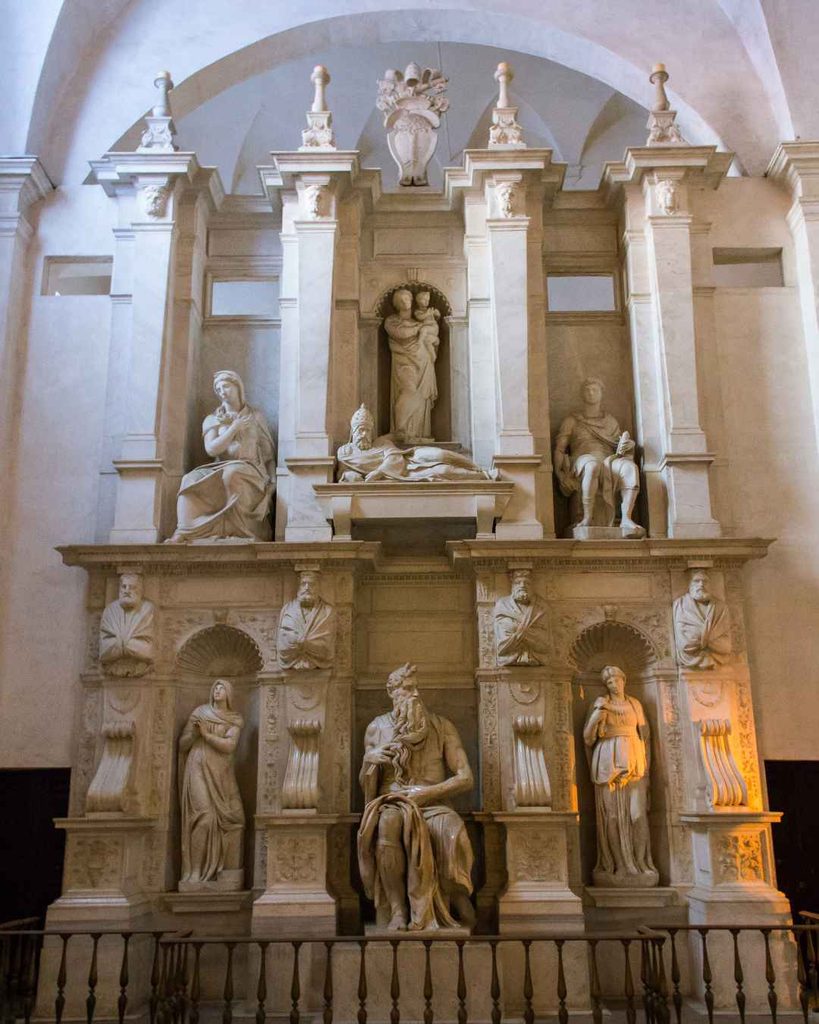
The story of Julius II’s tomb is one of the great tragedies of art history. It is a story of ambition, politics, and betrayal.
Julius II commissioned the tomb in 1505. He wanted something that would secure his place in history. He wanted a monument that would rival the tombs of the ancient emperors.
Michelangelo designed a tomb that would have been one of the wonders of the world. It would have been a free-standing structure, more than seven meters wide and eleven meters deep. It would have contained forty life-sized statues.
But the tomb was never built. Julius died in 1513, and his heirs did not have the money or the will to complete the project. The tomb was scaled back again and again, until it became a shadow of what Michelangelo had envisioned.
Michelangelo worked on the tomb for forty years. He carved the Moses, the two slaves now in the Louvre, and several other figures. But he never saw the tomb completed as he had designed it.
The final version of the tomb was installed in San Pietro in Vincoli in 1545. It is a modest wall monument, with the Moses as its centerpiece. It is not the tomb that Julius wanted. It is not the tomb that Michelangelo designed.
But it is the tomb that we have. And the Moses is the greatest treasure in it.
Where to Find Michelangelo’s Moses in Rome
The Moses is in the Church of San Pietro in Vincoli, in the Monti neighborhood of Rome. The church is a short walk from the Colosseum and the Cavour metro station.
The church is not on the main tourist route, and it is often overlooked by visitors. But it is one of the most rewarding places in Rome, and the Moses is one of the greatest sculptures in the world.
The church is free to enter. It is open every day, and the Moses is in the right transept. The statue is in a relatively dim alcove, and there is a coin-operated light box that illuminates it. Bring a coin, and use the light.
The church also contains the chains of Saint Peter, which are displayed beneath the main altar. The chains are the relic that gave the church its name. They are worth seeing, but the Moses is the main attraction.
What to Look for When You Stand in Front of Moses
When you stand in front of the Moses, there are several things to look for. The first is the tension in the body. Moses is seated, but he is not relaxed. His muscles are taut, his legs are ready to move.
The second is the expression on his face. His brow is furrowed, his eyes are fixed on something in the distance. He is not looking at us. He is looking at the Israelites, at the golden calf, at the scene that has provoked his rage.
The third is the beard. Look at the way the strands of hair are carved. They are not just decorative. They are part of the sculpture’s emotional language. The beard is a sign of wisdom, but it is also a sign of tension.
The fourth is the horns. They are small and subtle, but they are there. They are a sign that Moses has been in the presence of God, that he has been transformed by the encounter.
The fifth is the tablets. Moses is holding them, but he is not holding them securely. He is holding them as if he is about to let them go, as if he is about to throw them down.
How Michelangelo’s Moses Compares with His David
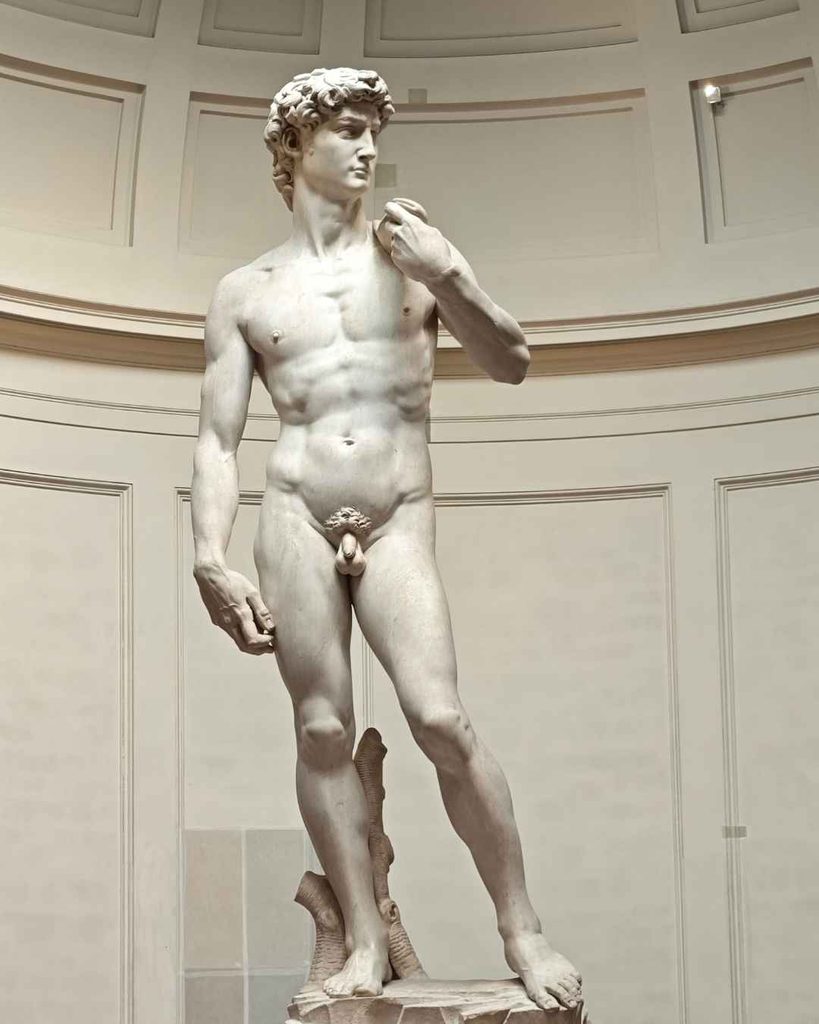
The Moses and the David are the two greatest sculptures of Michelangelo’s career, and they are also the two most different. The David is a figure of action, a young man about to fight a giant. The Moses is a figure of contemplation, an old man deciding whether to act.
The David is nude, and his body is the focus of the sculpture. The Moses is clothed, and his drapery is as important as his body.
The David is confident, poised, and self-contained. The Moses is tense, conflicted, and on the edge of action.
The David was carved when Michelangelo was in his twenties. The Moses was carved over a period of decades, as the artist grew older and more experienced.
Both sculptures are masterpieces. But they represent different phases of Michelangelo’s career, and different aspects of his genius.
Recommended: Apart from Moses, there are so many incredible things to see and do in Rome. Check out the top ones in this guide.
Final Thoughts
The Moses is one of the most powerful sculptures ever carved. It is a portrait of a man who has seen God, who has received the law, and who is struggling to control his rage. It is a sculpture about power, restraint, and the burden of leadership.
The story behind the Moses is a story of ambition and tragedy. It is the story of a pope who wanted to be remembered, and an artist who wanted to create something immortal. It is the story of a project that went wrong, and a sculpture that survived.
When you stand in front of the Moses, you are standing in front of a fragment of a dream. You are seeing what Michelangelo could do when he was given the time and the marble. You are seeing the genius of the Renaissance, frozen in stone.
The Moses is not as famous as the David. It is not as accessible as the Pietà. But it is one of the greatest works of art in Rome, and it is waiting to be discovered.
Again, feel free to go through the list below of my Italy recommendations that I have crafted after years of travel to this beautiful country:
- Packing List: Things Not to Go to Italy Without
- Must-Do Things: Unforgettable Experiences
- Where to Stay: Best Hotels in Italy.
- Where to Stay in Rome: Rome’s Best Neighborhoods
- Where to Stay in Florence: Picking the Best Area
- Where to Stay in Venice: Venice’s Best Districts
- Italy’s Cobblestone Streets: Best Shoes For the Job
- Backpack or Suitcase?: Italy Luggage Guide
- Travel Insurance: Always Be Covered
- E-Sim: Be Connected At All Times