
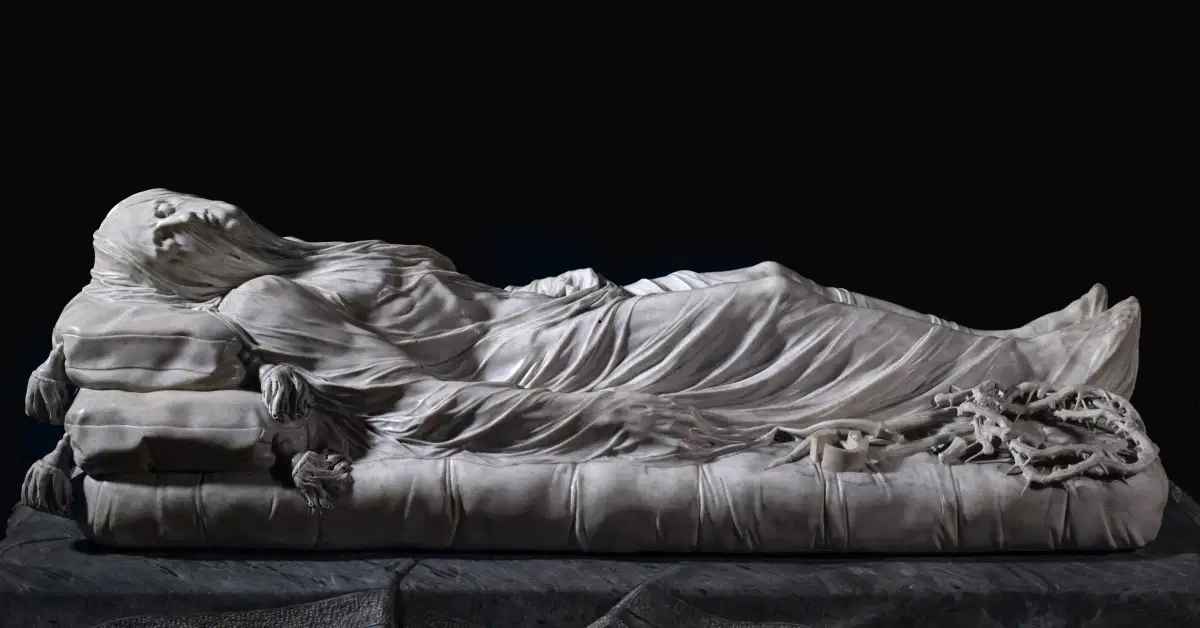
There is a sculpture in Naples that has been fooling people for more than 250 years. It shows the dead body of Christ, laid out on a couch, covered by a thin, translucent shroud.
The veil clings to his body. It reveals the wounds on his hands and feet. It shows the shape of his face beneath the fabric. And it is all carved from a single block of marble.
Visitors have stood in front of it and refused to believe their eyes. They have insisted that the veil must be real fabric, somehow turned to stone by an alchemist’s trick.
They have said that no human hand could carve marble thin enough to look like cloth, let alone cloth thin enough to see through. Even the great sculptor Antonio Canova, who saw the work decades later, said he would give up ten years of his life to have created something of similar quality.
The sculpture is the Veiled Christ, and it is one of the most astonishing achievements in the history of art. It sits in a small chapel in the heart of Naples, surrounded by other masterpieces, and it is the reason many travelers make the journey south. But the story behind it is as strange as the sculpture itself.
This post tells that story. The prince who commissioned it, the sculptor who carved it, the legend that grew up around it, and the reason why the Veiled Christ still has the power to stop you in your tracks.
Before you read further, remember that Italy rewards travelers who come prepared. I’ve found a few things especially useful on an Italy trip, and they’re worth having and/or knowing beforehand. See the checklist here. Also, if you want me to plan an Italy trip for you that you will never forget, drop me a message here
The Prince Who Wanted to Astonish the World
The Veiled Christ was commissioned by Raimondo di Sangro, the seventh Prince of Sansevero. He was one of the most extraordinary figures of the eighteenth century, a man who combined the interests of a scientist, a philosopher, a soldier, and a mystic.
Raimondo was a polymath. He wrote treatises on military tactics and on the art of printing. He conducted experiments in chemistry and anatomy. He was fascinated by alchemy, by the secrets of nature, and by anything that could inspire wonder in the people around him.
He was also a Freemason, and the chapel he rebuilt in the heart of Naples is filled with Masonic and esoteric symbols. The Veiled Christ was meant to be the centerpiece of this chapel, a monument to his family and to his own intellectual ambitions.
Raimondo’s family chapel, the Cappella Sansevero, had been in the family since the sixteenth century. But it was Raimondo who transformed it into the baroque jewel it is today.
He commissioned sculptures from the best artists of the day, including Antonio Corradini and Francesco Queirolo, and he filled the chapel with allegorical figures representing virtues, vices, and the quest for knowledge.
The Veiled Christ was to be the crowning achievement. It was to sit at the center of the chapel, beneath a ceiling painted with cosmic imagery, surrounded by statues that represented the prince’s philosophical beliefs.
It was not just a religious sculpture. It was a statement about the nature of art, of science, and of the human mind.
The Commission That Passed from One Hand to Another
The original commission for the Veiled Christ went to Antonio Corradini, a Venetian sculptor who was already famous for his own veiled figures. Corradini had created a statue of Modesty for the chapel, a figure covered by a veil that was also carved from marble, and Raimondo was impressed by his skill.
Corradini produced a terracotta model for the Christ, which still survives in the Museo Nazionale di San Martino. But he died shortly after, before he could begin work on the marble.
The commission passed to a young Neapolitan sculptor named Giuseppe Sanmartino. He was thirty-three years old, and he had trained in the workshops of Matteo Bottiglieri and Domenico Antonio Vaccaro. He was talented, but he was not yet famous.
Raimondo’s instructions to Sanmartino were precise. He was to create “a marble statue sculpted with the greatest realism, representing Our Lord Jesus Christ in death, covered by a transparent shroud carved from the same block of stone as the statue.”
The wording is important. The veil was not to be a separate piece of marble. It was to be carved from the same block as the body. This was the challenge that made the sculpture so extraordinary.
The Sculptor Who Made Marble Look Like Cloth
Giuseppe Sanmartino is one of the great unsung heroes of eighteenth-century sculpture. He is known today almost entirely for the Veiled Christ, but he was a prolific artist who worked across Campania and Puglia for decades.
Sanmartino’s style was characterized by a pronounced realism. He was particularly skilled at modeling clay, and he produced portraits, nativity figures, and models for silversmiths. But it was in marble that he achieved his greatest triumph.
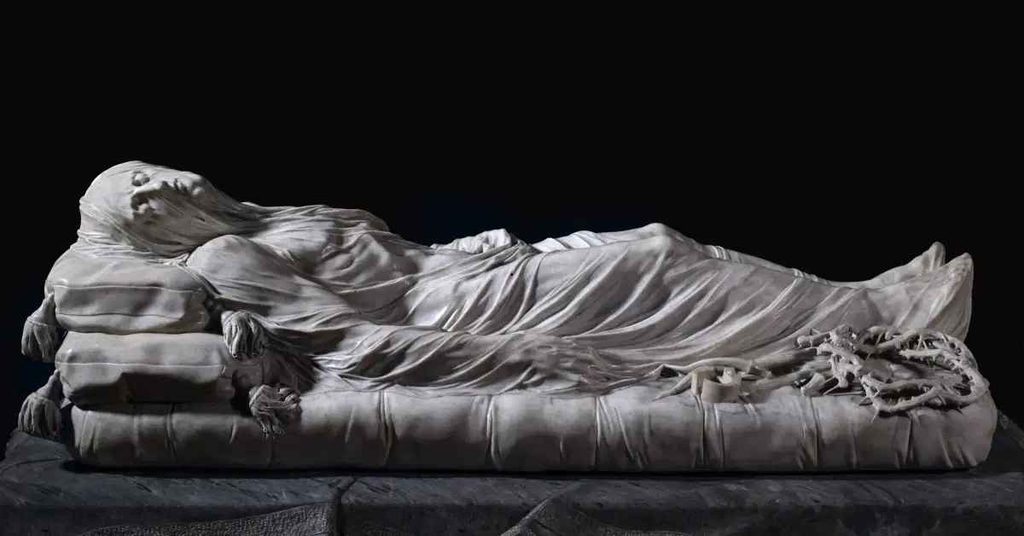
The Veiled Christ was completed in 1753. It depicts Christ lying on a couch, his body covered by a shroud that clings to every contour. The veil reveals the wounds on his hands and feet, the crown of thorns on his head, and the instruments of the Passion at his feet.
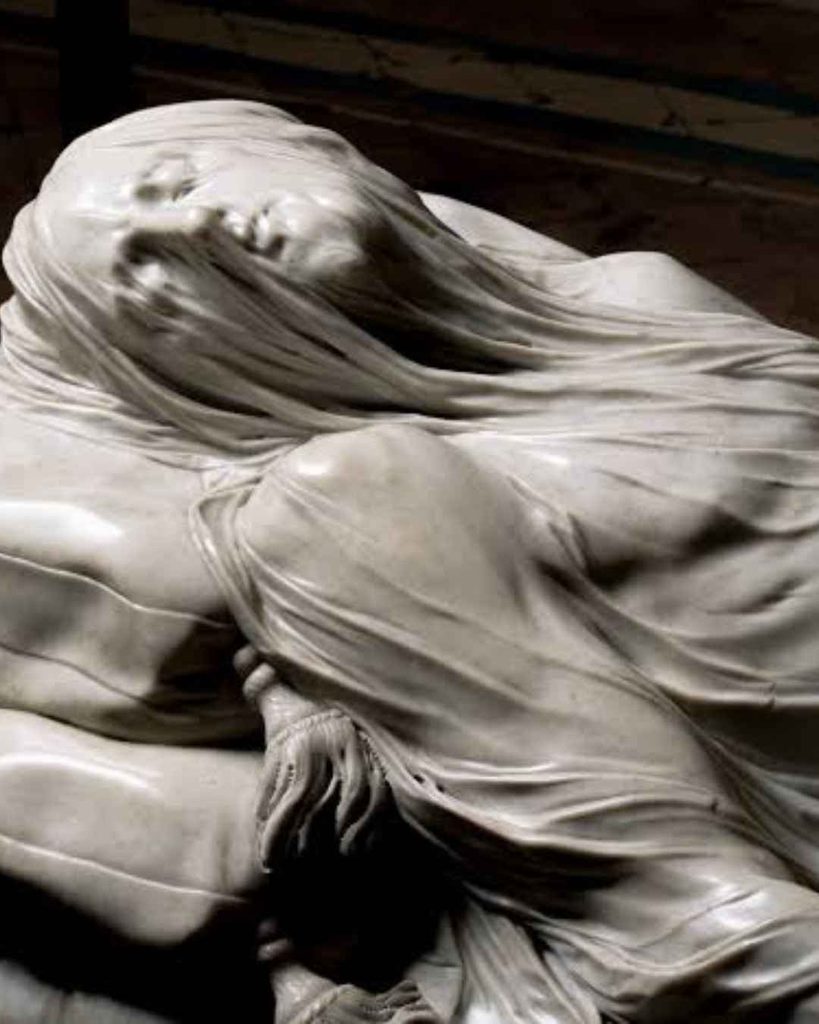
What makes the sculpture so remarkable is the way the veil interacts with the body beneath. It is not a simple covering. It is a translucent membrane that reveals as much as it conceals.
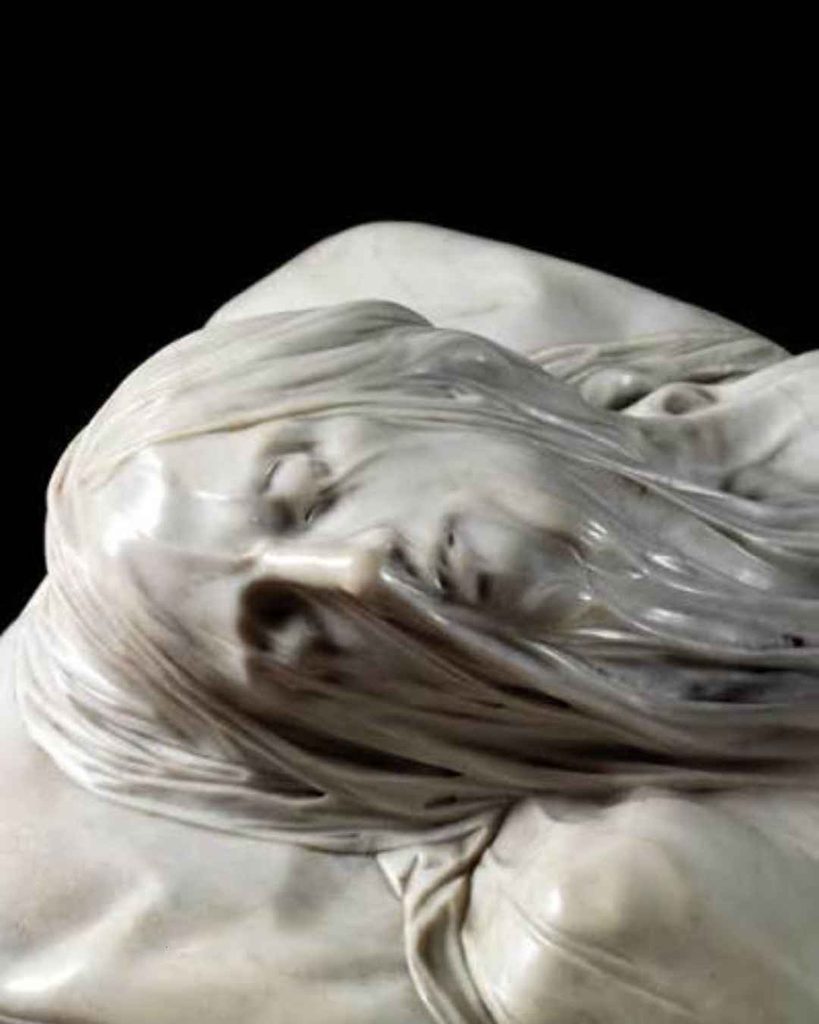
You can see the muscles of Christ’s chest through the fabric. You can see the shape of his nose and his closed eyes. You can see the suffering that his body has endured.
The marble is carved so thin in places that light seems to pass through it. The effect is not realistic in the ordinary sense. It is hyper-realistic, almost supernatural. It is as if Sanmartino had found a way to turn stone into silk.
The Legend of the Alchemical Veil
Almost as soon as the Veiled Christ was unveiled, the legends began. Visitors could not believe that the veil was carved from marble. They insisted that Raimondo di Sangro, who was known for his experiments in alchemy, must have used a secret process to turn real fabric into stone.
The story spread. It was said that the prince had draped a real veil over the statue and then treated it with a chemical solution that crystallized the cloth into marble. Others said that he had discovered a way to “marblify” organic materials, and that the Veiled Christ was the proof.
The legend was persistent because it seemed to explain the impossible. How else could marble look so much like cloth? How else could a sculptor achieve a transparency that seemed to defy the laws of physics?
But the legend was not true. The Veiled Christ is entirely carved from marble, from a single block of stone. The proof was there all along, in the archives.
A document in the Historical Archive of the Bank of Naples records a payment of fifty ducats from Raimondo di Sangro to Giuseppe Sanmartino, dated 16 December 1752.
The prince wrote: “And on my behalf you shall pay the aforementioned fifty ducats to the Magnificent Giuseppe Sanmartino against the Statue of Our Dead Lord still covered with a veil of marble.”
The wording is unambiguous. The veil is marble. There was no alchemy. There was only a sculptor with extraordinary skill, and a prince who was happy to let the legends grow.
Raimondo himself encouraged the mystery. He described the veil as “crafted with such finesse as to leave even the most discerning observers utterly spellbound.” He knew that the legend made the sculpture more famous, and he did nothing to dispel it.
What the Veil Reveals About Christ’s Suffering
The Veiled Christ is not a comfortable sculpture. It is a meditation on suffering, and the veil is the key to its power.
If the body were uncovered, we would see the wounds directly. The suffering would be explicit, and we could look away. But the veil forces us to look closer. It reveals the wounds indirectly, through the fabric. We have to strain to see them, and in doing so, we become complicit in the contemplation of Christ’s pain.
The veil also creates a sense of intimacy. It is as if we are standing at the tomb, watching the body being prepared for burial. The shroud is the last thing that touches the body before it is laid to rest. It is a covering, but it is also a caress.
Sanmartino carved the instruments of the Passion at Christ’s feet: the crown of thorns, the pliers, the shackles. They are small details, but they complete the story. This is not just a dead body. It is the body of a man who was tortured and executed.
The face beneath the veil is peaceful. The eyes are closed. The expression is one of rest, not agony. The suffering is over. What remains is the body, and the veil, and the silence.
The Chapel That Holds the Veiled Christ
The Cappella Sansevero is a small chapel, but it contains one of the most extraordinary collections of sculptures in Italy. The Veiled Christ is the centerpiece, but it is surrounded by other masterpieces that are almost as remarkable.
The statue of Modesty, by Antonio Corradini, is a veiled female figure that predates the Veiled Christ. It is a beautiful work, and it shows the tradition of veiled sculpture that Sanmartino was building on.
The statue of Disillusion, by Francesco Queirolo, is a male figure escaping from a net. The net is carved from marble, and it is so delicate that it seems impossible that it could have survived for centuries. It is a masterpiece of technical skill.
In the basement of the chapel, there are the Anatomical Machines, two skeletons surrounded by their circulatory systems.
For centuries, it was believed that these were the bodies of two servants, injected with a mysterious embalming substance by Raimondo. Recent research has shown that the bones are real, but the blood vessels are extraordinary artifacts.
The chapel is a complete work of art, a synthesis of sculpture, architecture, and philosophy. It is a testament to Raimondo di Sangro’s vision, and to the skill of the artists he employed.
Where to Find the Veiled Christ
The Cappella Sansevero is in the heart of Naples, on Via Francesco de Sanctis, a short walk from the Duomo and the Museo Archeologico Nazionale. It is open every day except Tuesday, and tickets should be booked in advance, especially in high season.
The chapel is small, and the number of visitors is limited. When you enter, you are given a timed slot, and you are asked to be quiet. The atmosphere is one of contemplation, and the Veiled Christ is displayed in a way that encourages silence.
The sculpture is in the center of the nave, on a raised platform. It is lit from above, and the light catches the surface of the veil in a way that makes it seem to shimmer.
You can walk around it, and you should. The effect changes depending on the angle. From the side, the veil seems almost transparent. From the front, it seems more opaque.
Photography is not allowed. This is a place to look, not to photograph. The experience is more powerful for it.
If you are in Naples, book one of these guided tours to really experience the miracle of the Veiled Christ.
What to Look for When You Stand in Front of the Veiled Christ
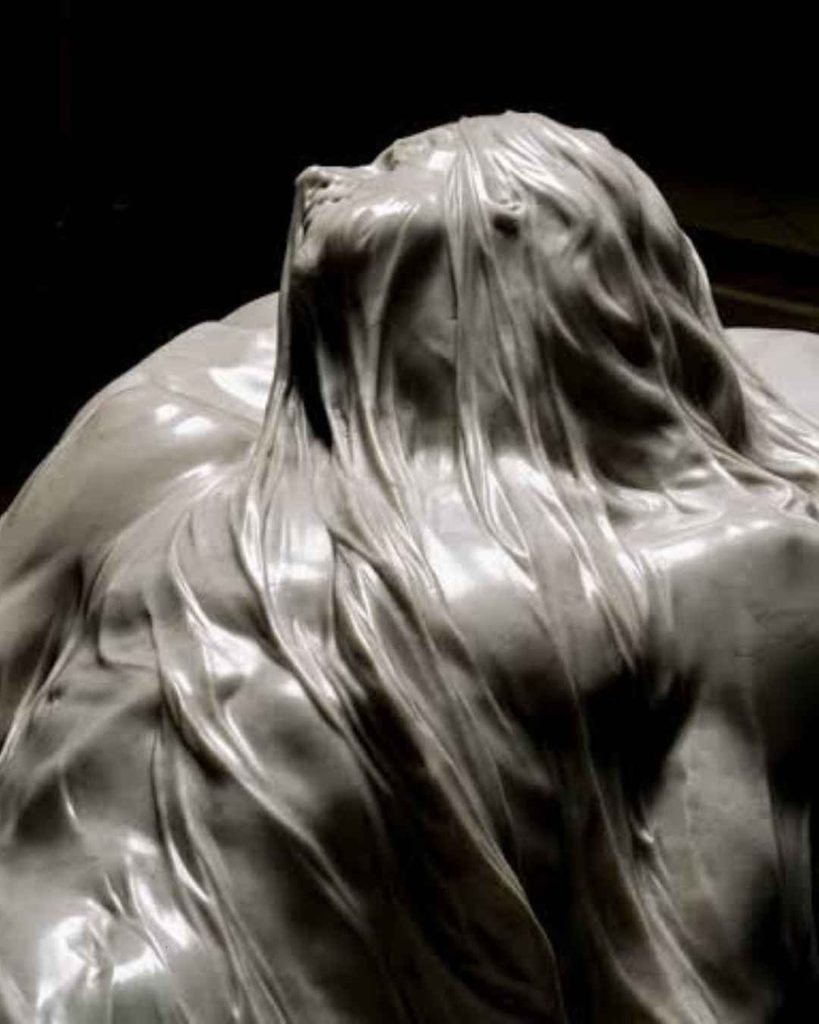
When you stand in front of the sculpture, there are several things to look for.
The first is the face. Look at the way the veil reveals the shape of Christ’s nose, his closed eyes, his lips. The features are not sharp. They are soft, as if seen through a thin layer of fabric.
The second is the hands. The wounds are visible through the veil. The fingers are relaxed, not clenched. The hands are the hands of a man who has died, not of a man who is fighting.
The third is the feet. The instruments of the Passion are carved at the feet: the crown of thorns, the pliers, the shackles. They are small details, but they are essential to the story.
The fourth is the drapery. Look at the way the fabric falls over the body. It clings to the chest, the hips, the legs. It reveals the contours of the body without exposing them. It is a masterpiece of carving.
The fifth is the transparency. Look at the way the light passes through the veil. It is not a trick. It is marble, carved so thin that it seems to dissolve. It is one of the greatest achievements in the history of sculpture.
Why the Veiled Christ Still Matters
The Veiled Christ is not just a masterpiece of technical skill. It is a meditation on suffering, on death, and on the limits of what art can do. It is a sculpture that makes you question your own eyes. It is a work that has been fooling people for more than 250 years, and it is still fooling them today.
The legend of the alchemical veil is a testament to the power of the sculpture. It is so extraordinary that people cannot believe it was made by human hands. They want to believe that there is a secret, a trick, a shortcut. But there is no shortcut. There is only marble, and a chisel, and a sculptor who spent years perfecting his craft.
Sanmartino never achieved the fame of Michelangelo or Bernini. He is not a household name. But the Veiled Christ is a work that belongs in the same conversation as the Pietà or the Ecstasy of Saint Teresa. It is a sculpture that transcends its material, that makes stone seem like cloth, and that makes death seem beautiful.
The Veiled Christ vs. Michelangelo’s Pietà
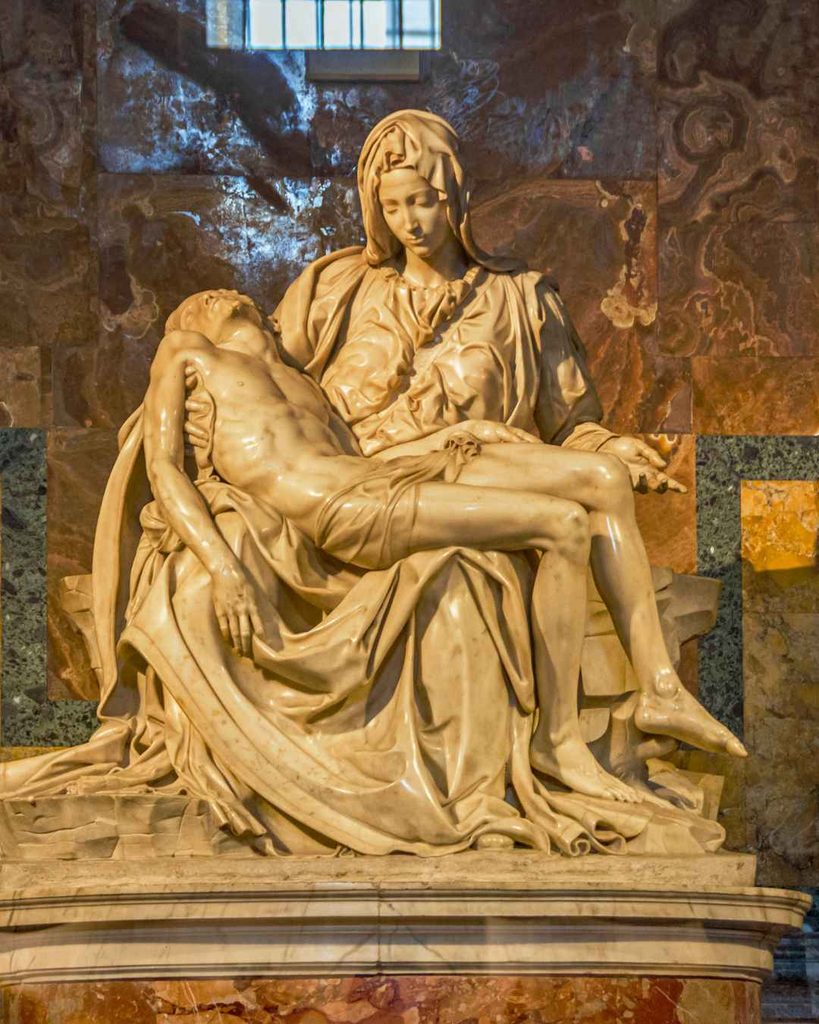
The Veiled Christ and Michelangelo’s Pietà are the two most moving depictions of the dead Christ in Italian sculpture, and they achieve their power in opposite ways.
Michelangelo shows the body openly, cradled by a mother whose face is serene and whose grief is held in check. The nakedness of Christ is the point: every wound is visible, every muscle slack, and the emotion comes from the contrast between the perfect body and its lifelessness.
Sanmartino hides the body, and that concealment is the source of the sculpture’s power. The veil makes the viewer work, straining to see the wounds, the face, the shape of the limbs beneath the marble cloth. Michelangelo invites you to look directly. Sanmartino forces you to look closely.
The Pietà is about grief shared between mother and son. The Veiled Christ is about isolation, a body alone beneath a shroud. One is a scene of embrace. The other is a scene of silence.
Michelangelo carved his masterpiece at twenty-three, in a single burst of youthful genius. Sanmartino carved his at thirty-three, after years of quiet craftsmanship. Both are miracles of technique. But they move you in completely different ways.
Conclusion
The Veiled Christ is one of the most extraordinary sculptures in the world. It is in a small chapel in Naples, surrounded by other masterpieces, and it is waiting to be discovered.
The story behind it is a story of ambition, skill, and legend. It is the story of a prince who wanted to astonish the world, and a sculptor who made it happen. It is the story of a veil that looks like cloth but is made of stone, and of a body that is dead but seems to be sleeping.
When you stand in front of the Veiled Christ, you are standing in front of a miracle. Not a religious miracle, but a human one. It is the miracle of what a person can do with a block of marble, a chisel, and a vision.
The Veiled Christ is not as famous as the David or the Pietà. It is not in Rome or Florence. It is in Naples, a city that is often overlooked by travelers rushing between the famous sights. But it is worth the journey. It is worth the ticket. It is worth the silence.
It is a sculpture that will stay with you long after you leave. It is a sculpture that makes you believe in the impossible.
And that is the greatest miracle of all.
Again, feel free to go through the list below of my Italy recommendations that I have crafted after years of travel to this beautiful country:
- Packing List: Things Not to Go to Italy Without
- Must-Do Things: Unforgettable Experiences
- Where to Stay: Best Hotels in Italy.
- Where to Stay in Rome: Rome’s Best Neighborhoods
- Where to Stay in Florence: Picking the Best Area
- Where to Stay in Venice: Venice’s Best Districts
- Italy’s Cobblestone Streets: Best Shoes For the Job
- Backpack or Suitcase?: Italy Luggage Guide
- Travel Insurance: Always Be Covered
- E-Sim: Be Connected At All Times