
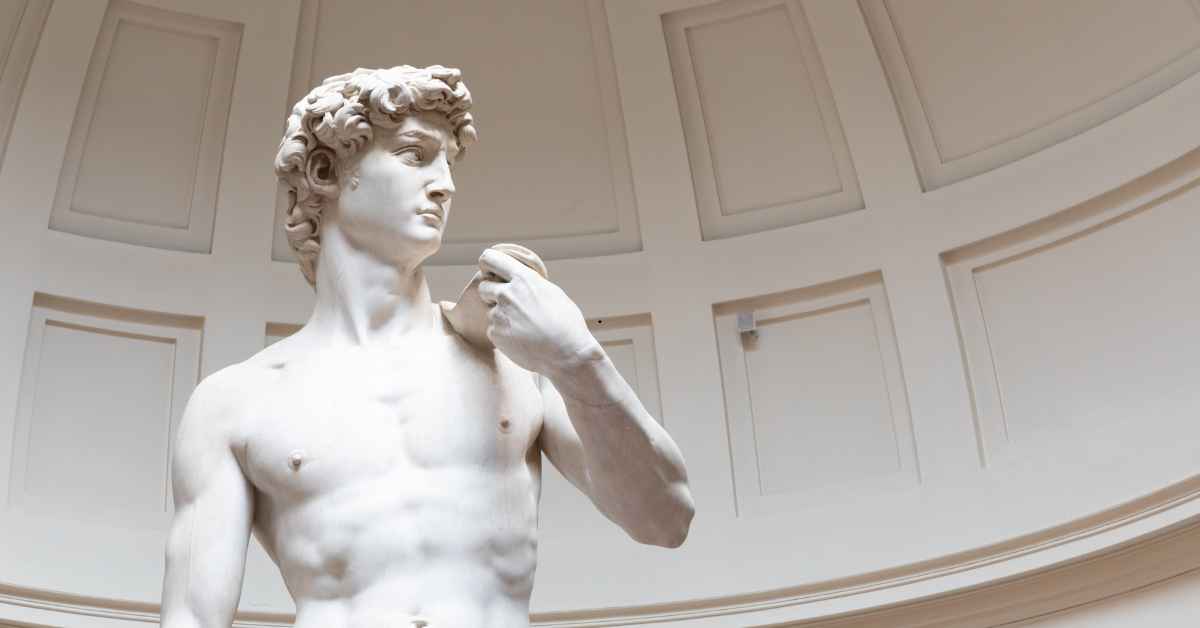
You can look at photos of Michelangelo’s David a hundred times, but seeing it in person at the Galleria dell’Accademia in Florence is a different experience.
Even if you’ve already seen the replica in Piazza della Signoria, the real thing still catches you off guard. It’s bigger, more impressive, and more detailed than you expect.
He stands at the end of a long corridor, lit from above, seventeen feet of white marble carved into the shape of a young man who is about to change the world.
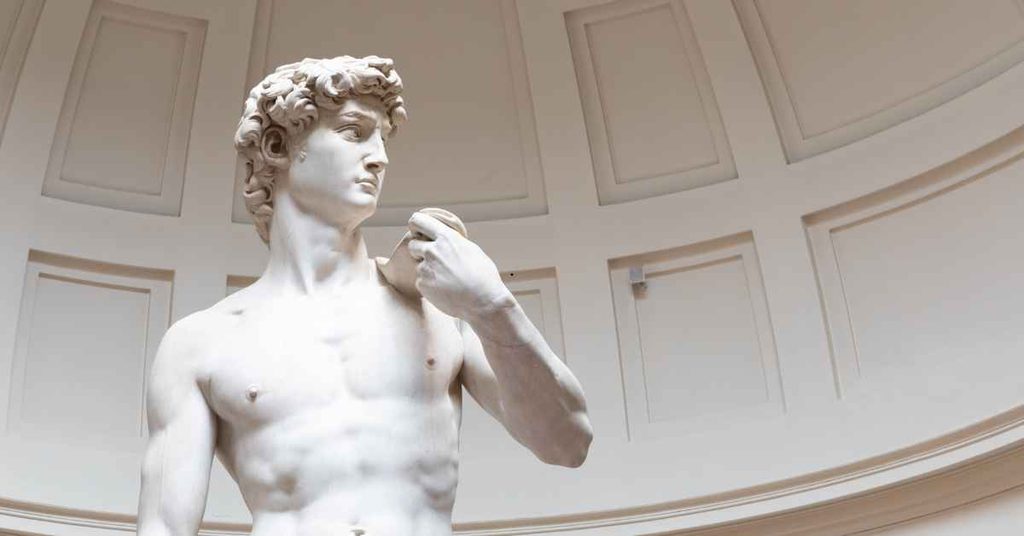
He is not fighting. He is not celebrating. He is standing still, and in that stillness there is more power than in any battle scene ever painted.
This is the story of how a discarded block of marble became the most famous sculpture in history, and how a twenty-six-year-old artist named Michelangelo turned it into a symbol of a city, an era, and an idea.
Before you read further, remember that Italy rewards travelers who come prepared. I’ve found a few things especially useful on an Italy trip, and they’re worth having and/or knowing beforehand. See the checklist here. Also, if you want me to plan an Italy trip for you that you will never forget, drop me a message here
The Block That Everyone Else Abandoned
The story of the David begins not with Michelangelo but with a block of marble that had been sitting in a courtyard in Florence for nearly forty years.
It was a massive piece of stone, eighteen feet tall, and it had been quarried in Carrara in the 1460s for a project that was never completed.
The block was initially intended for a statue of a prophet to be placed on the buttresses of the Florence Cathedral. But the artist who was supposed to carve it, Agostino di Duccio, abandoned the project after roughing out only a few basic shapes.
The marble was left in the courtyard of the Opera del Duomo, exposed to the elements, and over time it became known as “the Giant.”
Several artists were approached to finish the work, but all of them refused. The block was flawed. It had veins running through it, and the rough-hewing done by Agostino had already removed some of the stone that a sculptor would need.
The general consensus was that the block was ruined, and that any attempt to carve it would end in disaster.
In 1501, the Opera del Duomo decided to try one more time. They commissioned Michelangelo Buonarroti, a twenty-six-year-old sculptor who had already made a name for himself in Rome with the Pietà. Michelangelo accepted the challenge, and on August 16, 1501, he was officially given the block.
What happened next is one of the great mysteries of art history. Michelangelo worked on the David for more than two years, largely in secret. He built a wooden enclosure around the block so that no one could see what he was doing.
He worked alone, hewing every flake of marble with his own hand. No one knows exactly how he managed to extract the figure from the flawed stone, or how he solved the problems that had defeated everyone else.
The marble itself was not the finest quality. It was a block of “bianco ordinario” grade stone, rather than the superior “statuario” that Michelangelo would have preferred.
The block measured nine braccia in length, and it had been quarried decades earlier. Michelangelo had to work with what he had, and what he had was a stone that everyone else had given up on.
What we do know is that when the enclosure came down in 1504, the result was unlike anything the world had ever seen.
The Moment Before the Battle
Most depictions of David show him after the fight. Donatello’s bronze David, created in the 1430s, shows the boy standing victorious with the head of Goliath at his feet. Verrocchio’s David, from the 1470s, does the same. The message is clear: David is a hero because he won.
Michelangelo took a different approach. He chose to depict the moment before the battle, when David is still deciding. Goliath is not dead. The giant is still alive, still threatening, still enormous. And David is standing there, sling in hand, weighing whether to fight.
This choice changes everything. A victorious David is a celebration of past achievement. A David before the battle is a statement about courage, decision, and the willingness to face impossible odds.
Michelangelo understood that character is revealed not in what a person does, but in what they choose to do. The moment of choice is the moment that defines us. By freezing David in that moment, Michelangelo made him timeless.
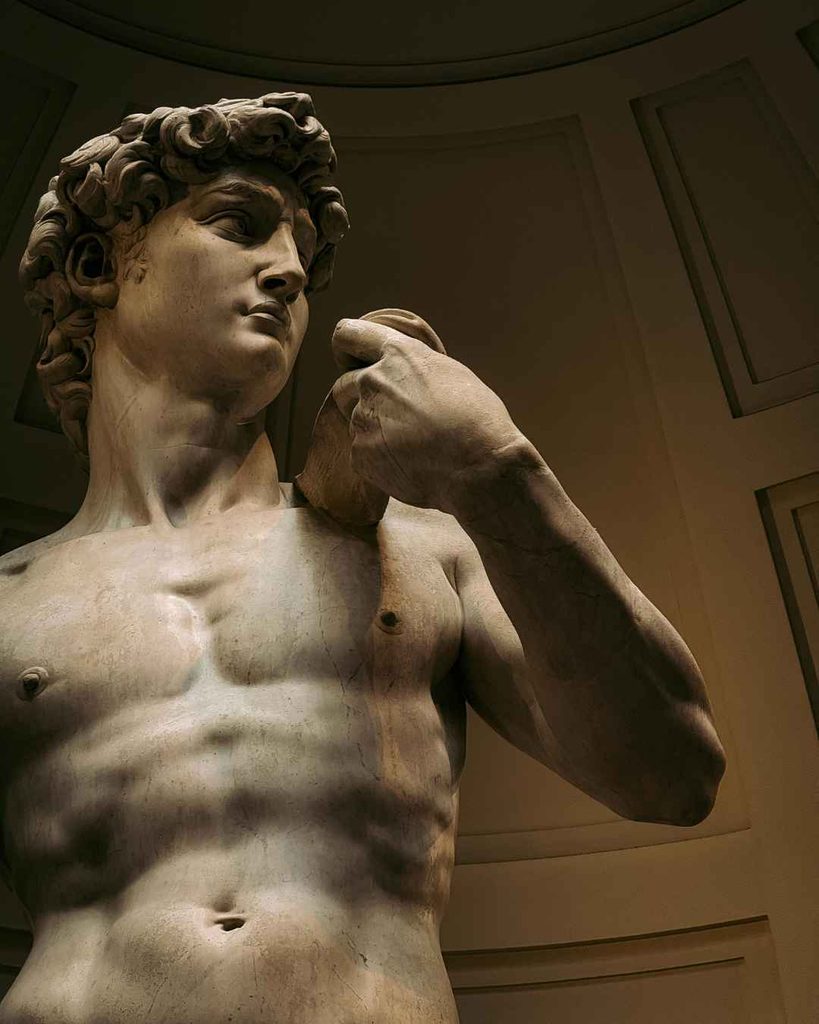
The sculpture captures a young man who is not yet a hero. He is a shepherd, a boy, someone who has no business fighting a giant. But he is standing there anyway, and his body is tense with the awareness of what is about to happen.
His brow is furrowed. His nostrils are slightly flared. His muscles are relaxed but ready. His gaze is fixed on something we cannot see, something beyond the frame of the sculpture. He is looking at Goliath, and he is deciding.
The Anatomy of a Miracle
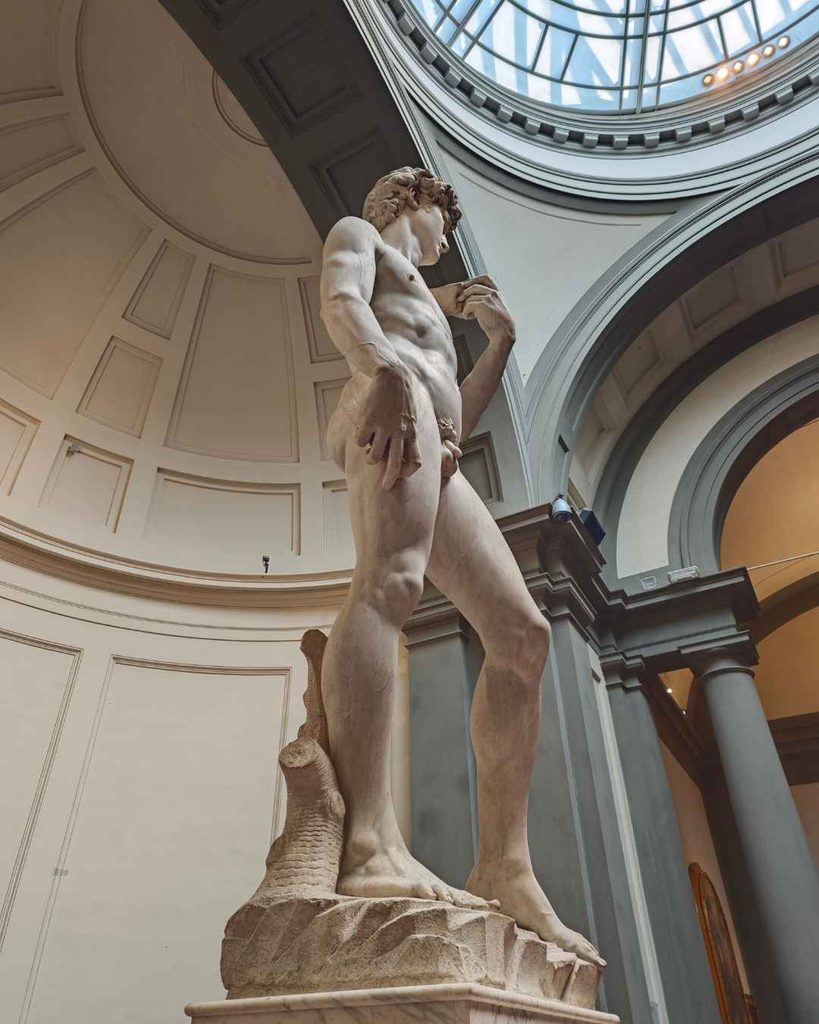
The David is seventeen feet tall, carved from a single block of white marble. It weighs more than six tons. The figure is nude, which was unusual for a biblical hero but entirely appropriate for a classical revival.
The anatomy is extraordinary. Every muscle, every tendon, every vein is rendered with a precision that suggests Michelangelo had studied human dissections. The torso is twisted slightly, creating a sense of potential movement.
The weight is on the right leg, while the left leg is relaxed, a pose known as contrapposto that was borrowed from ancient Greek sculpture.
Modern anatomical studies have confirmed the accuracy of Michelangelo’s work. Measurements taken in 2004 by anatomy professors Massimo Gulisano and Pietro Bernabei found that the statue represents a Caucasian male of about 180-185 centimeters in height and an apparent age of 20-30 years.
The head is one-eighth of the total height, which is the classical proportion. The arm span exceeds the height by at least 33.5 centimeters, a deliberate exaggeration that emphasizes David’s reach and power.
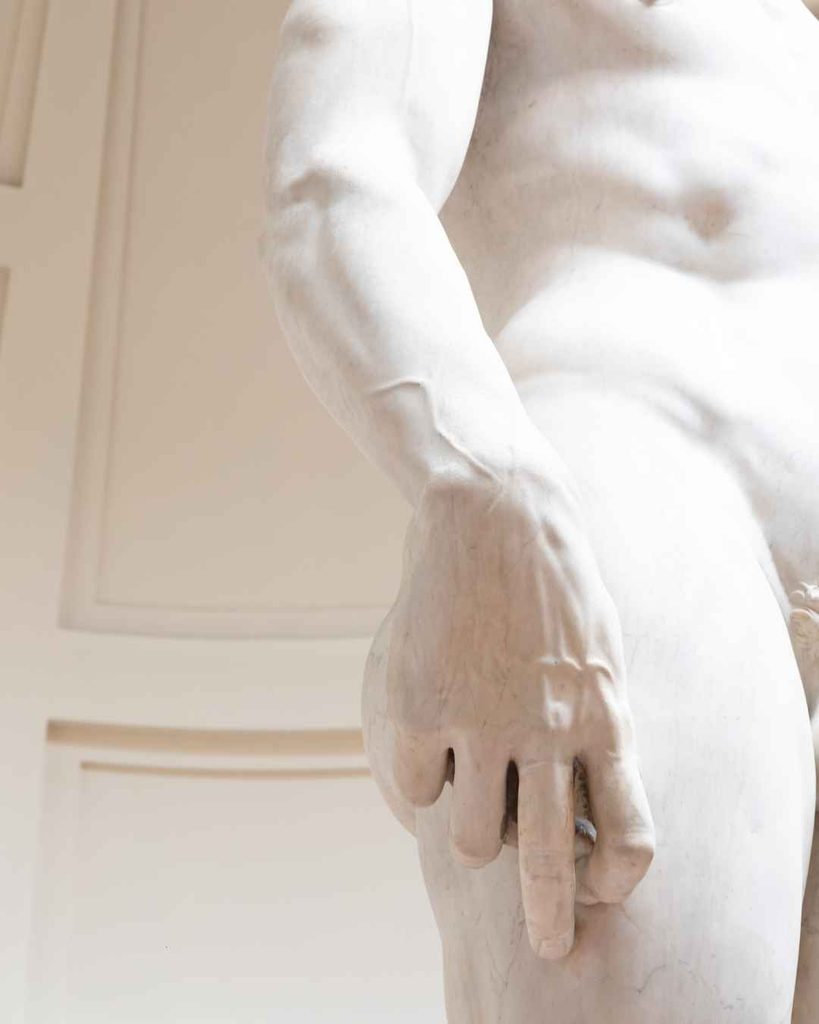
The hands are one of the most discussed details of the sculpture. The right hand is disproportionately large, with prominent veins.
Some scholars believe this is a deliberate choice, a way of emphasizing David’s strength and his readiness to use the sling. Others see it as a sign that David is not a boy at all but a mature man, fully grown and fully capable.
The anatomy is not perfect, and Michelangelo knew it. There is a hollow on the right side of David’s back where a muscle should be. Michelangelo wrote in a letter that a defect in the marble block forced him to leave out that muscle.
The flaw is invisible to most viewers, but it is a reminder that even the greatest artists work within constraints.
The sling is draped over his left shoulder, and his left hand holds the strap. His right hand grips a stone. The sling is the only weapon he has, and it is a humble one. This is not a warrior in armor. This is a shepherd with a piece of leather and a rock.
Michelangelo also carved a tree trunk behind the right leg, a structural necessity that also serves as a visual anchor. The trunk is carved with leaves and vines, adding a touch of naturalism to the composition.
Some parts of the statue were originally gilded, including a garland on David’s head, the tree trunk, and the sling. The gold has long since worn away, but traces remain.
A Symbol for a Republic
When the David was finished, a committee of Florence’s most prominent artists and citizens was convened to decide where it should be placed. The committee included Leonardo da Vinci, Sandro Botticelli, Filippino Lippi, and Perugino.
The original plan was to place the statue on the cathedral, but the committee quickly realized that the David was too beautiful, too powerful, and too important to be hidden on a rooftop. They decided to place it in front of the Palazzo Vecchio, the town hall, in the Piazza della Signoria.
The choice was political. Florence was a republic, surrounded by enemies. The Medici had been expelled in 1494, and the city was trying to maintain its independence against the combined power of the pope, the French, and the other Italian states.
The David was intended as a symbol of the city’s courage and its willingness to face overwhelming odds.
The statue was unveiled on September 8, 1504, and it immediately became the symbol of Florence. The citizens called it “the Giant,” and they used it as a way of marking time. Events were described as happening “before the giant was put up” or “after.”
The David was not just a work of art. It was a civic statement, a declaration that Florence would stand against its enemies the way David stood against Goliath.
The statue was placed to the left of the door of the Palazzo Vecchio, replacing Judith, who was moved to the Loggia. The message was clear: the republic had a new hero.
The Nudity and the Controversy
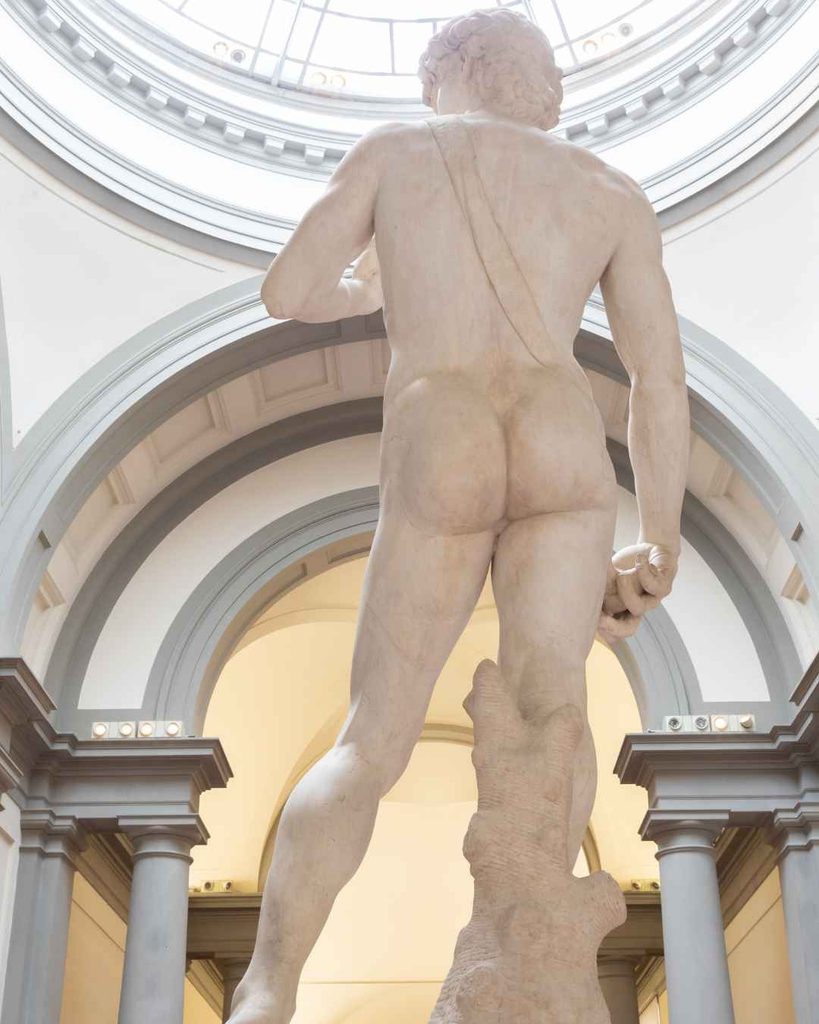
The David is nude, and this has been a source of controversy for centuries. In the Bible, David would have been clothed. In the Middle Ages, religious figures were always depicted with clothing. But Michelangelo chose to show David naked, and this choice was deliberate.
The nudity was a reference to classical antiquity. Ancient Greek and Roman sculptures of heroes and gods were often nude, and the Renaissance was a period of revival for classical culture. By making David nude, Michelangelo was placing him in the tradition of classical heroes like Apollo and Hercules.
The nudity also served a theological purpose. David is depicted as a human being, vulnerable and exposed, trusting in God rather than in armor. His nakedness emphasizes his humanity and his reliance on divine protection.
But not everyone approved. In the sixteenth century, a campaign was launched to cover the statue’s nudity with fig leaves. The campaign was led by Girolamo Savonarola, a Dominican friar who preached against what he saw as the immorality of Renaissance art.
After Savonarola’s death, the campaign continued, and at various times the David was covered with garlands of leaves or bronze fig leaves.
Today, the David is displayed without censorship, and the nudity is seen as an essential part of the sculpture’s meaning. But the controversy is a reminder that art is never neutral, and that the human body has always been a subject of debate.
The Journey to the Accademia
The David stood in the Piazza della Signoria for more than three centuries, exposed to the elements and to the political turmoil of the city. In 1527, during a riot, a bench was thrown from the Palazzo Vecchio and struck the statue, breaking its left arm into three pieces.
The arm was repaired by the Medici Duke Cosimo I, who had the fragments fastened back in place with copper nails.
By the nineteenth century, the statue was showing signs of wear. The marble was eroding, and the pollution of the city was damaging the surface. In 1866, a commission of artists, scientists, and technicians evaluated the urgency of moving the statue.
In 1873, a decision was made to move the David indoors, to protect it from further damage.
The move was a major undertaking. The statue was encased in a wooden and metal framework and placed on rails. It took ten days to move the David from the Piazza della Signoria to the Accademia, a journey of less than a kilometer through the streets of Florence.
The move took place in the early morning hours, from 4 to 11 AM, to avoid the heat of the day. The route passed through Via dei Calzaioli, the Duomo, Via Martelli, Via Cavour, Piazza San Marco, and finally to Via Cesare Battisti.
The statue was placed in a purpose-built gallery, the Tribuna, designed by the architect Emilio De Fabris. The Tribuna was completed in 1882, and the David has been there ever since. De Fabris designed a “secular temple” covered by a glass vault that would guarantee the most natural lighting possible.
A replica was placed in the Piazza della Signoria, on the spot where the original once stood.
The Other Davids: Copies Around the World

The David is the most reproduced sculpture in history. Copies exist in museums, public squares, and private collections around the world, and each one has its own story.
The most famous copy is the bronze replica that stands in the Piazzale Michelangelo, the terrace above Florence with panoramic views of the city.
This bronze was cast by Clemente Papi, a Florentine sculptor who was commissioned by Grand Duke Leopold II to make a copy of the David in the 1840s. Papi took a mould from the original in 1847, using a technique that required immense care to avoid damaging the already fragile marble.
He completed the plaster cast in 1853 and the bronze in 1866. The bronze was raised on the Piazzale Michelangelo in 1875 to commemorate the fourth centenary of Michelangelo’s birth.
The second most famous copy is the plaster cast at the Victoria and Albert Museum in London. This cast was made by Papi from the same moulds and was sent to Queen Victoria in 1857 as a diplomatic gift from Leopold II.
Queen Victoria was apparently surprised by the statue’s nudity, and a detachable plaster fig leaf was created to hang on the figure before royal visits. The fig leaf is still displayed nearby.
A marble copy, made by the sculptor Luigi Arrighetti, was installed in the Piazza della Signoria in 1910. This is the copy that most visitors see when they walk through the square, and it stands on the spot where the original once stood.
Other full-size copies of David are publicly displayed in cities around the world, including London, Moscow, Copenhagen, and Mexico City. A bronze cast of David from 1896, normally displayed outside in Copenhagen’s harbor district, was recently relocated indoors for an exhibition at the SMK museum.
A 19th-century bronze version of David was included in the “Michelangelo Imperfect” exhibition, alongside plaster casts and 3D-printed copies of other Michelangelo works.
In 2010, a fibreglass replica of David was installed atop a buttress on a corner of the north tribune of Florence Cathedral for a week. The installation revealed the statue the way the Operai who commissioned the work originally expected it to be seen, high above the ground.
One of the largest collections of Michelangelo replicas is located at Forest Lawn Memorial Park in Glendale, California. The statues were sculpted in Florence in the 1920s and 1930s, and they include David, the Pietà, Moses, and several of the Medici Chapel figures.
There is even a “Leather David,” a 1966 reproduction that captured attention in San Francisco for portraying David in leather attire.
The statue has been reproduced in plaster, marble, fibreglass, and simulated marble, and it has appeared in settings as unlikely as beach resorts, gambling casinos, and model railroads.
What the David Means
The David is more than a masterpiece of sculpture. It is a symbol of the Renaissance itself, a statement about human potential and the power of the individual.
Michelangelo believed that the human body was the highest form of art, a reflection of divine perfection. The David is his most complete expression of that belief. It is a body that is not just beautiful but meaningful, a body that carries ideas about courage, faith, and the power of the human will.
The David is also a political statement. It was created for a republic that was fighting for its survival, and it was placed in front of the seat of government as a reminder of what courage looks like. The message was clear: Florence, like David, would stand against its enemies, no matter how powerful they seemed.
And the David is a personal statement. Michelangelo was twenty-six when he began the sculpture, and he was working on a block that everyone else had abandoned. He was taking an enormous risk. If he failed, his reputation would be ruined. If he succeeded, he would be immortal.
He succeeded.
Where to See the David Today
The original David is in the Galleria dell’Accademia in Florence. The museum is open every day except Monday, and tickets should be booked in advance. The David is at the end of a long corridor, lit by a skylight, and the effect is theatrical.
There are replicas in several locations in Florence. The most famous is in the Piazza della Signoria, on the spot where the original once stood. There is also a bronze replica in the Piazzale Michelangelo, which offers panoramic views of the city.
The plaster cast at the Victoria and Albert Museum in London is another option for travelers who cannot make it to Florence.
The David has been cleaned and restored several times, most recently in the early 2000s, when the marble was carefully cleaned and monitored for signs of deterioration. The statue is regularly dusted and monitored to ensure its preservation.
In 2023, new lighting was installed to celebrate 150 years since the statue arrived at the Accademia, with a new LED system and a skylight that allows natural light to filter in, illuminating the David more clearly and creating a more suggestive atmosphere that changes throughout the day.
If you are in Florence and can’t find a ticket on the official website or want to do a guided tour, this is where I would recommend that you look for one.
Final Thoughts
The David is the most famous sculpture in the world, and it deserves the reputation. It is a work of extraordinary technical skill, a masterpiece of anatomical precision, and a profound statement about human courage and potential.
But what makes the David truly remarkable is the story behind it. A discarded block of marble. A young artist with no formal training in sculpture. A city fighting for its survival. A moment of decision frozen in stone.
Michelangelo saw something in that abandoned block that no one else could see. He saw a hero, a symbol, a masterpiece. And he carved it out with his own hands, working in secret for more than two years, creating something that had never existed before.
That is the lesson of the David. It is not just about what you can see. It is about what you can imagine. It is about believing that something beautiful can emerge from something broken.
The David stands in Florence today, as he has stood for more than five centuries. He is a reminder of what one person can do, and of what a city can become when it believes in itself.
Related topic: 5 Florence Experiences That Are Worth Every Euro
Again, feel free to go through the list below of my Italy recommendations that I have crafted after years of travel to this beautiful country:
- Packing List: Things Not to Go to Italy Without
- Must-Do Things: Unforgettable Experiences
- Where to Stay: Best Hotels in Italy.
- Where to Stay in Rome: Rome’s Best Neighborhoods
- Where to Stay in Florence: Picking the Best Area
- Where to Stay in Venice: Venice’s Best Districts
- Italy’s Cobblestone Streets: Best Shoes For the Job
- Backpack or Suitcase?: Italy Luggage Guide
- Travel Insurance: Always Be Covered
- E-Sim: Be Connected At All Times