
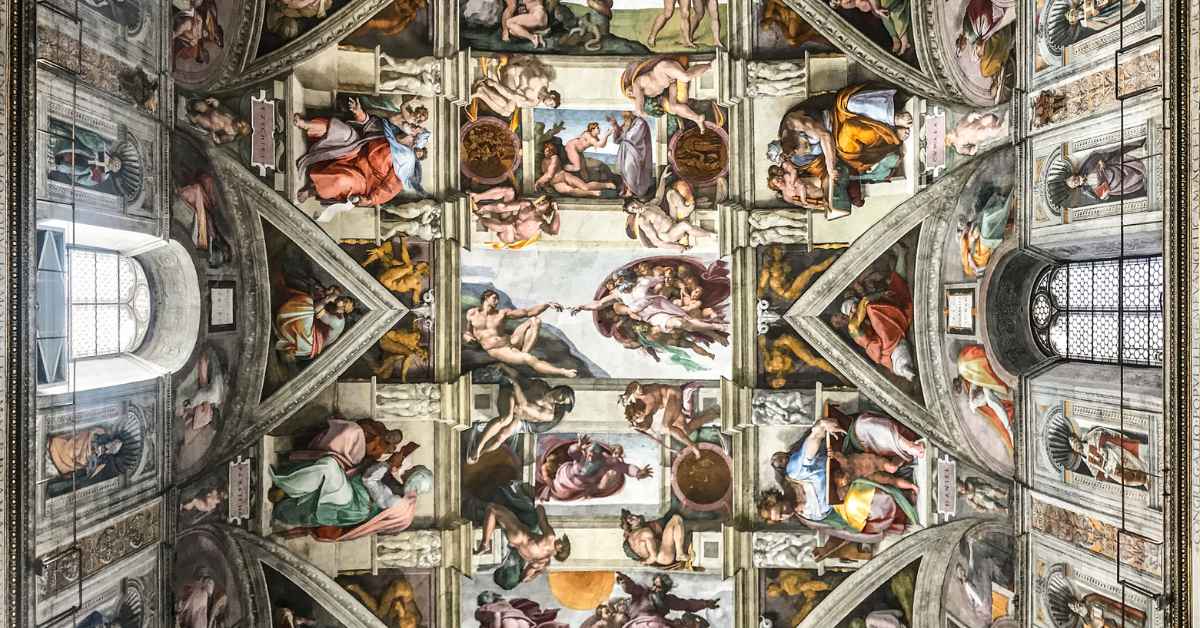
You step into the Sistine Chapel, look up, and suddenly understand why people have been talking about this ceiling for more than 500 years.
Above you, Michelangelo’s figures twist, stretch, and reach across a vast painted sky, telling biblical stories with a power that feels almost impossible to believe. You may recognize the famous image of God reaching toward Adam, but that is only a small part of what makes this place extraordinary.
Every section has a story, every figure has a purpose, and some of the most fascinating details are easy to miss when you are standing beneath one of the greatest artistic achievements in history.
Most visitors spend less than fifteen minutes in the chapel. They see the Creation of Adam, they see the Last Judgment, they leave. But the ceiling is not a single image.
It is a complex theological program that covers twelve thousand square feet and contains hundreds of figures, and it is packed with details that Michelangelo buried in the fresco for reasons that scholars are still debating.
Some of these details are anatomical. Some are symbolic. Some are so strange that they have generated entire academic careers. This article is about those details.
The things that most people walk past without seeing, and the stories they tell about the most famous ceiling in the world.
Before you read further, remember that Italy rewards travelers who come prepared. I’ve found a few things especially useful on an Italy trip, and they’re worth having and/or knowing beforehand. See the checklist here. Also, if you want me to plan an Italy trip for you that you will never forget, drop me a message here
1. The Brain Hidden in the Creation of Adam
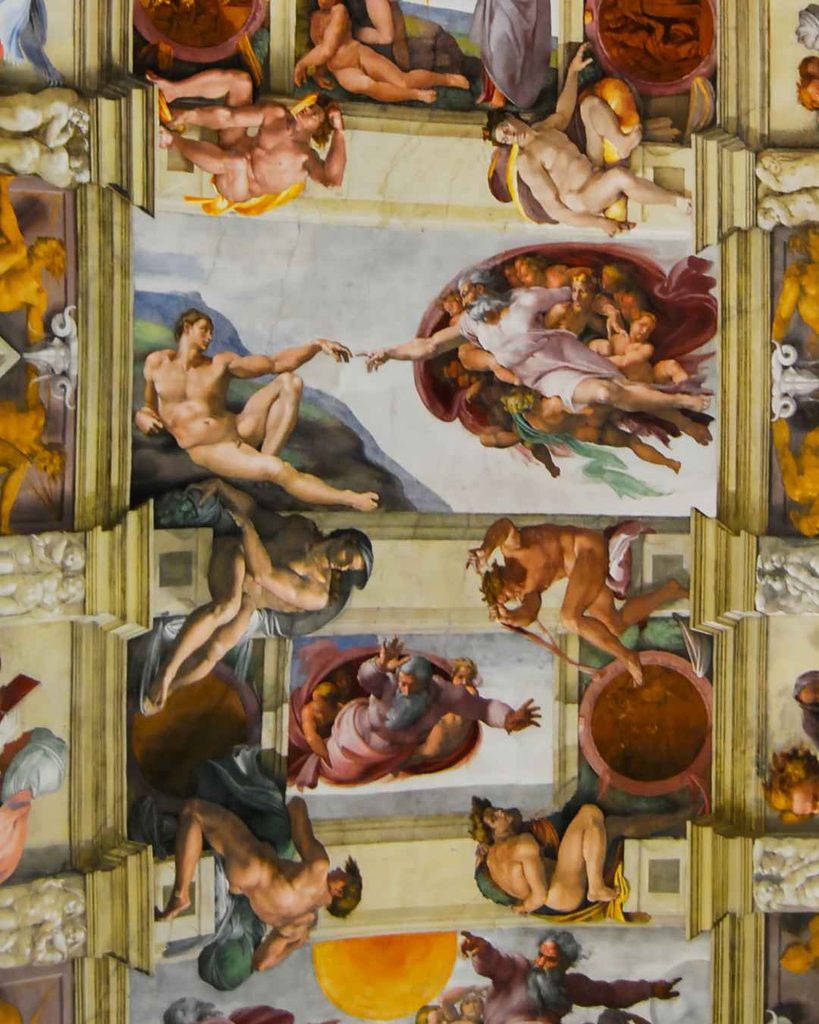
The most famous hidden detail in the Sistine Chapel is the one that surrounds God in the Creation of Adam. For centuries, viewers saw a cloud or a cloak behind the figure of God.
Then, in 1990, a physician named Frank Meshberger published a paper arguing that the shape was not a cloak at all. It was a cross-section of the human brain.
Look closely at the shape that God and the angels are sitting inside. The outline traces the sagittal section of a brain, with the cerebrum, the cerebellum, and the brainstem all visible.
The angel’s leg that crosses the lower part of the shape corresponds to the spinal cord. The billowing fabric that seems to swirl around God is actually the folds of the cerebral cortex.
The interpretation has been debated, but it has never been convincingly refuted. What would it mean? Michelangelo believed that the human body was a reflection of divine perfection.
He also believed that the brain was the seat of the soul. By placing God inside a brain, he may have been suggesting that the divine is accessible through human intellect, that the image of God is not in the clouds but in the mind itself.
2. The Self-Portrait on the Flayed Skin
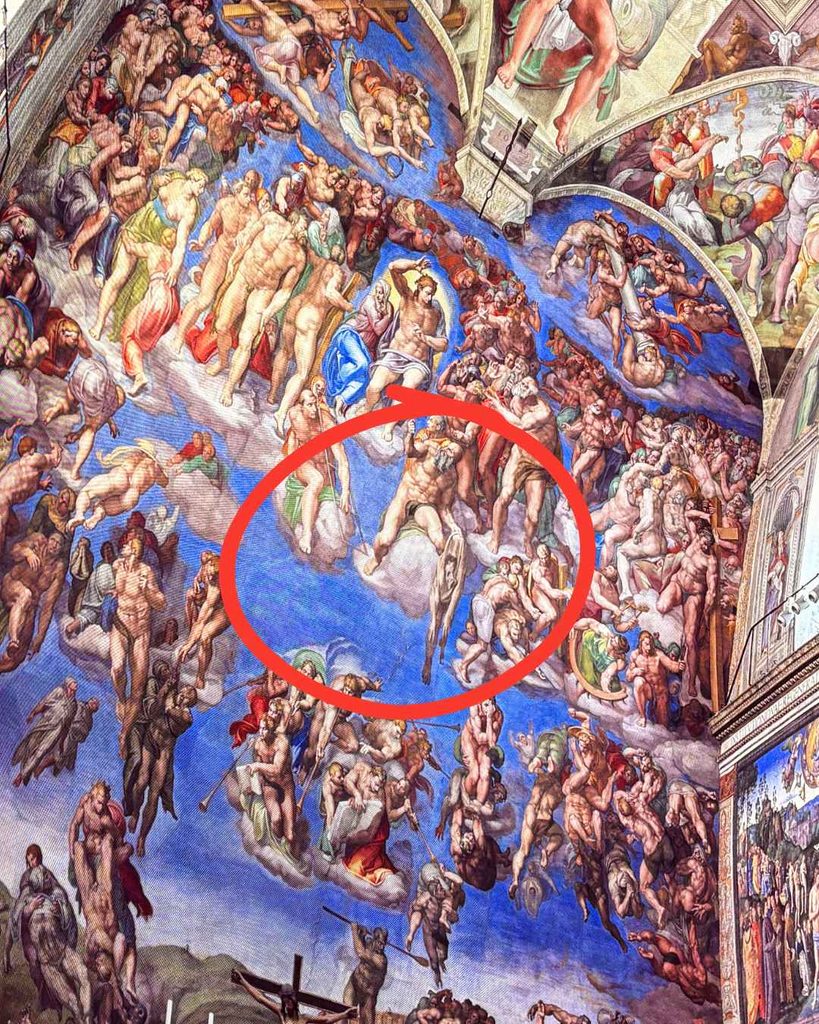
The Last Judgment, on the altar wall, is a terrifying painting. Christ stands at the center, surrounded by saints and martyrs, and the damned are dragged down to hell by demons. It is chaotic, violent, and deeply personal.
If you look at the lower right section, near the bottom of the fresco, you will see a figure holding a flayed skin. This is Saint Bartholomew, who was martyred by being skinned alive. He holds his own skin in his hand, and the skin is draped over his arm.
The face on that skin is Michelangelo’s own. The flayed skin is a self-portrait, and it is one of the most haunting images in the history of art. Michelangelo painted himself as a dead, empty husk, held up by a martyr.
It is a confession, a plea for mercy, and a meditation on his own sinfulness. He was in his sixties when he painted the Last Judgment, and he had spent his entire life in service to the popes. The skin is the shell of the man. The face is the soul.
3. The Ignudi and Their Secret Meaning
The ceiling is populated by twenty young male nudes known as the Ignudi. They sit on architectural blocks, holding ribbons and garlands of oak leaves and acorns. They are beautiful, muscular, and seemingly decorative. But they are not decoration.
The Ignudi have been interpreted in many ways. Some scholars see them as symbols of the human soul, caught between the divine and the earthly. Others see them as representations of the Neoplatonic idea of beauty.
The oak leaves and acorns that they hold are a reference to the della Rovere family, the family of Pope Julius II, who commissioned the ceiling. The oak was their emblem.
The Ignudi are not angels. They are not saints. They are ideal human forms, and they exist in a space between the earthly and the divine. Michelangelo believed that the human body was the highest form of art, and the Ignudi are his most complete expression of that belief.
4. The Prophets and Sibyls: The Seers Who Predicted Christ
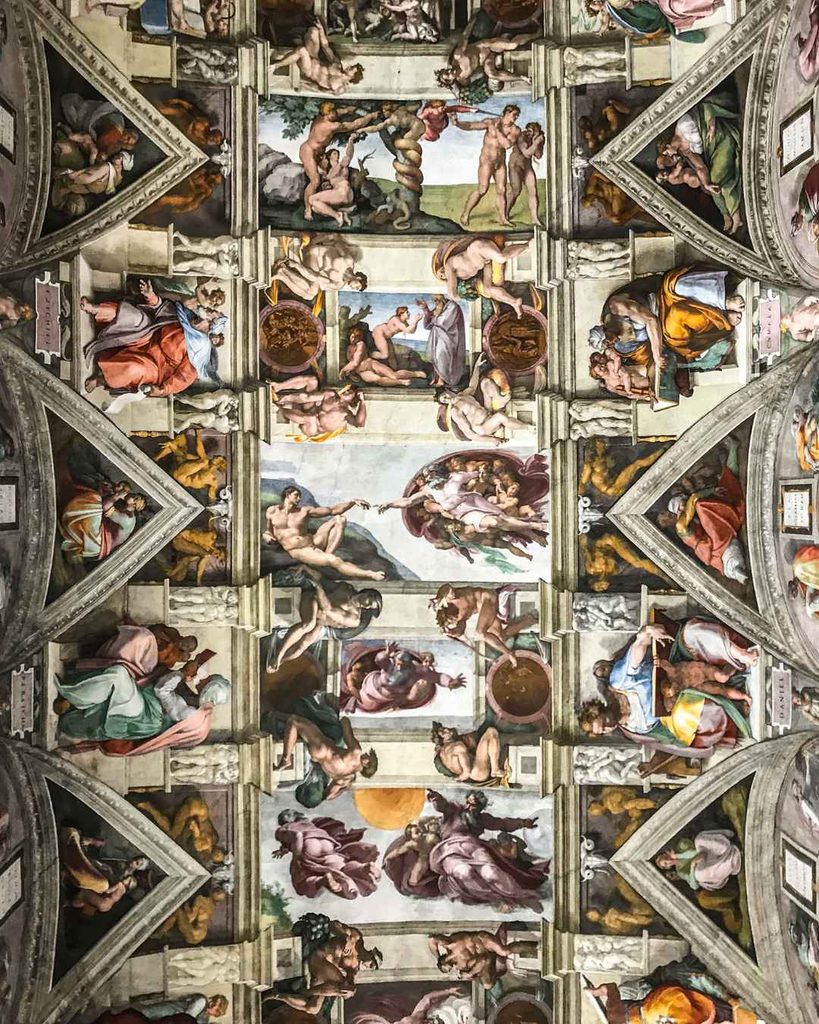
Around the edges of the ceiling, seated on thrones, are seven prophets and five sibyls. The prophets are from the Old Testament: Isaiah, Ezekiel, Daniel, Joel, Zechariah, Jonah, and Jeremiah. The sibyls are from classical mythology: the Delphic, Erythraean, Cumaean, Persian, and Libyan.
The pairing is deliberate. In Christian theology, the prophets foretold the coming of Christ. The sibyls were pagan seers who, according to medieval tradition, had also predicted the birth of a savior.
By placing them together, Michelangelo was making a statement about the relationship between the classical world and the Christian world. Truth was not limited to one tradition. The wisdom of the ancients pointed toward the same destination.
Each prophet and sibyl is accompanied by an Ignudo and two cherubs. The cherubs symbolize the will, and the Ignudo symbolizes the mortal body. Together, they represent the human struggle to understand divine revelation.
5. The Ancestors of Christ: The Forgotten Figures
The lunettes, the semicircular areas above the windows, are filled with the ancestors of Christ. These are the generations listed in the Gospel of Matthew, the human lineage that leads to the birth of Jesus. They are the least noticed part of the ceiling, and they are also the most intimate.
Michelangelo painted them as ordinary families. They are not heroic. They are not idealized. They are tired, distracted, and sometimes bored. A mother nurses a child.
A father stares into space. A family sits in silence. These are the people who lived in the shadows of history, waiting for something they could not see.
The colors in the lunettes are also unusual. The cleaning of the ceiling in the 1980s revealed that Michelangelo used a technique called cangianti, in which colors shift from one hue to another in the same garment.
The ancestors wear cloaks that change from green to orange, from red to violet. The effect is iridescent, like shot silk, and it may have been intended to suggest the exotic, Eastern origins of Christ’s ancestors.
6. The Separation of Light from Darkness and the Hidden Anatomy
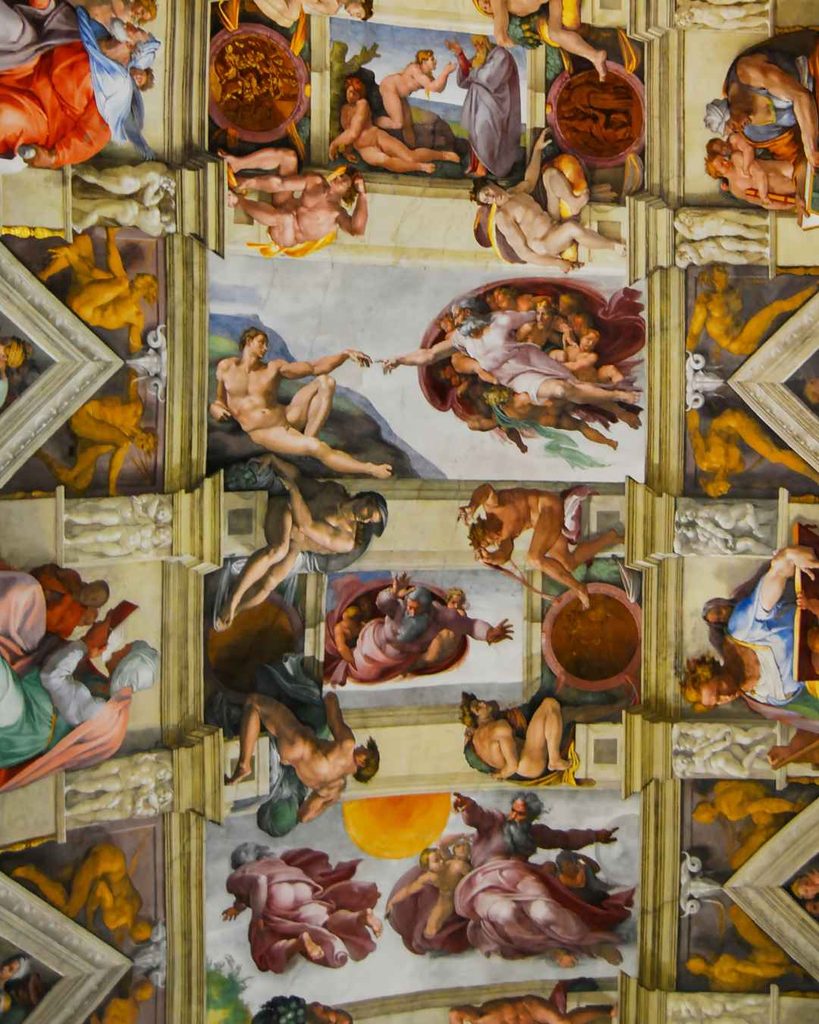
The first panel in the Genesis sequence shows God separating light from darkness. It is the most violent of the creation scenes. God is shown in motion, his arms raised, his body twisted. The light and the darkness are torn apart.
But there is something strange about the figure of God in this panel. He is painted from a three-quarter perspective, and the other figures in the same position on the ceiling show both thighs.
In this panel, God’s left thigh is replaced by a deep shadow. Some researchers have argued that the shadow is not a mistake. It is an anatomical drawing of the brainstem, hidden in the form of God’s leg.
The theory is controversial, but it fits a pattern. Michelangelo was a devoted student of anatomy. He dissected cadavers and sketched the human body with a precision that was unusual for his time.
He believed that the body was a map of the soul, and he may have hidden anatomical references in his work as a form of private devotion.
7. The Medallions and the Bronze Reliefs
Between the Ignudi, there are ten circular medallions. They look like bronze reliefs, but they are painted. They depict scenes from the Old Testament, including the Fall of Absalom, the Sacrifice of Isaac, and the Death of Uriah.
The medallions are painted in a technique that simulates the appearance of bronze, with dark shadows and golden highlights. They are a demonstration of Michelangelo’s virtuosity. He was a sculptor, not a painter, and the medallions are his way of proving that he could paint sculpture as well as carve it.
The medallions are also a reference to the Arch of Constantine in Rome. Michelangelo had studied the arch, and the round reliefs on the arch are the model for the medallions on the ceiling. By quoting a Roman monument, he was placing his own work in the tradition of classical art.
8. The Creation of Eve and the Figure of God

In the panel showing the Creation of Eve, God is depicted as a muscular, dynamic figure. He is not the bearded old man of popular imagination. He is young, strong, and full of energy. He is shown in motion, his arms outstretched, his body twisted.
But look at the figure of Eve. She is emerging from Adam’s side, and her pose is one of submission. Her hands are folded, her head is bowed. She is not the equal of Adam. She is his helpmeet, created from his rib.
The panel is a statement about gender roles, and it reflects the theology of the time. But it also contains a detail that is easy to miss. The serpent is already present in the Garden, coiled around the tree. The Fall is already foreshadowed, even in the moment of creation.
9. The Deluge and the Despair of Humanity
The Flood panel is the most chaotic of the Genesis scenes. It shows people trying to escape the rising waters. They climb to high ground; they carry their belongings; they fight for survival. In the background, Noah’s ark floats serenely on the water.
The panel is a meditation on human desperation. The people in the painting are not villains. They are ordinary people, caught in a catastrophe they cannot control. Michelangelo painted them with sympathy. He shows mothers lifting their children, men carrying the elderly, families huddled together.
The panel is also a technical achievement. It contains dozens of figures, all in motion, all in different poses. It is a demonstration of Michelangelo’s ability to render the human body in every possible position.
10. The Colors That Were Hidden for Centuries
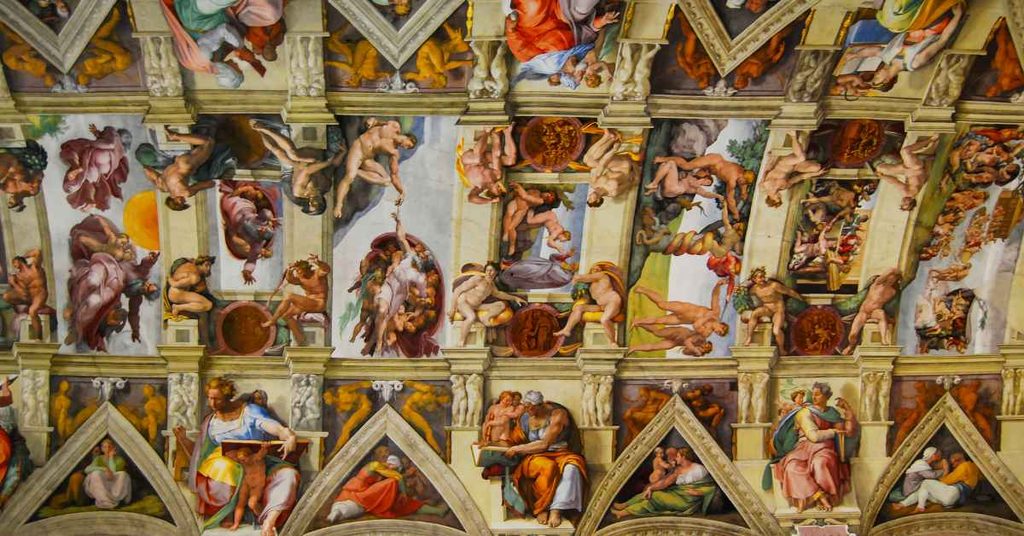
For centuries, the Sistine Chapel ceiling was dark. The smoke from candles, the dust, and the humidity had covered the frescoes in a layer of grime.
Art historians believed that Michelangelo had painted in muted, earthy tones. They described him as an artist who cared about form, not color.
The restoration, which began in 1980 and lasted for more than a decade, changed everything. When the grime was removed, the colors that emerged were not muted.
They were bright, saturated, and almost shocking. The sky was a vivid blue. The robes were orange, green, and violet. The flesh tones were alive with pink and gold.
The restoration revealed that Michelangelo was not just a sculptor who painted. He was a colorist of extraordinary boldness.
He used color to create drama, to guide the eye, and to express emotion. The ceiling that we see today is not the ceiling that generations of art lovers saw. It is the ceiling that Michelangelo painted.
11. The Missing Leg and the Mystery of God’s Body
In the Creation of Adam, God is shown in motion, reaching out to touch Adam’s hand. But look at his body. He has two legs, but the left leg is positioned in a way that is anatomically impossible. It seems to merge into the fabric behind him.
Some scholars believe this is a mistake. Others believe it is deliberate. The shape of the leg, they argue, is a reference to the placenta, the organ that sustains life in the womb. God is not just creating Adam. He is giving birth to him.
The theory is speculative, but it fits the pattern of hidden meanings in the ceiling. Michelangelo was not a literal painter. He was a symbolic one. Every detail, even the way God’s leg is positioned, may have a meaning that we are still trying to understand.
12. The Last Judgment and the Terror of the Damned

The Last Judgment is the most terrifying painting in the chapel. Christ is at the center, his arm raised in judgment. The saved rise to heaven, and the damned fall to hell. The damned are dragged down by demons, their faces twisted in agony.
Michelangelo painted himself into the scene. His face is on the flayed skin held by Saint Bartholomew. But he also painted his critics into the scene.
One of the damned, a figure near the bottom, has the face of Biagio da Cesena, the papal master of ceremonies who had criticized the nudity in the painting. Michelangelo gave him donkey ears and had him dragged to hell by a serpent.
The painting is a statement about divine justice, but it is also a statement about human pettiness. Michelangelo was a proud man, and he did not forgive his enemies. The Last Judgment is his revenge.
How to See the Details Without Missing Anything
The Sistine Chapel is crowded, and the guards are strict. Photography is not allowed, and visitors are moved along quickly. But there are ways to see the details.
Book a tour that includes early access or evening access. These tours are more expensive, but they allow you to be in the chapel when it is quieter. The Vatican Museums Night Tour, for example, spends thirty minutes in the chapel after closing time.
Bring binoculars. The ceiling is seventy feet above the floor, and many of the details are invisible to the naked eye. Binoculars will allow you to see the Ignudi, the medallions, and the ancestors in detail.
Look up, but also look around. The Last Judgment is on the altar wall, and it is easy to miss if you are focused on the ceiling. The lunettes above the windows are also worth studying. They contain some of the most intimate and human figures in the chapel.
For the best guided tours of the Sistine Chapel, here are my recommendations.
How Michelangelo Transformed the Sistine Chapel Into a Renaissance Masterpiece
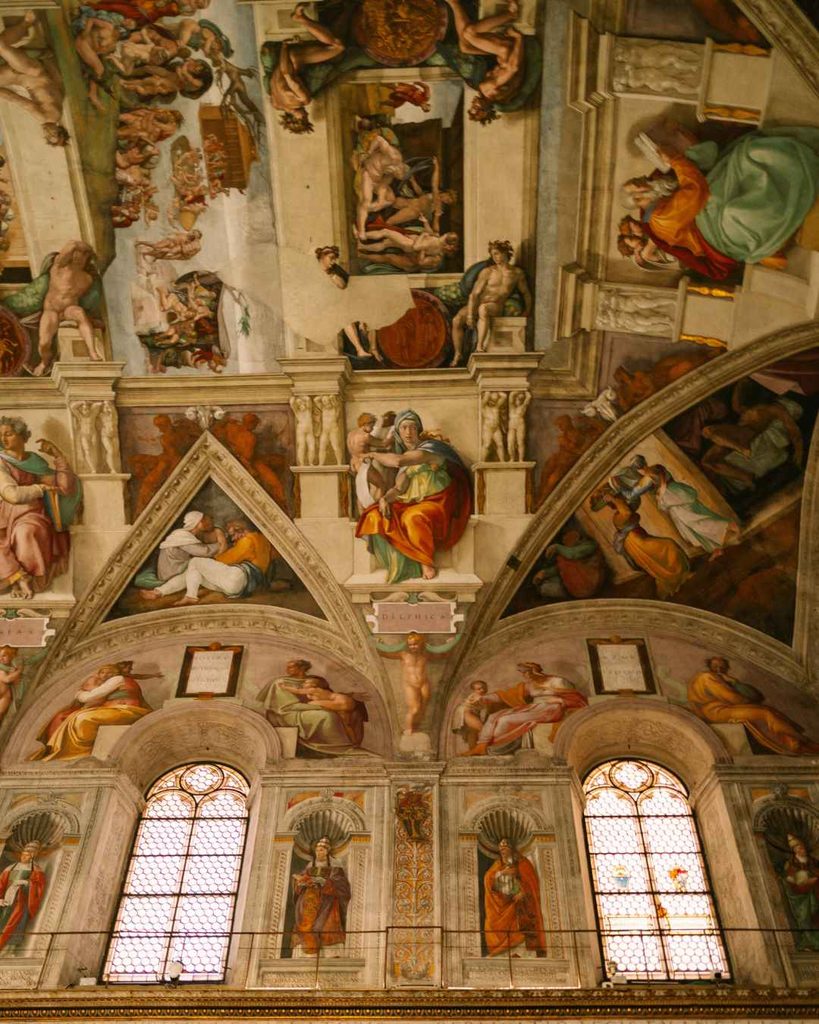
The Sistine Chapel is the private chapel of the Pope, located inside the Apostolic Palace in Vatican City. It was built between 1473 and 1481 for Pope Sixtus IV, whose name it bears. The architect was Giovannino de’ Dolci, and the design was based on the dimensions of the Temple of Solomon as described in the Old Testament.
The chapel is a simple rectangular structure with a barrel-vaulted ceiling. It was originally decorated with frescoes by some of the greatest artists of the fifteenth century, including Botticelli, Perugino, and Ghirlandaio. These frescoes line the side walls and depict scenes from the lives of Moses and Christ.
The purpose of the chapel was twofold. It was a place of worship for the pope and his court, and it was also a space for the College of Cardinals to gather and elect a new pope. That tradition continues today, and the conclave that elects each new pope is still held beneath Michelangelo’s ceiling.
In 1505, Pope Julius II, the nephew of Sixtus IV, decided to commission a new ceiling. The original ceiling was painted blue with gold stars, but it had been damaged by water and was in poor condition. Julius wanted something monumental, something that would glorify his papacy and secure his place in history.
Julius offered the commission to Michelangelo Buonarroti, who was already famous for his sculpture of the Pietà and his colossal statue of David. Michelangelo did not want the job.
He considered himself a sculptor, not a painter, and he initially refused. He proposed that Raphael be given the commission instead, but Julius insisted.
Michelangelo signed the contract in 1508. The original plan was modest: the twelve apostles in the lunettes, with ornamental decoration elsewhere. But Michelangelo rejected this plan as “a poor thing.”
He proposed something far more ambitious: a vast scheme that would cover the entire ceiling with scenes from Genesis, surrounded by prophets, sibyls, and ancestors of Christ.
He began work in 1508, and he completed the ceiling in 1512. He worked largely alone, with a small team of assistants who prepared the plaster and mixed the pigments. He painted standing on scaffolding, not lying on his back as the myth suggests. The conditions were difficult, and the project damaged his health.
Michelangelo painted the Last Judgment on the altar wall between 1536 and 1541, nearly thirty years after the ceiling was finished. He was in his sixties, and the painting reflects his deep religious anxieties and his personal struggles.
The Last Judgment is darker and more terrifying than the ceiling, and it was controversial from the moment it was unveiled.
The Sistine Chapel is now one of the most visited monuments in the world. It is a pilgrimage site, a museum, and a place of worship. It contains the greatest painted interior in the history of Western art, and it is the single greatest argument for the Vatican Museums being the greatest art collection in the world.
Related Post: Uffizi vs Vatican Museums
Final Thoughts
The Sistine Chapel is not a single painting. It is a universe. It contains hundreds of figures, dozens of scenes, and countless details that were painted for reasons that we are still trying to understand.
The brain in the Creation of Adam. The self-portrait on the flayed skin. The Ignudi and their oak leaves. The prophets and the sibyls. The ancestors in the lunettes. The medallions that look like bronze. The colors that were hidden for centuries.
These details are not decoration. They are the language of a genius who believed that art could express the deepest truths about God, humanity, and the universe.
Michelangelo spent four years on the ceiling, and he spent the rest of his life thinking about what he had painted. The details are his legacy, and they are waiting to be discovered.
Again, feel free to go through the list below of my Italy recommendations that I have crafted after years of travel to this beautiful country:
- Packing List: Things Not to Go to Italy Without
- Must-Do Things: Unforgettable Experiences
- Where to Stay: Best Hotels in Italy.
- Where to Stay in Rome: Rome’s Best Neighborhoods
- Where to Stay in Florence: Picking the Best Area
- Where to Stay in Venice: Venice’s Best Districts
- Italy’s Cobblestone Streets: Best Shoes For the Job
- Backpack or Suitcase?: Italy Luggage Guide
- Travel Insurance: Always Be Covered
- E-Sim: Be Connected At All Times