

Italy is the country that gave the world the Renaissance, and the Renaissance gave the world some of the most beautiful images ever created. Madonnas with serene faces.
Venus rising from the sea. Saints ascending to heaven in clouds of golden light. These are the paintings that appear on postcards, in guidebooks, and on the walls of every museum from Florence to Venice.
But look closer at some of these masterpieces, and you will find something else. Blood. Betrayal. Madness. Murder. Revenge. The most beautiful paintings in Italy often contain the darkest stories, and the artists who created them were not simply decorating churches and palaces.
They were commenting on the violence of their world, on the fragility of power, and on the terrible things that human beings do to each other.
This article is about 13 of those paintings. They are masterpieces of the Renaissance and the Baroque, and they are among the most beautiful works of art ever made. But each one hides a story of darkness, and each one is more disturbing the longer you look at it.
Before you read further, remember that Italy rewards travelers who come prepared. I’ve found a few things especially useful on an Italy trip, and they’re worth having and/or knowing beforehand. See the checklist here. Also, if you want me to plan an Italy trip for you that you will never forget, drop me a message here
1. Judith Beheading Holofernes – Caravaggio

Caravaggio’s Judith Beheading Holofernes is one of the most violent paintings in the history of Western art, and it is also one of the most compelling. It depicts the biblical story of Judith, a young widow who saves her people by seducing and then decapitating the Assyrian general Holofernes.
The painting captures the exact moment of the killing. Judith holds Holofernes by the hair and drives a sword into his neck.
Blood spurts from the wound in a dark, thick stream. Holofernes’s eyes are wide open, his mouth frozen in a scream. His head is already partially detached from his body, but he is still alive, still feeling, still aware of what is happening to him.
Caravaggio painted the work around 1598 or 1599, when he was in his late twenties. It was commissioned by Ottavio Costa, a Roman banker who was one of Caravaggio’s first patrons.
The painting was forgotten for centuries and was only rediscovered in 1951 by the art historian Roberto Longhi, who recognized it as a masterpiece of the young Caravaggio.
What makes the painting so disturbing is not just the violence. It is the psychology. Judith does not look triumphant. She looks disgusted, almost afraid. Her face is turned away from the deed, as if she cannot bear to watch.
The servant woman beside her is old and grotesque, a contrast to Judith’s beauty. Caravaggio used the contrast between youth and age, beauty and horror, to create one of the most psychologically complex paintings of the Baroque.
The painting is in the Galleria Nazionale d’Arte Antica in Palazzo Barberini in Rome. It is one of the most important works in the collection, and it is one of the few Caravaggios that has survived in its original condition.
2. David with the Head of Goliath – Caravaggio

Caravaggio’s David with the Head of Goliath is one of the most personal and haunting paintings in the history of art. It depicts the biblical hero David holding the severed head of the giant Goliath, but the head is not just any head. It is Caravaggio’s own.
The painting was completed around 1610, the year of Caravaggio’s death. He was on the run, having been condemned to death for killing a man in a brawl in Rome.
He was traveling between Naples, Malta, and Sicily, trying to obtain a pardon from the pope. The painting was probably intended as a gift for Cardinal Scipione Borghese, the pope’s nephew, who had the power to grant the pardon.
David is depicted as a young man, barely more than a boy, holding the giant’s head at arm’s length. His expression is not triumphant. It is sad, almost pitying.
He looks at the head with a mixture of disgust and sorrow. The head of Goliath, which is Caravaggio’s self-portrait, is bleeding from the forehead, and the eyes are half-closed, as if the giant is already dead or dying.
The painting is a confession and a plea. Caravaggio is admitting his guilt, and he is asking for mercy. He is also acknowledging his own mortality, his own sinfulness, and his own need for redemption.
The painting is one of the most powerful self-portraits ever made, and it is a reminder that even the greatest artists are human, flawed, and capable of terrible things.
The painting is in the Galleria Borghese in Rome. It is one of the most important works in the collection, and it is one of the last paintings Caravaggio ever made.
3. The Calumny of Apelles – Sandro Botticelli

Sandro Botticelli’s The Calumny of Apelles is one of the most complex and allegorical paintings of the Renaissance. It depicts a scene described by the ancient Greek painter Apelles, who was accused of treason by a rival and was nearly executed before the truth was discovered.
The painting shows a king seated on a throne, with two women whispering in his ears. These are Calumny and Treachery, and they are poisoning the king’s mind against an innocent man. The innocent man is being dragged before the king by a woman named Calumny, who is pulling him by the hair.
She is accompanied by Envy, Fraud, and Conspiracy, who are arranging her hair and her clothes. Behind them, a woman in black is turning away, and she is Remorse, who is looking back at Truth, the naked woman who is pointing upward to heaven.
The painting is a meditation on justice, truth, and the power of lies. It was painted around 1494 or 1495, when Botticelli was in his late forties, and it reflects the political turmoil of Florence at the time.
The Medici had been expelled from the city, and Botticelli’s patron, Lorenzo the Magnificent, had died. The painting is a warning about the dangers of false accusations and the corruption of power.
The painting is in the Uffizi Gallery in Florence. It is one of Botticelli’s most important late works, and it is one of the most complex allegories of the Renaissance.
4. Tarquin and Lucretia – Titian
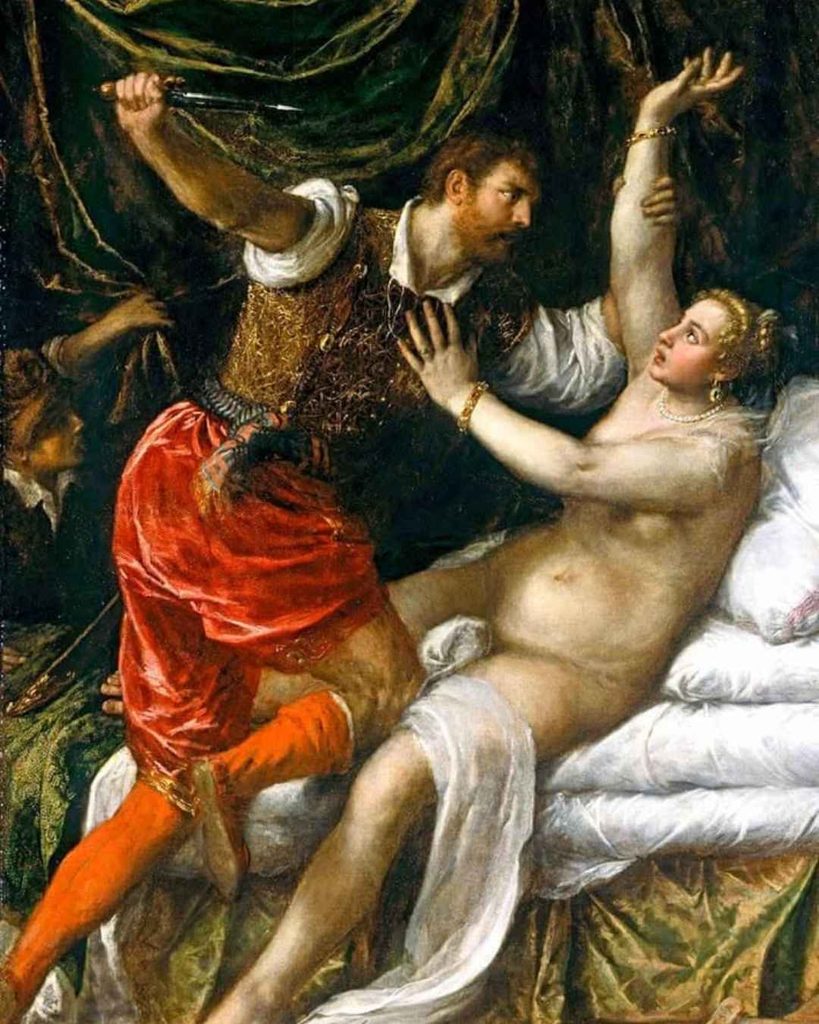
Titian’s Tarquin and Lucretia is one of the most disturbing paintings of the Renaissance.
It depicts the moment when Sextus Tarquinius, the son of the last king of Rome, rapes Lucretia, a Roman noblewoman whose violation and subsequent suicide would lead to the overthrow of the monarchy and the founding of the Roman Republic.
The painting was completed in 1571, when Titian was in his eighties. It is one of his last works, and it is one of the most violent and psychologically complex paintings of his career.
Tarquin is shown holding a dagger to Lucretia’s chest, his body pressed against hers. Lucretia is struggling, her face turned away in terror, her hand pushing against his chest.
What makes the painting so powerful is the way Titian captures the moment of violation. Lucretia is not a passive victim. She is fighting, resisting, refusing to submit. But she is also aware that she has no choice.
The dagger is at her throat. If she resists, she will die. The painting captures the impossible choice that Lucretia faces, and it does so with a sensitivity that is remarkable for its time.
The painting is in the Fitzwilliam Museum in Cambridge. It is one of the most important works in the collection, and it is one of the most powerful depictions of sexual violence in the history of art.
5. Judith Slaying Holofernes – Artemisia Gentileschi
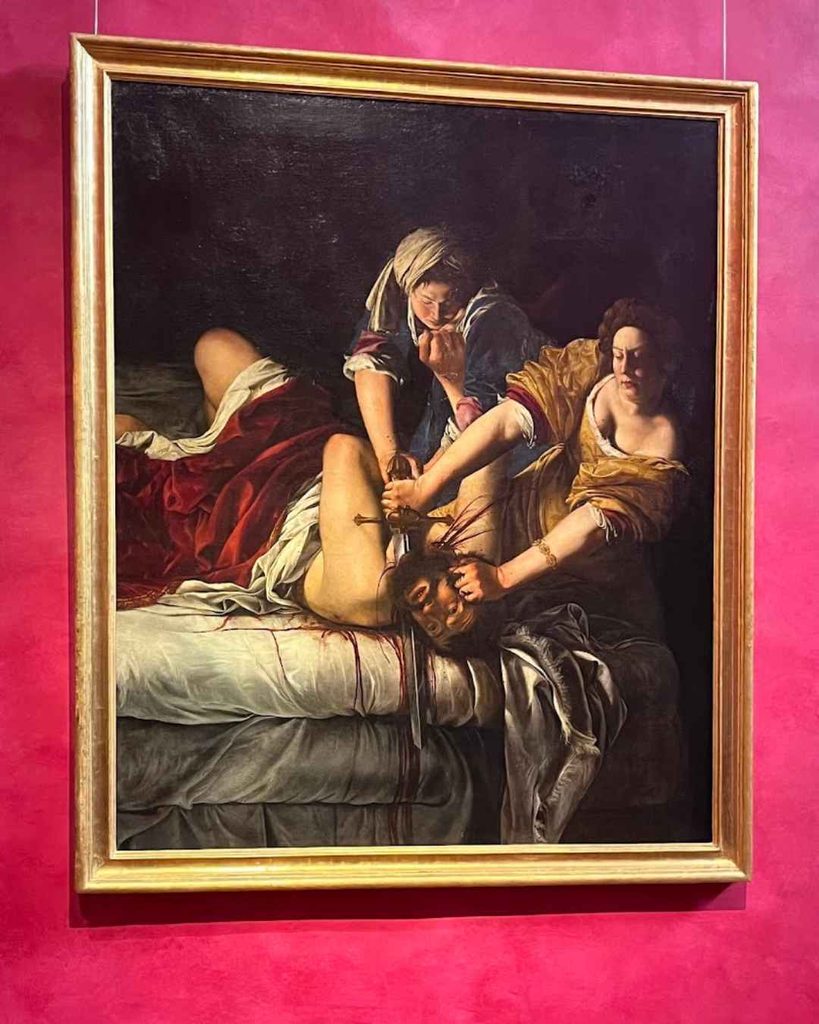
Artemisia Gentileschi’s Judith Slaying Holofernes is even more violent than Caravaggio’s, and it is one of the most famous feminist works in art history. She depicts the moment of the killing with a ferocity that has made the painting unforgettable.
In Artemisia’s version, Judith and her servant are both involved in the killing. They work together, one holding Holofernes down while the other drives the sword into his neck.
Blood spurts everywhere, staining the sheets and soaking into Judith’s dress. The general is awake and struggling, his eyes wide with terror.
Artemisia was raped by her tutor, Agostino Tassi, when she was seventeen. The trial that followed was brutal, and Artemisia was tortured to verify her testimony. She was humiliated and ridiculed, and the experience shaped her art. Her Judith is not a passive heroine.
She is a woman taking revenge on a powerful man, and the painting is a statement about female rage and female power.
The painting was completed around 1620, when Artemisia was in her late twenties. The naturalistic “virility” of the work provoked strong reactions, and the painting was denied the honor of being exhibited in the Gallery.
It was only with the help of her friend Galileo Galilei that Artemisia managed to extract the payment that had been agreed with Grand Duke Cosimo II de’ Medici.
The painting is in the Uffizi Gallery in Florence. It is one of the most important works in the collection, and it is one of the most powerful paintings of the Baroque.
6. The Flagellation of Christ – Piero della Francesca
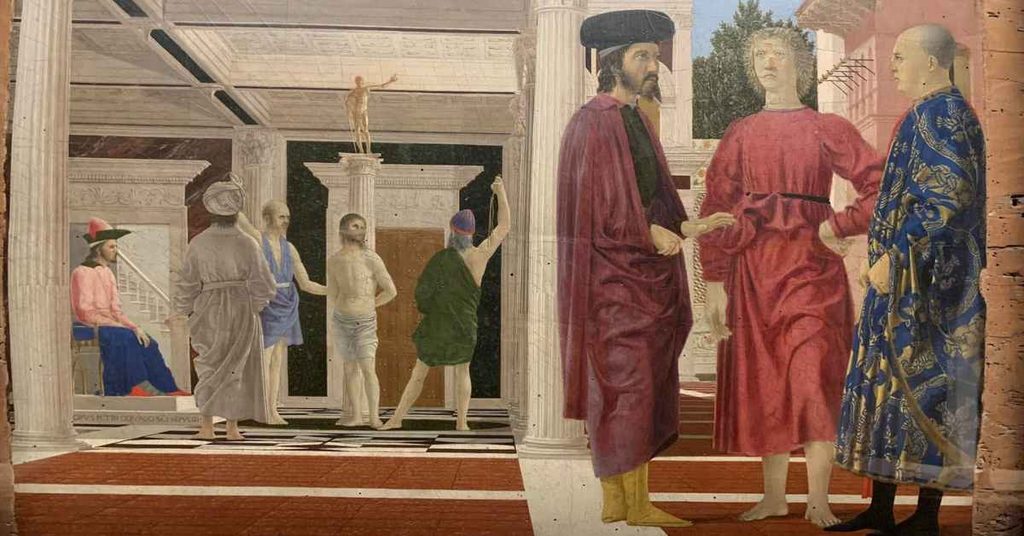
Piero della Francesca’s The Flagellation of Christ is one of the most enigmatic paintings of the Renaissance. It depicts the flagellation of Christ, but the scene is set in the background, while three men stand in the foreground, engaged in conversation.
The painting was completed around 1460, and it is one of Piero’s most famous works. The three men in the foreground have been identified as various historical figures, including the Byzantine patriarch, the Duke of Urbino, and a cardinal.
The painting is a meditation on the passion of Christ and the political intrigues of the time.
What makes the painting so dark is the contrast between the violence in the background and the calm in the foreground. Christ is being whipped, but the three men in the foreground seem oblivious to his suffering.
They are engaged in their own conversation, their own concerns. The painting is a reminder that suffering often goes unnoticed, and that people are often indifferent to the pain of others.
The painting is in the Galleria Nazionale delle Marche in Urbino. It is one of the most important works in the collection, and it is one of the most mysterious paintings of the Renaissance.
7. Lamentation over the Dead Christ – Andrea Mantegna
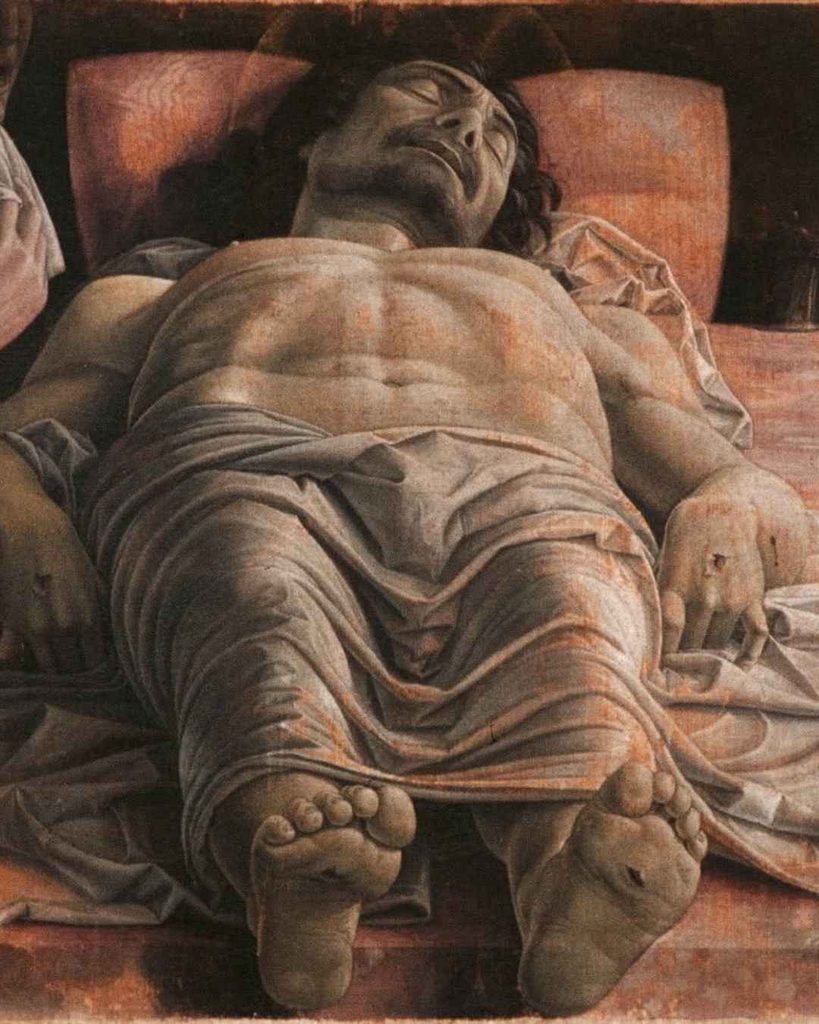
Andrea Mantegna’s Lamentation over the Dead Christ is one of the most shocking paintings of the Renaissance. It depicts the body of Christ after the crucifixion, laid out on a slab, with his mother and other mourners weeping over him.
The painting is famous for its extreme foreshortening. Christ’s body is shown from the feet up, and the perspective is so dramatic that his feet appear enormous while his head appears small.
The effect is unsettling, and it makes the viewer feel as if they are standing at the foot of the slab, looking down at the dead body.
The painting was completed around 1480, and it is one of Mantegna’s most personal works. The wounds on Christ’s hands and feet are clearly visible, and the marks of the nails are painted with a realism that is almost painful to look at.
The painting is a meditation on death, on grief, and on the physical reality of the crucifixion.
The painting is in the Pinacoteca di Brera in Milan. It is one of the most important works in the collection, and it is one of the most powerful depictions of the dead Christ in the history of art.
8. Atalanta and Hippomenes – Guido Reni

Guido Reni’s Atalanta and Hippomenes is one of the most beautiful paintings of the Baroque, and it is also one of the most tragic. It depicts the race between Atalanta, the swift-footed huntress, and Hippomenes, the young man who wants to marry her.
The story comes from Ovid’s Metamorphoses. Atalanta had sworn to remain a virgin, and she agreed to marry only the man who could beat her in a race.
Hippomenes knew he could not win without help, so he prayed to Venus, who gave him three golden apples. During the race, he dropped the apples one by one, and Atalanta stopped to pick them up, allowing him to win.
But the story does not end happily. Hippomenes forgot to thank Venus for her help, and the goddess punished him by making him and Atalanta consummate their love in a temple sacred to Cybele. The goddess Cybele turned them into lions, and they were forced to pull her chariot for eternity.
The painting is in the Museo del Prado in Madrid. It is one of Reni’s most famous works, and it is one of the most beautiful depictions of the race in the history of art.
9. The Story of Nastagio degli Onesti – Sandro Botticelli

Sandro Botticelli’s The Story of Nastagio degli Onesti is one of the most disturbing paintings of the Renaissance.
It depicts a scene from Boccaccio’s Decameron, in which a young man named Nastagio witnesses a knight chasing a naked woman through a forest, killing her, and feeding her heart to his dogs.
The story is a tale of unrequited love and divine punishment. The knight was a man who loved a woman who rejected him, and he killed himself in despair.
The woman was condemned to be chased and killed by the knight every day for eternity, as punishment for her cruelty. Nastagio witnesses this scene and uses it to convince his own beloved to marry him, threatening her with the same fate.
The painting is one of four panels that Botticelli painted for a wedding chest, and it was completed around 1483. It is a disturbing image, and it reflects the dark side of Renaissance attitudes toward love, marriage, and gender. The painting is in the Museo del Prado in Madrid.
10. Medusa – Caravaggio
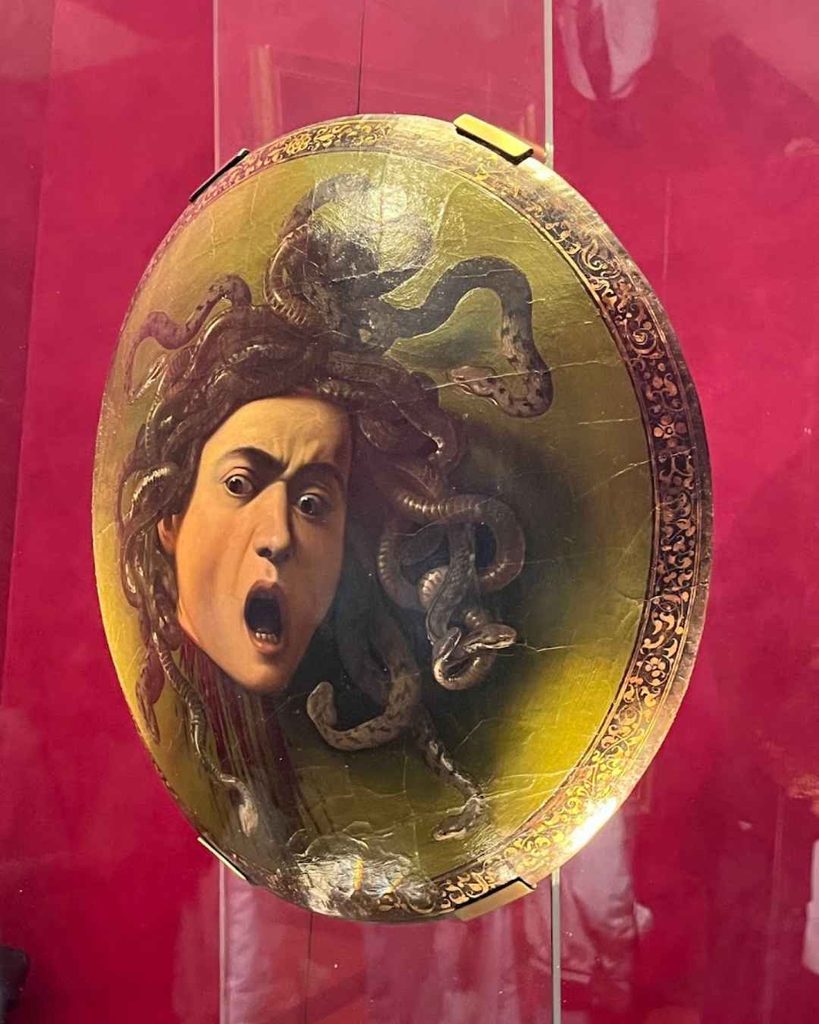
Caravaggio’s Medusa is one of the most striking paintings in the Uffizi Gallery, and it is also one of the most unusual. It depicts the head of Medusa, the mythological figure whose gaze could turn people to stone, painted on a shield.
The painting was commissioned by Cardinal Francesco Maria del Monte, Caravaggio’s patron, as a gift for the Grand Duke of Tuscany, Ferdinando I de’ Medici.
It was painted around 1597, when Caravaggio was in his mid-twenties, and it shows the moment of Medusa’s death. Her eyes are wide open, her mouth is open in a scream, and blood spurts from her severed neck.
What makes the painting so powerful is that Caravaggio painted Medusa’s face on a shield, which means the viewer is forced to confront her gaze directly.
In the myth, looking at Medusa turns you to stone. Caravaggio painted her so that you cannot look away. The painting is a meditation on death, on violence, and on the power of art to capture the moment of dying.
11. Pietà – Giovanni Bellini

Giovanni Bellini’s Pietà is one of the most beautiful and heartbreaking paintings of the Renaissance. It depicts the dead Christ supported by his mother and St. John the Evangelist, with Mary Magdalene weeping at his feet.
The painting was completed around 1470, and it is one of Bellini’s earliest masterpieces. The figures are arranged in a pyramidal composition, with Christ at the center, his body limp and pale. The Virgin Mary holds him, her face contorted with grief. St. John supports her, his own face turned away in sorrow.
What makes the painting so powerful is its intimacy. The figures are close together, their bodies touching, their grief shared. The painting is a meditation on loss, on love, and on the pain of watching someone you love die. It is one of the most moving depictions of the Pietà in the history of art.
The painting is in the Pinacoteca di Brera in Milan. It is one of the most important works in the collection, and it is one of the most beautiful paintings of the Renaissance.
12. The Sacrifice of Isaac – Caravaggio

Caravaggio’s The Sacrifice of Isaac is one of the most dramatic paintings of the Baroque. It depicts the moment when Abraham is about to sacrifice his son Isaac, as God has commanded, and an angel intervenes to stop him.
The painting was completed around 1603, and it is one of Caravaggio’s most important religious works. The composition is simple but powerful. Abraham holds the knife in his right hand, ready to strike.
Isaac is kneeling on the altar, his head turned away, his eyes wide with terror. An angel appears from the right, grabbing Abraham’s wrist and pointing to a ram caught in the bushes.
What makes the painting so disturbing is the realism of the scene. Abraham is not a distant biblical figure. He is a man, and his face is filled with anguish and confusion. Isaac is not a willing sacrifice. He is a terrified child, and his fear is palpable.
The painting is a meditation on faith, on obedience, and on the terrible things that people do in the name of God.
The painting is in the Uffizi Gallery in Florence. It is one of the most important works in the collection, and it is one of the most powerful paintings of the Baroque.
13. The Last Judgment – Michelangelo

Michelangelo’s The Last Judgment is one of the most powerful and terrifying paintings in the world. It covers the entire altar wall of the Sistine Chapel, and it depicts the moment of the Last Judgment, when Christ returns to judge the living and the dead.
The painting was commissioned by Pope Clement VII and completed by Pope Paul III in 1541. It took Michelangelo six years to paint, and it was controversial from the moment it was unveiled.
The nude figures were considered inappropriate for a chapel, and a campaign was launched to cover them with fig leaves. The painter Daniele da Volterra was hired to paint loincloths over the most offensive figures, earning him the nickname “Il Braghettone,” the breeches-maker.
The painting is a vision of hell as much as heaven. The damned are dragged down by demons, their faces twisted in terror. Charon, the ferryman of the underworld, beats them with an oar as they fall into the abyss.
Michelangelo painted himself into the scene, on the flayed skin of St. Bartholomew, a gesture that some scholars interpret as a confession of his own sinfulness.
The Last Judgment is a reminder that the Renaissance was not just about beauty and harmony. It was also about fear, guilt, and the terror of damnation. Michelangelo’s vision of the end of the world is one of the most haunting images ever created, and it still has the power to disturb.
If you are going to Italy and want to see most of these paintings, the Uffizi Gallery is a must-visit, and a guided tour comes in handy so that you know what you are looking at. This is the one I recommend.
Final Thoughts
The most beautiful paintings in Italy often tell the darkest stories. They are not simply decorations. They are windows into the fears, desires, and anxieties of the people who created them and the people who commissioned them.
Judith Beheading Holofernes is about revenge and violence. David with the Head of Goliath is about guilt and redemption. The Calumny of Apelles is about lies and injustice. Tarquin and Lucretia is about violation and resistance. Judith Slaying Holofernes is about female rage and power.
The Flagellation of Christ is about indifference and suffering. Lamentation over the Dead Christ is about grief and death. Atalanta and Hippomenes is about love and punishment.
The Story of Nastagio degli Onesti is about cruelty and obsession. Medusa is about death and terror. Pietà is about loss and love. The Sacrifice of Isaac is about faith and fear.
These paintings are beautiful, but they are not innocent. They are complex, disturbing, and deeply human. And that is what makes them unforgettable.
Again, feel free to go through the list below of my Italy recommendations that I have crafted after years of travel to this beautiful country:
- Packing List: Things Not to Go to Italy Without
- Must-Do Things: Unforgettable Experiences
- Where to Stay: Best Hotels in Italy.
- Where to Stay in Rome: Rome’s Best Neighborhoods
- Where to Stay in Florence: Picking the Best Area
- Where to Stay in Venice: Venice’s Best Districts
- Italy’s Cobblestone Streets: Best Shoes For the Job
- Backpack or Suitcase?: Italy Luggage Guide
- Travel Insurance: Always Be Covered
- E-Sim: Be Connected At All Times