
There are sculptures that impress you with their size, others that capture your attention through their beauty, and then there are those that make you stop and wonder how a human being could possibly have created something so extraordinary from a block of stone.
Bernini’s Apollo and Daphne belongs firmly in the last category.
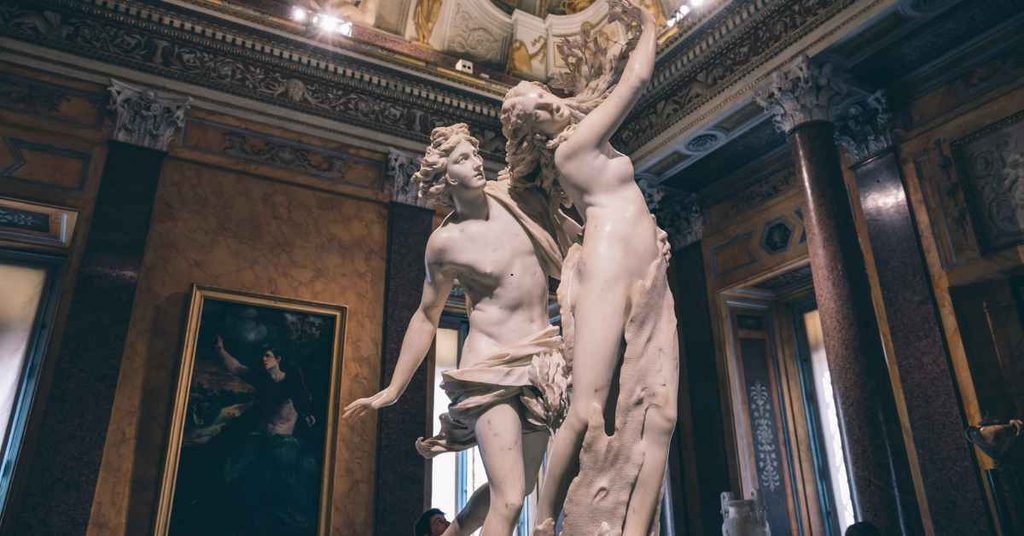
At first glance, it looks almost impossible. A young woman is running away from a man who has nearly caught her. Her arms stretch above her head, her hair flows backwards, and her face turns in desperation. But something remarkable is happening. Her fingers are becoming leaves, her arms are turning into branches, and roots are beginning to grow from her feet.
Beside her, Apollo reaches out, seemingly unaware that the woman he has spent so much time pursuing is disappearing beneath his hands.
The entire scene is carved from marble, yet it appears to capture a moment of movement, emotion, and transformation. You can almost feel the urgency of the chase.
Created by Gian Lorenzo Bernini between 1622 and 1625, Apollo and Daphne is one of the greatest masterpieces of Baroque sculpture. It stands in the Borghese Gallery in Rome, where visitors can examine its extraordinary details from different angles.
But understanding the sculpture requires knowing the tragic story behind it. Every leaf, branch, expression, and gesture has a purpose.
Here is the mythological story, followed by ten extraordinary details that make this one of the most remarkable sculptures you will ever encounter.
Before you read further, remember that Italy rewards travelers who go prepared. I have prepared a checklist of things you must have when visiting Italy if you want to have an unforgettable trip. See the checklist here.
1. The Mythological Story of Apollo and Daphne
The story of Apollo and Daphne comes from Metamorphoses, an epic poem written by the Roman poet Ovid in the early first century AD.
The poem is filled with stories of gods, mortals, and mythical creatures whose lives are changed through extraordinary transformations. People become trees, animals, rivers, and stars. Love, jealousy, revenge, and divine punishment appear throughout its many tales.
The story of Apollo and Daphne is one of its most famous episodes.
It begins with a dispute between two gods.
Apollo, the god associated with music, prophecy, healing, and archery, had recently killed the enormous serpent Python. Proud of his achievement, he encountered Cupid, the god of love, carrying his bow and arrows.
Apollo mocked the young god, suggesting that weapons of war and hunting were more appropriate for him than Cupid’s little bow. He even questioned whether Cupid had the skill to use it properly.
Cupid was not amused.
Determined to teach Apollo a lesson, he took two arrows. The first was made of gold and had the power to inspire overwhelming romantic desire. The second was made of lead and produced the opposite effect, creating an intense rejection of love.
Cupid shot Apollo with the golden arrow.
He then shot a beautiful nymph named Daphne with the lead arrow.
The result was devastating for both.
Apollo became completely captivated by Daphne. He was overwhelmed by her beauty and immediately wanted her to become his companion. Daphne, however, felt no attraction towards him whatsoever. In fact, the sight of Apollo filled her with an overwhelming desire to escape.
Daphne was the daughter of Peneus, a river god, and was devoted to Diana, the Roman goddess of hunting and the wilderness. She had chosen a life of independence and wished to remain unmarried.
Her father had previously encouraged her to marry and give him grandchildren, but Daphne resisted. She wanted to live freely, much like Diana herself.
Apollo’s sudden appearance threatened everything she valued.
Unable to understand why Daphne rejected him, Apollo began pursuing her. He followed her through the landscape, calling out and attempting to persuade her to stop.
He reminded her that he was not an ordinary man. He was a god, the son of Jupiter, and the master of prophecy and music. He promised that he would treat her well and tried to convince her that running away was unnecessary.
But Daphne was not interested.
She ran as fast as she could, terrified that Apollo would catch her.
Ovid describes the chase with extraordinary energy. Apollo was faster, but Daphne was desperate to escape. He pursued her across the landscape, gradually closing the distance between them.
Eventually, she began to tire.
Realising that she could no longer outrun the god, Daphne called upon her father for help.
She begged Peneus to change her appearance, to destroy the beauty that had attracted Apollo and caused her so much suffering.
Her prayer was answered.
As Apollo finally reached her and placed his hand upon her body, Daphne began to transform.
Her feet became roots, fixing her to the ground. Her skin hardened into bark, her arms stretched into branches, and her fingers became leaves. Her hair transformed into foliage, while her body gradually lost its human form.
Within moments, the beautiful nymph had become a laurel tree.
Apollo had finally caught the woman he desired, but she was no longer there.
He stood before a tree, unable to embrace Daphne or win her affection. His pursuit had ended, but not in the way he had imagined.
Although Daphne had escaped him, Apollo remained attached to her. He declared that the laurel would become his sacred tree and that its leaves would be used to crown victorious poets, heroes, and important figures.
From then on, the laurel became closely associated with Apollo and the idea of achievement.
This is the tragic moment Bernini chose to capture.
Rather than showing Apollo chasing Daphne or standing beside an already completed tree, he depicts the precise instant in which her human body is disappearing and her transformation is taking place.
It is a moment of extraordinary drama, and understanding the story makes every detail of the sculpture more meaningful.
2. Apollo and Daphne by Bernini: A Brief History of the Sculpture
Before examining the details, it is worth understanding how this extraordinary work came into existence.
Apollo and Daphne was created by Gian Lorenzo Bernini, one of the most important artists of the Baroque period.
Born in Naples in 1598, Bernini moved to Rome as a young boy with his father, the sculptor Pietro Bernini. His talent became apparent early, and he quickly attracted the attention of wealthy and influential patrons.
One of his most important supporters was Cardinal Scipione Borghese, a powerful art collector and nephew of Pope Paul V.
Borghese recognised Bernini’s extraordinary ability and commissioned several major sculptures from him. These included Aeneas, Anchises and Ascanius, The Rape of Proserpina, and David.
Apollo and Daphne was another commission for the cardinal’s collection.
Bernini began working on the sculpture in 1622, when he was only 24 years old. He completed it in 1625, although the work was interrupted for a period while he concentrated on other projects, including David.
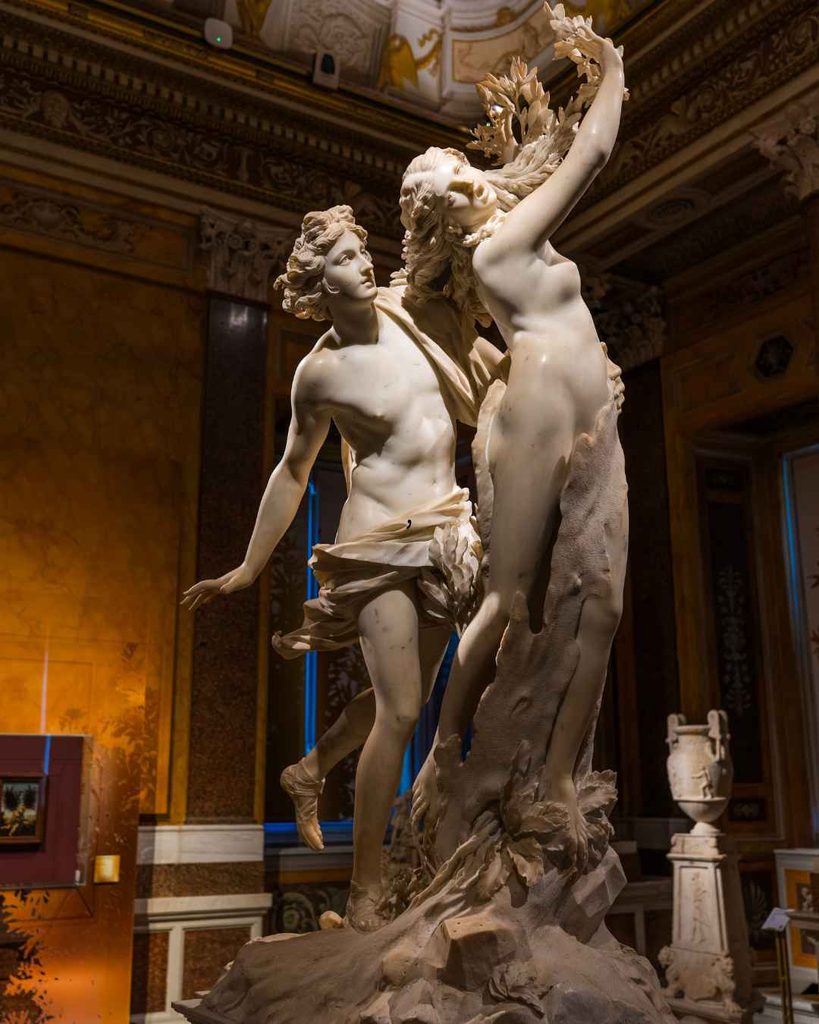
The sculpture is made from Carrara marble and stands approximately 243 centimetres tall. It was carved from a single block of marble, an extraordinary achievement considering the delicate branches, leaves, and other fragile-looking elements that extend from the figures.
Bernini was also assisted by his workshop, including the sculptor Giuliano Finelli, whose contribution to the intricate details of Daphne’s transformation is recognised in the history of the work.
The sculpture was completed in 1625 and installed at the Villa Borghese, where it remains one of the collection’s most celebrated masterpieces.
Today, it is displayed in Room III of the Borghese Gallery in Rome.
What makes the sculpture particularly remarkable is that Bernini did not simply reproduce two mythological characters. He created an entire story in marble, capturing movement and transformation in a medium that is naturally rigid and motionless.
And the best way to appreciate his achievement is to look closely at the details.
3. Ten Extraordinary Details to Look for in Apollo and Daphne
1. Daphne’s Fingers Are Turning Into Delicate Laurel Leaves
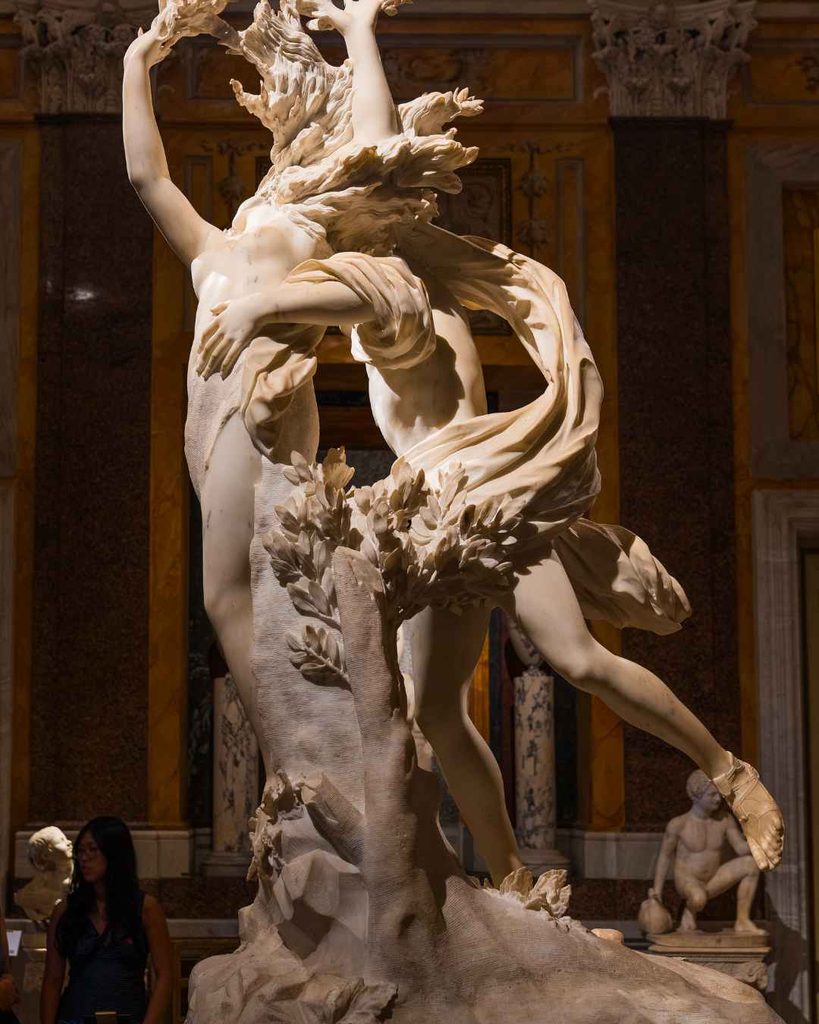
Perhaps the most astonishing detail of the entire sculpture is found at the very tips of Daphne’s fingers.
As she raises her arms above her head, her hands are no longer entirely human. Her fingers are gradually transforming into delicate laurel leaves.
Look closely, and you will notice how Bernini has carved individual leaves extending from her fingertips. They are thin, delicate, and surprisingly naturalistic, almost as though they could move in a gentle breeze.
This is not simply decoration. It represents the exact moment when Daphne’s human body begins to disappear.
Her fingers are among the first parts of her body to become foliage, and Bernini captures this transformation with extraordinary precision.
Think about the difficulty involved.
Marble is a hard and unforgiving material. A sculptor can remove stone, but cannot easily repair a fragile section once it breaks. Creating thin, projecting forms that look as delicate as leaves requires incredible control.
Bernini’s achievement is even more impressive when you consider that these leaves are not separate pieces of decoration attached to the sculpture. They form part of the larger marble composition.
The detail also creates an interesting contrast. Daphne’s hands are still recognisably human, but the leaves growing from them tell us that her transformation is already beyond her control.
When you stand in front of the sculpture, take a moment to examine each hand separately. The change from fingers to foliage is one of the clearest demonstrations of Bernini’s extraordinary ability to make marble appear alive.
2. Her Feet Are Becoming Roots That Grip the Ground
Move your attention down towards Daphne’s feet and you will discover another remarkable part of the transformation.
Her legs are no longer entirely human. They are gradually becoming the trunk and roots of a tree.
One of the most striking features is the way the roots extend from her feet and begin attaching her to the ground.
This detail is particularly important because it shows the physical consequences of Daphne’s transformation. A moment earlier, she was running desperately to escape Apollo. Now, the very limbs that allowed her to flee are becoming the structures that will hold her permanently in place.
There is a powerful irony in this.
Daphne has escaped Apollo, but she has also lost the freedom of movement that defined her existence.
The roots are not simply decorative additions. They tell the viewer that the transformation is almost complete and that Daphne will never run again.
Bernini also uses the roots to create a connection between the sculpture and its surroundings. Rather than having the figures appear to float above the base, the transformation physically connects Daphne to the ground.
Look at the contrast between the delicate human anatomy of her upper body and the emerging roots below. It is almost as though two different materials are being used, even though everything is carved from marble.
This is one of the reasons the sculpture feels so extraordinary. Bernini manages to make a single material appear to represent two completely different forms of life.
3. The Bark Is Spreading Across Daphne’s Body
Perhaps the most unsettling part of Daphne’s transformation is the appearance of tree bark across her body.
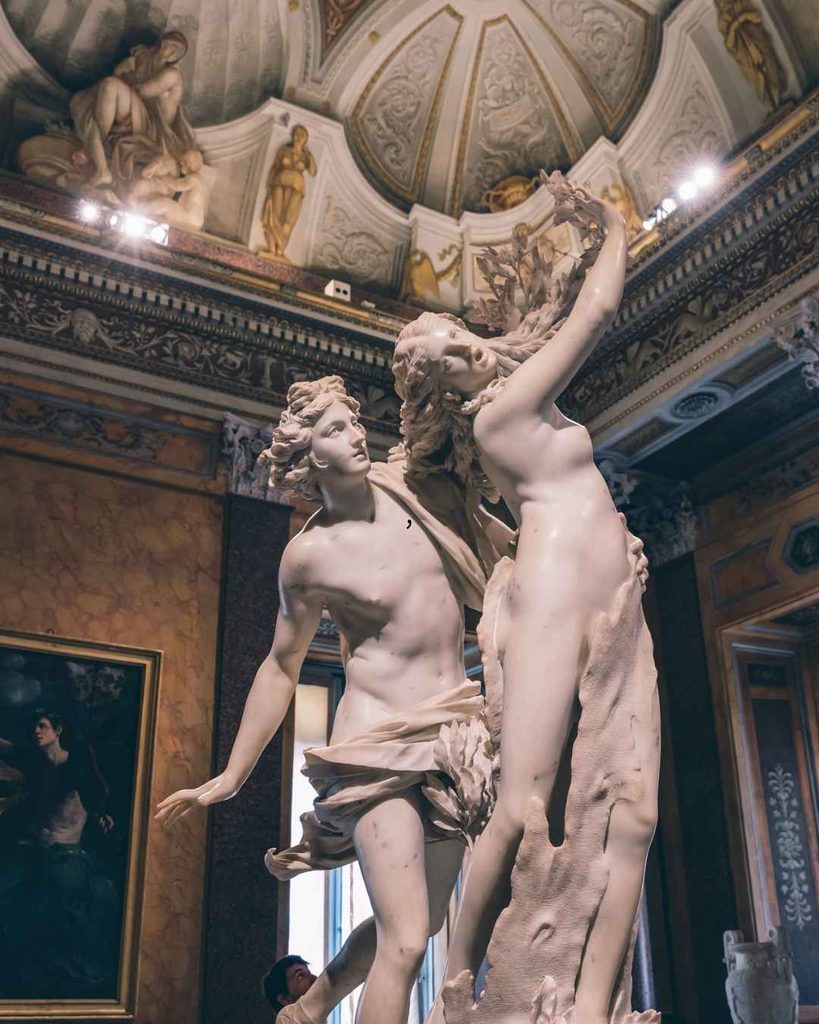
Look at her torso and legs. In certain areas, her skin is beginning to lose its smooth appearance and is being replaced by the rough texture of a tree.
Bernini has carefully carved this changing surface to make it look different from the flesh surrounding it.
The transition is not presented as a simple line separating a woman from a tree. Instead, it appears to be happening gradually, with bark spreading across parts of her body while other areas remain human.
This is an extraordinary artistic decision.
A less ambitious sculptor might have represented Daphne as a woman standing beside a tree or shown her body already covered in bark. Bernini chose a much more difficult moment: the instant in which both forms exist simultaneously.
The viewer can still recognise the human figure, but the tree is beginning to take over.
The texture is particularly impressive because marble does not naturally resemble either soft skin or rough tree bark. Yet Bernini gives each surface a distinctive appearance through his use of carving and finishing techniques.
The contrast also adds to the emotional impact of the scene.
Apollo’s hand is reaching towards the body of the woman he has pursued, but the transformation means that he is no longer touching the same person. The human form he desires is disappearing beneath the bark.
It is one of the most powerful details in the entire composition.
4. Daphne’s Hair Looks Like It Is Blowing in the Wind
Daphne’s hair is another detail that deserves a closer look.
As she turns her head away from Apollo, her hair appears to flow backwards, following the movement of her body.
Some strands remain recognisable as human hair, while others begin to transform into the foliage of the laurel tree.
The result is remarkably convincing.
Bernini could have carved Daphne’s hair in a simple arrangement, but that would have weakened the sense of movement. Instead, he gives it an almost weightless quality, allowing the strands to extend and flow around her head.
The hair helps communicate the speed and direction of the chase. It suggests that Daphne has been running at full speed and has only just been caught.
It also reinforces the idea that her transformation is happening everywhere at once.
Her feet are becoming roots, her torso is developing bark, her fingers are turning into leaves, and her hair is becoming foliage.
One of the most fascinating things about this detail is how Bernini creates the appearance of something soft and delicate using hard marble.
Hair is naturally flexible. It moves, bends, and responds to the slightest breeze. Marble does none of these things.
Yet Bernini manages to give the stone a sense of lightness and movement that makes Daphne appear almost weightless.
The flowing hair also helps balance the composition, extending the movement of her body upwards and backwards while the branches stretch in the opposite direction.
It is a small detail with an enormous impact on the overall appearance of the sculpture.
5. Daphne’s Face Captures the Terror of the Moment
Look at Daphne’s face.
It is one of the most emotionally important parts of the sculpture.
Her head is turned backwards as she looks towards Apollo, and her expression communicates fear and desperation. She appears to be aware that he has finally caught up with her, even as her body begins to change.
There is no expression of romantic happiness or relief. Instead, her face captures the distress of someone desperately trying to escape an unwanted pursuit.
This is an important part of understanding the sculpture.
The story is sometimes described as a tragic love story, but Daphne does not share Apollo’s feelings. She has repeatedly rejected him and is running because she does not want to be caught.
Her transformation is an act of escape.
Bernini gives the viewer a glimpse of her emotional state at the precise moment her human existence is disappearing. Her face remains recognisably human even as the rest of her body is becoming something else.
It creates a disturbing contrast.
The branches and leaves growing around her suggest the transformation of nature, but her expression reminds us that a person is being lost in the process.
The detail also demonstrates Bernini’s understanding of facial expression. He does not need to exaggerate Daphne’s features to communicate fear. The position of her head, the direction of her gaze, and the tension in her face are enough.
It is a reminder that great sculpture is not only about technical skill. It is also about understanding human emotion and finding a way to communicate it through a material that cannot move.
6. Apollo’s Expression Changes From Triumph to Astonishment
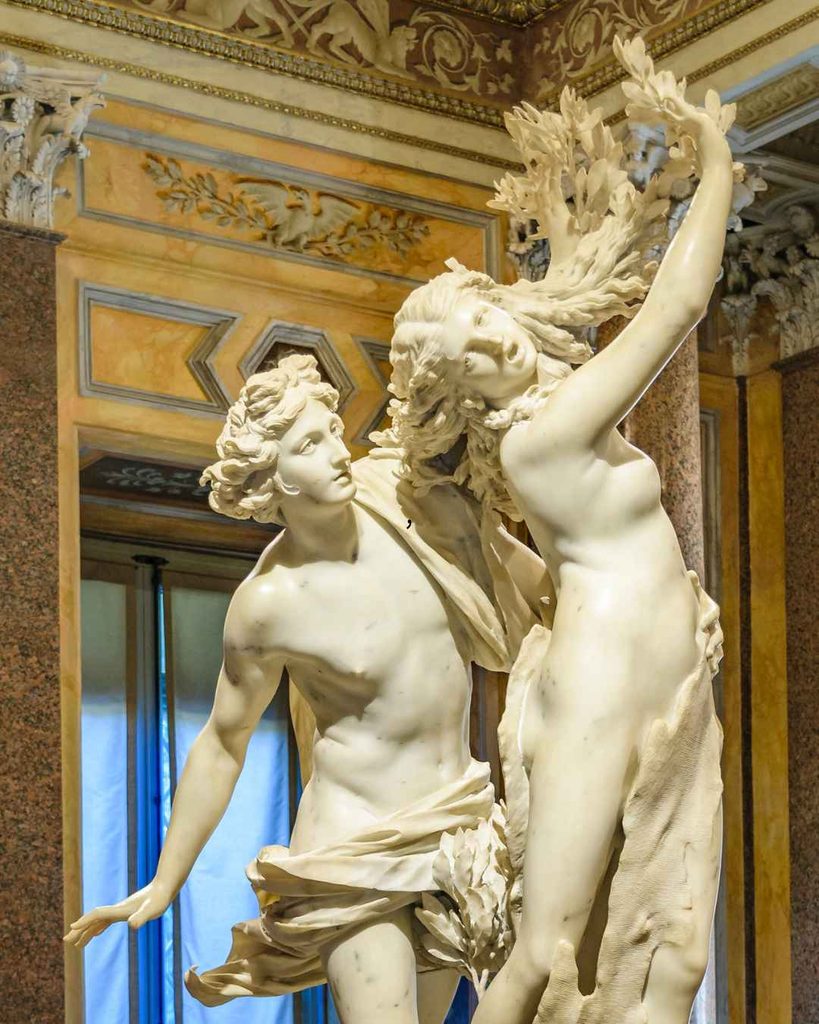
Although Daphne is the central figure of the transformation, Apollo’s expression is equally important.
Look closely at his face.
He appears to have been running with confidence, convinced that he is about to catch the woman he desires. His body is still moving forward, and his hand has finally reached Daphne.
But something unexpected is happening.
Instead of finding the woman he has pursued, Apollo discovers that she is transforming into a tree.
His expression captures the instant of realisation.
There is astonishment in his face, as though he cannot quite understand what is happening beneath his hand. The confident pursuit has suddenly become an encounter with something beyond his control.
This is one of Bernini’s greatest achievements.
He does not represent Apollo simply as a handsome mythological god. He gives him an emotional response that makes the scene feel like a real event unfolding before the viewer.
Apollo’s face also contrasts beautifully with Daphne’s.
She is looking backwards in fear, while he appears surprised by the transformation. Both characters are reacting to the same event, but from entirely different emotional positions.
One is desperately escaping. The other is discovering that the object of his desire is disappearing.
The contrast between their expressions makes the sculpture far more powerful than a simple representation of two mythological figures.
7. Apollo’s Hand Is Touching Daphne at the Exact Moment of Transformation
One of the most important details is the point where Apollo’s hand touches Daphne’s body.
This is the moment that connects the entire story.
Apollo has finally caught up with her. His hand reaches her waist, and the transformation is already underway.
The contact is especially significant because it creates the impression that Apollo has arrived just a fraction of a second too late.
He has spent the entire chase trying to reach Daphne, only to discover that she is no longer entirely human.
The viewer can see the bark beginning to replace her skin, suggesting that Apollo’s touch is meeting a body that is changing before his eyes.
Ovid’s account describes the transformation beginning as Apollo reaches her. Bernini turns that literary moment into a visual experience.
Notice how the figures are arranged around this point of contact. Apollo’s hand brings the two bodies together, but the transformation also separates them. The closer he gets physically, the further Daphne becomes from the person he wants to possess.
There is something almost cruel about the timing.
Apollo has achieved the physical goal of his pursuit, but he has failed to achieve what he wanted.
This small area of contact therefore carries much of the sculpture’s emotional meaning. It is where desire, desperation, and transformation meet.
8. Apollo’s Body Appears to Be Running at Full Speed
Take a step back and look at Apollo’s entire body.
His posture is one of the clearest demonstrations of Bernini’s ability to create movement in marble.
His right foot touches the ground while his left leg is raised. His body leans forward, suggesting that he is still running, and his arms extend towards Daphne.
Even his clothing contributes to the sense of motion.
The drapery around his waist and shoulder appears to be caught in the movement of his body, flowing behind him rather than hanging naturally.
It is difficult to believe that something so dynamic has been carved from stone.
The sculpture seems to capture Apollo in the middle of a stride, with his body suspended between one step and the next.
This is important because Bernini does not simply show the moment Apollo catches Daphne. He allows the viewer to understand what has happened immediately before that moment.
You can almost reconstruct the chase from the figures’ positions.
Apollo has been running. Daphne has been fleeing. He is finally close enough to touch her. And at that precise instant, she begins turning into a tree.
The composition makes the viewer feel as though they have arrived just as the action reaches its dramatic conclusion.
Bernini’s ability to create this sense of movement was one of the defining characteristics of his Baroque style.
Unlike many earlier sculptures that presented figures in balanced, self-contained poses, Bernini often used twisting bodies, dramatic gestures, and energetic compositions to create the impression of action unfolding in front of the viewer.
Here, the effect is extraordinary.
9. The Contrast Between Human Flesh and Tree Foliage Is Almost Impossible to Believe
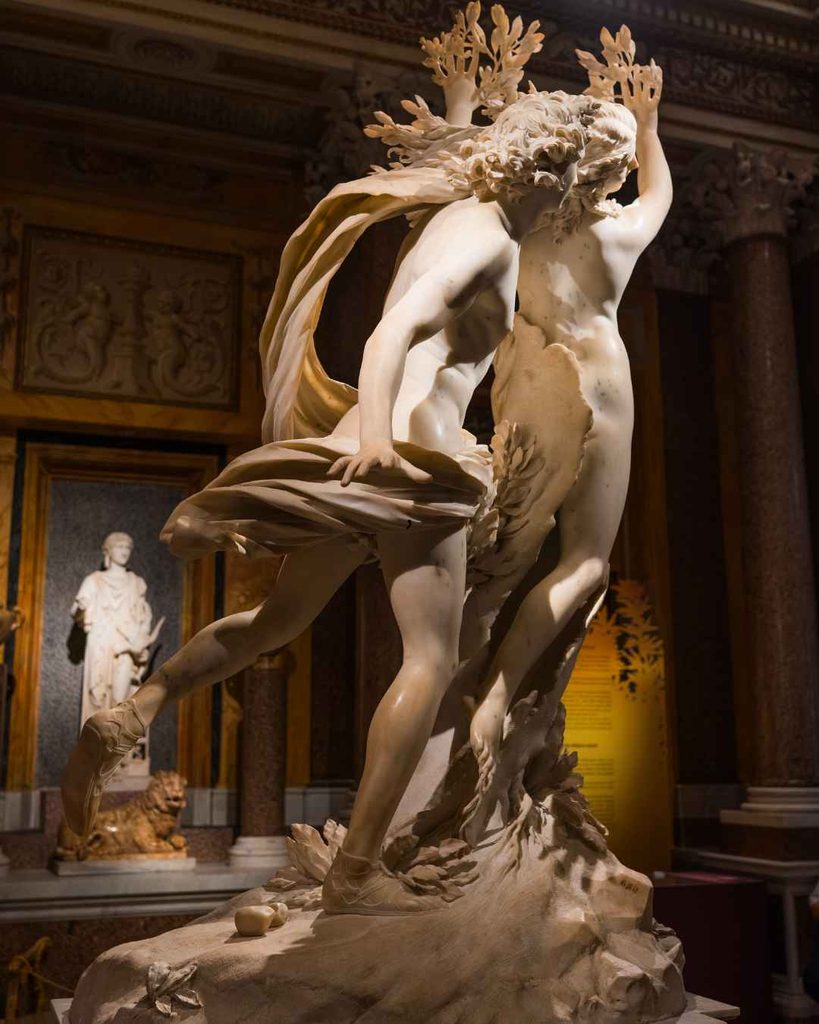
One of the greatest achievements of Apollo and Daphne is the way Bernini makes a single material look like several completely different substances.
The sculpture is made from Carrara marble, but look closely and you will see what appears to be soft human skin, rough tree bark, delicate leaves, flowing hair, and lightweight fabric.
Each surface has its own visual character.
Daphne’s body is smooth and almost delicate. The bark spreading across her torso has a rougher, more irregular appearance. The leaves are thin and finely shaped, while the branches extend from her arms with a natural sense of structure.
Apollo’s body provides another contrast.
His skin is smooth, his muscles are carefully defined, and the drapery around him appears soft and flexible.
Yet everything comes from the same block of stone.
This is what makes the sculpture such an extraordinary technical achievement. Bernini understood how different surfaces respond to light, and he used variations in carving and finishing to make the marble appear to change material.
The result is particularly impressive when you move around the sculpture.
Light catches the smooth surfaces differently from the rougher textures. The delicate leaves create small shadows, while the deeper carving around the branches gives them a sense of depth.
The sculpture seems to contain several different materials, even though it is made from one.
It is also worth remembering that the most delicate details required extraordinary care. Bernini and his workshop had to remove stone gradually, knowing that a mistake could damage parts of the sculpture that would be extremely difficult to repair.
This is not simply a beautiful representation of a myth. It is a demonstration of what an exceptionally skilled sculptor could achieve with marble.
10. The Entire Sculpture Tells a Story From a Carefully Chosen Angle
Perhaps the most overlooked detail is not a particular leaf, facial expression, or part of the anatomy. It is the way the entire sculpture was designed to be viewed.
Bernini did not simply place two figures together and leave the viewer to interpret them from any direction.
He carefully considered the position of the sculpture within the room at the Villa Borghese.
Originally, it stood against a wall near the chapel and staircase. Visitors approaching it would encounter the figures from a particular direction, following Apollo’s movement and gradually discovering the transformation taking place in Daphne.
The arrangement was intended to create a theatrical experience.
As the viewer moved into the room, the story unfolded. Apollo’s pursuit became apparent, Daphne’s transformation came into view, and the emotional conclusion became clear.
This is a very different way of thinking about sculpture.
A traditional statue might be designed primarily to be admired from the front. Bernini created something closer to a frozen performance, in which the viewer’s position helps determine how the story is revealed.
The sculpture’s current arrangement reflects later changes to the gallery, but understanding its original placement helps explain why the composition feels so carefully choreographed.
The figures are not simply arranged to look attractive. Their positions, gestures, and expressions all contribute to the story.
It is worth walking around the sculpture when visiting the Borghese Gallery, observing how Apollo’s body, Daphne’s face, and the branches appear from different perspectives.
You will notice details that are difficult to appreciate from a single viewpoint.
And that is part of the genius of Bernini: he understood that a sculpture could be more than an object. It could be an experience.
4. What Does Apollo and Daphne Symbolise?
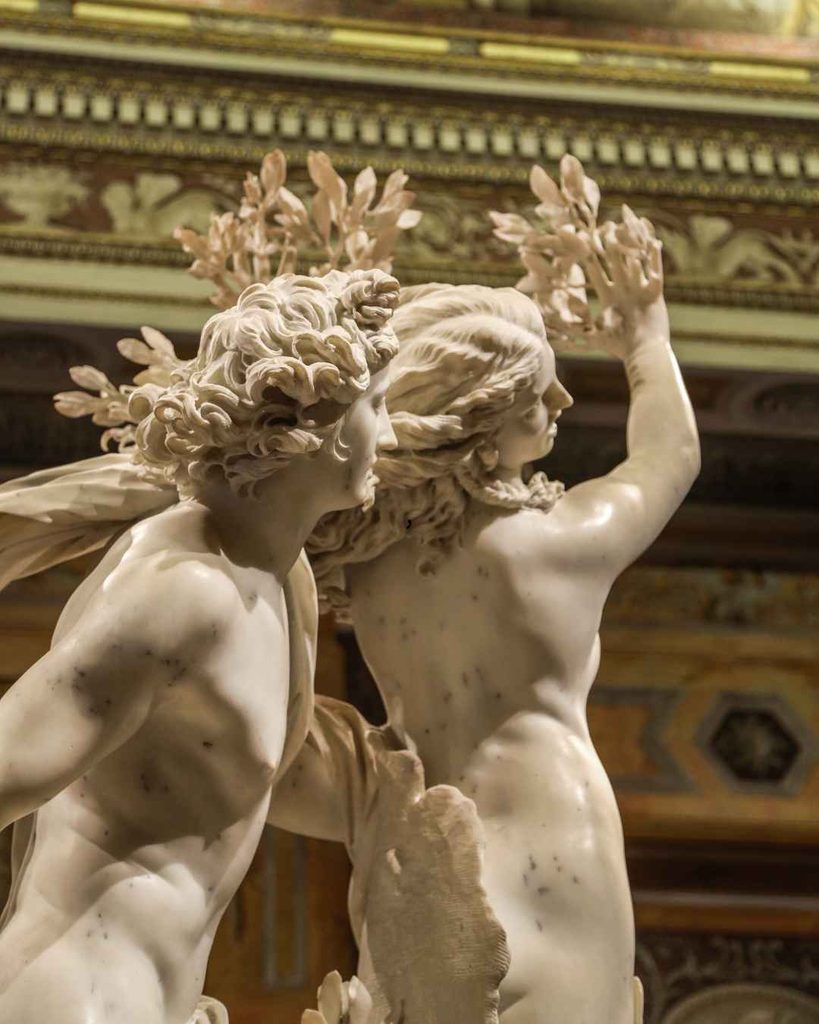
The story of Apollo and Daphne is about much more than an unsuccessful pursuit.
It explores desire, rejection, freedom, transformation, and the consequences of pursuing something that cannot be possessed.
At its simplest level, Daphne’s transformation is an escape. She does not want Apollo’s affection, and when she can no longer outrun him, she asks her father to change her form.
The laurel tree therefore becomes a symbol of protection and the preservation of her independence.
There is also a second layer of meaning connected to Apollo.
After Daphne becomes a tree, Apollo declares that the laurel will become sacred to him. He promises to wear its leaves as a crown and associates them with honour and achievement.
This explains the laurel wreath’s importance in classical culture.
Laurel crowns became associated with victory, distinction, and recognition. They were traditionally used to honour victors and became symbols of achievement in fields such as poetry and artistic excellence.
The association with Apollo also made the laurel particularly important to poets and musicians.
However, there is a darker interpretation of the story.
Apollo’s pursuit is not a mutual romance. Daphne repeatedly rejects him, and her transformation is the only way she can escape. The sculpture therefore invites us to consider the difference between desire and consent.
This is worth remembering when looking at the work today. Its beauty should not make us overlook the distress at the centre of the story.
The contrast between Apollo’s desire and Daphne’s fear gives the sculpture much of its emotional power.
5. The Famous Inscription at the Base of the Sculpture
There is another interesting element that helps explain how Bernini’s patrons understood the sculpture.
At the base is a Latin inscription traditionally attributed to Cardinal Maffeo Barberini, who later became Pope Urban VIII.
The inscription reads:
Quisquis amans sequitur fugitivae gaudia formae, fronde manus implet baccas seu carpit amaras.
It is commonly translated along the lines of:
Whoever pursues the fleeting joys of beauty fills his hands with leaves or gathers bitter berries.
The message provides a moral interpretation of the myth.
Apollo spends the entire story pursuing Daphne because of her beauty. But just when he believes he has finally caught her, that beauty disappears. Instead of the woman he desires, he is left with leaves and branches.
The inscription suggests that the pursuit of fleeting physical beauty and pleasure ultimately leads to disappointment.
This interpretation was particularly useful because it helped present a pagan mythological subject within the collection of a powerful Catholic cardinal.
It also adds another dimension to the sculpture.
The viewer is not simply being invited to admire Bernini’s technical ability or appreciate a classical story. They are being encouraged to reflect on the consequences of desire and the temporary nature of physical beauty.
It is a fascinating example of how Baroque art could combine classical mythology with moral and religious ideas.
6. Where to See Apollo and Daphne in Rome
If you want to see Apollo and Daphne in person, you will find it at the Galleria Borghese in Villa Borghese.
The gallery houses one of the most important collections of Baroque sculpture in the world, including several masterpieces by Bernini.
The sculpture is displayed in Room III, also known as the Apollo and Daphne Room.
Other important works by Bernini are also worth looking for during your visit, including:
- The Rape of Proserpina – a remarkable sculpture showing Pluto carrying Proserpina away, famous for the extraordinary way Bernini carved the impression of fingers pressing into flesh.
- David – a dynamic representation of the biblical hero at the moment he prepares to throw the stone at Goliath.
- Aeneas, Anchises and Ascanius – a sculpture depicting the legendary escape of Aeneas and his family from Troy.
The gallery also contains important paintings by Caravaggio, Raphael, Titian, and other celebrated artists.
Practical information for visiting
The Borghese Gallery operates with timed admission, and advance reservations are essential. It is not the kind of museum where you should simply turn up and expect to purchase a ticket at the door. Buy tickets online in advance.
The gallery is located inside Villa Borghese, one of Rome’s most beautiful parks. You can reach it by walking through the gardens or using public transport to get close to the entrance.
Allow enough time to explore the collection rather than visiting only to see Bernini’s sculpture. The gallery is relatively compact compared with some of Rome’s larger museums, but its collection is exceptionally rich.
A guided tour of the Borghese Gallery is also worth the extra euros. This is the tour that I would recommend.
7. Interesting Facts About Apollo and Daphne
Before leaving the subject, here are a few additional facts worth knowing about this extraordinary masterpiece.
1. Bernini was only 24 when he began the sculpture.
He started work in 1622 and completed it in 1625, while still in his twenties.
2. It is made from Carrara marble.
The sculpture was carved from a single block of marble, despite the extraordinary number of delicate and projecting details.
3. It stands 243 centimetres tall.
The work is slightly larger than life-size, making the figures particularly impressive when viewed in person.
4. It was commissioned by Cardinal Scipione Borghese.
The cardinal was one of Bernini’s most important early patrons and commissioned several of his greatest works.
5. It is based on Ovid’s Metamorphoses.
The myth appears in Book I of the Roman poet’s famous work, which contains numerous stories of transformation.
6. Bernini was assisted by Giuliano Finelli.
Finelli, a sculptor working in Bernini’s circle, contributed to the exceptionally detailed parts of Daphne’s transformation, including the bark, branches, and hair.
7. Apollo’s appearance was inspired by ancient sculpture.
Bernini drew inspiration from the famous Apollo Belvedere, adapting the classical ideal of the youthful god for his own composition.
8. The sculpture was completed in 1625.
Historical records document the purchase of the marble block in August 1622 and the final payment to Bernini in November 1625.
9. The work was originally positioned differently in the gallery.
Bernini intended it to stand near the wall adjoining the chapel and staircase, creating a particular viewing experience as visitors entered the room.
10. The laurel became Apollo’s sacred tree.
In the myth, Apollo declares that he will wear its leaves as a crown, helping explain the laurel wreath’s long association with victory and artistic achievement.
Conclusion
Nearly four centuries after Bernini created Apollo and Daphne, it remains one of the most extraordinary sculptures in Rome.
Its greatness is not simply that Bernini managed to carve two beautiful human figures from marble. It is that he managed to capture an entire story in a single moment.
You can see the desperation in Daphne’s face, the movement in Apollo’s body, the delicate leaves growing from her fingers, and the roots emerging from her feet. Every part of the sculpture contributes to the story.
What makes it even more remarkable is the emotional contrast at its centre. Apollo believes he has finally caught the woman he desires, while Daphne is desperately trying to escape him. Their meeting is not a romantic conclusion but the beginning of her transformation.
When you visit the Borghese Gallery, don’t rush past it. Walk around the sculpture, examine the smallest details, and look at the expressions of both figures.
The more closely you look, the more you begin to appreciate what Bernini achieved.
He took a block of stone and made it appear to move, breathe, and transform. And in doing so, he created one of the most unforgettable masterpieces of Baroque art.
Again, feel free to go through the list below of my Italy recommendations that I have crafted after years of travel to this beautiful country:
- Packing List: Things Not to Go to Italy Without
- Must-Do Things: Unforgettable Experiences
- Where to Stay: Best Hotels in Italy.
- Where to Stay in Rome: Rome’s Best Neighborhoods
- Where to Stay in Florence: Picking the Best Area
- Where to Stay in Venice: Venice’s Best Districts
- Italy’s Cobblestone Streets: Best Shoes For the Job
- Backpack or Suitcase?: Italy Luggage Guide
- Travel Insurance: Always Be Covered
- E-Sim: Be Connected At All Times