
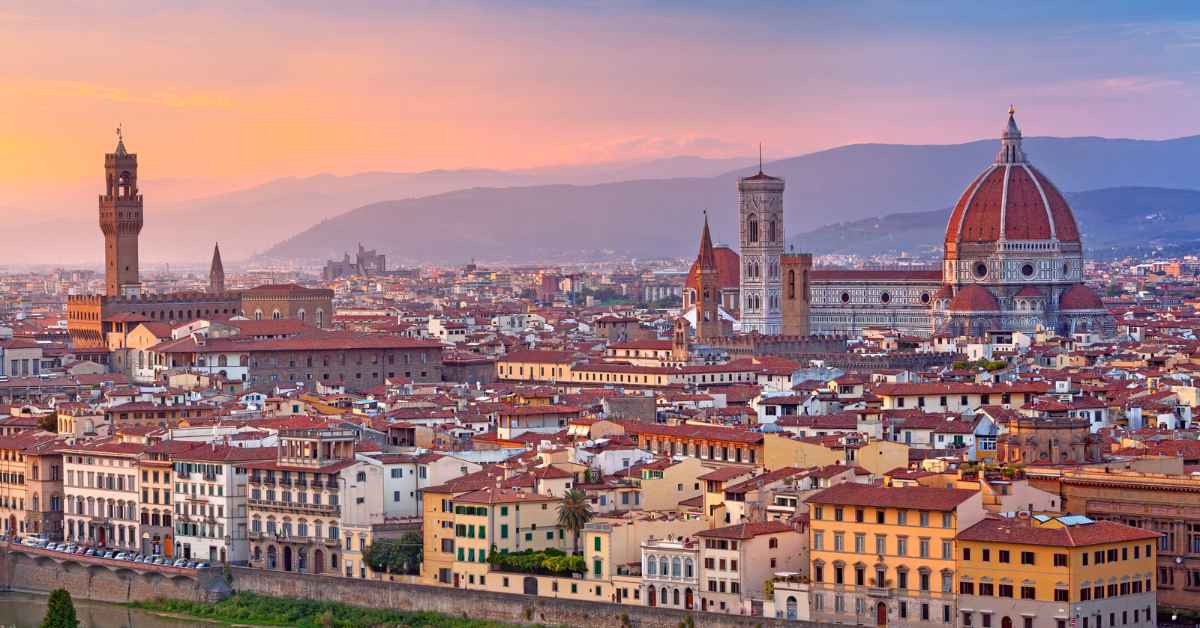
Florence is small. Not in spirit, obviously—the place gave the world the Renaissance, after all—but in actual, physical size. You can cross the entire historic center in about twenty minutes if you walk with purpose and don’t stop to gawk at anything.
That compactness is a gift. It means you can spend a single day on foot and come away feeling like you’ve actually understood the city, not just checked off a few boxes.
But here’s the thing about Florence: it rewards the walker who slows down.
The city is dense with layers—a medieval street grid beneath Renaissance palaces, a working-class Oltrarno across the river, a market district that smells of leather and lampredotto, and views from high hills that make you forget how much your feet hurt.
This route strings together fifteen stops that tell that story, from the train station to the most famous panorama in Tuscany.
It’s not a sprint. It’s a long, unhurried loop through the best of Florence, with time built in for coffee, lunch, gelato, and the kind of aimless wandering that always ends up being the best part of the day.
Before you read further, remember that Italy rewards travelers who go prepared. I have prepared a checklist of things you must have when visiting Italy if you want to have an unforgettable trip. See the checklist here.
Before You Start: The Practical Bits
Distance and time. The core route covers roughly 6 to 7 kilometers, depending on how much you wander and whether you take the optional detours. Without stops, you could walk it in about two hours.
With stops—and you will stop—plan for a full day. Eight to ten hours is realistic if you want to see the major sights, eat properly, and not feel like you’re rushing.
Start and finish. Begin at Piazza Santa Maria Novella, right by the main train station. This is deliberate. It’s easy to reach, it gives you a grand introduction to the city, and it puts you at the northern edge of the historic center, so you can work your way south and east before crossing the river and ending on a hill.
Finish at Piazzale Michelangelo, where the whole city spreads out below you. It’s the only proper way to end a day in Florence.
When to start. Early. Aim for 8:30 or 9:00 AM. Florence’s narrow streets and major piazzas become genuinely uncomfortable by mid-morning in peak season, and the light is better for photos before 10 AM anyway.
If you’re visiting in July or August, consider splitting the walk: do the northern half in the morning, retreat for a long lunch and a siesta during the worst heat, and resume in the late afternoon for the Oltrarno and the climb to Piazzale Michelangelo.
What to wear and bring. Comfortable shoes with good grip. Florence’s streets are cobblestoned and uneven, and you’ll cover more ground than you think. These are the shoes I recommend.
Bring a refillable water bottle—Florence has public drinking fountains scattered throughout the center, and the water is cold and free. A light scarf or shawl is useful for churches, where shoulders and knees need to be covered. In summer, a hat and sunscreen are essential.
Tickets. If you want to climb Brunelleschi’s Dome or Giotto’s Bell Tower, book those slots well in advance—they sell out quickly.
The Uffizi and Accademia also require advance booking if you plan to go inside. For this walking route, most of what you’ll see is free from the outside, but the churches of Santa Maria Novella and Santa Croce charge small admission fees, and the Baptistery requires a ticket if you want to go in.
The Best Florence Walking Route
1. Piazza Santa Maria Novella
The walk begins in a wide, elegant square that most visitors rush past on their way to the Duomo. Don’t. This piazza has a quieter grandeur, framed by the basilica’s green-and-white marble facade and lined with cafés that feel more local than touristy.
Stand in the middle, turn a slow circle, and get your bearings. You’re at the northern edge of the historic center, and everything from here is downhill or flat until the very end.
2. Basilica of Santa Maria Novella
The church’s facade is one of the great achievements of the Renaissance—a perfect geometric composition in white and green marble, completed by Leon Battista Alberti in 1470. It’s the kind of facade that makes you stop and stare, not because it’s flashy, but because the proportions are so satisfying.
Inside, if you have time, there are Masaccio’s frescoes and Ghirlandaio’s elaborate choir frescoes, but even from the outside, the facade alone justifies the stop. Walk along the side of the church toward the station and then turn south into the heart of the city.
3. Piazza del Duomo
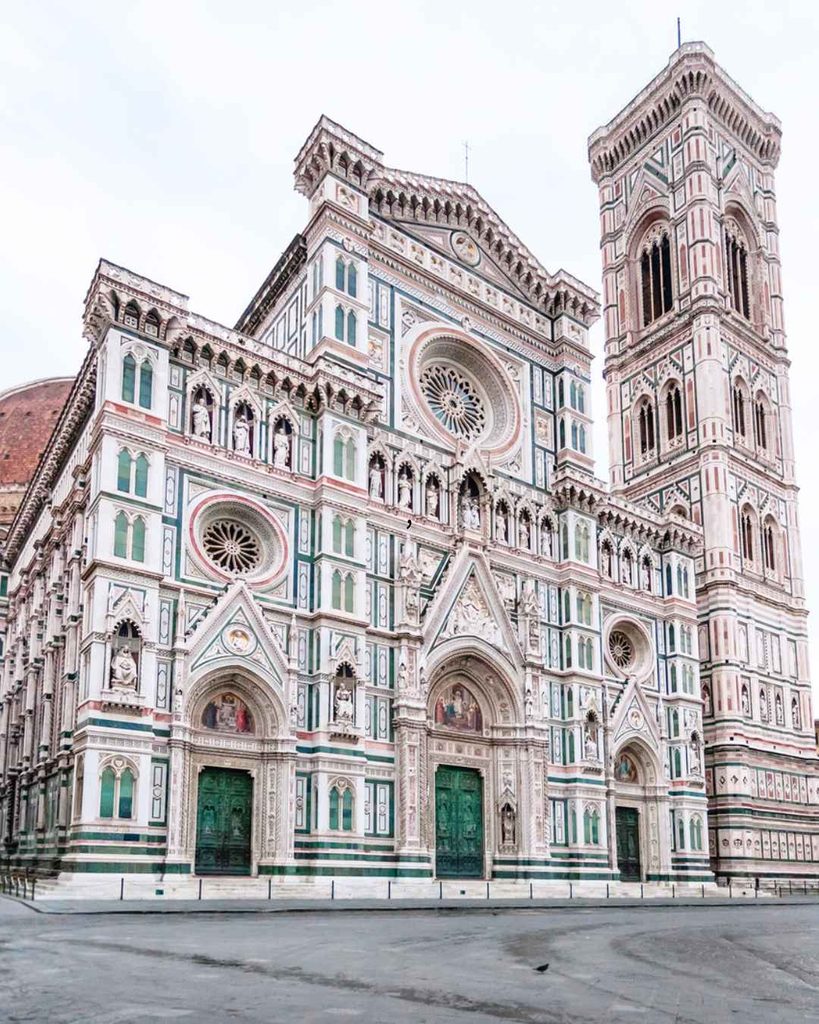
You’ll see the dome before you reach the piazza. Brunelleschi’s cupola—that enormous terracotta octagon—rises above the rooftops like something from another world, and as you walk closer, it keeps getting bigger.
Then you step into the piazza, and the full cathedral comes into view: the white, green, and pink marble facade, the sheer scale of it, the way it seems to loom over everything. This is one of the great architectural moments in Europe. Stand at the far end of the square for the best full view, then walk slowly toward the cathedral doors.
4. Baptistery of St. John and Giotto’s Bell Tower
The Baptistery sits directly in front of the cathedral, an octagonal Romanesque building with doors that Michelangelo reportedly called the “Gates of Paradise.” The original panels by Ghiberti are in the Museo dell’Opera del Duomo now, but the copies on the doors still give you a sense of the craftsmanship.
Look up at Giotto’s Bell Tower beside the cathedral—it’s 85 meters of white marble, standing free of the church, and if you’ve booked a climb, this is where you do it. Even if you don’t climb, walk around the base and appreciate how the decorative program shifts as your perspective changes.
5. Piazza San Lorenzo and Mercato Centrale
From the Duomo, head northwest through the streets toward San Lorenzo. The basilica here has a famously unfinished facade—bare brick, no marble—which makes it look almost plain from the outside.
Don’t let that fool you; inside is Brunelleschi’s calm, perfectly proportioned Renaissance interior, and the Medici Chapels attached to the church contain Michelangelo’s New Sacristy. But the real reason to come here is the market.
The Mercato Centrale is a two-story food temple: the ground floor is fresh produce, butchers, and cheese stalls, while the upper floor is a sprawling food hall where you can get everything from lampredotto (the classic Florentine tripe sandwich) to truffle pasta.
This is a good place to pause for a mid-morning snack, even if you’re planning a proper lunch later.
6. Piazza della Repubblica
A few minutes’ walk south brings you to Florence’s grandest square, a vast open space lined with cafés and anchored by a carousel that seems to be there year-round.
The piazza sits on the site of the old Roman forum, and though the current architecture is mostly nineteenth-century, the sense of openness is a relief after the narrow streets. Grab a coffee at one of the historic cafés—Caffè Gilli is the oldest—and watch the city go by for a few minutes. You’ve earned it.
7. Orsanmichele Church
This is one of Florence’s strangest and most fascinating buildings. Originally a grain market, it was converted into a church in the fourteenth century, and the result is a structure that feels like it can’t quite decide what it wants to be.
The exterior is decorated with niches containing statues of the patron saints of Florence’s guilds—Donatello’s St. George, Ghiberti’s St. John the Baptist, Verrocchio’s Incredulity of St. Thomas—each one a masterpiece of Renaissance sculpture.
Inside, the old market hall has been transformed into a soaring church with a tabernacle by Orcagna. It’s easy to walk past without noticing, so keep an eye out for the blocky, rectangular building on Via dei Calzaiuoli.
8. Piazza della Signoria
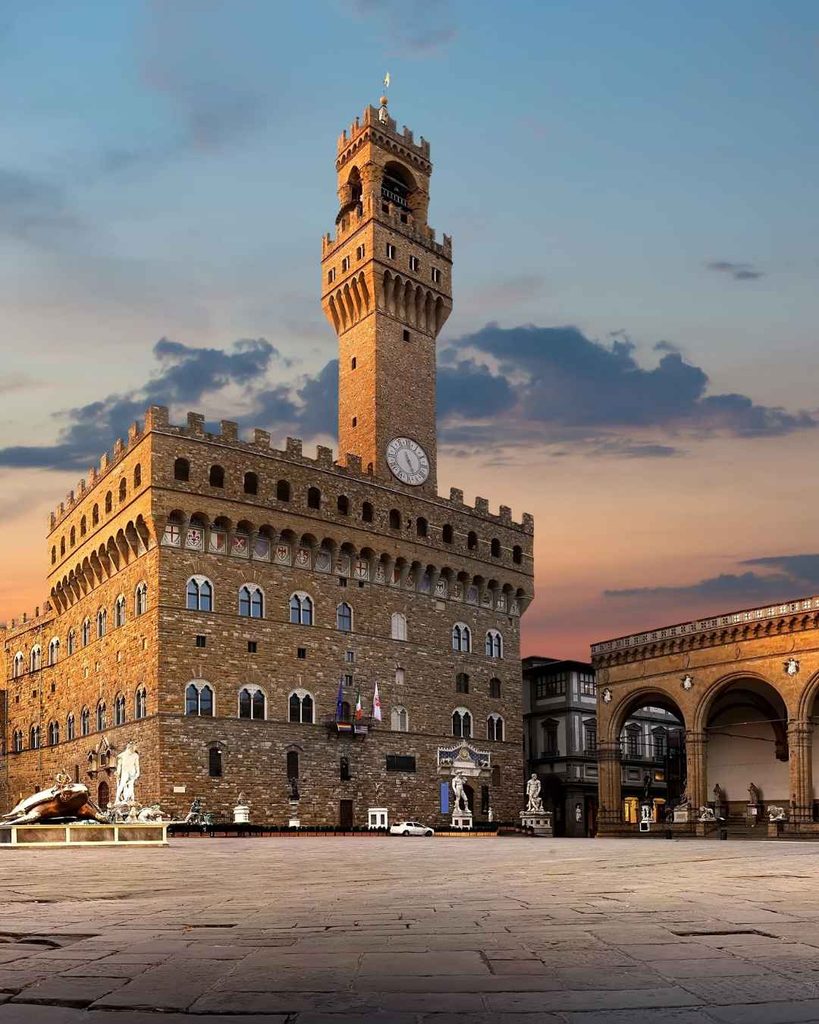
Florence’s most impressive square, and the political heart of the city for centuries. The Palazzo Vecchio dominates one end, its crenellated tower stabbing into the sky.
The Loggia dei Lanzi opens onto the square like an outdoor sculpture gallery, and the fountain of Neptune—known locally as “the big ugly one”—splashes away in the corner.
But the real draw is the collection of statues: a replica of Michelangelo’s David stands where the original once did, alongside Bandinelli’s Hercules and Cacus and Ammannati’s Neptune. Stand in the middle of the square, turn slowly, and take it all in. This is Florence at its most theatrical.
9. Palazzo Vecchio and Loggia dei Lanzi
The Palazzo Vecchio is still the seat of the city government, and its interior—the Salone dei Cinquecento, with its colossal frescoes by Vasari—is worth a visit if you have time.
But even from the outside, the building tells a story: the massive rusticated stone, the projecting battlements, the sense of fortified power. Beside it, the Loggia dei Lanzi is an open-air sculpture gallery that has been sheltering masterpieces since the fourteenth century.
Perseus holding the head of Medusa, the Rape of the Sabine Women, and a collection of Roman statues—all free to view, all standing in the open air. Walk through slowly.
10. Uffizi Gallery Courtyard
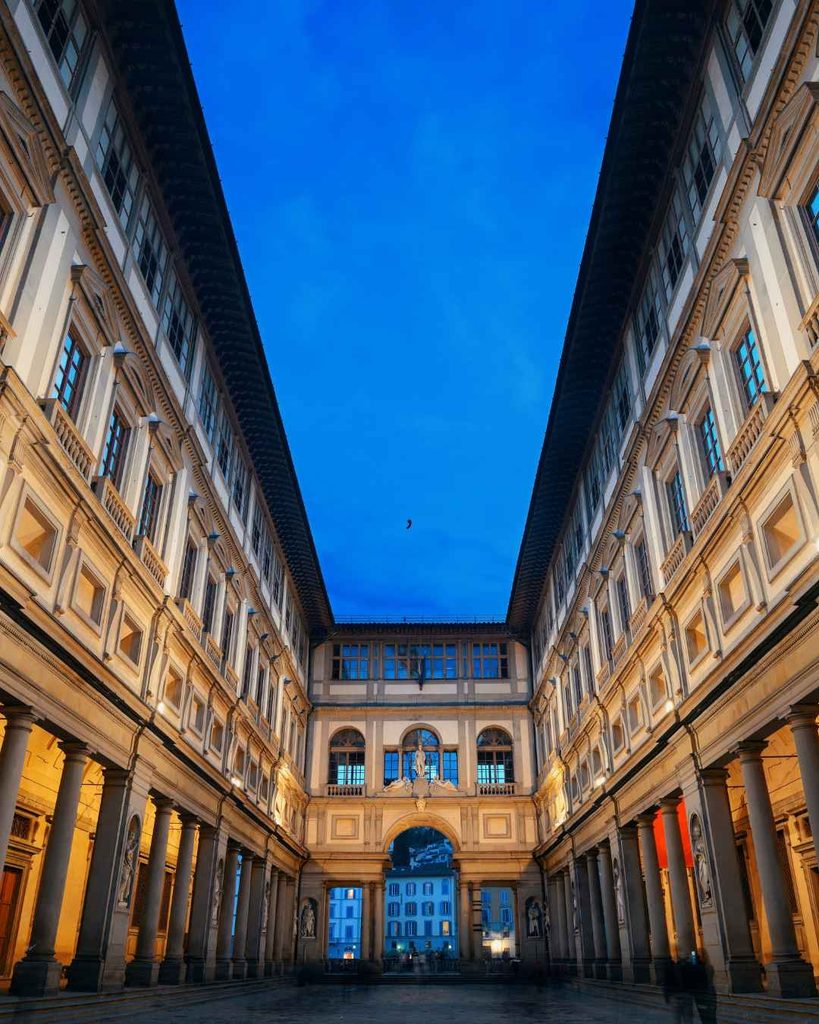
From Piazza della Signoria, walk under the archway at the corner of the square, and you’ll find yourself in the Uffizi courtyard—a long, narrow perspective of pale stone buildings converging toward the river.
The Uffizi itself is one of the world’s great museums, but even if you’re not going inside, the courtyard is worth walking through. It was designed by Vasari as a way of organizing the city’s administrative offices, and the sense of order and proportion is palpable.
Look up at the ceilings of the porticoes, and then walk toward the river.
11. Ponte Vecchio
Florence’s most famous bridge, and one of the most recognizable structures in Italy. The Ponte Vecchio has been crossing the Arno since Roman times, though the current version dates from 1345. What makes it unique is the row of shops built directly onto the bridge—originally butchers and tanners, now jewelers and goldsmiths.
Walk across slowly, stopping to look at the river through the gaps between the shops. The Vasari Corridor runs above the bridge, connecting the Uffizi to the Pitti Palace, and if you look up, you can see the small windows where the Medici family once walked between their palaces without ever touching the street.
12. Palazzo Pitti and Piazza de’ Pitti
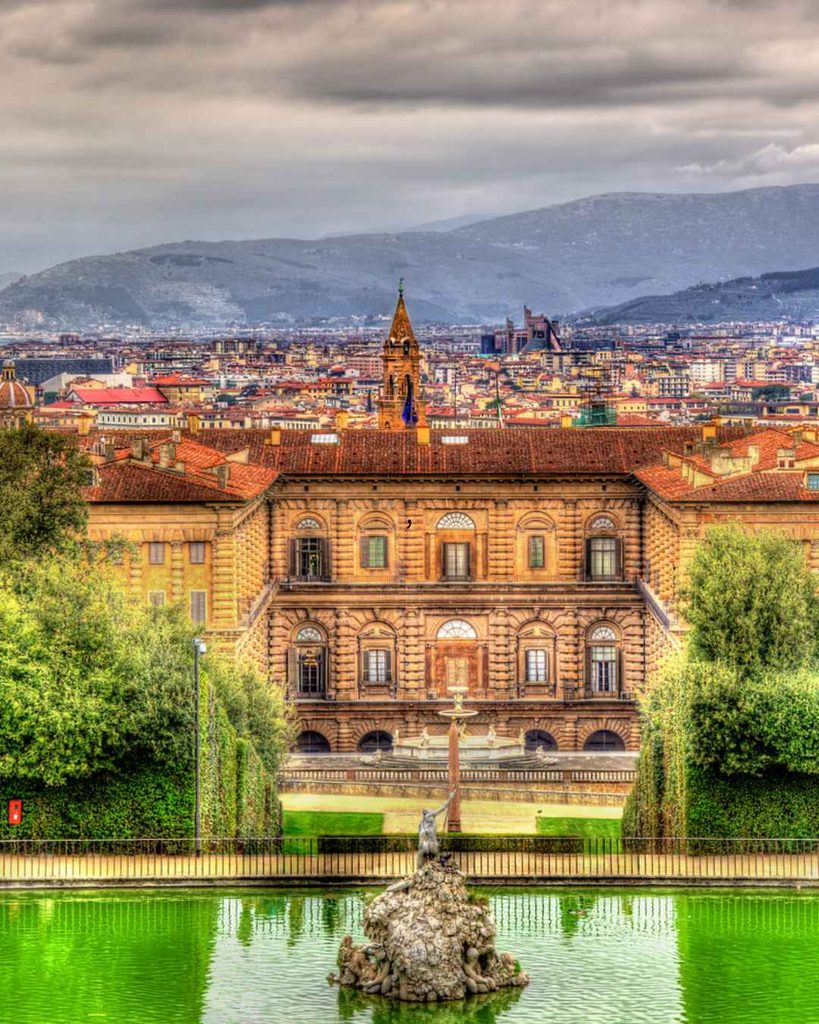
Cross the Ponte Vecchio and walk up Via Guicciardini until you reach the vast, sloping Piazza de’ Pitti. The Palazzo Pitti—a massive Renaissance palace that was once the home of the Medici—dominates the square with its rusticated stone facade and its sheer size.
The square itself is a gathering place for locals and visitors alike, with a lively market in the warmer months and a constant flow of people heading to and from the Boboli Gardens. It’s a good place to pause and get your bearings before heading into the Oltrarno.
13. Piazza Santo Spirito
From Piazza de’ Pitti, walk south through the narrow streets of the Oltrarno until you reach Piazza Santo Spirito, the neighborhood’s living room. This is Florence at its most relaxed: a wide, tree-lined square surrounded by cafés, restaurants, and artisan workshops, with the facade of the church of Santo Spirito—another Brunelleschi design—looking out over the scene.
The atmosphere here is noticeably different from the centro storico: quieter, more local, more human. Sit at one of the cafés, order a coffee or a glass of wine, and watch the neighborhood go about its business.
14. Ponte alle Grazie
From Santo Spirito, walk east along the river until you reach the Ponte alle Grazie, the easternmost of Florence’s historic bridges. The original bridge was destroyed during World War II, and the current version is a modern reconstruction, but the views from it are some of the best in the city.
Look west toward the Ponte Vecchio, with its jumble of shops, and east toward the hills of San Niccolò. The river here is wide and calm, and the light in the late afternoon turns the water gold. Cross the bridge and head east along the riverbank toward the final stop.
15. Piazzale Michelangelo
The walk up to Piazzale Michelangelo is the only real climb of the day, and it’s worth every step. The path winds up through the hillside, past the rose garden and the church of San Niccolò, and then suddenly the whole city opens up below you.
The panorama from the terrace is the most famous view in Florence: the Duomo, the Palazzo Vecchio, the Arno winding through the city, the hills of Tuscany in the distance. Stand there as the sun begins to set, and let the day settle.
You’ve walked through centuries of history, from a Renaissance facade to a medieval bridge to a modern reconstruction, and you’ve ended up here, looking out over the city that started it all.
Beautiful Streets and Hidden Corners Along the Way
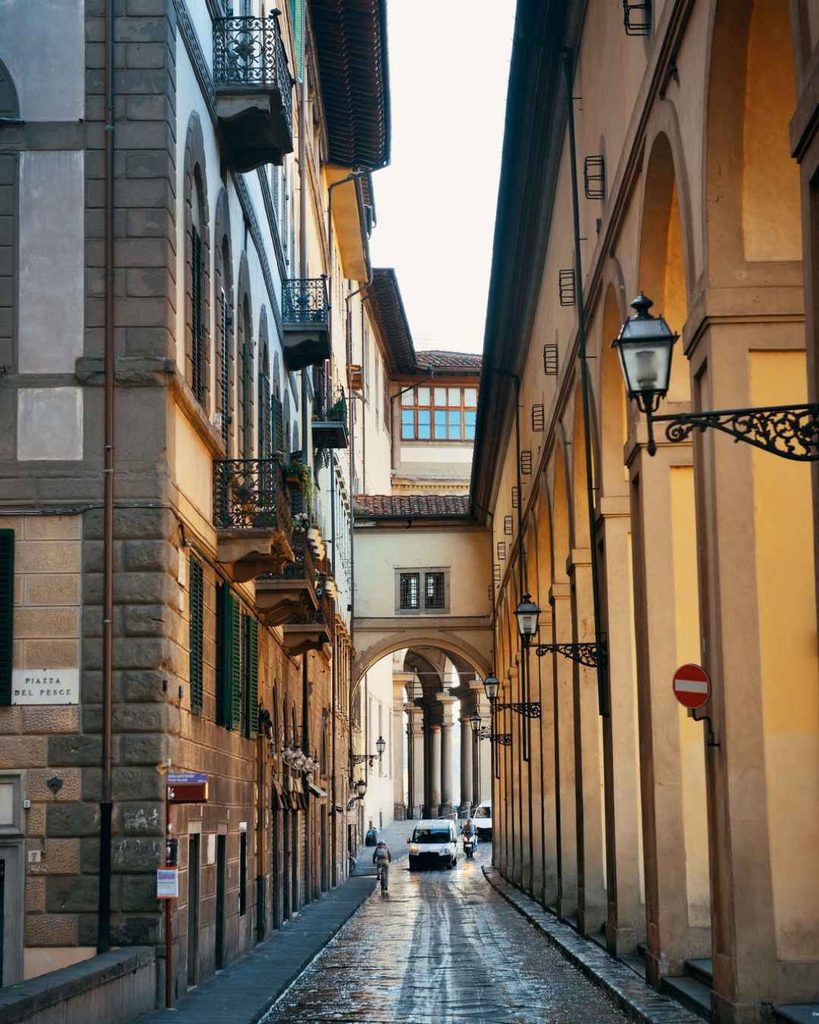
The stops are the skeleton of the walk, but the streets between them are the flesh and blood. Here are a few you should not rush through.
Via dei Calzaiuoli. The main pedestrian artery running from the Duomo to Piazza della Signoria, lined with shops and cafés. It’s busy, but it’s also one of the best places to feel the pulse of the city.
Via de’ Tornabuoni. Florence’s most elegant shopping street, lined with luxury boutiques and Renaissance palazzi. Even if you’re not buying, the window displays and the architecture are worth a stroll.
Borgo San Jacopo. A narrow, atmospheric street in the Oltrarno that runs parallel to the river, lined with restaurants and small shops. It’s a good place to get slightly lost.
Via Maggio. Another Oltrarno street, this one lined with antique shops and workshops. It’s quieter than the centro storico and gives you a sense of the neighborhood’s artisan heritage.
Via dei Neri. A lively street near Santa Croce, full of sandwich shops, wine bars, and restaurants. It’s a good place to stop for lunch or a snack.
The little streets around Santo Spirito. There’s no wrong turn here. Every lane seems to lead to a small piazza, a hidden church, or a workshop where someone is making something by hand. Give yourself permission to wander without a destination for twenty minutes. That’s where the real Florence lives.
Where to Stop for Food, Coffee and Gelato
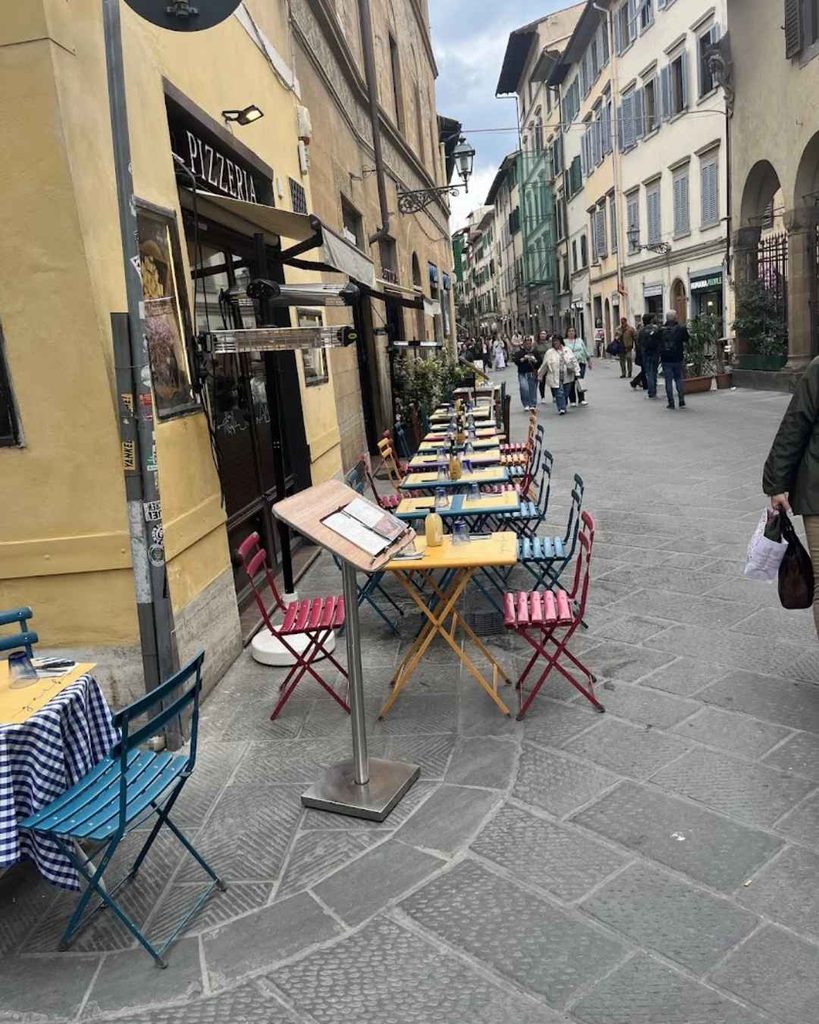
Best places for an Italian breakfast. A cappuccino and a cornetto at a standing bar is the classic Florentine start to the day. Try Caffè Scudieri near the Duomo or any of the small bars around Santa Maria Novella. Sit-down breakfasts are less common in Italy, but if you want one, look for a café with a terrace.
Where to enjoy an authentic Florentine lunch. Look for a trattoria serving lampredotto, ribollita, or bistecca alla fiorentina. The Mercato Centrale is a good option for variety, but for a proper sit-down meal, head to the Oltrarno, where the restaurants are smaller, and the prices are lower. Avoid any place with a photo menu out front.
Best gelato stops along the route. Gelateria dei Neri near Santa Croce is a local favorite, with inventive flavors and generous portions. La Carraia, near the Ponte alla Carraia, is another good option. In the Oltrarno, try Gelateria Santo Spirito for a quiet stop in the square.
Historic cafés worth visiting. Caffè Gilli in Piazza della Repubblica is the oldest café in Florence, and its interior is a beautifully preserved piece of nineteenth-century design. Caffè Rivoire, in Piazza della Signoria, has a terrace with a view of the Palazzo Vecchio, though the prices reflect the location.
Where to enjoy an aperitivo with a view. The terrace at Piazzale Michelangelo has a bar that serves drinks and snacks, and the view is unbeatable. For something closer to the center, the bars around Santo Spirito are relaxed and local.
Optional Detours Worth Adding
Galleria dell’Accademia and Michelangelo’s David. If you want to see the real David, book a timed ticket in advance and allow at least an hour. The gallery is small but the statue is worth the visit.
Basilica of Santa Croce. Known as the “Pantheon of Florence,” this church contains the tombs of Michelangelo, Galileo, Machiavelli, and Rossini. It’s a short detour from the route and well worth the admission fee.
Bargello Museum. A stunning collection of Renaissance sculpture, housed in a former prison. It’s less crowded than the Uffizi, and the pieces are extraordinary.
Boboli Gardens. Behind the Palazzo Pitti, these formal gardens are a peaceful escape from the city. Allow at least an hour to wander through the terraces, fountains, and sculptures.
San Miniato al Monte. If you have the energy, continue past Piazzale Michelangelo to this beautiful Romanesque church on the hill. The view from the terrace is even better than the one from the piazzale, and the church itself is one of the finest in Florence.
Practical Tips for Exploring Florence on Foot
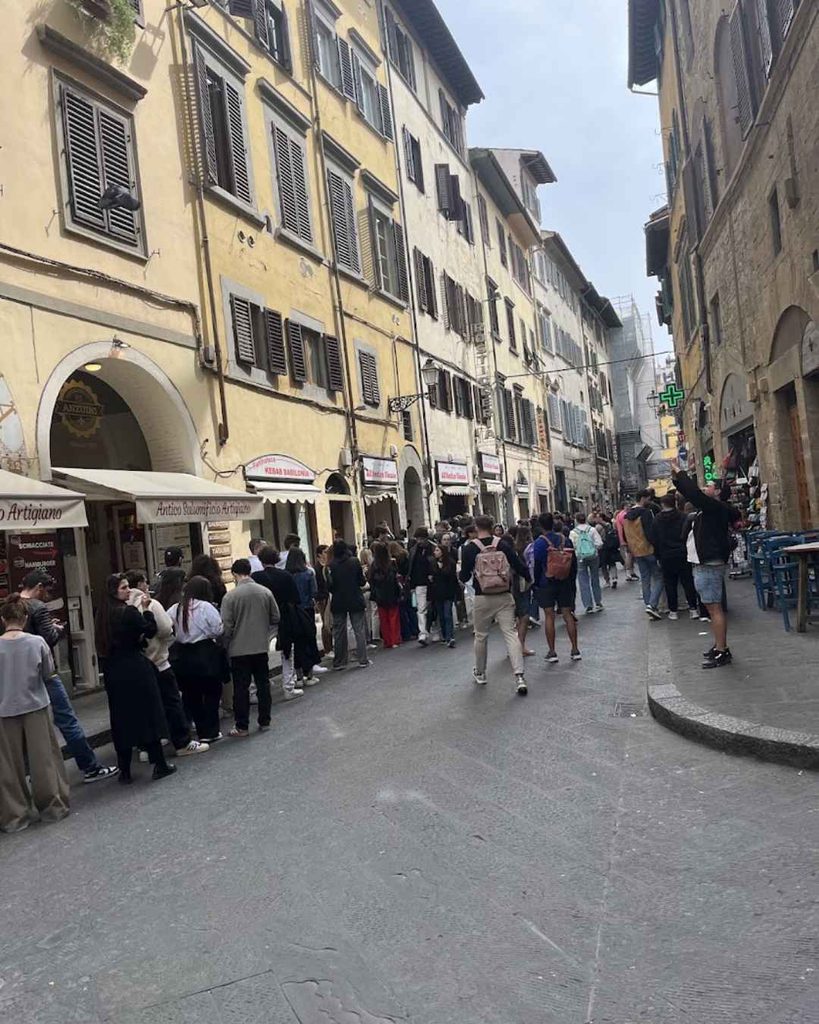
Avoiding crowds. Start early, take a long lunch break when the day-trippers are at their peak, and resume in the late afternoon. The hours between 1 and 4 PM are the most crowded in the center; use them for a slow meal or a museum visit.
Finding public drinking fountains. Florence has public fountains scattered throughout the center, and the water is cold and safe to drink. Fill your bottle and save your euros for gelato.
Avoiding tourist traps. Menus with photos, touts on the street, and restaurants directly facing major monuments are red flags. Walk two blocks away and the quality improves dramatically.
Booking attractions in advance. The Uffizi, the Accademia, and the climbs up the Duomo and the bell tower all require advance booking if you want to avoid long queues. Do this before you leave home.
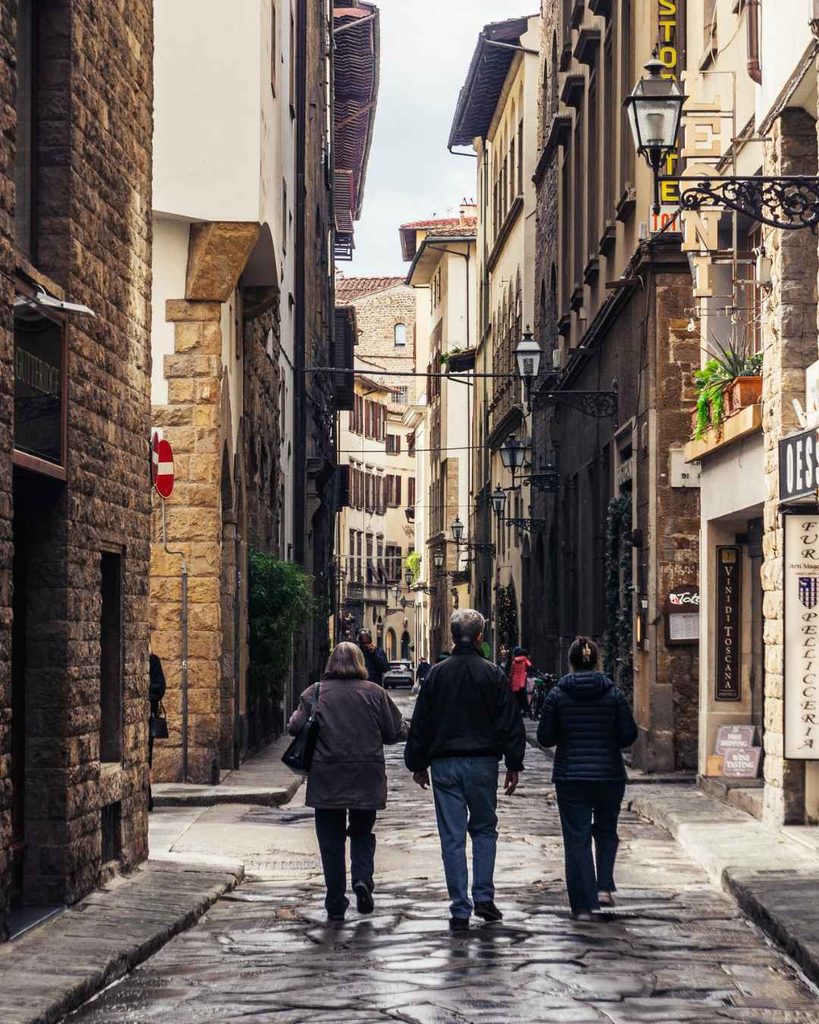
Navigating cobblestone streets. Florence’s streets are paved with stone, and they can be uneven and slippery. Wear shoes with good grip and ankle support. If it has rained, watch your step.
Staying safe and comfortable. Florence is generally very safe for walkers, but pickpockets operate in crowded areas—the Duomo, the Ponte Vecchio, and the markets. Keep your valuables zipped and close. Take breaks. Sit when you can. Drink water. This is a long walk, and burnout is real.
Where to Stay
Choosing the right base can make or break a walking-focused trip to Florence. The good news is that this route passes through several neighborhoods that are ideal for walkers, and staying in the right spot means you can roll out of bed and start exploring without wasting time on buses or taxis.
Near Santa Maria Novella and the Duomo (Start of the Route)
If you want maximum convenience and don’t mind paying for it, the area around Piazza Santa Maria Novella and the Duomo puts you right at the starting line.
The Brunelleschi Hotel is a standout choice—hidden in a small alley near the Duomo, it occupies a former 12th-century church and offers rooms with historical charm just steps from the cathedral, the Uffizi, and the Ponte Vecchio.
For something slightly more budget-conscious but still central, Hotel della Signoria sits just off Piazza della Signoria with a seventh-floor breakfast room offering views of the Duomo and Giotto’s Bell Tower. Both are ideal if you want to wake up, walk out the door, and be at your first stop within minutes.
The Oltrarno and Santo Spirito (The Local Vibe)
For a quieter, more neighborhood-focused stay, the Oltrarno district—specifically around Piazza Santo Spirito—is hard to beat.
This is where the route’s thirteenth stop lands, and staying here means you get to experience the square’s relaxed evening atmosphere after the day-trippers have gone home.
Casa Botticelli in San Felice is a nine-room boutique hotel that doubles as an art gallery, located in what the hoteliers call Florence’s coolest neighborhood.
For a more budget-friendly option in the same area, Santa Monaca Hostel occupies a 15th-century former convent and offers dorms and private rooms with a communal kitchen and terrace, just a short walk from Ponte Vecchio and Palazzo Pitti.
If you prefer an apartment, small studios in the Santo Spirito area offer kitchenettes and a truly local experience, with the square’s market and cafés right outside your door.
Near the Train Station (Practical for Arrivals)
If you’re arriving by train and want to drop your bags before starting the walk, the streets just south of Santa Maria Novella station have plenty of mid-range options.
Several hotel chains have properties within a five-minute walk of the station, offering clean, reliable rooms at prices that are often lower than the historic center.
Emerald Palace, a hostel in the San Lorenzo neighborhood, is about a five-minute walk from the Duomo and a third of a mile from the train station, making it a practical choice for budget travelers who want to be close to the action without paying center-of-the-center prices.
Related post: The best areas to stay when visiting Florence
Frequently Asked Questions
Can you see Florence in one day on foot? You can see the highlights, yes—this route covers them. But “seeing” Florence in a day means moving quickly and skipping the moments that make the city special. If you only have one day, do the northern half in the morning and the Oltrarno in the afternoon. It will be a whirlwind, but a memorable one.
How many kilometres is the walking route? The core route is about 6 to 7 kilometers, depending on detours and how much you wander. With side streets and optional detours, it can easily become 9 or 10 kilometers.
Is Florence easy to explore on foot? Yes. The historic center is compact, largely flat (except for the climb to Piazzale Michelangelo), and almost entirely pedestrian-friendly. Most of the major sights are within a twenty-minute walk of each other.
What is the best starting point? Piazza Santa Maria Novella. It’s easy to reach by train or bus; it gives you a grand entrance into the city, and it puts you at the northern edge of the historic center.
Can you walk from the Duomo to Piazzale Michelangelo? Yes, it’s about 2.5 kilometers, and the walk takes about 40 minutes at a steady pace. The climb up to the piazzale is the only significant ascent of the day, and it’s worth every step.
What are the best free attractions in Florence? The piazzas—Santa Maria Novella, del Duomo, della Signoria, della Repubblica—are all free to walk through. The Loggia dei Lanzi is free and open to the public. The Uffizi courtyard is free to walk through. The view from Piazzale Michelangelo is free. And the simple act of walking these streets, which have been walked for centuries, costs nothing at all.
Florence doesn’t reveal itself all at once. It gives you a facade that stops you in your tracks, a bridge lined with shops, a hilltop view that makes you forget how tired you are. It gives you cobblestones that hurt your feet and coffee that jolts you awake and a square where you can sit and watch the city go by.
Walk it slowly. Look up often. Let yourself get lost. The city will find you.
Again, feel free to go through the list below of my Italy recommendations that I have crafted after years of travel to this beautiful country:
- Packing List: Things Not to Go to Italy Without
- Must-Do Things: Unforgettable Experiences
- Where to Stay: Best Hotels in Italy.
- Where to Stay in Rome: Rome’s Best Neighborhoods
- Where to Stay in Florence: Picking the Best Area
- Where to Stay in Venice: Venice’s Best Districts
- Italy’s Cobblestone Streets: Best Shoes For the Job
- Backpack or Suitcase?: Italy Luggage Guide
- Travel Insurance: Always Be Covered
- E-Sim: Be Connected At All Times