
Rome is not a city you conquer in a day. It is a city you surrender to. The moment you stop trying to tick off monuments and start letting the streets pull you where they will, something shifts.
A temple that predates the birth of Christ sits casually next to a café serving espresso for a euro and a half. Nobody is guarding it. Nobody is asking for a ticket. It is just part of the neighborhood, the way it has been for two thousand years.
That is the magic of exploring Rome on foot. The city is not a museum you walk through in a reverent hush; it is a place where antiquity and daily life have been tangled together for so long that they are inseparable.
This route, which stitches together fifteen of the city’s most extraordinary sights across roughly five to six kilometers, is designed to let you experience that tangled beauty at your own pace. It is not a sprint. It is a long, delicious amble through the layers of history.
Here is everything you need to know to walk Rome the right way.
Before you read further, remember that Italy rewards travelers who go prepared. I have prepared a checklist of things you must have when visiting Italy if you want to have an unforgettable trip. See the checklist here.
Before You Start: Everything You Need to Know
Walking Distance and Estimated Duration
The core route, from Piazza del Popolo to the Palatine Hill, covers approximately 5 to 6 kilometers (roughly 3 to 3.7 miles) of walking. If you were to walk it without stopping, you could cover the ground in about an hour and a half.
But you are not going to do that. The whole point of this route is to stop, to look up, to wander into a church because the door is open, to sit on a step and eat a gelato before it melts down your wrist.
Realistically, you should set aside a full day—eight to ten hours—if you want to see the major sights, take a proper lunch break, and not feel like you are rushing from one photo opportunity to the next.
Starting and Finishing Points
Start at Piazza del Popolo. This is deliberate. It is a grand, open gateway to the historic center, easy to reach by Metro (Flaminio station on the A line), and it allows you to approach the city from the north, moving gradually into the denser, more intimate streets of the centro storico before ending at the ancient heart of Rome.
Starting here also means you get the one significant climb of the day—up to the Pincio Terrace—out of the way early, while your legs are still fresh.
Finish at the Palatine Hill. After a day of walking through Renaissance piazzas and Baroque fountains, ending among the ruins of the emperors’ palaces is a fitting conclusion.
The views over the Roman Forum from the Palatine are some of the most evocative in the city, and you are perfectly positioned to catch a sunset before heading off to dinner.
Best Time to Start
Start early. Aim for 8:00 or 9:00 AM. Rome is not a city that rewards late risers, especially in the warmer months.
The Trevi Fountain, the Spanish Steps, and the Colosseum become genuinely unpleasant—shoulder-to-shoulder, selfie-stick-forest unpleasant—by mid-morning. If you start at nine, you can reach the Trevi before the worst of the crowds and have a fighting chance of hearing the water over the chatter.
If you are visiting in July or August, consider splitting the walk.
Do the northern half of the route (Piazza del Popolo to the Pantheon) in the early morning, retreat indoors or to a long lunch during the brutal afternoon heat, and resume at the Campidoglio in the late afternoon when the light turns golden, and the temperatures become bearable.
Romans themselves follow this rhythm; you should too.
What to Wear and Bring
Comfortable shoes are non-negotiable. Rome’s streets are paved with sampietrini—those small, rounded basalt cobblestones that look so charming in photographs and feel so unforgiving underfoot after the fifth kilometer.
Wear shoes with thick soles and good support. Leave the fashionable but flimsy sandals at home. Here are my recommendations.
Bring a reusable water bottle. Rome is covered in public drinking fountains, the nasoni (literally “big noses”), which run constantly with cold, fresh, perfectly drinkable water.
You will save a fortune and stay hydrated. Wear layers and bring a light scarf or shawl, especially if you plan to enter churches. Many require shoulders and knees to be covered, and a scarf is an easy way to comply without carrying a heavy jacket.
A hat and sunscreen are essential in summer.
Tickets and Reservations
Book the Colosseum in advance. Do not debate this. Walk-up queues in peak season can stretch beyond two hours, and the site frequently sells out entirely.
Book a timed entry on the official Parco del Colosseo website or through a reputable reseller. The combined ticket includes the Roman Forum and Palatine Hill and is valid for 24 hours from first use, which is perfect for this route.
The Pantheon now charges for entry and, while tickets can often be bought on the spot, booking a time slot online in advance is wise during busy periods. Most other stops on this route—the piazzas, fountains, churches, and outdoor ruins—are free to view from the outside.
The Capitoline Hill and its square are free to walk through; the Capitoline Museums require a ticket if you want to go inside.
Walking Route Map
You do not need a paper map. Google Maps works perfectly well in Rome for walking directions, and the route follows a logical, well-trodden path through the historic center.
That said, the joy of this walk is in the detours. Use the map to keep yourself roughly oriented, but let the narrow streets pull you where they will. You will almost always end up somewhere interesting.
The Ultimate Rome Walking Route: 15 Must-See Stops
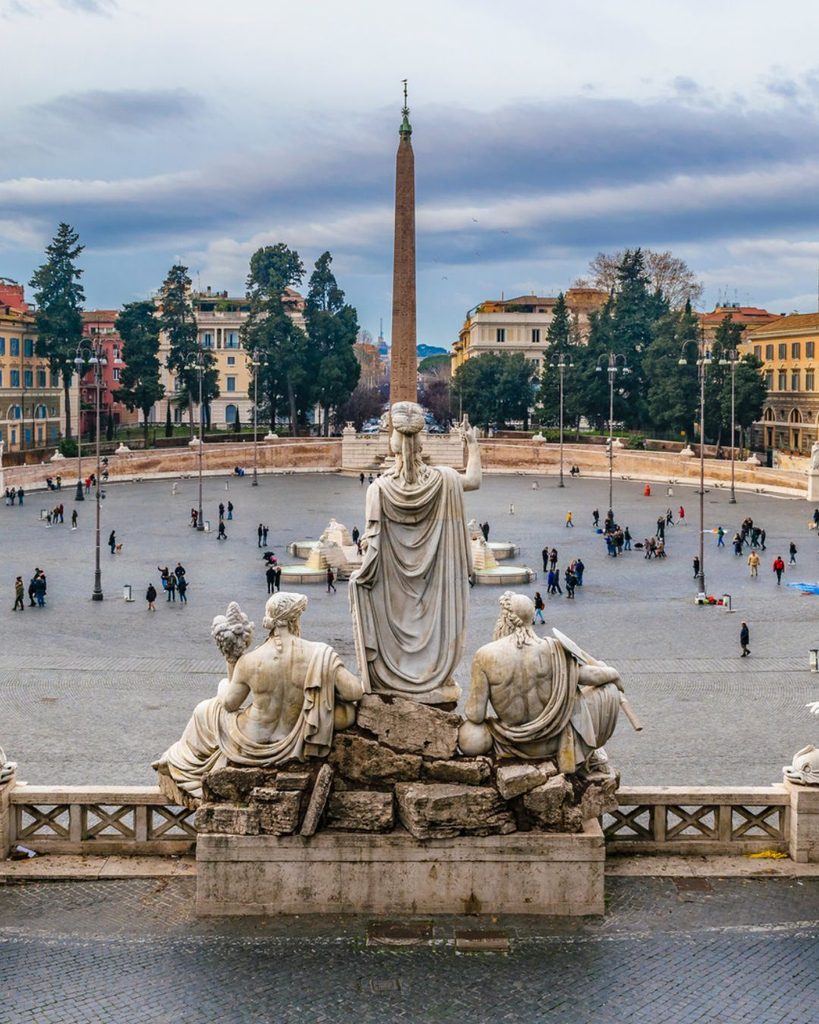
1. Piazza del Popolo
The name means “People’s Square,” and for centuries this was the first thing travelers saw when entering Rome from the north.
It is a vast, elliptical space dominated by an Egyptian obelisk brought to Rome by Augustus, flanked by twin churches that create a perfectly symmetrical framing for the street that leads into the city’s heart. Stand in the center, turn in a slow circle, and get your bearings. You are at the threshold.
2. Villa Borghese and Pincio Terrace
From Piazza del Popolo, climb the steps on the eastern side up to the Pincio. It is a short, gentle ascent that rewards you with one of the finest panoramic views in Rome. Below you, the piazza spreads out like a geometry lesson; beyond it, the domes and rooftops of the historic center stack up toward the horizon.
This is your first “pinch me” moment of the day. The terrace itself sits at the edge of the Villa Borghese gardens, a green refuge that feels a world away from the traffic below.
3. Spanish Steps
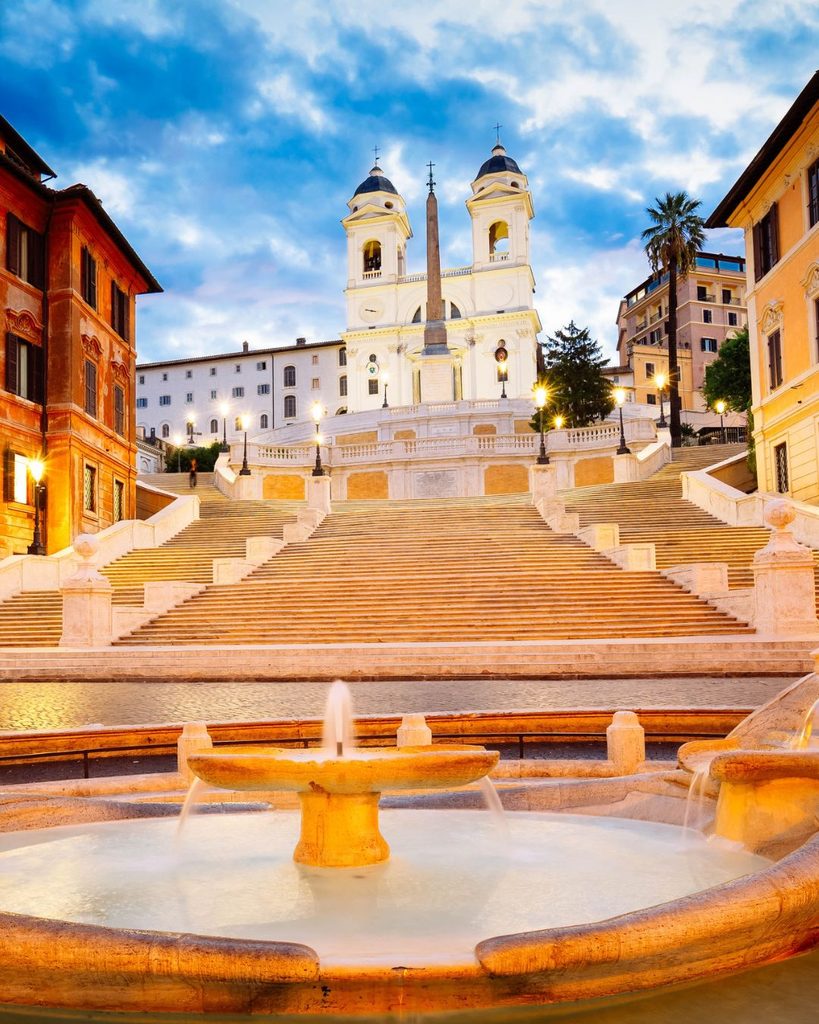
Descend from the Pincio and follow the elegant Via del Babuino or Via dei Condotti until you reach Piazza di Spagna. The Spanish Steps—135 of them, curving up to the Trinità dei Monti church—are best admired from the bottom, where Bernini’s fountain, La Barcaccia, sits half-sunken in the piazza.
Sit for a moment, watch the parade of people, and then move on. Note that sitting directly on the steps themselves is now discouraged by local rules, and eating on them can result in a fine.
4. Trevi Fountain
A short walk through the lanes brings you to the most theatrical fountain in the world. Nicola Salvi’s masterpiece fills an entire small piazza, with Neptune’s chariot bursting from the rock face and water cascading over sculpted cliffs. It is crowded, yes, but it is also genuinely breathtaking.
Toss a coin over your left shoulder with your right hand—the legend says this guarantees your return to Rome. Do it quickly, take your photo, and slip away. The fountain is best experienced early or late; midday is a scrum.
Tip: At this time, the Trevo Fountain will most likely be crowded. Plan to visit it another time, either very early in the morning or late at night
5. Piazza di Pietra and Temple of Hadrian
Most visitors walk right past this one, which is precisely why it is worth stopping.
A few minutes from the Trevi, the Piazza di Pietra is a quiet, almost forgotten square where eleven massive Corinthian columns—the surviving remains of a temple built by Hadrian in 145 AD—are embedded directly into the wall of a later building.
It is a perfect illustration of how Rome recycles itself: the temple became a customs house, then a stock exchange, and the ancient columns have simply always been there, holding up whatever came next.
6. The Pantheon
There is nothing else like it. The Pantheon’s dome, completed around 126 AD, remains the largest unreinforced concrete dome in the world. The oculus at its center—a 9-meter opening to the sky—is the only source of light, and when it rains, the water falls straight through and drains through holes in the floor.
Stand beneath it and look up. The geometry is so perfect that it feels less like architecture and more like a mathematical proof. Book your ticket in advance if you are visiting during peak season.
7. Piazza Navona

From the Pantheon, a five-minute walk brings you to Piazza Navona, built directly on the footprint of the ancient Stadium of Domitian. The oval shape is still perfectly preserved.
Bernini’s Fountain of the Four Rivers dominates the center, with the Nile, Ganges, Danube, and Río de la Plata represented by muscular river gods. The piazza is lined with cafés and restaurants, but be warned: this is prime tourist territory, and prices reflect it. Admire the fountain, soak in the atmosphere, and keep moving.
8. Campo de’ Fiori
A few streets west, the atmosphere shifts. Campo de’ Fiori is a working market square by day—produce, spices, flowers, and the occasional souvenir stall—and a raucous bar scene by night.
In the center stands a grim reminder of the square’s darker history: a statue of Giordano Bruno, the philosopher burned here for heresy in 1600. It is a good spot to grab a piece of fruit or a quick snack from a market stall before continuing.
9. Largo di Torre Argentina
This sunken square is not much to look at from street level—a jumble of ancient ruins below the modern road—but it holds two distinctions worth knowing. First, these are the ruins of four Republican-era temples, dating back to the third and second centuries BC.
Second, this is where Julius Caesar was assassinated in 44 BC; the Theatre of Pompey, where the Senate was meeting that day, once stood nearby. Today, the site is a cat sanctuary, and you will likely see volunteers tending to the colony of strays that sun themselves on the ancient stones.
10. Piazza Venezia and the Vittoriano
You will hear the Vittoriano before you see it—the traffic of Piazza Venezia is a constant roar. The massive white monument, officially the Altare della Patria (Altar of the Fatherland), commemorates Italy’s first king and the unification of the country.
It is enormous, gleaming, and deeply divisive among Romans, who have nicknamed it “the typewriter” and “the wedding cake.” Love it or hate it, the terrace offers a superb view over the Forum, and the climb is free. Take the external stairs up for a quick orientation before heading to the Capitoline.
11. Piazza del Campidoglio
Michelangelo designed this square in the sixteenth century, and it remains one of the most harmonious urban spaces in Europe. The trapezoidal paving pattern, the statue of Marcus Aurelius at the center, and the three palazzi framing the space create a sense of balance and calm that feels almost sacred.
The Capitoline Museums, housed in the buildings on either side, contain some of Rome’s greatest classical art, but even if you skip the museums, the square itself is worth the climb.
12. Roman Forum
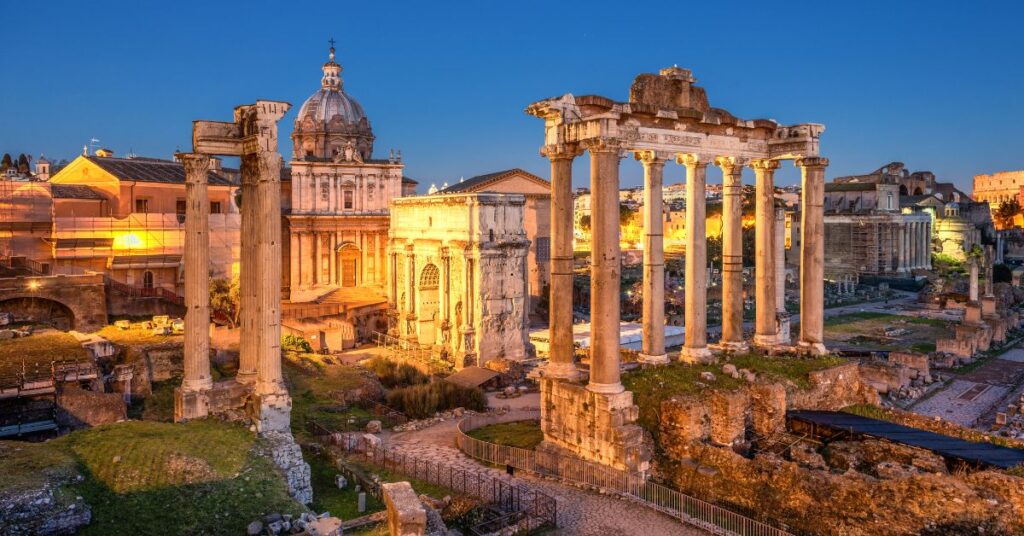
Descend from the Capitoline into the valley that was once the political, commercial, and religious heart of the ancient world. The Forum is a sprawling field of ruins—temples, basilicas, triumphal arches—and it can be overwhelming without context.
Take your time. Find the Temple of Antoninus and Faustina, the Curia (the Senate house), and the Arch of Septimius Severus. The combined Colosseum/Forum/Palatine ticket covers entry. If you have the energy, the view from the Via dei Fori Imperiali, looking back over the whole complex, is spectacular.
13. Colosseum
There it is. The Flavian Amphitheater, completed in 80 AD, was capable of holding 50,000 spectators who came to watch gladiators, wild animal hunts, and executions.
The exterior is iconic, but the interior is what surprises people—the exposed hypogeum, the underground labyrinth where animals and fighters waited, is now visible and gives a chilling sense of the scale of the operation. Give yourself at least an hour and a half here. Book ahead. Your future self will thank you.
14. Arch of Constantine
Just outside the Colosseum, the Arch of Constantine stands as a monument to the emperor who legalized Christianity and changed the course of Western history.
Built in 315 AD, it reuses reliefs and sculptures from earlier monuments—a pragmatic recycling that was common in antiquity. It is also one of the best-preserved triumphal arches in Rome, and it makes a natural pause between the Colosseum and the Palatine.
15. Palatine Hill Viewpoints
The final stop is the quietest and, in many ways, the most evocative. The Palatine is where Rome began—the legendary she-wolf nursed Romulus and Remus here—and it later became the address of emperors, who built sprawling palaces that overlooked the Circus Maximus on one side and the Forum on the other.
The ruins are extensive and largely unexcavated in places, but the views from the edge of the hill are the real reward. Stand there as the light softens, look out over the Forum and the Colosseum beyond, and let the day settle.
You have walked through two thousand years of history. Your feet will feel every single one of them, but it will have been worth it.
Beautiful Streets and Hidden Corners Along the Route
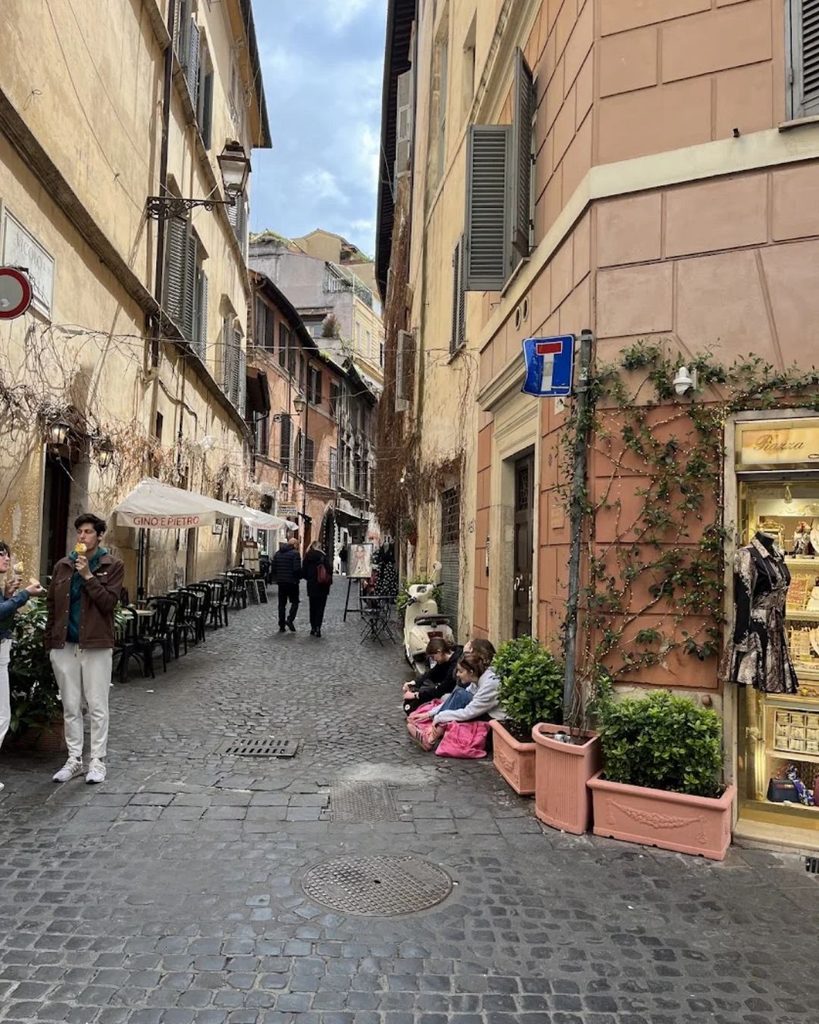
The stops are the skeleton of the walk, but the streets between them are the flesh and blood. Here are a few you should not rush through.
Via Margutta. Tucked just off the Spanish Steps, this quiet, ivy-draped lane was once the haunt of artists and bohemians—Federico Fellini lived here—and it still feels a world away from the crowds a few blocks over.
Galleries, antique shops, and the occasional hidden courtyard make it a perfect detour when the Spanish Steps become too much.
Via dei Condotti. Rome’s most famous shopping street, running straight from the Spanish Steps to the Tiber. The windows are full of luxury brands, but even if your budget does not extend to Prada, the architecture and the people-watching are free.
The historic Antico Caffè Greco, one of Rome’s oldest cafés, is here—though its tenancy has been in dispute in recent years, so check it is open before planning a visit.
Via dei Coronari. This is the street that makes people fall in love with Rome. A long, straight lane lined with antique shops, small churches, and weathered ochre facades, it runs from the Pantheon area toward Piazza Navona. It is quieter than the main drags, and the afternoon light on the plaster walls is extraordinary.
Via del Governo Vecchio. Parallel to Via dei Coronari, this street is slightly more lived-in, with a mix of trattorias, vintage shops, and neighborhood bars. It is a good place to get slightly lost.
The little streets around the Pantheon. There is no wrong turn here. Every lane seems to lead to a tiny piazza with a fountain, a church with an unexpected Caravaggio, or a bakery that has been making the same bread for a century.
Permit yourself to wander without a destination for twenty minutes. That is where the real Rome lives.
Where to Eat and Drink Along the Way
Best Coffee Stops
Sant’Eustachio il Caffè near the Pantheon is legendary—the espresso is sweetened by default unless you specify otherwise, and it is served standing at the counter.
Tazza d’Oro, also near the Pantheon, is another classic; order the coffee granita with cream in summer. Near the Trevi, Antico Caffè San Marcello is an ordinary neighborhood bar where you can drink a cheap espresso standing up, away from the tourist crush.
Where to Find Excellent Gelato
Gelateria San Crispino near the Trevi is the closest of the well-known gelaterias, with a short list of seasonal flavors served in cups. Giolitti, near Montecitorio, is the historic choice—touristy, yes, but the gelato is still good. Fatamorgana in the Corso area has inventive flavors and is worth the short detour.
Best Places for Traditional Roman Pasta
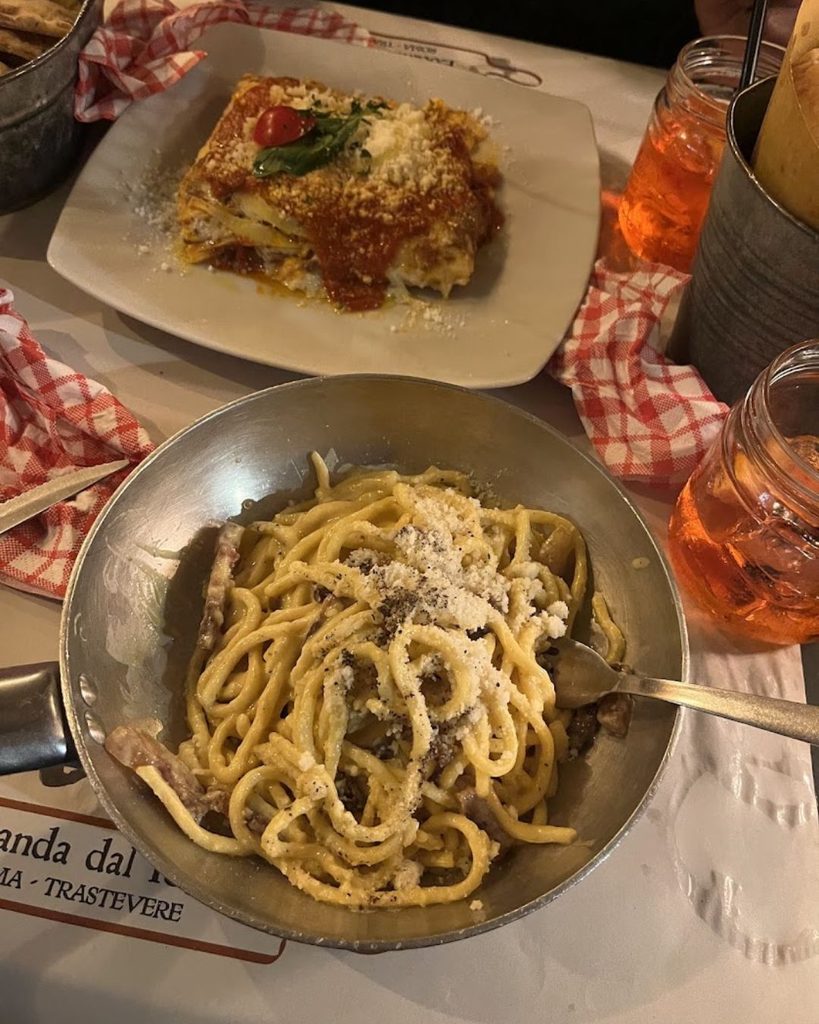
Look for the words cacio e pepe, carbonara, amatriciana, and gricia on menus. The Testaccio neighborhood, south of the route, is the spiritual home of Roman pasta, but you do not need to go that far.
Trattorias around Campo de’ Fiori and the Pantheon serve excellent versions. Avoid any restaurant with a photo menu out front and a tout trying to pull you inside; those are the tourist traps.
Where to Enjoy an Authentic Italian Lunch
The best lunch is often not a restaurant at all. Find a bakery (forno) or a small tavola calda and get a slice of pizza bianca, some supplì (fried rice balls), or a panino with porchetta.
Eat it standing up, like a Roman. If you want a sit-down meal, look for places a few streets back from the main piazzas, where the prices drop and the quality rises.
Best Spots for an Evening Aperitivo
By the time you reach the end of the route, you will have earned a drink. The area around Campo de’ Fiori and Piazza Navona has no shortage of bars, but for something slightly more local, head toward Monti—the neighborhood just north of the Colosseum—where the streets are full of small wine bars and aperitivo spots.
A glass of prosecco and a few olives will set you back a fraction of what you would pay in the center.
Where to Stay: Accommodation Recommendations Along the Route
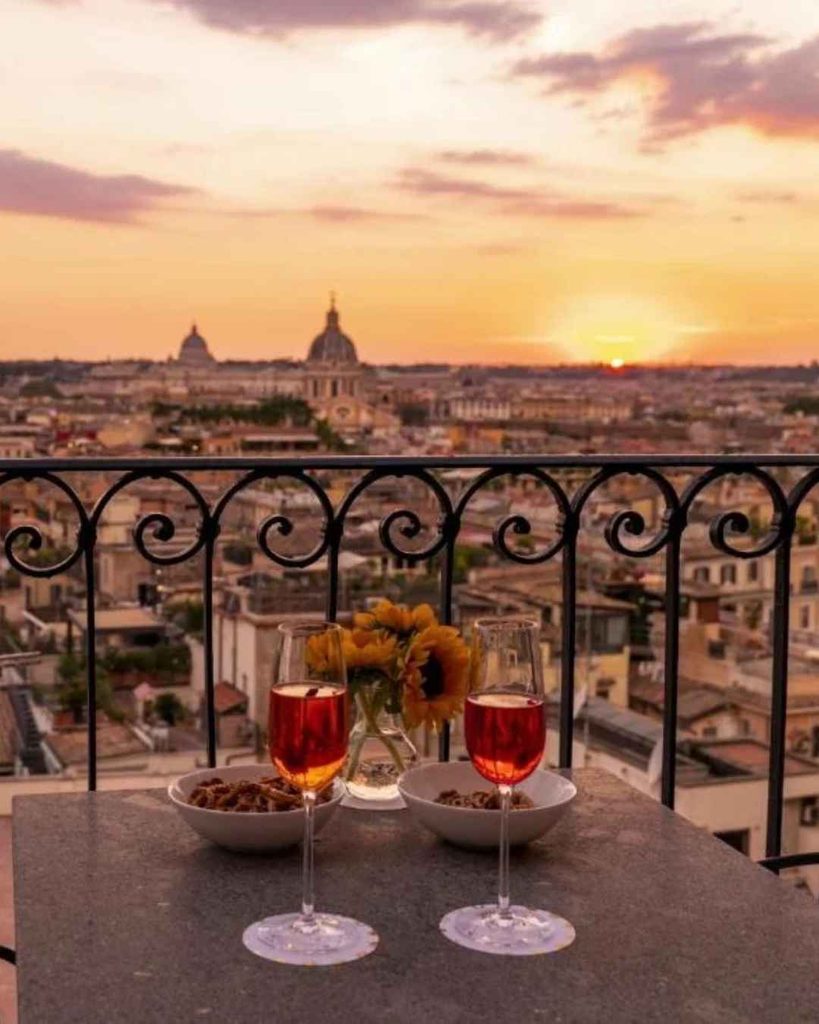
Choosing the right base can make or break a walking-focused trip to Rome. The good news is that this route passes through several neighborhoods that are ideal for walkers. Here are recommendations for every budget, organized by area.
Piazza del Popolo and the Northern Center
Staying near the start of the route means you can roll out of bed and begin walking immediately. This area is elegant, relatively quiet at night, and well connected by Metro.
The Hotel de Russie is the luxury choice, with a gorgeous terraced garden, though it comes with a correspondingly eye-watering price tag. For mid-range comfort, Hotel Valadier sits just off the piazza and offers a rooftop terrace with views over the city.
Budget travelers should look at the guesthouses and small hotels along Via del Babuino and the side streets off the piazza, where double rooms can be found for reasonable rates outside peak season.
The Spanish Steps and Via dei Condotti Area
This is the heart of Rome’s shopping district, which means high prices and heavy crowds, but also unbeatable convenience. The Hotel Scalinata di Spagna is a charming mid-range option right at the top of the Spanish Steps.
For a splurge, the Hotel Hassler at the top of the steps is a Rome institution with legendary views. Budget options are scarce here, but a handful of small pensione-style guesthouses operate on the upper floors of the buildings along Via dei Condotti and Via della Croce.
The Pantheon and Piazza Navona Area
This is arguably the best area to stay for a walking trip. You are in the dead center of the historic district, surrounded by restaurants, cafés, and narrow lanes, and every major sight on this route is within a fifteen-minute walk.
The Hotel Abruzzi faces the Pantheon directly and offers surprisingly reasonable rates for the location.
For a mid-range option with character, the Hotel Navona is a solid choice tucked into a quiet side street. Budget travelers should look at the hostels and guesthouses around Campo de’ Fiori and Largo di Torre Argentina, where dorm beds and simple private rooms are available at prices that are hard to find elsewhere in the center.
Monti
Just north of the Colosseum, Monti is Rome’s most charming “village within the city.” It is quieter than the centro storico, full of independent shops, wine bars, and excellent restaurants, and it puts you within a ten-minute walk of the Colosseum and the Forum.
The Hotel Forum Roma sits directly overlooking the Forum and is a mid-range favorite. For something smaller and more personal, the guesthouses along Via dei Serpenti and Via del Boschetto offer comfortable rooms at reasonable prices. This is also a great area for budget travelers, with several well-run hostels and B&Bs.
Trastevere
Across the Tiber, Trastevere is cobblestone lanes, ivy-covered walls, and a lively restaurant scene. It is slightly off this route but well worth considering as a base—the walk back to the historic center takes about twenty minutes along the river, and the evening atmosphere in Trastevere is unmatched.
The Hotel Santa Maria is a peaceful mid-range option set around a courtyard garden. Budget travelers will find plenty of hostels and guesthouses in the area, though the neighborhood can be noisy at night.
A Note on Booking
Whatever your budget, book well in advance if you are traveling in spring, summer, or early autumn.
Rome’s best-value accommodations fill up months ahead of time, and last-minute bookings in the historic center often mean paying luxury prices for mid-range rooms. If you are flexible, late autumn and winter offer lower rates and a quieter, moodier Rome that is still wonderful for walking.
Related post: The best neighborhoods to stay in Rome
Optional Detours Worth Adding
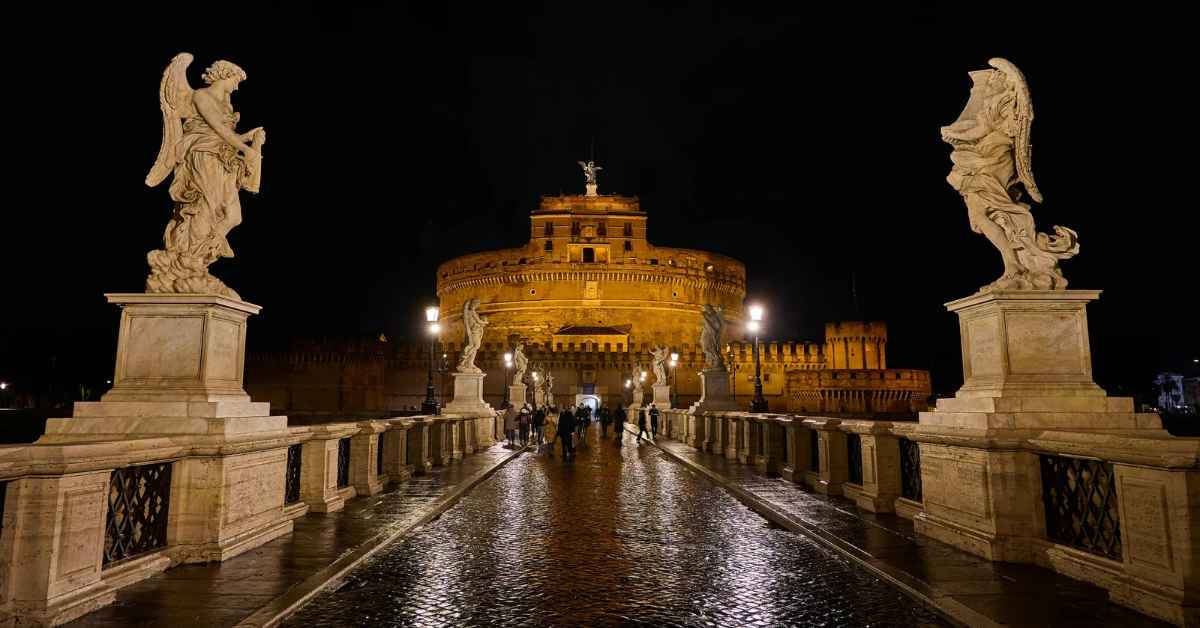
Castel Sant’Angelo and Ponte Sant’Angelo
If you have the energy and the time, cross the Tiber and walk along the river to Castel Sant’Angelo, the fortress-tomb of Hadrian that later became a papal refuge.
The bridge leading to it, Ponte Sant’Angelo, is lined with Bernini’s angels, each holding an instrument of the Passion. The walk from Piazza Navona takes about fifteen minutes.
St. Peter’s Square and St. Peter’s Basilica
Continue past Castel Sant’Angelo, and you will arrive at the Vatican. St. Peter’s Square is free to enter, and the basilica itself is free (though you will pass through security).
The climb to the dome costs money and involves a lot of stairs, but the view is the best in Rome. Note that this is a significant detour—at least half a day if you want to do it properly—and dress code is enforced.
Basilica of San Luigi dei Francesi
Just off Piazza Navona, this church contains three Caravaggio paintings in the Contarelli Chapel, including The Calling of St. Matthew. They are free to see, and the church is usually quiet. Do not miss them.
Basilica of Sant’Ignazio di Loyola
A few streets away, this Baroque church has a painted ceiling that creates an optical illusion of a dome that does not actually exist. It is a testament to the theatricality of the Counter-Reformation, and it is free to enter. Look up.
Practical Tips for Exploring Rome on Foot
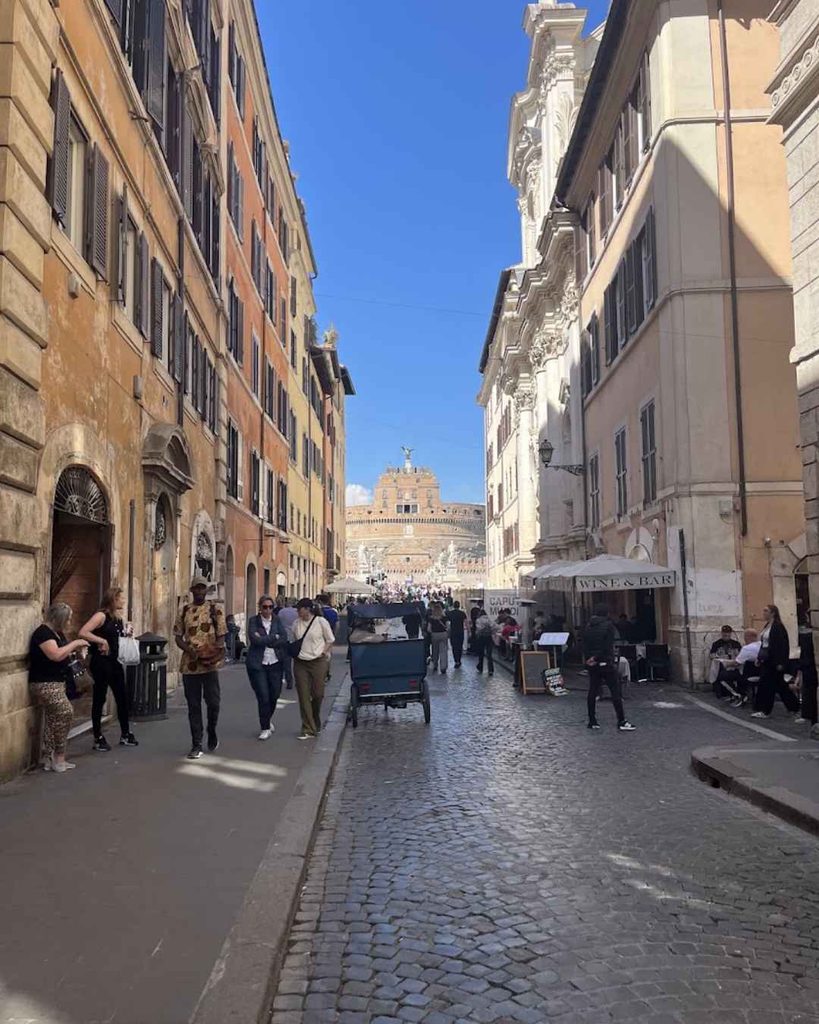
Avoiding crowds. Start early, take a long lunch break when the day-trippers are at their peak, and resume in the late afternoon. The hours between 1 and 4 PM are the most crowded in the center; use them for a slow meal or a museum visit.
Finding public drinking fountains. The nasoni are everywhere in the historic center. Look for the distinctive cast-iron spouts, often shaped like a nose or a column. The water is cold, fresh, and safe to drink. Fill your bottle and save your euros for gelato.
Avoiding tourist traps. Menus with photos, touts on the street, and restaurants directly facing major monuments are red flags. Walk two blocks away, and the quality improves dramatically.
Booking attractions in advance. The Colosseum is the big one, but the Borghese Gallery and the Vatican Museums also require advance booking. Do this before you leave home.
Navigating cobblestones. Sampietrini are beautiful and treacherous. Watch your step, especially when they are wet. Wear shoes with grip and ankle support. If it has rained, the stones become slick.
Staying safe and comfortable. Rome is generally very safe for walkers, but pickpockets operate in crowded areas—the Metro, the Trevi, the Spanish Steps, and the buses. Keep your valuables zipped and close. Take breaks. Sit when you can. Drink water. This is a long walk, and burnout is real.
Frequently Asked Questions
Can you see Rome in one day on foot?
You can see the highlights, yes—this route covers them. But “seeing” Rome in a day means moving quickly and skipping the moments that make the city special. If you only have one day, do the centro storico (Piazza del Popolo to Campo de’ Fiori) in the morning and ancient Rome (Campidoglio to Palatine) in the afternoon. It will be a whirlwind, but a memorable one.
How many kilometres is the walking route?
The core route is about 5 to 6 kilometers, depending on detours and how much you wander. With side streets and a Vatican extension, it can easily become 8 to 10 kilometers.
Is Rome easy to explore on foot?
Yes. The historic center is compact, largely flat (except for the Pincio and the Capitoline), and almost entirely pedestrian-friendly. Most of the major sights are within a twenty-minute walk of each other.
What is the best starting point?
Piazza del Popolo. It is easy to reach by Metro, it gives you a grand entrance into the city, and it puts the one significant climb (to the Pincio) at the very beginning of the day.
Can you walk from the Colosseum to the Vatican?
Yes, it is about 3.5 kilometers along the river, passing through Piazza Navona and across Ponte Sant’Angelo. It takes about 45 minutes to an hour at a steady pace, but you will want to stop along the way.
What are the best free attractions in Rome?
The Pantheon used to be free; it now charges, but most churches are free, including San Luigi dei Francesi with its Caravaggios and Sant’Ignazio with its painted ceiling. The piazzas—Navona, del Popolo, di Spagna—are free.
The Trevi Fountain is free to view from the piazza. The Vittoriano terrace is free. The view from the Pincio is free. And the simple act of walking these streets, which have been walked for millennia, costs nothing at all.
Rome does not reveal itself all at once. It gives you a temple embedded in a wall, a fountain that seems to have grown from the rock, a dome that opens to the sky. It gives you cobblestones that hurt your feet and espresso that jolts you awake and a view from a hill that makes you forget, for a moment, that you have anywhere else to be. Walk it slowly. Look up often. Let yourself get lost. The city will find you.
Again, feel free to go through the list below of my Italy recommendations that I have crafted after years of travel to this beautiful country:
- Packing List: Things Not to Go to Italy Without
- Must-Do Things: Unforgettable Experiences
- Where to Stay: Best Hotels in Italy.
- Where to Stay in Rome: Rome’s Best Neighborhoods
- Where to Stay in Florence: Picking the Best Area
- Where to Stay in Venice: Venice’s Best Districts
- Italy’s Cobblestone Streets: Best Shoes For the Job
- Backpack or Suitcase?: Italy Luggage Guide
- Travel Insurance: Always Be Covered
- E-Sim: Be Connected At All Times