
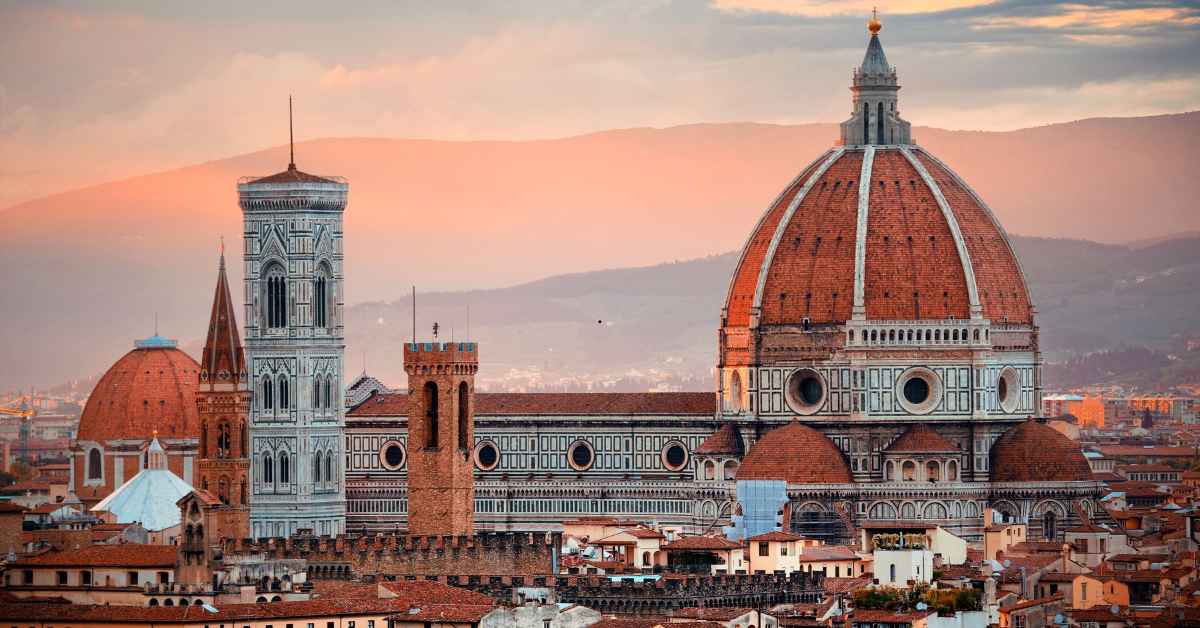
Italy has lots of magnificent buildings. There are, however 2 that are my personal favorites. The first one is the Pantheon back in Rome, and the second one is the Santa Maria Del Fiore in Florence, commonly known as the Florence Duomo.
I will never forget the first time I saw it with my own eyes. My wife and I were walking from the train station to our hotel, and lo and behold, there it was! Big and beautiful. The grotto bell tower and the baptistery complement the Duomo in a way I can’t explain.
Fun fact: The best place to see and appreciate the beauty of the Duomo is from Piazzale Michelangelo, especially in the evening when the sun is setting. Booking a hotel with a great view of the Duomo is another excellent idea, if budget allows.
The Florence Duomo has more to offer than just looks. The more you learn about it, the more you appreciate it, and the more you fall in love with Florence, the cradle of the Renaissance.
Most people see the Duomo from the outside, snap a photo, and move on to the next item on their list. That’s fine. Florence has a lot to offer, and the Uffizi isn’t going to visit itself.
But here’s what they miss: the Duomo is not just a building you look at. It is a building you can enter, climb through, and stand inside in ways that reveal how it was built, how it was almost destroyed, and how it survived.
The cathedral has been under construction for so long that it has changed its face three times. It has been struck by lightning dozens of times. Its most famous architect took the secret of how he built the dome to his grave, and people are still arguing about what that secret was.
This article is for the traveler who wants more than the postcard. It’s for the person who looks at a 600-year-old dome and wonders: how did they do that, and why does it still matter?
Before you read further, remember that Italy rewards travelers who come prepared. I’ve found a few things especially useful on an Italy trip, and they’re worth having and/or knowing beforehand. See the checklist here
1. The Architect Had No Architecture Training
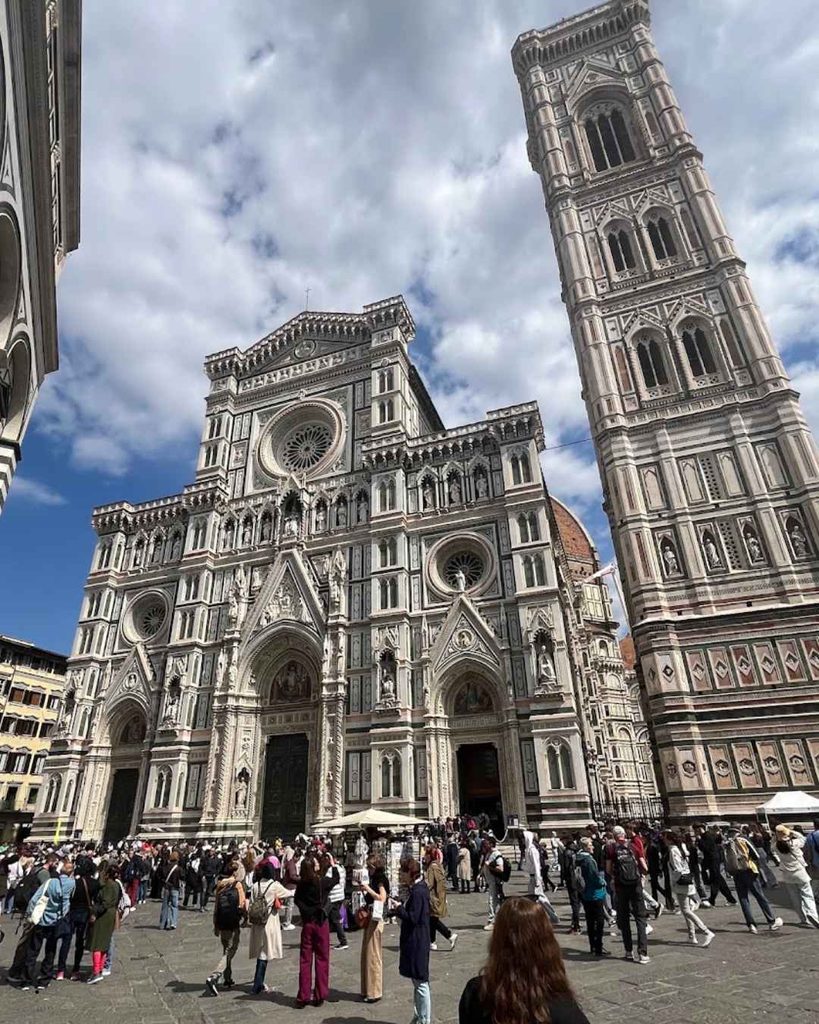
Filippo Brunelleschi had no formal training as an architect. He was a goldsmith, apprenticed at fifteen, trained to set stones, cast metal, and work with enamels. Goldsmiths in his era were expected to know how to solve mechanical problems, and Brunelleschi took to that part of the trade with particular intensity. He also studied clockmaking, which gave him a working knowledge of weights, wheels, and gears.
That background turned out to be more useful than any architecture degree. Building a dome 150 feet wide, starting 180 feet in the air, required inventing machines that didn’t exist yet — cranes, hoists, and pulley systems capable of lifting tons of stone and brick without a wooden support structure underneath.
By 1418, the cathedral had been under construction for over 120 years, and the dome opening was still exposed to the sky. The challenge was simple to state and terrifying to attempt: span the octagonal opening without traditional centering, the wooden scaffolding that would normally hold the dome up while it was being built.
The problem was that centering for an opening that size would have required forests’ worth of timber, and Florence didn’t have it.
Brunelleschi proposed something radical. He would build a double-shell dome: a thick inner shell that carried the structural load, and a lighter outer shell to protect it from the weather. Twenty-four stone ribs would connect the two shells. Horizontal chains of stone, timber, and iron would act like rings around a barrel, resisting the outward pressure that would otherwise split the dome apart.
And the bricks would be laid in a herringbone pattern, which allowed the masonry to lock itself in place as it rose, preventing bricks from sliding before the mortar cured.
It worked. The dome was completed in 1436, just sixteen years after construction began — an astonishingly short time given that the cathedral itself took over 140 years. But here’s the thing: Brunelleschi left no complete drawings, no detailed calculations, no written explanation of his method. He carried the secret to his grave.
2. No One Has Ever Fully Figured Out How He Built It
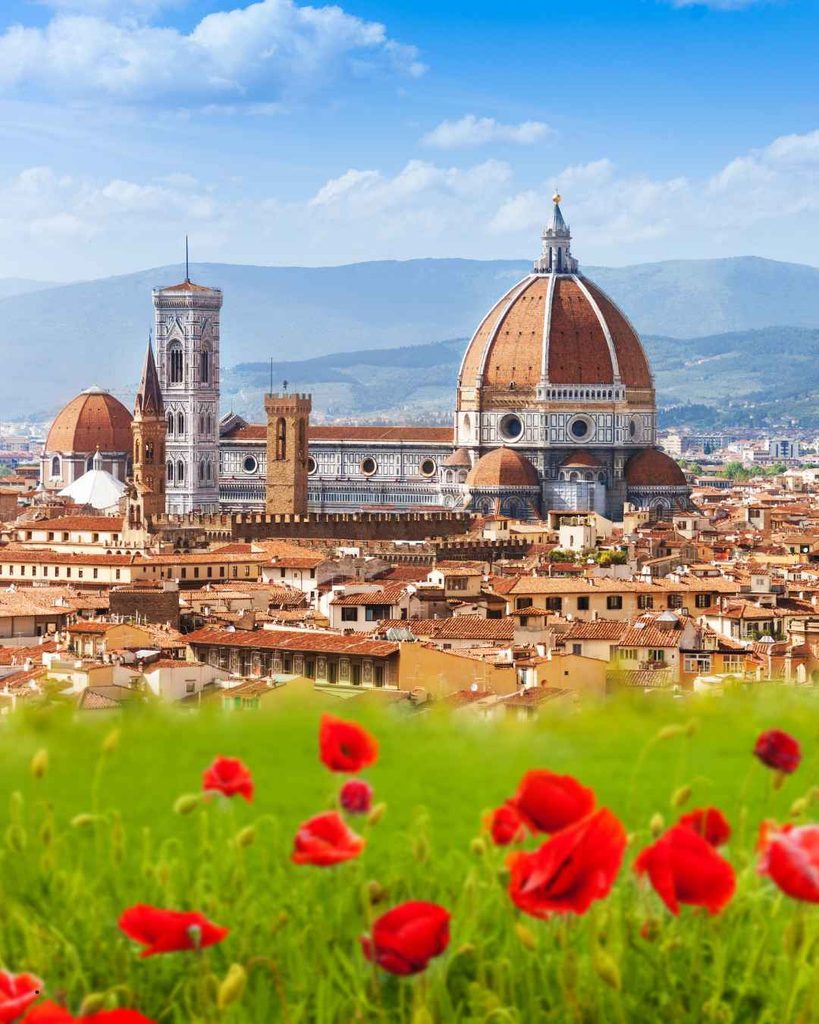
For centuries, architects and engineers have tried to figure out exactly how Brunelleschi positioned every brick and stone with such precision inside that vast, complex structure. Modern architects with laser levels and CAD software would still find the task challenging.
One man has spent most of his life trying to solve it. Massimo Ricci, an architect from an old Florentine family, has been building a scale model of the dome since 1989 in a park on the south bank of the Arno. The model is thirty-three feet across at its base and contains about 500,000 bricks.
Ricci’s theory involves a web of fixed and mobile chains. He suspended a star-shaped hub in the center of his model dome, stretched eight chains from its points to hooks in the walls, and then linked those chains with horizontal ropes that traced arcs along the rising walls. Seen from above, the ropes resemble the petals of a flower.
That last detail is worth sitting with for a moment. The cathedral is called Santa Maria del Fiore — Saint Mary of the Flower. The symbol of Florence is the lily. If Ricci is right, Brunelleschi built the dome using a literal flower of ropes and chains, and the name of the building had been pointing at the method all along.
Ricci’s model is still under construction. It may never be finished. But it has already revealed something about how the dome might have been built that no document ever recorded.
There is another layer to the mystery. Brunelleschi’s dome was built without a wooden centering framework, but that doesn’t mean the bricks were placed freehand. The herringbone pattern itself is a kind of self-supporting system. Each brick leans against its neighbor, and the weight of the rising courses presses them together.
The spiral arrangement means that no single brick is ever unsupported for long. It is a technique that predates modern structural engineering by centuries, and yet it works on a scale that modern engineers still find remarkable.
What makes it more impressive is that Brunelleschi was working from the ground up, with no way to inspect the interior of the dome as it rose. He had to trust his geometry, his chains, and his own calculations completely. If he was wrong at any point, the entire structure could have collapsed inward before anyone could correct it.
3. The Facade Was Demolished and Left Blank for Centuries
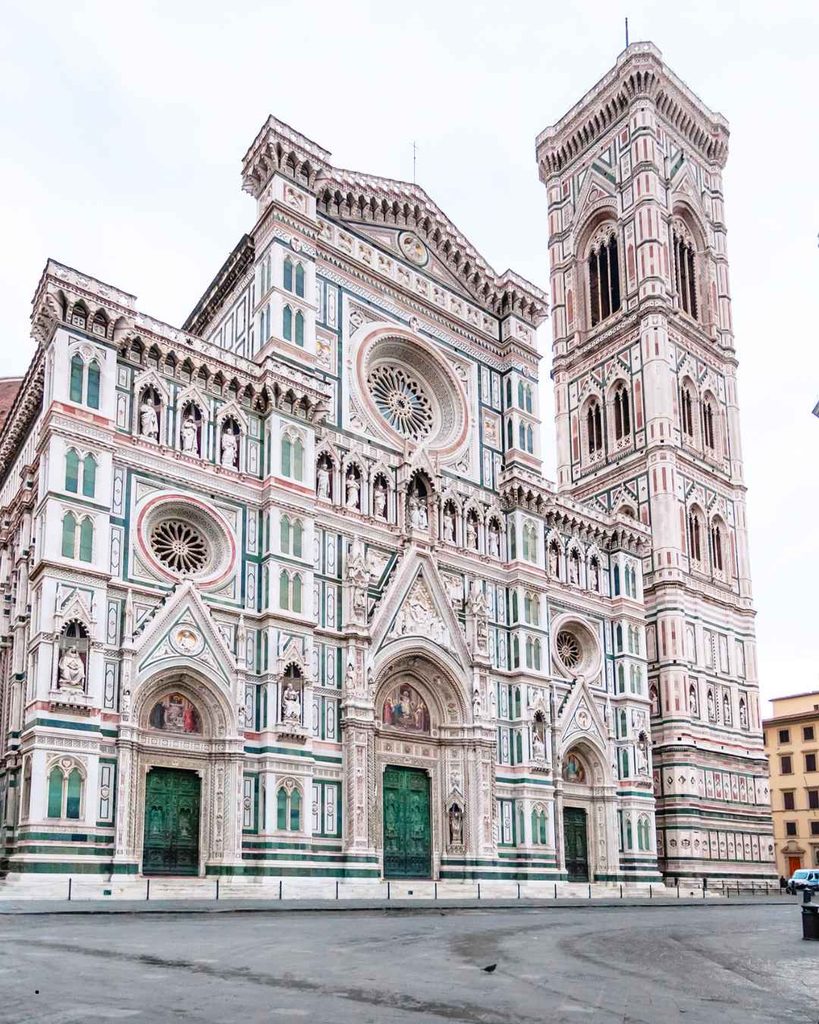
The cathedral you see today has a facade of green, white, and red marble, neo-Gothic in style, completed in 1887. It is not the original. It is not even the second version.
The first facade was begun by Arnolfo di Cambio in the late thirteenth century. It was covered in colored mosaics, loggias, niches, and galleries, with statues of the Virgin Mary, martyrs, and angels. Donatello and other masters contributed sculptures in the early 1400s. But the facade was never finished — only about a third of its height was completed.
In 1587, Grand Duke Francesco I de’ Medici decided the medieval facade was outdated. He ordered it demolished. The medieval marbles were detached, many decorative elements destroyed, dozens of statues dispersed to private villas and gardens.
And then nothing happened. For centuries.
Three Grand Dukes tried to revive the project. Buontalenti, Giambologna, Dosio, and others created elaborate wooden models — seven of which survive in the Duomo Museum today. None were built.
In 1689, for the wedding of Grand Duke Cosimo III’s son, a colossal mural painting was applied to the facade — a temporary, sepia-toned illusion of architecture. Traces of it were still visible in early photographs of the cathedral from the 1850s.
The current facade was finally completed only in 1887, designed by Emilio De Fabris after multiple international competitions. It was deliberately neo-Gothic, chosen to evoke the medieval communes and to celebrate Italian unity and freedom from foreign rule.
Stand in the piazza today and look up. What you’re seeing is a nineteenth-century answer to a sixteenth-century question that nobody could agree on for three hundred years.
What makes the story stranger is that the demolition was not universally popular. Some Florentines objected at the time, and the dispersal of the statues meant that pieces of the original facade ended up in private collections, some of which have never been recovered.
The Duomo Museum has reassembled what it can, but the original facade is gone in a way that is more complete than most people realize. It is not just that the facade was replaced. It is that the replacement took three hundred years, and in the meantime the cathedral stood with a bare, unfinished front, as if the city had simply given up on the idea of finishing it.
4. The Golden Ball at the Top Has Been Hit by Lightning Repeatedly
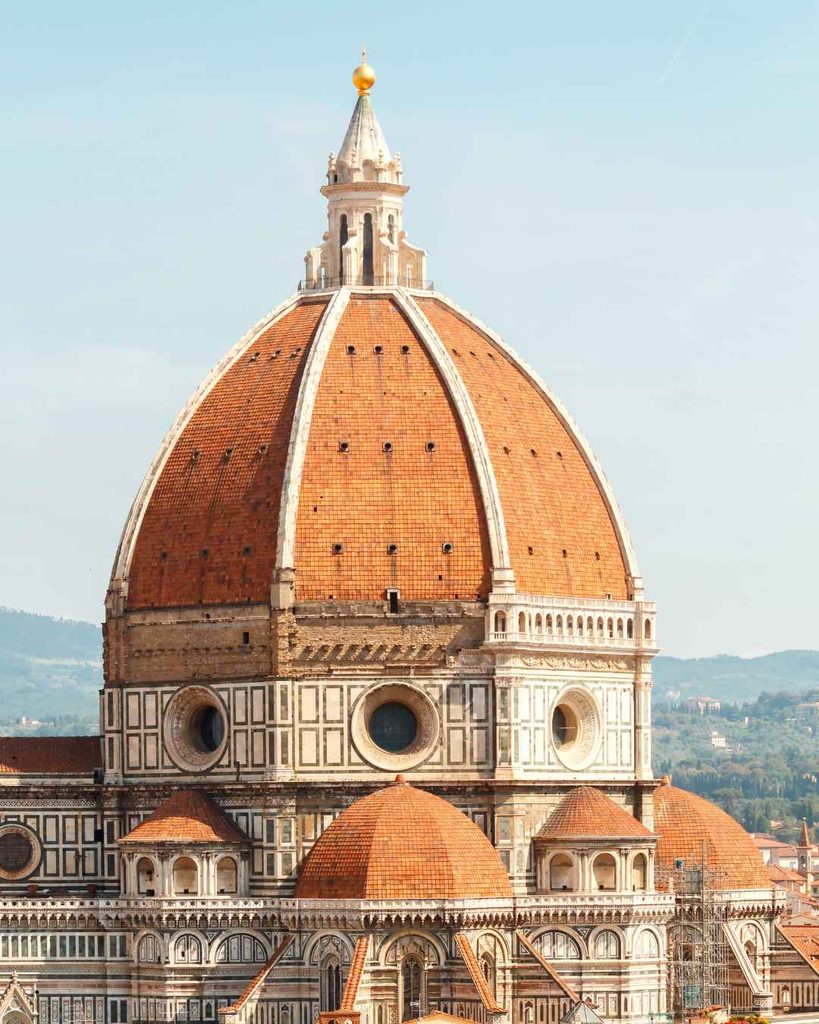
At the top of the lantern, almost 380 feet above the piazza, sits a gilded copper ball. It is about two and a half meters in diameter and weighs almost two tons. Andrea del Verrocchio designed it, and it was placed in 1471. Leonardo da Vinci, then a teenager in Verrocchio’s workshop, likely participated in its creation and hoisting.
Neither Verrocchio nor anyone else realized that a massive copper sphere at the highest point in Florence would become an extraordinary lightning magnet.
Between 1471 and 1859, at least twenty-seven significant lightning strikes hit the apex of the cathedral. In 1492, a strike was interpreted as a premonition of Lorenzo the Magnificent’s death. On the night of January 26, 1601, a massive bolt damaged the lantern and caused the ball to fall.
The impact damaged the lantern below, and marble pieces tumbled down the slopes of the dome, landing on the vaults of the nave and the cornice. Some stone landed on buildings and streets nearby, exploding on impact; pieces were found as far away as Via de’ Servi.
The ball was rebuilt and put back in place by October 1602. A white marble plaque embedded in the pavement on the eastern side of the piazza still marks the exact spot where it landed.
A lightning rod was finally installed in 1859, ending four centuries of electrical bombardment.
There is a symbolic dimension to the ball that is easy to miss. It represents the world under the supremacy of God, and it stands in deliberate dialogue with the lion on the tower of the Palazzo Vecchio, the symbol of civic power.
The cathedral’s sphere and the city’s lion were meant to face each other across the piazza, a conversation between divine and earthly authority. The fact that the ball kept getting struck by lightning gave that conversation an unexpected edge.
5. There Are Hidden Terraces and Rooms Most Visitors Never See
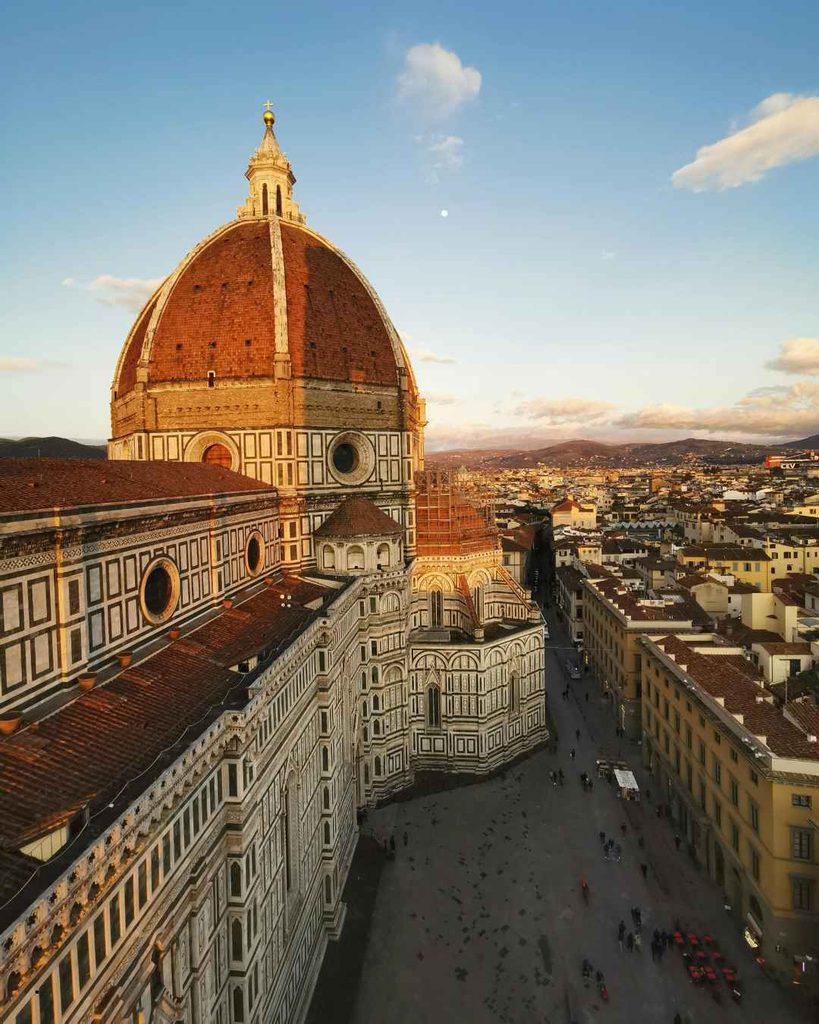
Most visitors climb the dome and call it a day. Another layer of the Duomo requires a specialized guided tour: the northern terrace, a hidden gallery thirty-two meters above the piazza that has been closed to the general public for centuries.
The tour also opens a circular room where original statues from the cathedral’s facade are kept, and where conservators continue active restoration work. The smell of stucco and the sight of conservators at their benches give the visit an authenticity that polished museum displays rarely match.
Access to these spaces is limited and must be booked separately. It is not included in the standard combined ticket.
The northern terrace is not just a viewpoint. It is a working part of the cathedral’s maintenance system. From there, restorers can access the exterior of the dome and the lantern without erecting scaffolding from the ground.
The terrace has been used for centuries for exactly this purpose, and it remains in use today. Standing on it, you are closer to the dome’s exterior than any other publicly accessible point, and you can see the marble panels and the brickwork in a way that is impossible from the piazza.
If you want to do a guided tour that shows all of that, this is the one I would recommend.
6. The Climb Is 463 Steps Through the Inside of the Dome
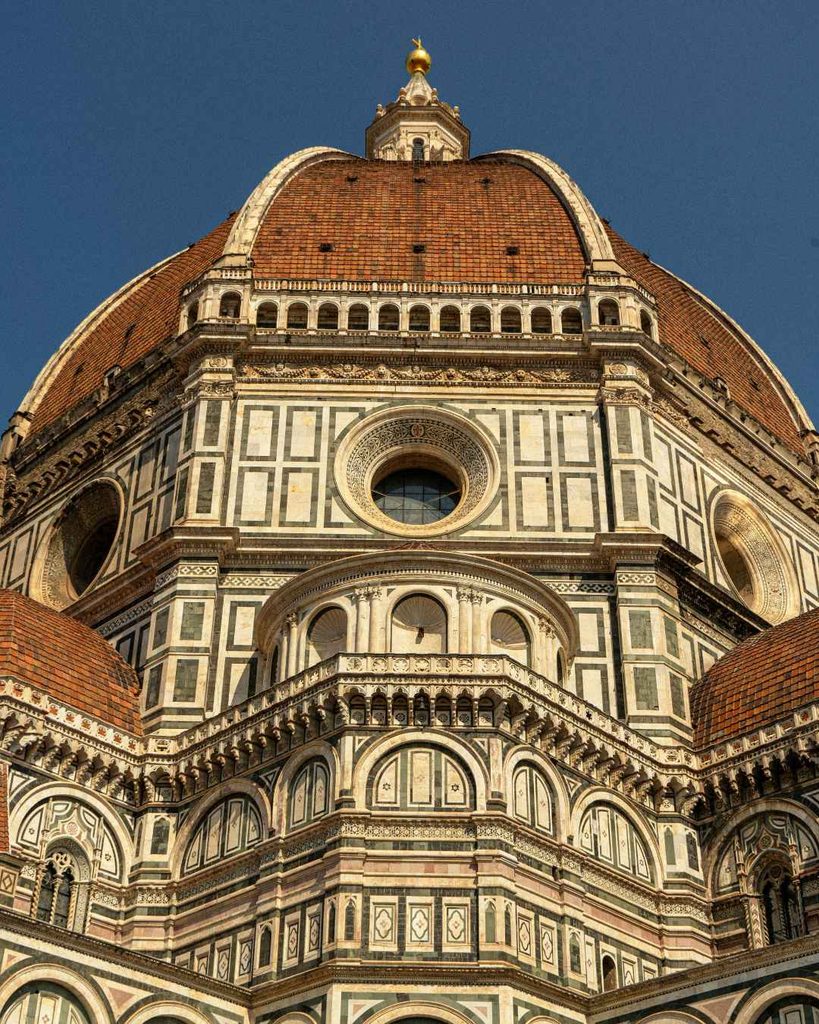
The dome climb is 463 steps. There is no elevator. The stairs were built for construction and maintenance, not for tourists, and they are narrow in several sections.
The climb happens in stages. First, about 150 steps to the base of the dome, where you step onto an interior balcony. From here you are suddenly level with the Last Judgment frescoes, close enough to see details invisible from the cathedral floor. The fresco covers 3,600 square meters and contains roughly 700 figures, painted by Giorgio Vasari and completed after his death by Federico Zuccari.
Then you continue through the space between the inner and outer domes — the double shell that makes the structure possible. These passages are narrow, sloping, and can feel claustrophobic. You are walking inside the architecture, seeing the herringbone brickwork and the stone chains that hold the whole thing together.
At the top, you step out onto the lantern terrace. The view is the best in Florence. You can see the Palazzo Vecchio, the Ponte Vecchio, Santa Croce, Santa Maria Novella, and on a clear day, the hills of Fiesole.
There is a time limit of about forty-five minutes for the ascent and descent. It is not a leisurely museum visit. It is a physical effort combined with an architectural immersion that has no equivalent in the city.
My wife and I did the climb on our first trip to Florence. She has a healthy respect for heights — the kind that makes her grip the railing with both hands and refuse to look down. I had to coax her past the interior balcony. She made it to the top, and she still talks about the view.
One detail that most people miss on the way up is the graffiti. Not modern graffiti, but centuries-old marks scratched into the plaster by workers and visitors. Some of them date back to the construction period. They are easy to overlook in the dim light of the stairwells, but they are a reminder that the dome has been a living, working space for hundreds of years, not just a monument.
7. Tickets, Booking, and Practical Details
The dome cannot be booked separately. You have to buy the combined ticket for the entire Duomo complex, which costs about thirty euros and covers the dome climb, Giotto’s Bell Tower, the Baptistery, the Duomo Museum, and the crypt. It is valid for seventy-two hours from first use, which means you can spread the attractions across multiple days.
Book in advance. During peak season, dome slots sell out weeks or even months ahead. Morning slots are less crowded. Winter is quieter.
Backpacks and large bags are not allowed inside. There is an official luggage storage area, but it’s easier to travel light.
The climb is not accessible to wheelchair users or anyone with significant mobility limitations. It is also not recommended for people with heart conditions, claustrophobia, or severe breathing issues.
If you only have time for one climb, choose the dome over the bell tower. The dome experience takes you through Brunelleschi’s double-shell structure and past the frescoes at close range. The bell tower gives you a view of the dome from outside, which is nice, but the dome climb is the one that shows you how the thing was built.
A few more practical notes. The Baptistery is worth a visit on its own, and its bronze doors are among the most famous sculptures in Florence. The Duomo Museum houses the original artworks from the cathedral, including the statues that were removed from the facade.
The crypt contains the remains of the original cathedral of Santa Reparata, which was demolished to make way for the Duomo. Each of these is included in the combined ticket, and each is worth at least an hour.
If you are traveling with someone who is not comfortable with heights, the bell tower is a reasonable alternative. It has 414 steps, and the views are still excellent, but the experience is less immersive. The dome climb is the one that takes you inside the structure, and it is the one that most people remember.
The best place to buy tickets is from the official website. If you, however, need a guided tour, or if you can’t find a ticket on the official website, check out the options available here.
8. The Dome Is Still Being Studied Today
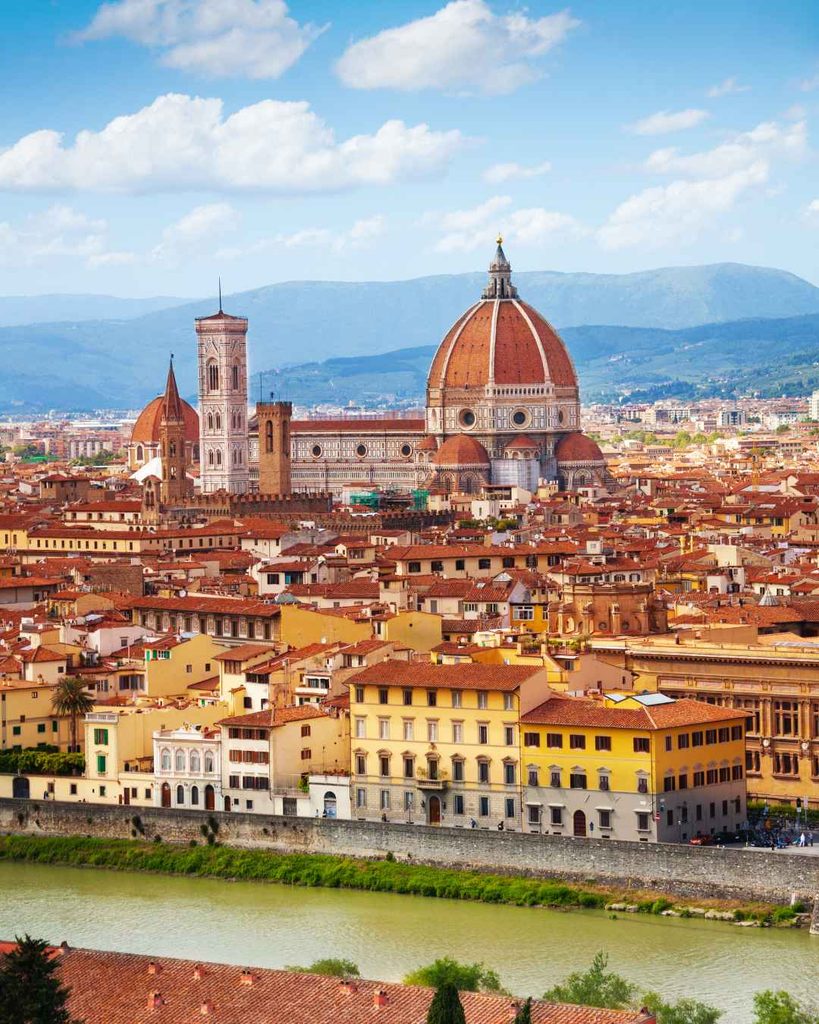
The Duomo is not a finished relic. It is still being studied, still being restored, still being argued about. Massimo Ricci’s half-million-brick model is still under construction after more than thirty years. Engineers are still publishing papers analyzing how the herringbone brickwork distributes weight and thrust through the structure, and what those techniques might teach modern builders about constructing without temporary supports.
Brunelleschi was described by a contemporary as homely and hot-tempered. He was secretive, competitive, and apparently content to let the dome’s methods die with him. He succeeded anyway. The dome he built is still the largest masonry dome on Earth, still standing, still defying the expectations of everyone who thought it would collapse.
My wife took a photo from the lantern terrace, looking down at the piazza where we had stood an hour earlier. In the photo, the people are tiny. The cathedral casts a long shadow across the square. It is the kind of image that makes you realize how much of this city was built by people who knew they would never see it finished.
The Duomo took over 140 years to complete. Brunelleschi died before the lantern was finished. The facade he never saw was demolished and replaced by one he couldn’t have imagined. And still, every day, thousands of people climb 463 steps to stand where he stood and look out at the city he helped create.
The secret of how he did it may never be fully known. But the dome is still there. That’s the only proof that matters.
Worth Reading: Why Every Woman Should Carry a Scarf When Visiting Italy
Again, feel free to go through the list below of my Italy recommendations that I have crafted after years of travel to this beautiful country:
- Packing List: Things Not to Go to Italy Without
- Must-Do Things: Unforgettable Experiences
- Where to Stay: Best Hotels in Italy.
- Where to Stay in Rome: Rome’s Best Neighborhoods
- Where to Stay in Florence: Picking the Best Area
- Where to Stay in Venice: Venice’s Best Districts
- Italy’s Cobblestone Streets: Best Shoes For the Job
- Backpack or Suitcase?: Italy Luggage Guide
- Travel Insurance: Always Be Covered
- E-Sim: Be Connected At All Times