
Rome is not the city where Michelangelo was born, and it is not the city where he is buried. But it is the city where he became Michelangelo.
He arrived as a young man of twenty-one, already skilled but not yet famous. He left, decades later, as the most celebrated artist in the Western world.
In between, he created works in Rome that changed the course of art history. Most travelers see one or two of his Roman masterpieces. They queue for the Sistine Chapel, or they stop at the Pietà on their way through St. Peter’s.
But Michelangelo left his mark across the city in ways that most visitors never discover. There is a colossal statue of Moses hidden in a quiet church in Monti. There is a sculpture of Christ that Michelangelo abandoned and that was finished by his assistants.
There is a piazza that he designed on a hilltop, a monument to civic power that still functions as the seat of Rome’s government. This article is a complete guide to Michelangelo’s works in Rome. It covers where to find them, what to look for, and the stories behind them.
It is organized by location, so you can plan your visits efficiently. By the end, you will have a map of Michelangelo’s Rome, and a deeper understanding of why these works still matter.
Before you read further, remember that Italy rewards travelers who come prepared. I’ve found a few things especially useful on an Italy trip, and they’re worth having and/or knowing beforehand. See the checklist here. Also, if you want me to plan an Italy trip for you that you will never forget, drop me a message here
1. The Pietà: The Masterpiece That Made His Name
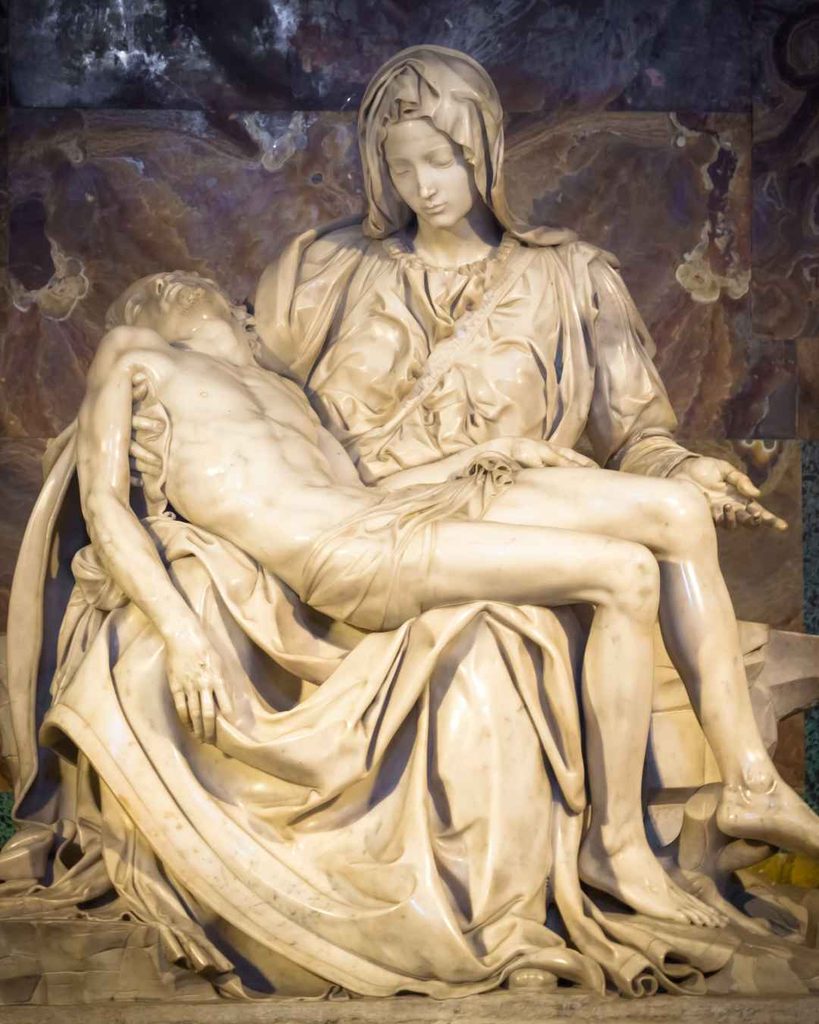
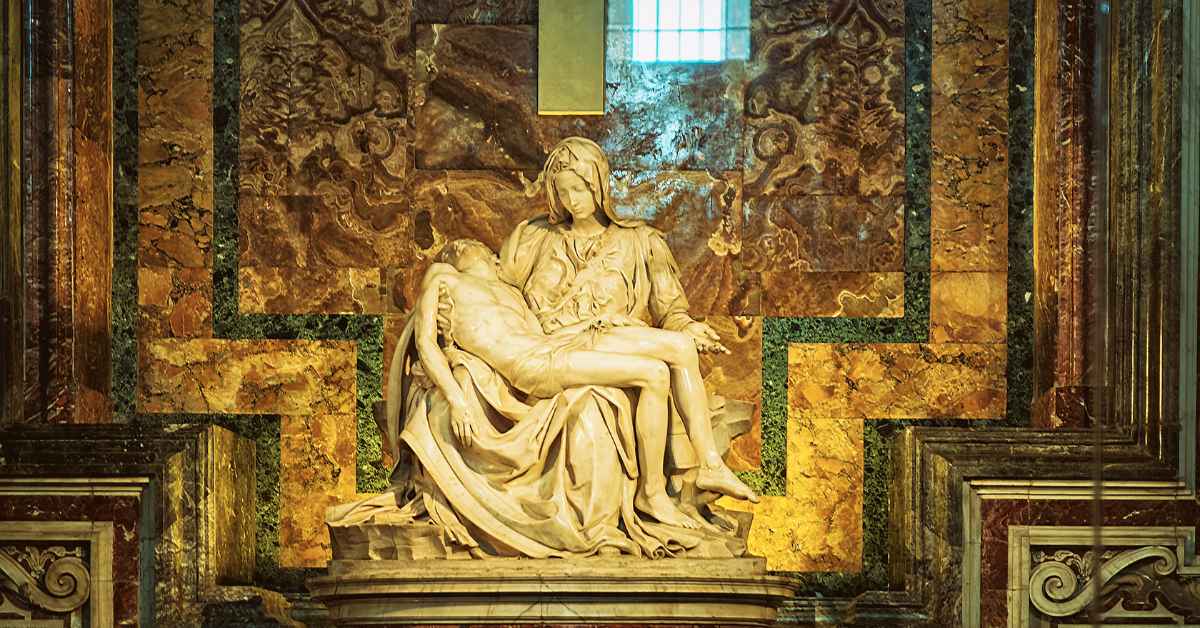
The Pietà is the first great work Michelangelo completed in Rome, and it is still the one that moves people most. It is in St. Peter’s Basilica, in the first chapel on the right, and it is impossible to miss. But it is worth more than a glance.
Michelangelo was twenty-three years old when he received the commission. A French cardinal, Jean de Bilhères Lagraulas, wanted a monument for his tomb in the Chapel of the King of France.
The contract described the work as “a robed Virgin Mary with the dead Christ in her arms, as large as a good-sized man.” Michelangelo carved it from a single block of Carrara marble in just nine months.
What makes the Pietà extraordinary is not just its technical perfection but the way it tells a story. Mary holds the body of her son with a composure that is almost impossible to describe. She does not weep. She does not wail.
Her face is young, younger than her son’s, because she is Immaculate and without sin. Her right hand supports Christ’s body, while her left hand invites the viewer to look, to contemplate, to adore.
The sculpture is designed to be seen from the front, but if you move to the side, you will notice something remarkable. Mary’s body is larger than it should be, scaled up so that she can cradle a full-grown man without appearing to struggle.
This is a deliberate choice, a way of making the impossible seem natural. The Pietà is the only work Michelangelo ever signed. The inscription is carved on the sash that crosses Mary’s breast.
Vasari wrote that Michelangelo signed it because he was proud of the work. He also wanted to claim it as his own after hearing visitors attribute it to another sculptor.
The Pietà has survived more than five centuries, but it has not been without incident. In 1972, a man attacked the statue with a hammer, damaging Mary’s arm and face.
The restoration took years, and the sculpture is now behind bulletproof glass. It is still possible to see it up close, but you cannot approach it as closely as you once could.
The Pietà is in St. Peter’s Basilica, which is free to enter. The basilica is open daily, and the Pietà is in the first chapel on the right. Arrive early in the morning to avoid the crowds.
2. The Sistine Chapel Ceiling: The Work That Changed Everything
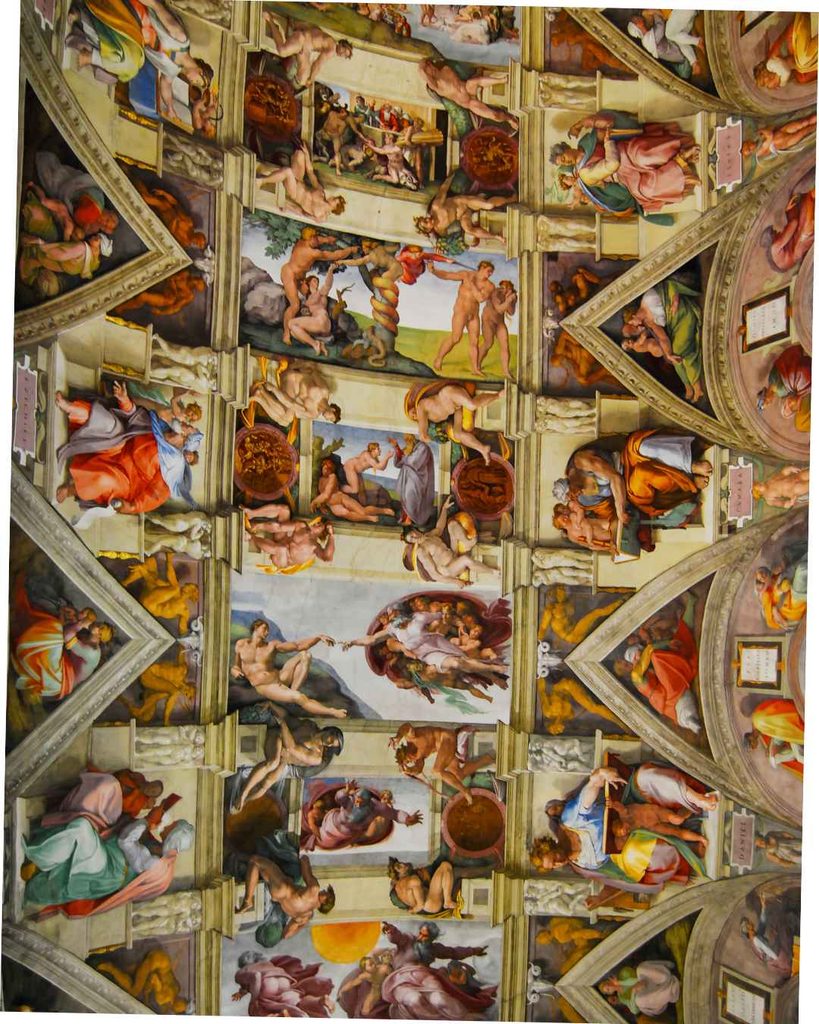
The Sistine Chapel ceiling is the most famous work of art in the world, and it is the reason most travelers visit the Vatican Museums. But the story behind it is less well known than the ceiling itself.
Michelangelo did not want the commission. He considered himself a sculptor, not a painter, and he initially refused. Pope Julius II insisted.
The original contract called for the twelve apostles in the lunettes, with ornamental decoration elsewhere. Michelangelo rejected this as “a poor thing” and proposed something far more ambitious.
He proposed a vast scheme covering the entire ceiling with scenes from Genesis. It would be surrounded by prophets, sibyls, and ancestors of Christ.
The work took four years, from 1508 to 1512. Michelangelo painted standing on scaffolding, not lying on his back as the myth suggests. The conditions were difficult, and the project damaged his health.
He wrote a sonnet complaining about the physical toll. The ceiling is best understood not as a single image but as a narrative. The central panels tell the story of Creation, the Fall, and the Flood.
The prophets and sibyls around the edges foretell the coming of Christ. The ancestors of Christ in the lunettes trace the human lineage that leads to the birth of Jesus.
The whole scheme is a meditation on God’s relationship with humanity. It moves from the creation of the world to the promise of redemption.
The Sistine Chapel is inside the Vatican Museums, which require a ticket and a reservation. The ceiling is best seen in the early morning, before the crowds make it impossible to look up without being pushed.
The museums open at nine, and the first hour is the quietest. Book your ticket in advance, and go directly to the chapel when you enter.
3. The Moses: The Statue That Was Never Meant to Be Here
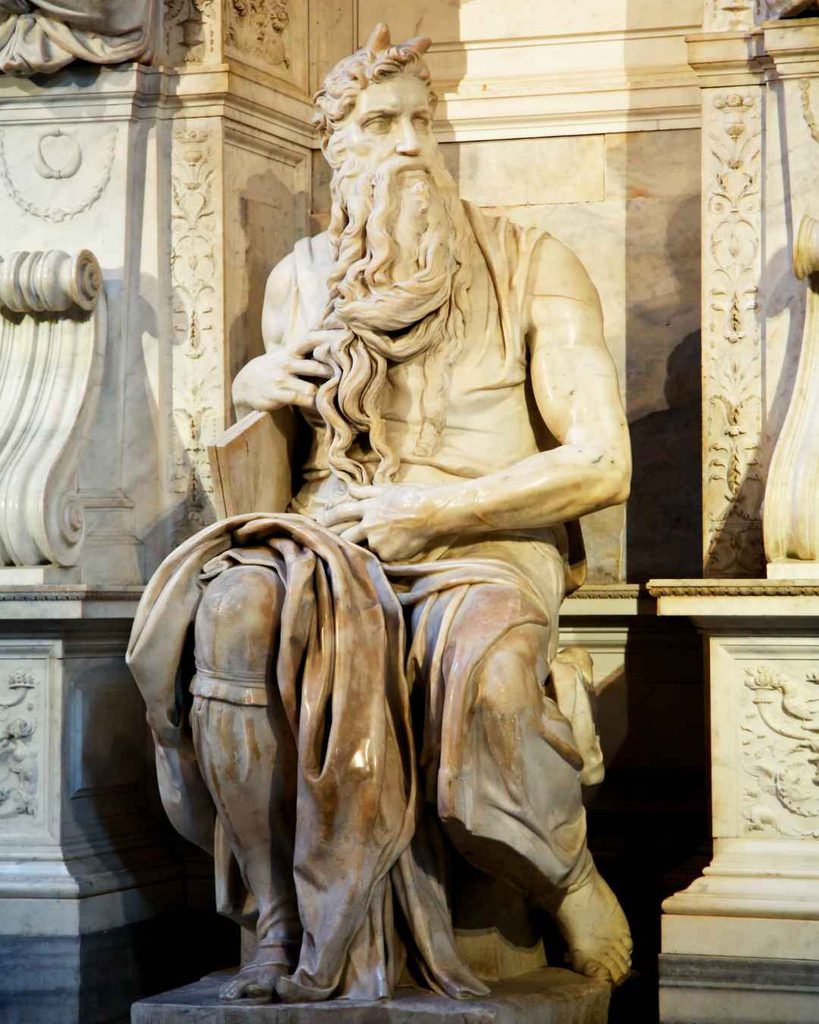
The statue of Moses is in the Church of San Pietro in Vincoli, in the Monti neighborhood. It is one of the great underappreciated masterpieces in Rome.
It was intended for the tomb of Pope Julius II, which Michelangelo worked on for forty years and never finished. The story of the tomb is one of the great frustrations of Michelangelo’s career.
Julius II commissioned a monumental mausoleum in 1505. It would have been one of the wonders of the Renaissance. But the pope’s attention shifted to the rebuilding of St. Peter’s, and the tomb was scaled back again and again.
When Julius died in 1513, the project was far from complete. The final version, installed in San Pietro in Vincoli in 1545, is a fraction of what Michelangelo had envisioned.
The Moses was carved in 1513, but Michelangelo did not complete it until 1542, nearly thirty years later. It depicts the moment after Moses has received the Ten Commandments and descended from Mount Sinai.
He finds the Israelites worshipping a golden calf. Moses is angry, and the anger is visible in every line of the sculpture. His muscles are tensed, his veins are swollen, and he seems to be on the verge of rising to his feet.
The horns on Moses’s head are one of the most discussed details of the sculpture. They come from a mistranslation of the Hebrew Bible.
The Hebrew word “keren” can mean both “rays” and “horns.” The Latin Vulgate translation that Michelangelo knew used “horns.” The result is a Moses who looks slightly demonic, though this was not the intention.
The horns were understood as a sign of divine radiance, not of evil. Vasari wrote that the Moses was so realistic that Michelangelo, upon finishing it, struck the statue and ordered it to speak.
The story may be apocryphal, but it captures something true about the sculpture. It is not a statue of a man. It is a man, rendered in marble, with all the complexity and contradiction that implies.
San Pietro in Vincoli is free to enter, and the Moses is in the right transept. The church is in Monti, a short walk from the Colosseum and the Cavour metro station.
4. The Risen Christ: The Work That Went Wrong
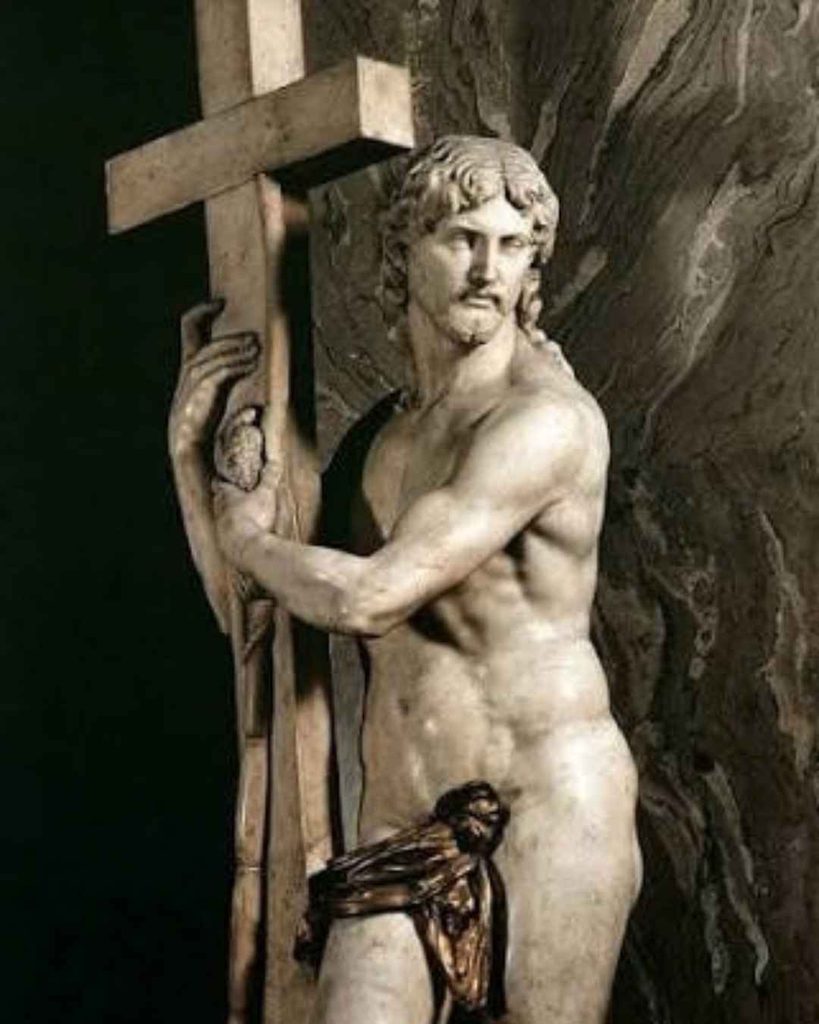
The Risen Christ, in the Church of Santa Maria sopra Minerva, is the most debated of Michelangelo’s Roman works. It was commissioned in 1514 by Metello Vari and Pietro Castellani.
Michelangelo began work on it shortly after. But a defect in the marble, a dark vein running through the face, caused him to abandon the first version.
He began a second version in Florence, which was dispatched to Rome in 1521. By that time, Michelangelo had left Rome, and he delegated the completion of the sculpture to his assistant Pietro Urbano.
Urbano’s work was so poor that another artist, Federico Frizzi, was brought in to finish it. The result is a sculpture that is partly Michelangelo and partly not.
The Risen Christ depicts Jesus after the resurrection, standing naked with the cross and the reed. The figure is muscular and vigorous, a representation of Christ’s triumph over death.
But the face is passive, and the pose is somewhat awkward. Some critics have argued that the sculpture lacks the power of Michelangelo’s other works, and that the involvement of assistants diluted its quality.
Others have defended it, arguing that the very awkwardness of the figure reflects Michelangelo’s experimentation with new compositional solutions. The statue is in the left transept of Santa Maria sopra Minerva, one of the few Gothic churches in Rome.
The church is near the Pantheon, and it is free to enter. The Risen Christ is worth seeing not because it is Michelangelo’s best work, but because it is a reminder that even the greatest artists sometimes fail.
Their failures can be as interesting as their successes.
5. The Capitoline Hill: Michelangelo as Urban Planner
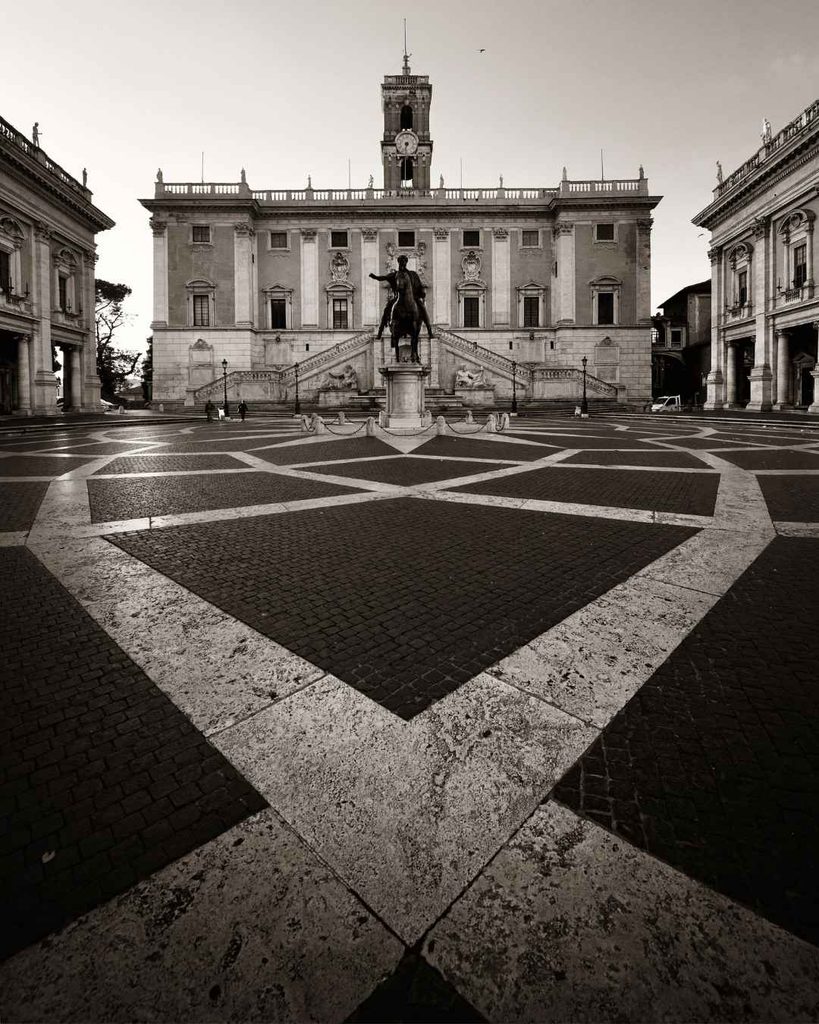
The Piazza del Campidoglio, on the Capitoline Hill, is one of Michelangelo’s most important works. It is also one of the least understood. It is not a building or a sculpture.
It is a public space, a civic square, and it represents a new way of thinking about how cities should be organized. Michelangelo was commissioned to redesign the Capitoline Hill in 1536.
The occasion was the visit of the Spanish Emperor Charles V. The hill had been the religious and political center of ancient Rome. By the sixteenth century, it was neglected and disorganized.
Michelangelo’s design transformed it into a unified space. He created a new façade for the Palazzo Senatorio, redesigned the Palazzo dei Conservatori, and added a new building, the Palazzo Nuovo, on the opposite side.
The three buildings frame the square. The equestrian statue of Marcus Aurelius, placed on a pedestal in the center, provides the focal point.
The design is remarkable for its symmetry and its use of perspective. The Cordonata, the wide stepped ramp that leads up to the square, was designed to allow knights to ride up on horseback.
The oval pattern in the pavement, which is best seen from above, creates an optical illusion that makes the square feel larger than it is. The whole composition is a statement about the relationship between civic authority and public space.
The Piazza del Campidoglio is free to visit, and it is one of the best places in Rome to watch the sunset. The Capitoline Museums, which house a collection of ancient sculptures and art, are also on the hill.
The square is a short walk from the Vittoriano and the Roman Forum.
6. The Farnese Palace: The Window Michelangelo Designed
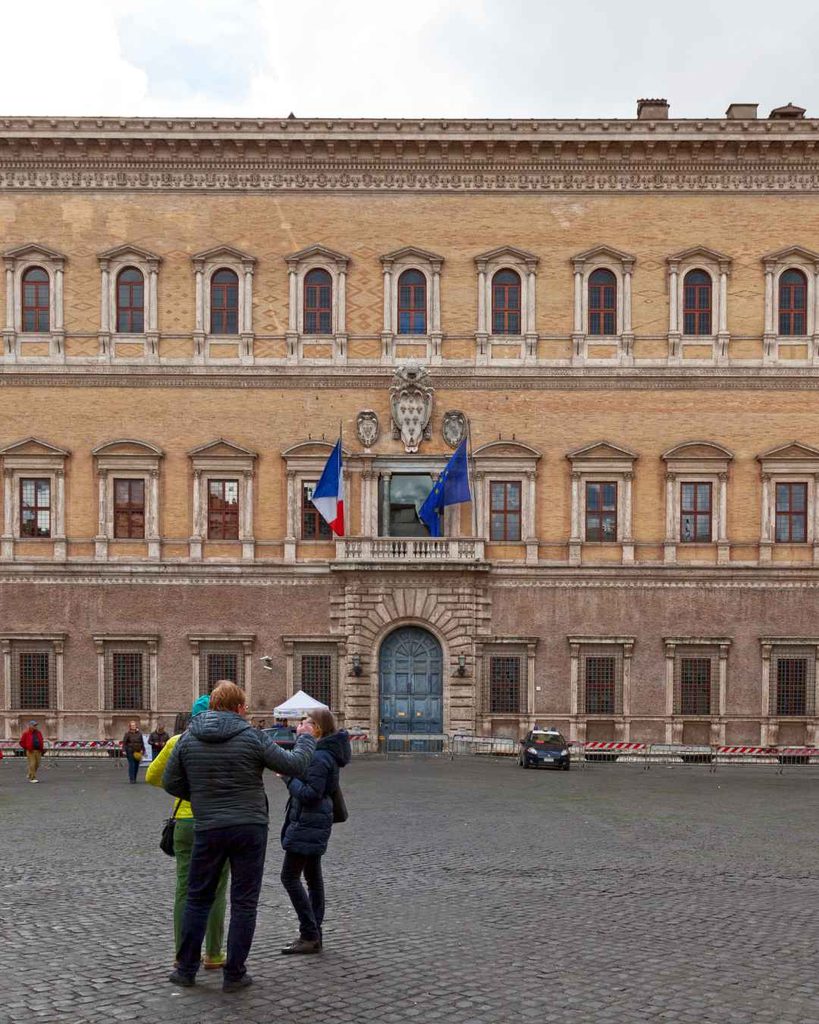
The Palazzo Farnese is one of the most important Renaissance palaces in Rome, and Michelangelo had a hand in its design. The palace was begun by Antonio da Sangallo the Younger in 1517.
Michelangelo took over the project in 1546 and made significant changes. These included the design of the cornice and the central window on the façade.
The Palazzo Farnese is now the French Embassy, and it is not open to the public for regular visits. But you can see the façade from the Piazza Farnese.
The cornice, which Michelangelo designed, is one of the most admired architectural details in Rome. It is a good example of Michelangelo’s ability to work within an existing design and improve it, rather than starting from scratch.
Michelangelo vs Bernini in Rome
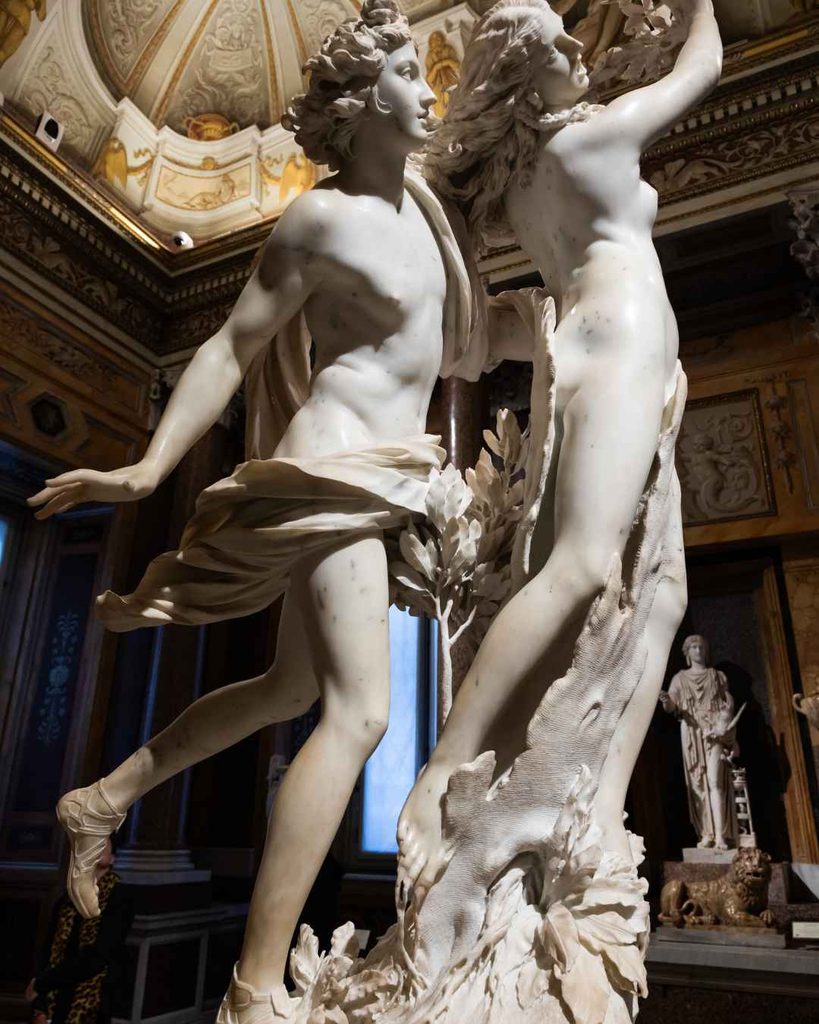
Michelangelo and Gian Lorenzo Bernini are the two greatest sculptors in the history of Rome, and they represent two entirely different eras of the city’s art.
Michelangelo worked in the Renaissance, in the early sixteenth century, when the goal was to capture the ideal human form. Bernini worked in the Baroque, in the seventeenth century, when the goal was to capture movement, emotion, and drama.
Michelangelo’s sculptures are calm, monumental, and self-contained. Think of the Pietà, where Mary holds Christ’s body with a stillness that feels eternal. Or the Moses, where the prophet sits in a state of barely contained anger.
Michelangelo carved marble as if it were flesh, but he always kept the figure within the boundaries of the block. His works feel solid, permanent, and restrained.
Bernini’s sculptures are the opposite. They twist, they turn, they reach into the space around them. His David is caught mid-swing, his Apollo and Daphne is caught mid-transformation, his Ecstasy of Saint Teresa is caught in a moment of divine rapture.
Bernini treated marble as if it were clay, and he used light, shadow, and theatrical settings to make his figures feel alive.
Where Michelangelo sought perfection, Bernini sought drama. Michelangelo carved figures that seemed to exist outside of time.
Bernini carved figures that seemed to exist in a specific moment, caught between one action and the next. Both approaches are extraordinary, and both are essential to understanding Rome.
If you want to compare them in person, start with Michelangelo’s Pietà in St. Peter’s Basilica, then walk through the Vatican Museums to see the Apollo and Daphne and the David in the Galleria Borghese.
The contrast is immediate. Michelangelo will make you feel small in the presence of something eternal. Bernini will make you feel like you are watching a scene unfold in front of you.
Together, they tell the story of Rome’s artistic soul across two centuries. Michelangelo represents the Renaissance at its height, the belief that art could capture the ideal.
Bernini represents the Baroque at its most theatrical, the belief that art could capture life itself. You cannot understand Rome without understanding both.
Practical Tips for Following Michelangelo in Rome
Michelangelo’s works are spread across the city, and visiting them requires some planning. The Pietà and the Sistine Chapel are in the Vatican, which requires a ticket and a reservation for the museums.
The Moses and the Risen Christ are in churches that are free to enter. The Capitoline Hill is free to visit. The Palazzo Farnese can only be seen from the outside.
If you want to see all of Michelangelo’s Roman works in a single day, it is possible, but it requires careful timing. Start at St. Peter’s early in the morning, when the basilica is quiet.
Visit the Pietà first, then head to the Vatican Museums for the Sistine Chapel. In the afternoon, visit San Pietro in Vincoli for the Moses, then Santa Maria sopra Minerva for the Risen Christ.
End the day at the Capitoline Hill, where you can watch the sunset from the Piazza del Campidoglio. The churches in Rome have dress codes.
Shoulders and knees must be covered. A scarf can help with shoulders, but knees require actual coverage. It is worth carrying a light layer with you, even in summer.
The Moses in San Pietro in Vincoli is best seen in the morning, when the light from the windows illuminates the statue. The church is often quiet, and you can spend as long as you like in front of the sculpture.
The Risen Christ in Santa Maria sopra Minerva is in a darker part of the church, and it can be harder to see. The Pietà in St. Peter’s is behind glass, but it is well lit and easy to view.
Final Thoughts
Michelangelo spent much of his life in Rome, and the city shaped him as much as he shaped it. The Pietà made him famous. The Sistine Chapel ceiling made him immortal.
The Moses and the Risen Christ show him experimenting, pushing the boundaries of what sculpture could do. The Capitoline Hill shows him thinking about space and civic life in ways that were ahead of his time.
These works are not just masterpieces. They are documents of a life, a career, and a city. They show a man who was difficult, ambitious, and driven.
He left behind a body of work that still astonishes five centuries later. Rome is not the city where Michelangelo was born. But it is the city where he became himself.
And the works he left here are still there, waiting to be discovered.
Again, feel free to go through the list below of my Italy recommendations that I have crafted after years of travel to this beautiful country:
- Packing List: Things Not to Go to Italy Without
- Must-Do Things: Unforgettable Experiences
- Where to Stay: Best Hotels in Italy.
- Where to Stay in Rome: Rome’s Best Neighborhoods
- Where to Stay in Florence: Picking the Best Area
- Where to Stay in Venice: Venice’s Best Districts
- Italy’s Cobblestone Streets: Best Shoes For the Job
- Backpack or Suitcase?: Italy Luggage Guide
- Travel Insurance: Always Be Covered
- E-Sim: Be Connected At All Times