
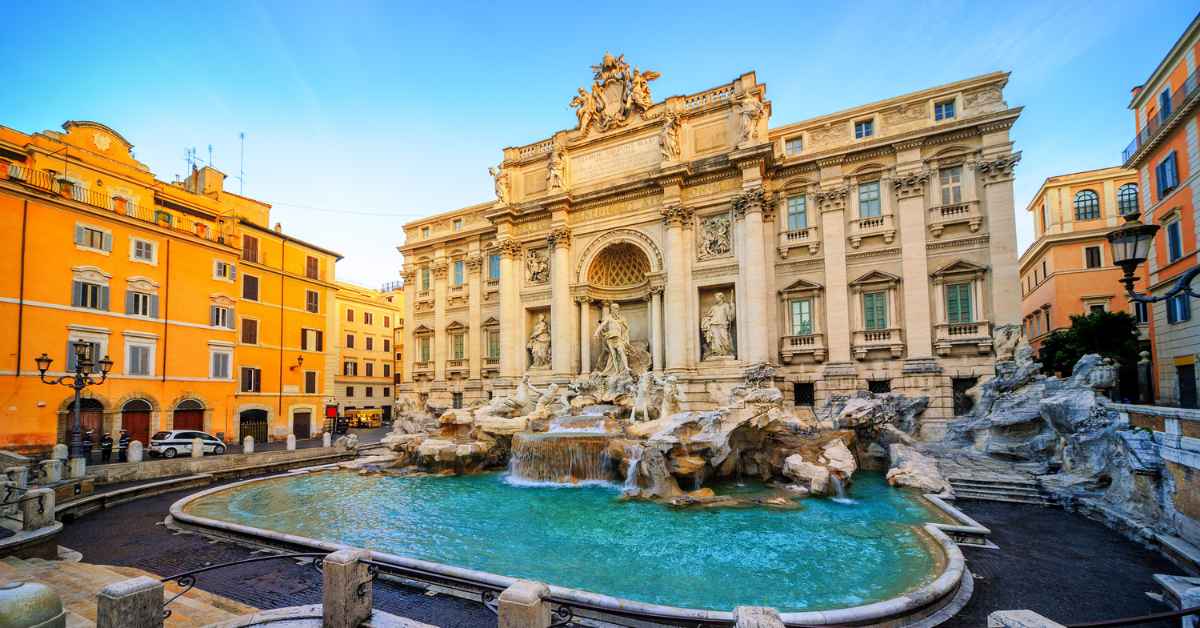
The best thing about the Trevi Fountain is that you hear it before you see it, especially early in the morning (which is when we first saw it, and so should you). I vividly remember my wife and I walking along Via Poli, taking a left turn and coming face-to-face with something we had wanted to see for a long time. She teared up.
The Trevi Fountain doesn’t just sit in its square; it commands it, erupting from the pale stone facade of the Palazzo Poli like a cliff face that has miraculously learned to weep fresh water.
Standing about 85 feet tall and stretching roughly 160 feet wide, it’s roughly the height of a six-story building and spans the width of a Boeing 747’s wingspan.
Before you read further, remember that Italy rewards travelers who come prepared. I’ve found a few things especially useful on an Italy trip, and they’re worth having and/or knowing beforehand. See the checklist here. Also, if you want me to plan an Italy trip for you that you will never forget, drop me a message here
The Ancient Water That Still Flows
To understand the fountain, you have to start with the water itself. The Trevi is not a modern marvel plumbed into the city mains; it is the spectacular endpoint of one of Rome’s oldest and most vital aqueducts, the Aqua Virgo, or Acqua Vergine in Italian.
This aqueduct has been running continuously for over two thousand years. Think about that for a moment. While empires rose and fell, while the Renaissance bloomed and the world wars raged, this same spring water has been flowing into the heart of Rome without interruption since the year 19 BC.
The legend behind it is a lovely piece of Roman mythology. According to tradition, a group of thirsty Roman soldiers found themselves lost in the countryside, unable to locate a reliable source of fresh water. As they trudged along, weary and parched, they encountered a young virgin girl who took pity on them. She led them to a pure, bubbling spring hidden among the rocks.
Grateful for her guidance, the soldiers named the source the Aqua Virgo, and it became the lifeblood for the public baths commissioned by Marcus Vipsanius Agrippa, the right-hand man of Emperor Augustus.
For centuries, that water travelled more than twelve miles through underground tunnels to reach the city. In the fifteenth century, Pope Nicholas V decided to spruce up the terminus of this ancient aqueduct. He built a simple, modest fountain with three small spouts at the junction of three roads—hence the name “Trevi,” which most historians agree comes from the Italian tre vie, meaning three streets. It was a humble beginning for what would become an icon of Western art.
A Paper Trail of Broken Dreams
The fountain we see today is not the work of one man or one era. In fact, it spent the better part of a century as an architectural pipe dream. In 1629, Pope Urban VIII, a man of grand tastes, looked at the modest fountain and decided Rome deserved something far more spectacular. He approached the legendary sculptor and architect Gian Lorenzo Bernini, the man who practically sculpted Baroque Rome, and asked him to design something monumental.
Bernini got to work, sketching out ambitious plans that would integrate the fountain with the facade of the Palazzo Poli, the palace that stood behind it. His vision was theatrical, dramatic, and utterly stunning. But then the pope died in 1644, and just like that, the project was shelved. Bernini’s drawings were rolled up and stored away, and the fountain remained stubbornly ordinary for nearly another century.
It wasn’t until 1730 that Pope Clement XII resurrected the idea. He launched a public competition, inviting architects from all over Italy to submit their designs. The winner was a Florentine named Alessandro Galilei, a distant relative of the famous astronomer. But Rome’s citizens were having none of it. They wanted a local, a Roman through and through. The pope, ever the politician, bowed to public pressure and handed the commission to the second-place finisher—a relatively unknown architect named Nicola Salvi.
Salvi must have felt the weight of history on his shoulders. He had the ghost of Bernini’s unfinished vision hovering over him, and he had a pope breathing down his neck. But what he created was nothing short of revolutionary. He took Bernini’s concept of merging the fountain with the palace facade and turned it up to eleven.
Construction began in 1732, and Salvi poured his heart and soul into the project. He worked on it for nearly two decades, until his death in 1751. He left behind detailed models, but it fell to another architect, Giuseppe Pannini, to see the work through to completion. Pannini made a few tweaks to Salvi’s design, but the overall vision remained intact. Finally, in 1762—thirty years after construction first began—the Trevi Fountain was unveiled to the world. It was an instant sensation, and it has never stopped captivating visitors since.
The Masterpiece Emerges from the Stone

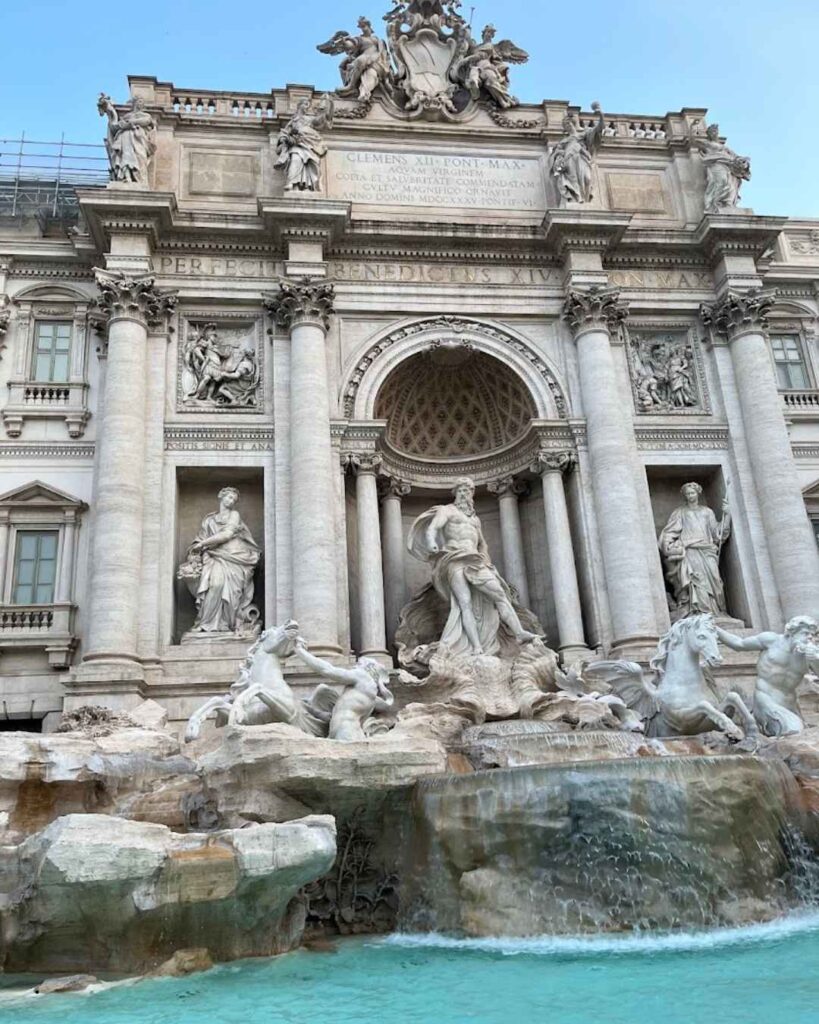
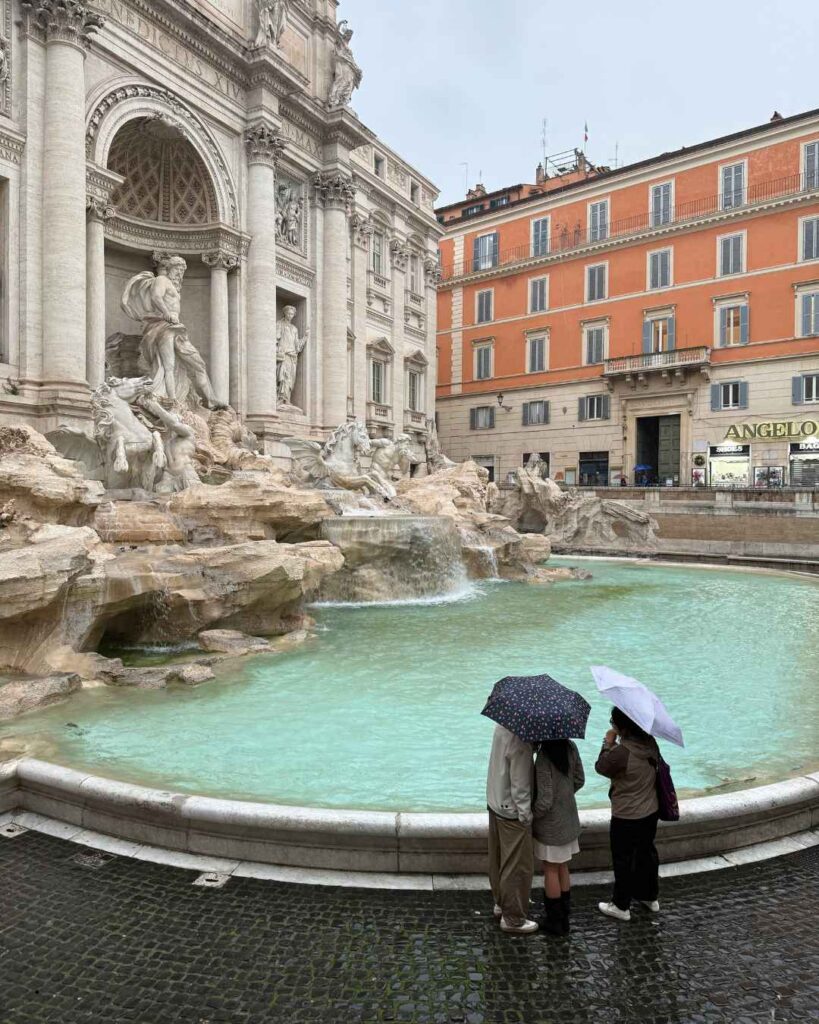
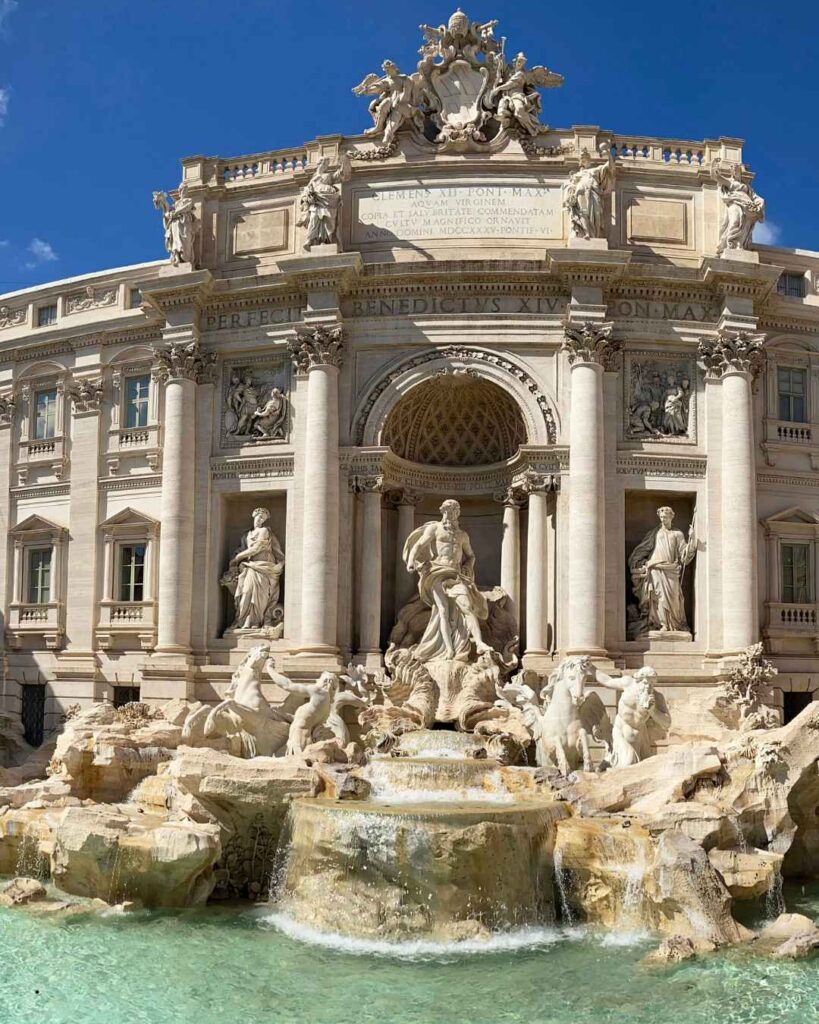
The secret to the Trevi Fountain’s power lies in its audacious design. Salvi didn’t build a freestanding monument; he essentially turned the entire back wall of the Palazzo Poli into a giant, watery stage set. The palace facade was reconfigured to resemble a triumphal arch, complete with massive Corinthian columns that frame the central niche like the grand entrance to a temple. It blurs the line between architecture and sculpture, between building and natural formation.
But the most striking feature is what Salvi did with the rocks. Instead of building a neat, symmetrical basin, he created a chaotic, jagged cliff face of travertine and tufo stone that seems to have erupted right out of the palace wall.
Water doesn’t just spill over the edge—it crashes, tumbles, and froths over these artificial crags, creating the illusion of a wild, untamed spring emerging from the depths of the earth. It is controlled chaos, and it is utterly mesmerizing. My wife and I spent a good twenty minutes just watching the way the light danced on the tumbling water; it never looked the same twice.
The Gods and Their Stories
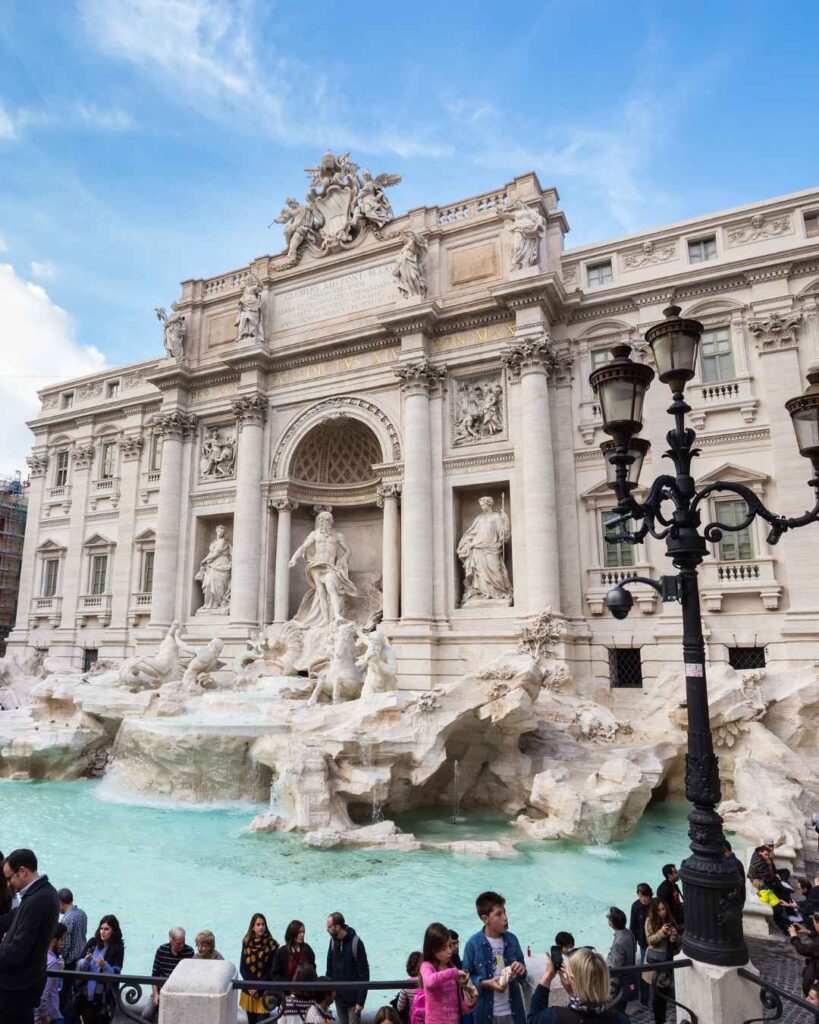
Now, let’s talk about the sculptures, because this is where the fountain truly comes alive. Every figure, every horse, every shell has a meaning, and together they tell a story of power, nature, and the taming of the waters.
At the very center, commanding the entire composition, stands the towering figure of Oceanus, the god of all the world’s waters. He is no ancient, weathered deity; this Oceanus is youthful and vigorous, with a flowing beard and hair that whips back as if blown by a sea breeze. He stands triumphant in a shell-shaped chariot, gripping a scepter that symbolizes his absolute authority over the oceans, rivers, and springs. He is the undisputed king of this watery kingdom, and his gaze is fixed firmly on the horizon.
But Oceanus doesn’t travel alone. His chariot is pulled by two magnificent sea horses, known as hippocamps, and they could not be more different in temperament. One is calm and obedient, gliding smoothly through the water with an almost serene grace. The other is wild and restive, thrashing against its reins, eyes wide with barely contained fury.
These two horses represent the dual nature of the sea itself—sometimes peaceful and generous, sometimes violent and unpredictable. It is a reminder that water, for all its life-giving properties, can never truly be controlled.
Guiding these horses are two Tritons, half-men and half-fish, their muscular bodies straining as they wrestle with the animals. One of them blows a conch shell, sounding a silent call that seems to echo across the centuries. These are not gentle creatures; they are the raw, elemental forces of the deep, and they are barely holding it all together.
Flanking the central niche are two more statues, these ones more allegorical in nature. On the left, we have Abundance, holding a cornucopia overflowing with fruit and grain. She represents the fertility and prosperity that fresh water brings to the land.
On the right, Salubrity offers a cup to a sacred snake, a symbol of health and healing. In the ancient world, clean water was literally a matter of life and death, and these figures remind us just how precious that resource was—and still is.
Above the side statues, two bas-relief panels tell the history of the aqueduct itself. One shows the young virgin pointing out the hidden spring to the thirsty Roman soldiers. The other depicts Agrippa ordering the construction of the aqueduct. It is a beautiful touch, connecting the glorious Baroque monument back to its humble, legendary origins.
And if you look all the way to the top, you will see the coat of arms of Pope Clement XII, flanked by statues representing the Four Seasons. It was his money that made it all possible, and he wanted everyone to know it.
The Coins, the Wishes, and the Millions

Of course, no discussion of the Trevi Fountain would be complete without talking about the coins. The tradition is simple: you stand with your back to the fountain, toss a coin over your left shoulder with your right hand, and make a wish.
The most famous legend says that one coin ensures your return to Rome. A second coin guarantees a new romance. And a third coin ensures marriage. There are as many variations as there are tourists, but the core ritual remains the same.
The origin of this tradition is a bit murky, but its popularity exploded thanks to Hollywood. The 1954 romantic comedy “Three Coins in the Fountain,” starring Frank Sinatra, turned the simple act of tossing a coin into a global phenomenon. And then came Federico Fellini’s “La Dolce Vita” in 1960, with Anita Ekberg wading into the fountain at night in a black dress, immortalizing the fountain as the ultimate symbol of Roman glamour and romance.
My wife, ever the pragmatist, pointed out that the logistics of retrieving those coins must be quite a spectacle. She was right. Every night, Rome’s city workers don waders and wade into the water to collect the day’s haul. On average, they scoop out roughly three thousand euros a day—that’s over a million euros a year.
And before you ask, no, the money does not go into the pockets of city officials. It is donated to a Catholic charity called Caritas, which uses the funds to provide meals, shelter, and social services for Rome’s poor and homeless. So your coin doesn’t just buy you a wish; it buys someone else a hot meal. Not a bad deal, if you ask me.
A Fountain in Perpetual Need of Love
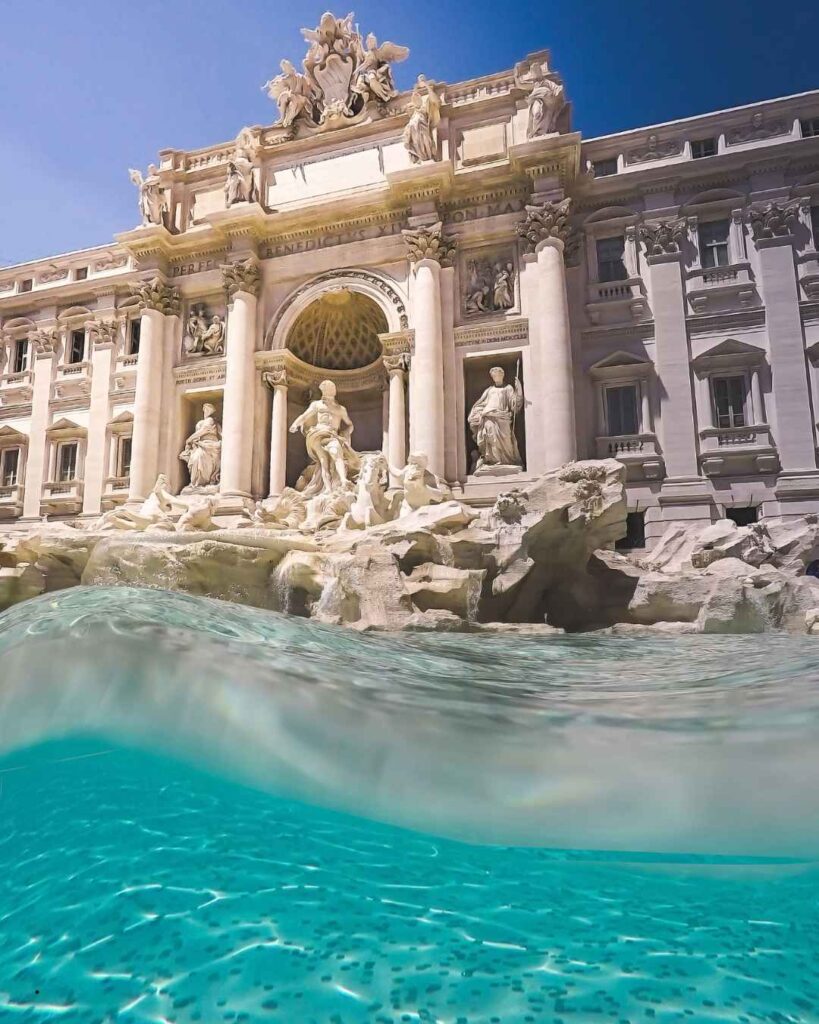
For all its grandeur, the Trevi Fountain is also a fragile old lady. She is constantly battered by the elements, by pollution, and by the sheer weight of the millions of people who visit her every year. In 2012, pieces of the elaborate cornice began to crumble and fall off after an unusually harsh winter, sparking fears that the fountain was in serious structural trouble.
Enter the Italian fashion house Fendi. In 2014, they stepped up with a staggering 2.2 million euro donation to fund a complete restoration of the fountain. The project took nearly a year and a half. Teams of skilled restorers painstakingly cleaned every inch of travertine, repaired cracked stone, sealed leaks, and installed new lighting to show off the fountain’s beauty at night. The result was breathtaking—the marble gleamed like it hadn’t in generations.
But the work is never truly finished. The Trevi Fountain requires constant care and attention. In late 2024, as the Catholic Church prepared for its Jubilee year and the expected influx of pilgrims, the fountain underwent another three-month cleaning.
New measures were introduced to manage the crowds—a ticketed queuing system to prevent the square from becoming dangerously overcrowded. There has even been talk of charging a small entry fee to help fund future maintenance. For now, though, the fountain remains free for all to enjoy, a magnificent gift from the past to the present.
The Eternal Moment
Standing in the Piazza di Trevi, watching the water cascade over the ancient stone, you feel a profound connection to something much larger than yourself. You are standing on the same cobblestones where Roman soldiers once walked, where popes once schemed, where artists once dreamed. The same water that quenched the thirst of Augustus’s legions still flows today. The same legends that captivated the ancient world still capture our imaginations.
The Trevi Fountain is not a relic; it is a living, breathing piece of history that has survived earthquakes, wars, and the relentless march of time. It has been kissed by the lips of Frank Sinatra and splashed through by Anita Ekberg. It has witnessed a thousand proposals and a million wishes. And it will continue to stand there, in that small piazza, long after we are all gone, whispering its story to anyone who takes the time to listen.
So when you go—and you should go, if you haven’t already—don’t just snap a photo and move on. Pause. Look at the wild horses and the defiant Tritons. Watch the water tumble and froth. Toss your coin, make your wish, and for just a moment, let yourself be transported back to a time when the gods walked among us, when water was a miracle, and when a fountain was a doorway to eternity. Because that, right there, is the real magic of the Trevi. And that is a wish worth making.
Related Post: Rome Neighborhood guide. Where should you stay?
Again, feel free to go through the list below of my Italy recommendations that I have crafted after years of travel to this beautiful country:
- Packing List: Things Not to Go to Italy Without
- Must-Do Things: Unforgettable Experiences
- Where to Stay: Best Hotels in Italy.
- Where to Stay in Rome: Rome’s Best Neighborhoods
- Where to Stay in Florence: Picking the Best Area
- Where to Stay in Venice: Venice’s Best Districts
- Italy’s Cobblestone Streets: Best Shoes For the Job
- Backpack or Suitcase?: Italy Luggage Guide
- Travel Insurance: Always Be Covered
- E-Sim: Be Connected At All Times