
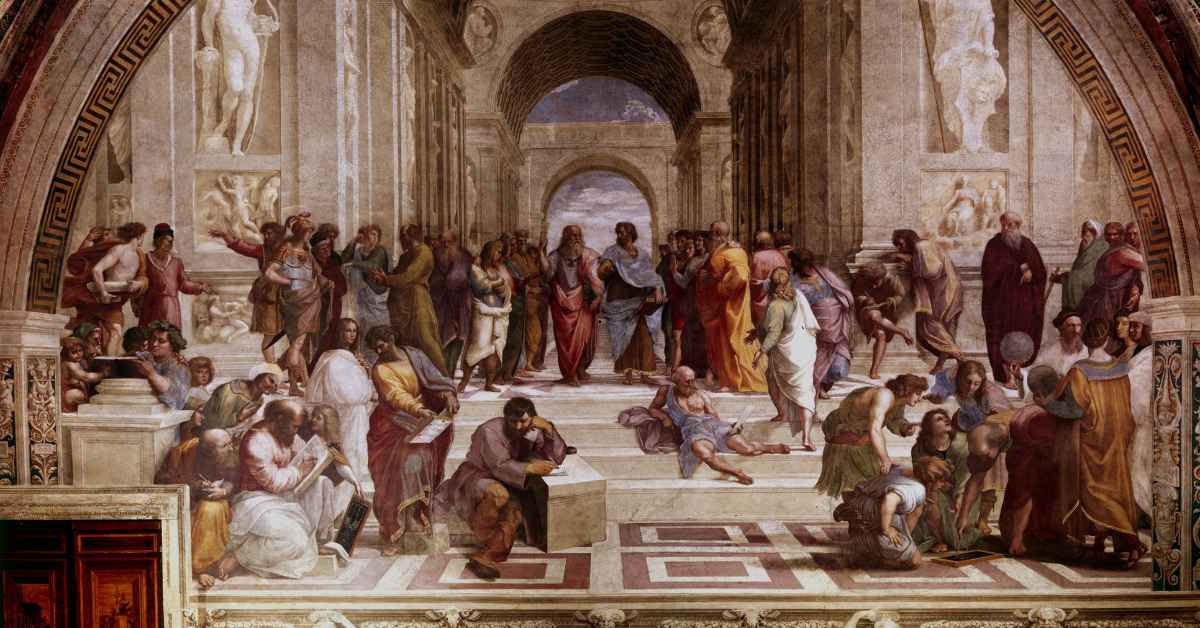
There is a room in the Vatican that contains the entire history of human thought. Not a summary of it, not an interpretation of it, but the thing itself, painted on a wall, with every major philosopher, mathematician, and scientist of antiquity gathered in a single imaginary hall.
You can stand in front of it for an hour and still find something new. You can come back the next day and notice a face you missed, a gesture that changes the meaning of everything around it, a figure hiding in the crowd who has no business being there at all.
This is Raphael’s School of Athens. It is one of the most famous paintings in the world, and it is also one of the most mysterious. It contains more than fifty identifiable figures, and scholars have spent centuries arguing about who they are, what they mean, and why Raphael put them where he did.
Some of the identifications are certain. Plato and Aristotle in the center, obviously. Socrates, unmistakable. Diogenes, lying on the steps, impossible to confuse with anyone else.
But then there are the others. The man in the front, writing on a tablet. The woman in the corner, looking directly at the viewer. The figure who might be Michelangelo, or might be Heraclitus, or might be someone else entirely.
The School of Athens is not just a painting. It is a puzzle, a manifesto, and a time capsule. It is the Renaissance’s greatest statement about the value of knowledge, and it is also a portrait of the men who made the Renaissance possible.
This is the story of what Raphael painted, what it means, and why it still matters more than five hundred years later.
Before you read further, remember that Italy rewards travelers who come prepared. I’ve found a few things especially useful on an Italy trip, and they’re worth having and/or knowing beforehand. See the checklist here. Also, if you want me to plan an Italy trip for you that you will never forget, drop me a message here
The Room Where It Happens
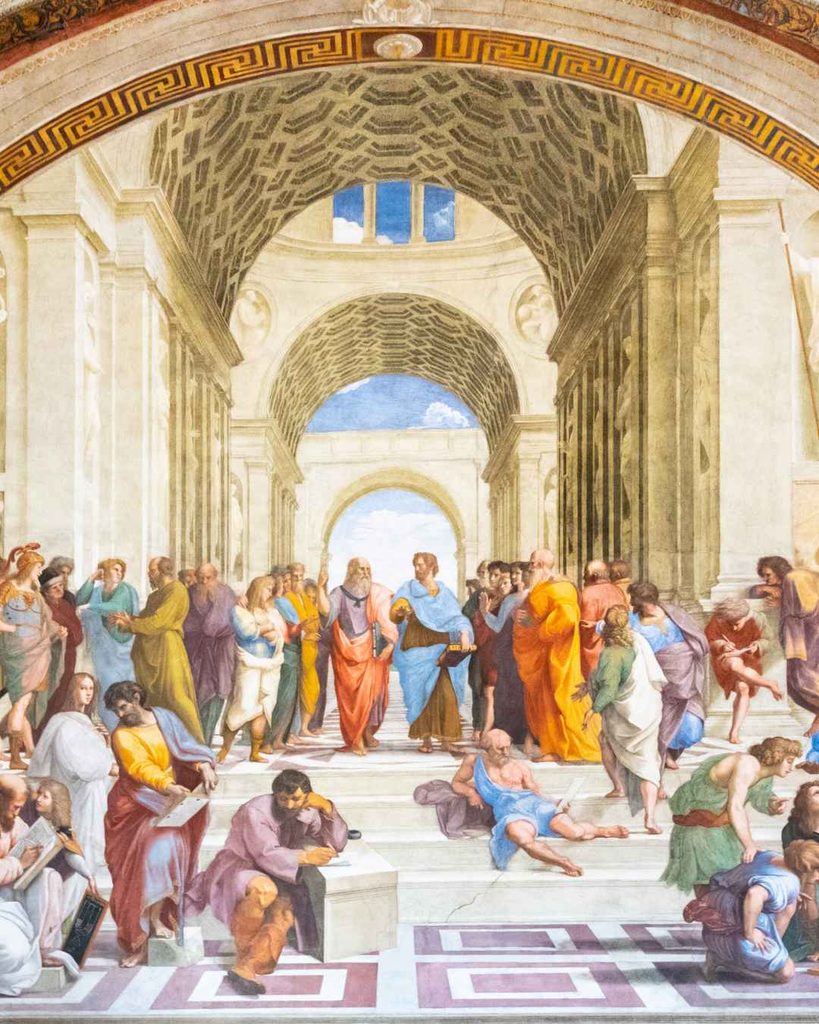
The School of Athens is in the Stanza della Segnatura, one of four rooms in the Vatican Palace that Raphael decorated for Pope Julius II between 1508 and 1511.
The room was intended to be the pope’s private library, and Raphael designed the decoration around the four branches of knowledge that a library would contain: theology, poetry, philosophy, and law.
The School of Athens represents philosophy. It is on the wall opposite the Disputa, which represents theology. The other two walls contain the Parnassus, which represents poetry, and the Cardinal and Theological Virtues, which represent law.
Together, the four frescoes form a complete statement about the relationship between faith and reason, between divine truth and human knowledge.
The room itself is small, and the frescoes cover every surface. Raphael designed the decoration to be seen as a whole, with each wall commenting on the others.
The School of Athens is not just a painting. It is part of an argument about what it means to be human, and what it means to seek the truth.
The Central Figures: Plato and Aristotle
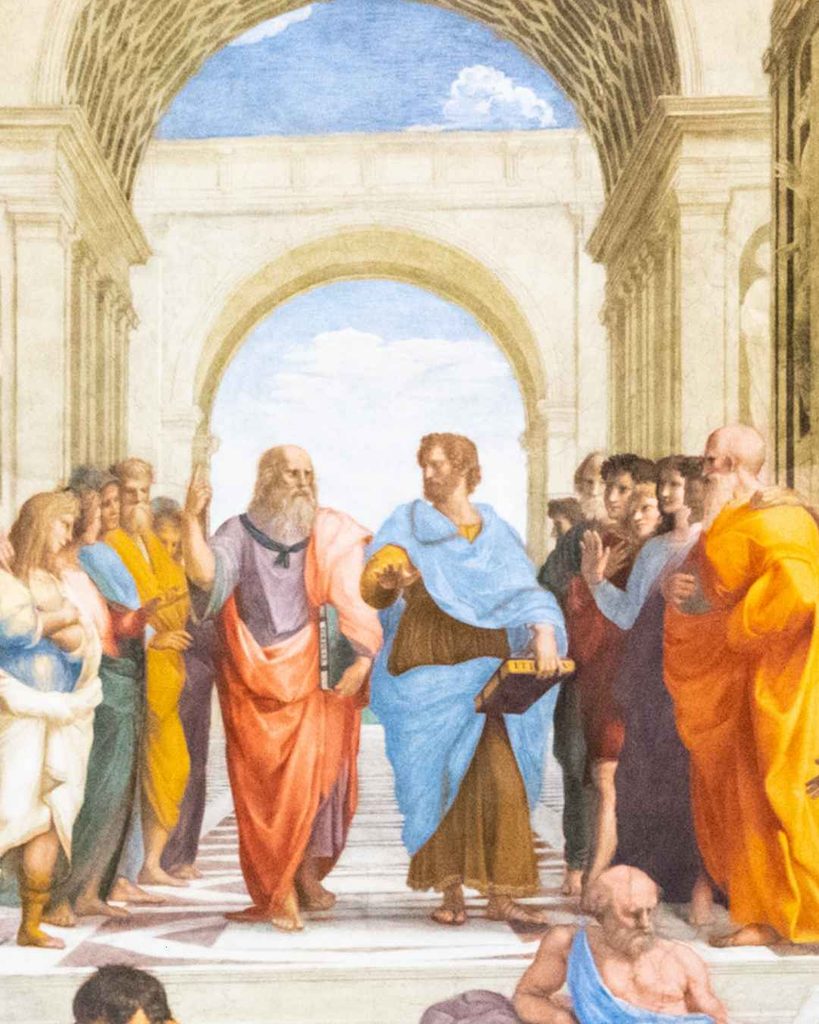
At the center of the fresco, framed by a massive architectural arch, are two men walking toward the viewer. They are Plato and Aristotle, the two greatest philosophers of antiquity, and their gestures define the entire painting.
Plato, on the left, is an old man with grey hair and a beard. He holds a copy of his Timaeus, the dialogue in which he discusses the nature of the physical world and the creation of the universe.
His right hand points upward, toward the heavens, toward the realm of ideal forms. For Plato, true knowledge was not found in the physical world but in the abstract realm of ideas.
Aristotle, on the right, is younger and more confident. He holds a copy of his Nicomachean Ethics, the work in which he argues that ethical knowledge is practical and grounded in experience.
His right hand gestures outward, palm down, toward the earth. For Aristotle, knowledge came from observation and experience, not from abstract contemplation.
The contrast between the two gestures is the key to the painting. Plato points to the heavens, to the ideal. Aristotle points to the earth, to the real. The School of Athens is not a celebration of one philosophy over another. It is a portrait of a debate, a conversation between two ways of understanding the world.
Plato is depicted with the face of Leonardo da Vinci. Raphael had met Leonardo, and he admired him deeply. By giving Plato Leonardo’s features, Raphael was paying tribute to the greatest living genius of his time, placing him in the company of the ancients.
The Philosophers of the Past
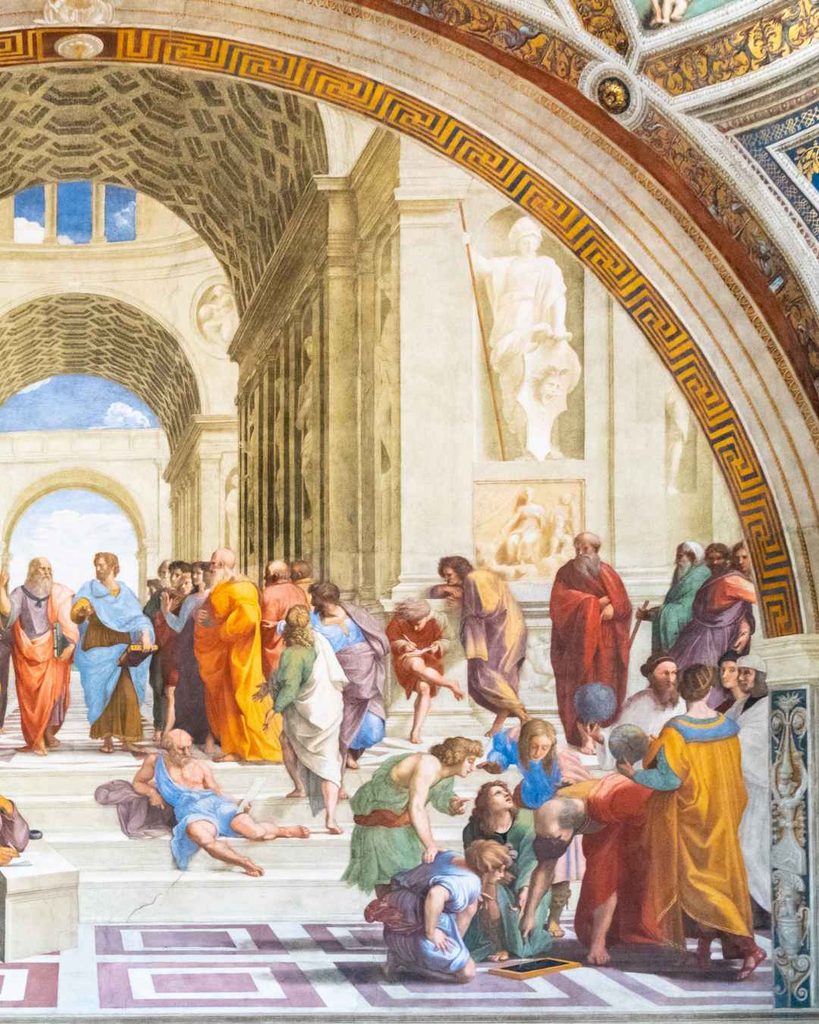
Around Plato and Aristotle, the hall is filled with figures representing the full range of ancient philosophy. Each one is engaged in conversation, reading, writing, or contemplating. Each one is a story.
On the left side of the painting, near the center, is Socrates. He is recognizable from classical busts, with his bald head and snub nose.
He is surrounded by a group of young men, and he is counting on his fingers, as if making a logical argument. Socrates never wrote anything himself. His philosophy survives only through the writings of his students, particularly Plato and Xenophon.
In the foreground, lying on the steps, is Diogenes of Sinope, the Cynic philosopher. He is sprawled on the marble, reading a book, completely indifferent to the grandeur around him.
Diogenes was famous for his rejection of social conventions and his embrace of a simple life. He lived in a barrel, insulted powerful people, and famously told Alexander the Great to step out of his sunlight.
Raphael depicts him as an outsider, a man who refuses to participate in the intellectual games of the academy.
Near Diogenes is a man sitting on the steps, writing on a tablet. He is Pythagoras, the mathematician and philosopher who founded a religious movement based on the idea that reality is fundamentally mathematical.
He is surrounded by students, and he is pointing to a diagram on his tablet that represents the harmonic ratios of music. Pythagoras believed that the universe could be understood through numbers, and his ideas influenced Plato deeply.
On the right side of the painting, in the foreground, is Euclid, the mathematician. He is bent over a slate, demonstrating a geometric proof to a group of students.
Some scholars have identified him as the architect Bramante, who was a friend of Raphael and was working on St. Peter’s Basilica at the time. Euclid holds a compass, and his students lean in to watch him work.
Near Euclid is Ptolemy, the astronomer, holding a globe of the earth. He is also holding a model of the celestial spheres. Ptolemy’s model of the universe, with the earth at the center, dominated astronomy for more than a thousand years.
He is depicted wearing a crown, which may indicate that he is also a portrait of a contemporary ruler.
Also in the foreground, at the far right, is Zoroaster, the Persian prophet, holding a celestial globe. Zoroaster founded a religion based on the duality of good and evil, and his ideas influenced Greek philosophy.
He is depicted as a wise man, engaged in conversation with Ptolemy and others.
The Figures Who Are Also Portraits
One of the most fascinating aspects of the School of Athens is that many of the ancient philosophers are depicted with the faces of Raphael’s contemporaries. The painting is not just a tribute to the ancients.
It is a statement about the Renaissance itself, a claim that the great minds of Raphael’s time were the equal of the great minds of antiquity.
Plato has the face of Leonardo da Vinci. Aristotle has the face of a man who is harder to identify, though some scholars believe it is a portrait of Raphael’s friend and patron, or perhaps a self-portrait of the artist.
In the foreground, on the right, is a figure who is often identified as Michelangelo. He is sitting alone, leaning on a block of marble, and he appears to be brooding.
He is separated from the rest of the group, isolated from the conversation. This is a portrait of Michelangelo as Heraclitus, the philosopher who believed that everything is in flux, that nothing is permanent.
The depiction is not entirely flattering. Michelangelo is shown as a solitary, difficult genius, brilliant but apart from the community of scholars.
Raphael himself appears in the painting, at the far right, standing with a group of mathematicians. He is the young man with the dark hair, looking out at the viewer. He is not pretending to be an ancient philosopher.
He is simply there, a witness to the gathering, a young artist who has been given the extraordinary privilege of painting this room.
The Woman Who Shouldn’t Be There
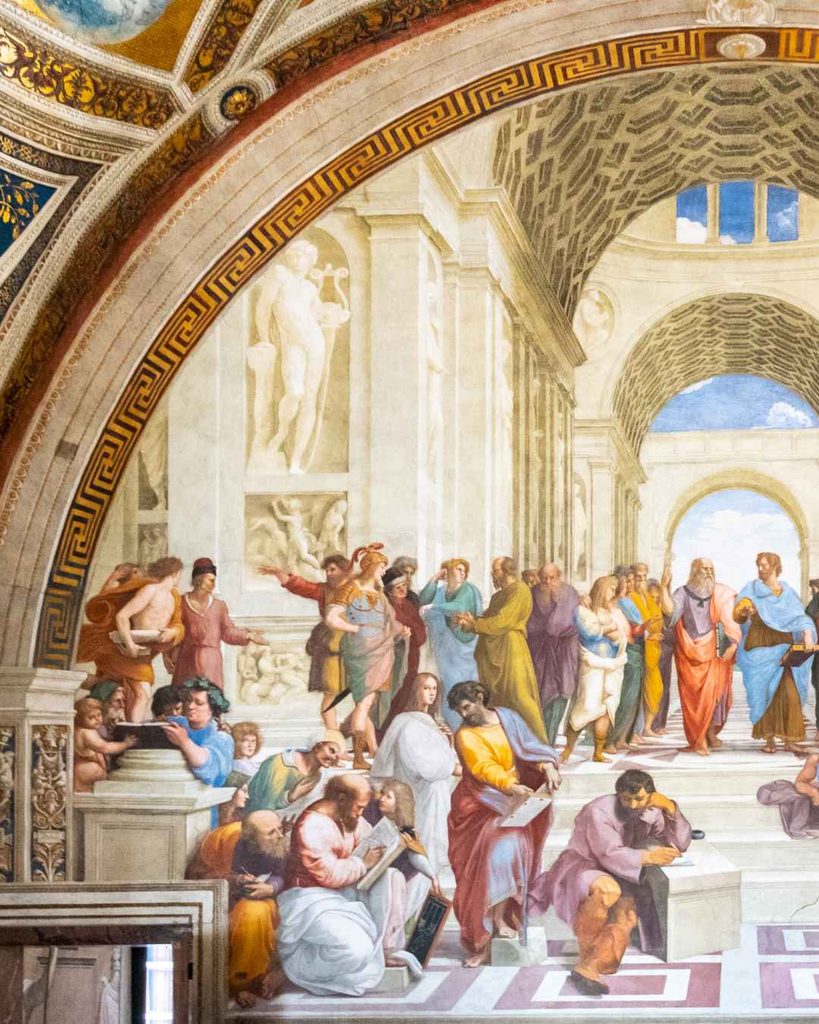
In the foreground of the painting, on the left side, there is a woman. She is young, dressed in white, and she is kneeling or crouching. She is looking out at the viewer with an expression that is difficult to read.
She is one of the few women in the painting, and her presence is one of the most debated details of the fresco.
She is usually identified as Hypatia of Alexandria, the female mathematician and philosopher who lived in the fourth century AD. Hypatia was one of the last great scholars of the classical world.
She taught mathematics and astronomy in Alexandria, and she was murdered by a Christian mob in 415 AD. Her story is a tragedy, and her presence in the School of Athens is a statement about the role of women in the history of philosophy.
Some scholars, however, believe the figure is a portrait of a contemporary woman, perhaps a member of the pope’s family or a patron of the arts. Others believe she is simply an allegorical figure, representing the idea of philosophy itself.
Whatever her identity, she is one of the most striking and mysterious figures in the painting.
The Architecture: A Classical World Reimagined
The architecture of the School of Athens is as important as the figures. Raphael designed the setting to evoke the grandeur of classical antiquity, but he did not copy any existing building. Instead, he created an imaginary space that combines elements of Roman baths, basilicas, and temples.
The central arch, which frames Plato and Aristotle, is the focal point of the composition. The vaulted ceiling above it is decorated with coffers, and the walls are lined with statues of Apollo and Minerva, the gods of music and wisdom.
The statues are in niches, and they are depicted in a style that recalls the great sculptural works of antiquity.
The perspective of the architecture is one of the most impressive aspects of the fresco. The lines of the building converge on a point behind Plato and Aristotle, creating a sense of depth that draws the viewer into the space.
The floor is a mosaic of geometric patterns, and the steps at the front of the painting invite the viewer to climb up and join the gathering.
The architecture is not just a backdrop. It is a statement about the Renaissance’s relationship with the classical past. Raphael was not trying to recreate an ancient building.
He was trying to create a space that would be worthy of the philosophers who gathered in it. The result is a vision of classical antiquity that is both historically informed and imaginatively transformed.
The Story Behind the Painting

The School of Athens was commissioned by Pope Julius II, one of the most ambitious and difficult popes in history. Julius was a warrior pope, a man who led armies into battle and who was determined to restore the power and glory of the papacy.
He was also a great patron of the arts, and he hired the best artists of his time to decorate the Vatican.
Raphael was twenty-five years old when he began work on the Stanza della Segnatura. He had been recommended by his friend and mentor, the architect Bramante, who was working on St. Peter’s Basilica.
Julius was impressed by Raphael’s work, and he gave him the commission to decorate the rooms that would become known as the Raphael Rooms.
The School of Athens was painted between 1509 and 1511. It was completed at the same time that Michelangelo was painting the ceiling of the Sistine Chapel, which is only a few minutes’ walk away.
The two artists were rivals, and their simultaneous work on the Vatican was one of the great artistic competitions of the Renaissance.
Raphael finished the School of Athens and moved on to other projects. Michelangelo finished the Sistine Chapel and returned to Florence. The two men never became friends, but they changed the course of art history.
The School of Athens and the Sistine Chapel ceiling are the two greatest works of the High Renaissance, and they were created at the same time, in the same city, by two artists who could not have been more different.
The Most Interesting Details Visitors Often Miss
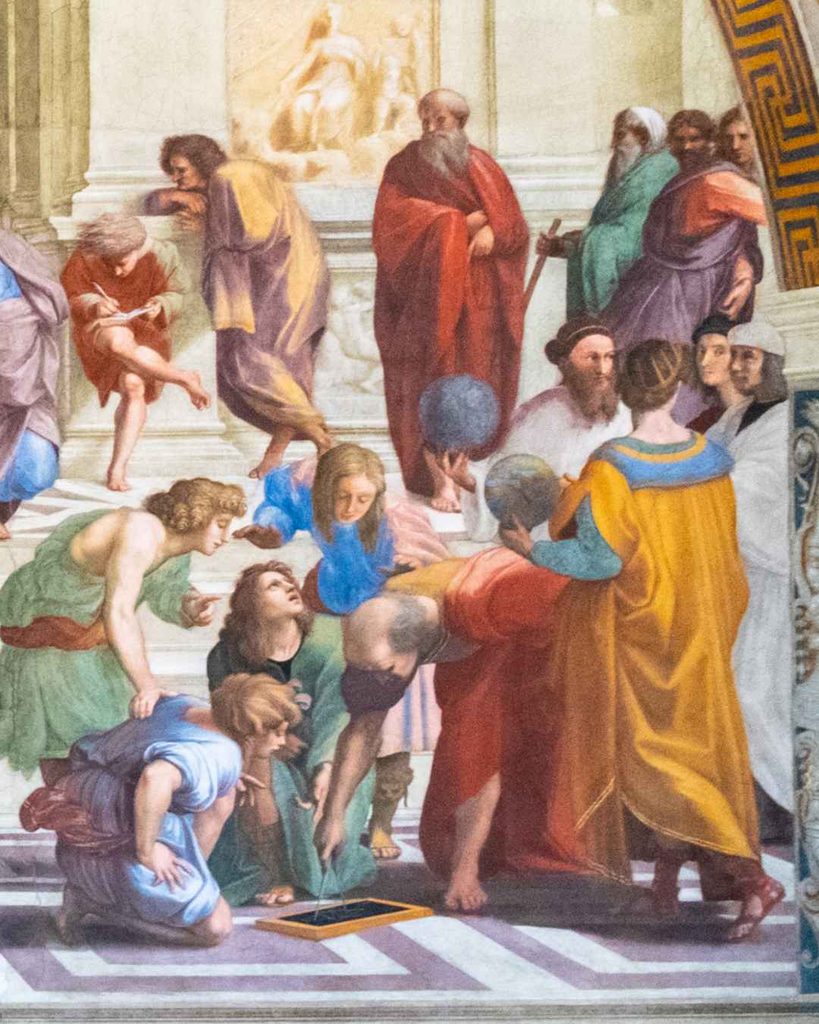
The School of Athens rewards close looking, and most visitors spend ten minutes in front of it before moving on to the Sistine Chapel. But the fresco is packed with details that are invisible at first glance, and that change the way you understand the whole composition.
Look at the floor. The geometric pattern of the mosaic is not decorative. It represents the four elements and the four temperaments, and it is a visual map of the philosophical system that Raphael is depicting. The squares and circles are not random. They are a diagram of the universe.
Look at the statues in the niches. Apollo and Minerva stand on either side of the central arch, and they are not just decoration. Apollo represents music and poetry; Minerva represents wisdom and war.
Together, they frame the philosophical debate at the center of the painting, reminding the viewer that philosophy is not just about thinking. It is also about creation and action.
Look at the figure of Diogenes, sprawled on the steps. He is the only person in the painting who is not engaged in conversation, reading, or writing.
He is indifferent to the intellectual activity around him, and that indifference is the point. Diogenes represents the Cynic tradition, the rejection of social convention and the pursuit of a simple, virtuous life.
Look at the man leaning on the block of marble in the foreground. He is Michelangelo, or at least he is usually identified as Michelangelo, and he is depicted as Heraclitus, the philosopher who believed that everything is in flux.
He is isolated from the other figures, brooding and alone. It is a portrait of genius as solitude, and it is one of the most psychologically complex figures in the painting.
Look at the woman in the foreground. She is usually identified as Hypatia, the female mathematician and philosopher who was murdered by a Christian mob in Alexandria.
She is one of the few women in the painting, and her presence is a reminder that the history of philosophy is not exclusively male. She is looking out at the viewer, and her expression is difficult to read.
Some scholars see defiance; others see sorrow. Whatever she is feeling, she is not passive. She is watching.
Why the School of Athens Still Matters
The School of Athens is a painting about knowledge, but it is also a painting about the people who seek it. It is a portrait of a community of thinkers, a group of men and women who dedicated their lives to understanding the world.
Some of them are famous. Some of them are obscure. Some of them were right about the nature of reality. Some of them were wrong.
What they share is a commitment to inquiry, to asking questions, to seeking truth. The School of Athens is not a celebration of any particular philosophy. It is a celebration of philosophy itself, of the human desire to understand.
This is why the painting still resonates. We live in a time when knowledge is more accessible than ever, and also more contested. We live in a time when the value of the humanities is questioned, when the pursuit of wisdom is sometimes seen as a luxury rather than a necessity.
The School of Athens is a reminder that the search for meaning is one of the oldest and most important things that humans do.
Raphael painted the School of Athens more than five hundred years ago. The philosophers he depicted lived more than two thousand years ago. And yet the painting feels alive, urgent, and relevant. It is a conversation that continues across the centuries, and we are invited to join it.
How to See the School of Athens
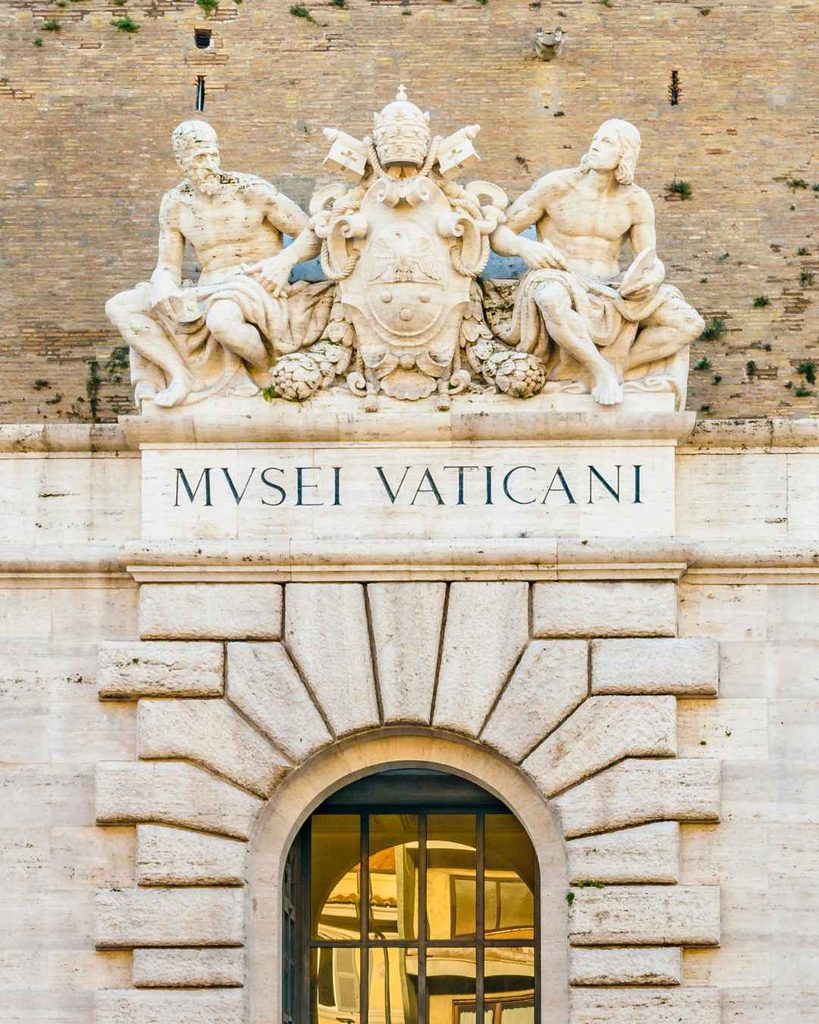
The School of Athens is in the Stanza della Segnatura in the Vatican Museums. It is one of the first rooms you encounter on the standard museum route, and it is usually crowded. The best time to see it is early in the morning, when the museums first open.
The fresco is on the wall opposite the Disputa. It is large, and it is best viewed from the center of the room, where you can see the full composition.
Take your time. Look at the central figures first, then let your eye wander to the sides. Look at the faces of the philosophers. Look at the architecture. Look at the woman in the foreground.
The Vatican Museums require a ticket and a reservation. Book in advance, especially in high season. The museums are open Monday through Saturday, and they are closed on Sundays except for the last Sunday of the month.
If you would like a guided trip that takes you to the Vatican Museums, Sistine Chapel, and St. Peter’s Basilica, this is the one I would book.
Final Thoughts
The School of Athens is not just a painting. It is a world. It contains more than fifty figures, each with a story, each with a meaning. It contains the history of philosophy, the history of science, the history of art, and the history of the Renaissance itself.
Raphael was twenty-five when he painted it. He had already absorbed the lessons of Leonardo and Michelangelo, and he had already surpassed them in some ways. The School of Athens is his masterpiece, and it is one of the greatest achievements of Western civilization.
It is a painting that rewards attention. The more you look, the more you see. The more you see, the more you understand. And the more you understand, the more you realize that the questions Raphael’s philosophers were asking are still the questions we are asking today.
What is truth? What is knowledge? What is the good life? How should we live?
The School of Athens does not answer these questions. It shows us how to ask them. And that is the greatest gift a painting can give.
Again, feel free to go through the list below of my Italy recommendations that I have crafted after years of travel to this beautiful country:
- Packing List: Things Not to Go to Italy Without
- Must-Do Things: Unforgettable Experiences
- Where to Stay: Best Hotels in Italy.
- Where to Stay in Rome: Rome’s Best Neighborhoods
- Where to Stay in Florence: Picking the Best Area
- Where to Stay in Venice: Venice’s Best Districts
- Italy’s Cobblestone Streets: Best Shoes For the Job
- Backpack or Suitcase?: Italy Luggage Guide
- Travel Insurance: Always Be Covered
- E-Sim: Be Connected At All Times