

If you have been to the Galleria Borghese, then you know that marble is not supposed to do what Bernini makes it do.
You are standing in front of Pluto and Proserpina, watching a god’s fingers press into a woman’s thigh, and the stone yields. It dimples. It gives way like flesh.
You have to remind yourself that this is rock, that this is cold and hard and unyielding, and that no human hand should be able to make it look like this.
This is what Bernini does. He does not carve marble. He transforms it. He takes the most rigid material in the sculptor’s arsenal and makes it move, breathe, twist, and feel. He makes it weep. He makes it burn. He makes it die.
And he did it all in Rome. Gian Lorenzo Bernini was born in Naples in 1598, but he became a Roman in every way that mattered. The city shaped him, and he shaped it in return. If you walk through Rome today and look up, you will see his work everywhere.
The fountains, the churches, the colonnades, the tombs. He was the artist who defined what Rome looks like, and he did it for more than sixty years.
This is the story of his masterpieces. Where to find them, what to look for, and why they still have the power to stop you in your tracks.
Before you read further, remember that Italy rewards travelers who come prepared. I’ve found a few things especially useful on an Italy trip, and they’re worth having and/or knowing beforehand. See the checklist here. Also, if you want me to plan an Italy trip for you that you will never forget, drop me a message here
Who Was Bernini?
Gian Lorenzo Bernini was born in Naples in 1598, the son of Pietro Bernini, a Mannerist sculptor who worked in the tradition of late Renaissance and Hellenistic art. Pietro moved the family to Rome when Gian Lorenzo was still a child, and the city became his home for the rest of his life.
Bernini was a child prodigy. By his early teens, he was producing sculptures that astonished his contemporaries. He spent years sketching ancient marble sculptures in the Vatican, absorbing the lessons of classical art.
He was noticed by Cardinal Scipione Borghese, the nephew of Pope Paul V, who became his first major patron.
Cardinal Maffeo Barberini also noticed him; he would later become Pope Urban VIII, and Bernini would tell him it was his great fortune to see Barberini become pope, but an even greater fortune for the world that Bernini lived during his pontificate.
Bernini worked under eight popes. He was a sculptor, architect, painter, playwright, and stage designer. His aim was to unite architecture with sculpture and painting, creating works that were dramatic, moving, and full of energy.
He believed that sculpture should not be viewed from a single angle but from multiple perspectives, and he designed his works to be walked around, to reveal new details with every step.
He was not an easy man. He was tempestuous and deeply religious. He was fiercely competitive and could be ruthless in his pursuit of commissions. He once ordered that a rival’s sculpture be destroyed.
He was known to be jealous of his reputation and quick to defend it. But his talent was so overwhelming that even his rivals had to acknowledge it.
Bernini died in Rome in 1680, at the age of eighty-two. He had transformed the city. And the city has never forgotten him.
1. The Ecstasy of Saint Teresa

If you see only one Bernini in Rome, make it this one. The Ecstasy of Saint Teresa is his most complete fusion of sculpture, architecture, and painting, and it is one of the defining works of the Baroque.
It is in the Cornaro Chapel in the Church of Santa Maria della Vittoria, and it was commissioned by Cardinal Federico Cornaro.
The sculpture depicts a vision described by Saint Teresa of Ávila, a Spanish nun and mystic. In her writings, Teresa described an angel piercing her heart with a golden arrow, filling her with a pain that was also a kind of ecstasy, a sense of oneness with God.
She wrote that the pain was so great that she moaned, but that the sweetness of it was so excessive that she could not wish to be rid of it.
Bernini’s sculpture shows Teresa reclining on a cloud, her body limp, her head thrown back, her mouth open. Her eyes are half-closed, and her expression is one of complete surrender. An angel stands above her, holding the arrow, about to strike.
The angel is smiling, and his drapery swirls around him. The drapery of Teresa’s habit is carved with deep folds that catch the light and create shadows.
The chapel itself is part of the artwork. Bernini designed it as a theatrical setting, with colored marble panels, a projecting cornice, and relief sculptures of the Cornaro family members, who sit in what look like theater boxes on either side of the chapel, watching the scene unfold.
The viewer is invited to join them, to become part of the audience for this divine drama.
The light comes from a hidden window above the sculpture, and it falls directly on the figures, making them seem to glow. The effect is theatrical and deeply emotional. It is one of the most important works of art in Rome, and it is free to see.
2. Pluto and Proserpina
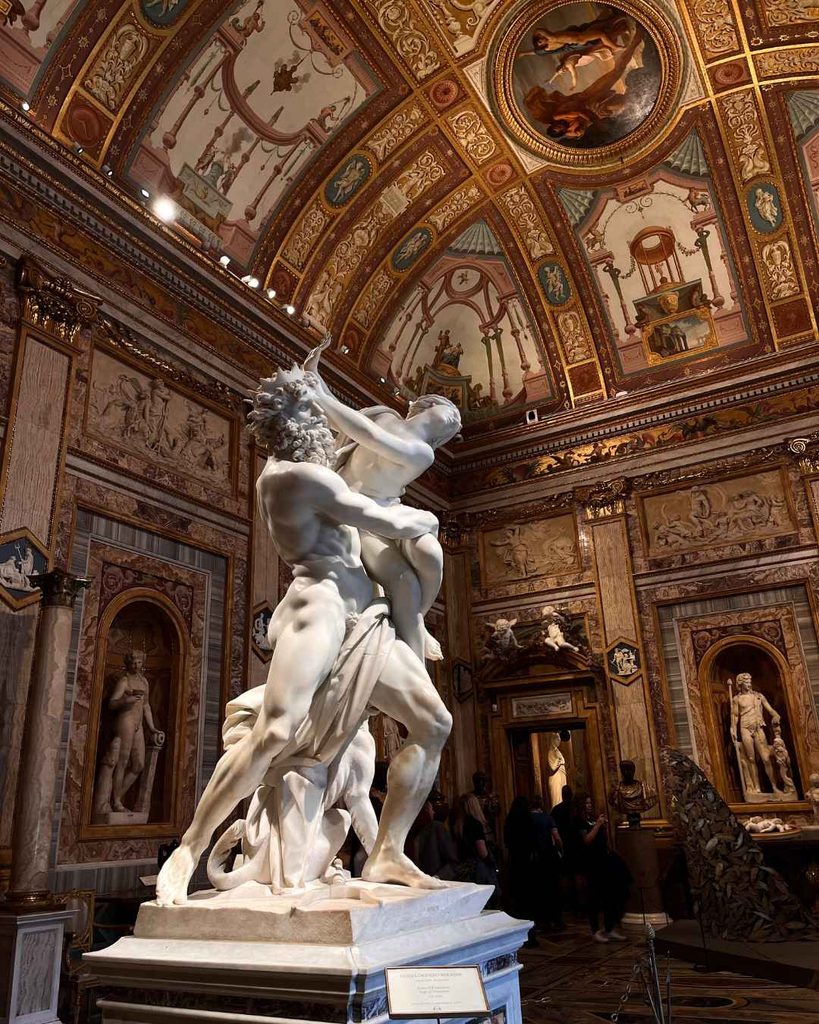
Carved between 1621 and 1622, when Bernini was in his early twenties, this is the sculpture that made him famous. It depicts the moment when Pluto, the god of the underworld, abducts Proserpina, the daughter of Ceres, to make her his queen.
The sculpture is a masterpiece of dynamic composition. Pluto strides forward, his muscular body tensed, while Proserpina twists and struggles in his arms. Her hair flies back, her arms push against his chest, and her face is turned away in terror.
The god’s fingers press into her thigh, and the marble yields, dimpling under his grip in a way that seems impossible. The indentations of his fingertips are visible in the stone, and the flesh around them seems to compress.
The sculpture captures a single moment of violence and desperation. It is not beautiful in the conventional sense. It is disturbing, and that is the point.
Bernini wanted the viewer to feel Proserpina’s fear, to understand her helplessness. The sculpture is also a technical marvel. The marble is carved so thin in places that it seems translucent.
The hair of both figures is carved with a lightness that makes it seem to float. The drapery of Proserpina’s robe is carved with deep folds that suggest movement and struggle.
It is in the Galleria Borghese, and it is one of the most powerful works in the museum. The gallery limits admission, and tickets must be booked in advance.
3. Apollo and Daphne
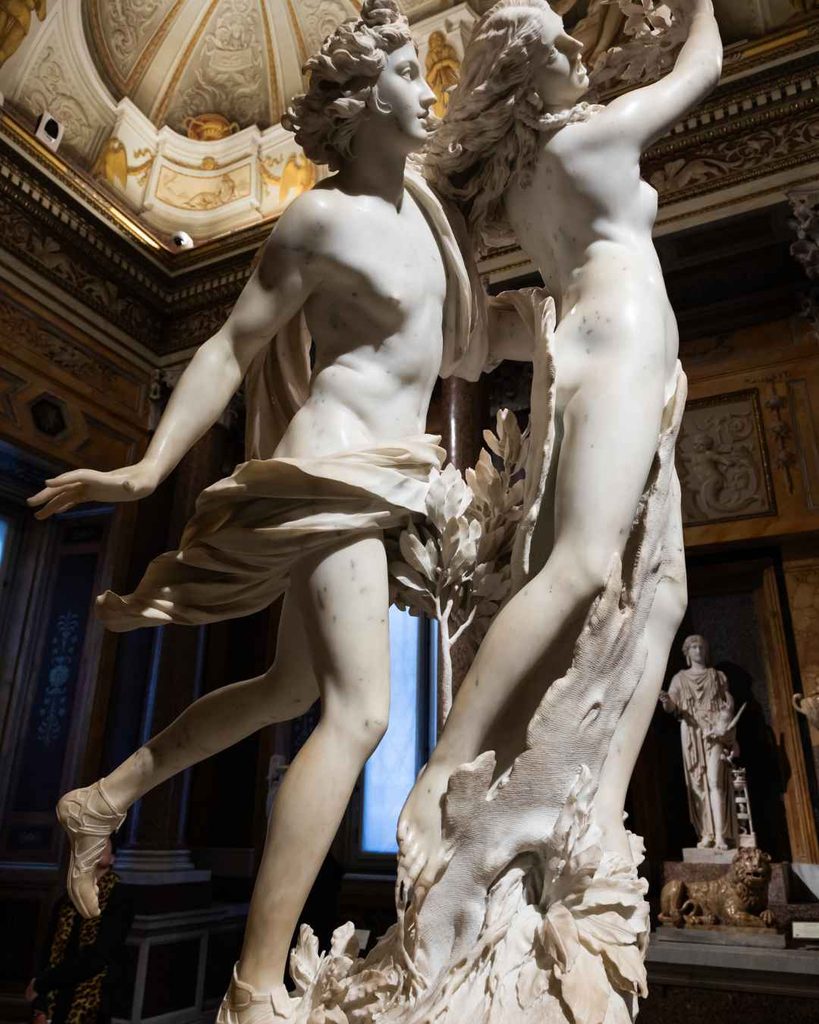
Carved between 1622 and 1625, Apollo and Daphne is the most technically astonishing of the Borghese sculptures. It depicts the moment when Daphne, fleeing from the god Apollo, is transformed into a laurel tree to escape his pursuit.
The sculpture shows Daphne mid-transformation. Her fingers are sprouting leaves. Her toes are becoming roots. Her hair is turning into branches. Her skin is becoming bark.
Apollo’s hand is touching her waist, but she is already slipping away from him, becoming something else. Her face is turned away, and her expression is one of fear and desperation.
The technical achievement is extraordinary. Bernini carved marble so thin that it looks like leaves, so delicate that it seems to be growing. The sculpture is a study in metamorphosis, in the boundary between human and natural, between flesh and wood.
The transition is gradual and seamless. You can see the exact moment when Daphne stops being a woman and becomes a tree.
The work also has a personal dimension. Cardinal Borghese had recently lost his position as Cardinal Nephew, and some scholars believe the sculpture reflects his own transformation, his own loss of power and identity. It is in the Galleria Borghese.
4. David
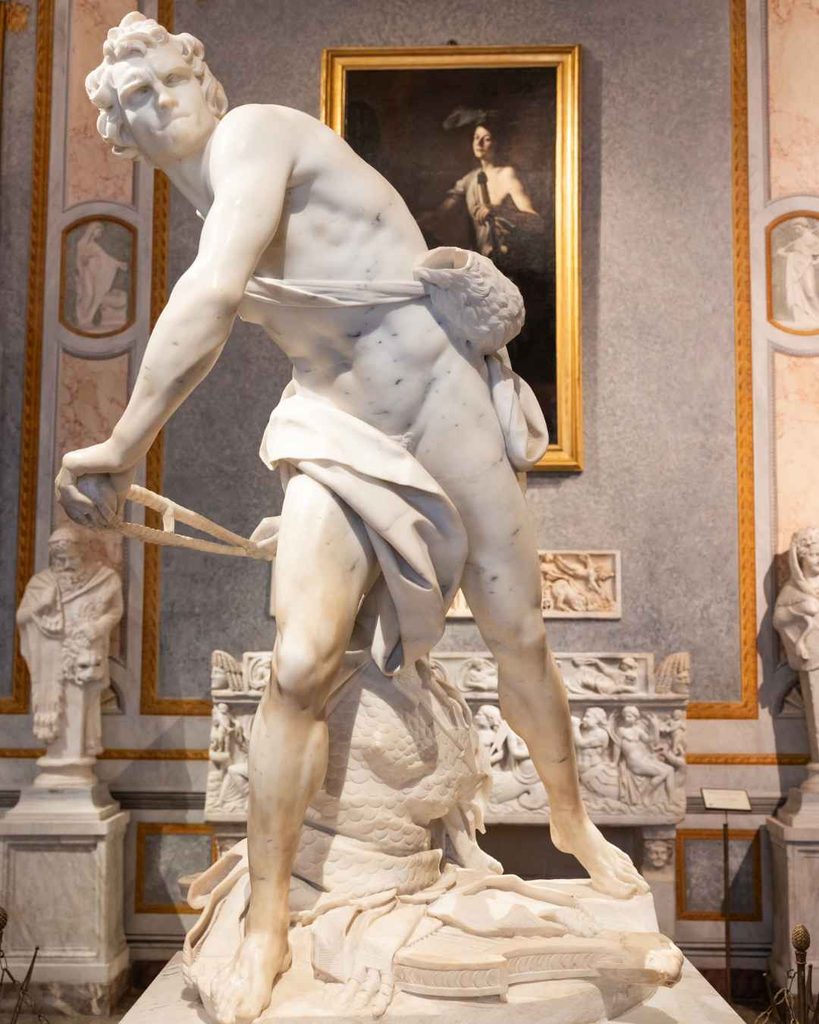
Bernini’s David, carved in 1623, is a radical departure from the famous David of Michelangelo. Michelangelo’s David is calm, poised, and self-contained. He stands still, deciding whether to fight. Bernini’s David is caught in the middle of the action.
He is twisting, his body coiled like a spring, his lips bitten in concentration. He is about to release the stone that will kill Goliath.
The sculpture is designed to be viewed from multiple angles. From behind, you see David’s back and the harp at his feet, decorated with an eagle’s head, the symbol of the Borghese family. From the side, you see his profile, his arm cocked back. From the front, you see his face, intense and focused.
The sculpture is not meant to be seen from a single viewpoint. It is meant to be walked around, to reveal its different aspects.
What makes Bernini’s David unique is that it implies the presence of an unseen adversary. The viewer becomes part of the action, standing in the space where Goliath would be. This was a radical idea at the time. It made the viewer a participant rather than just a spectator. It is in the Galleria Borghese.
If you would like to buy a ticket or book a guided tour of the Borghese Gallery, check out this guide.
5. The Fountain of the Four Rivers
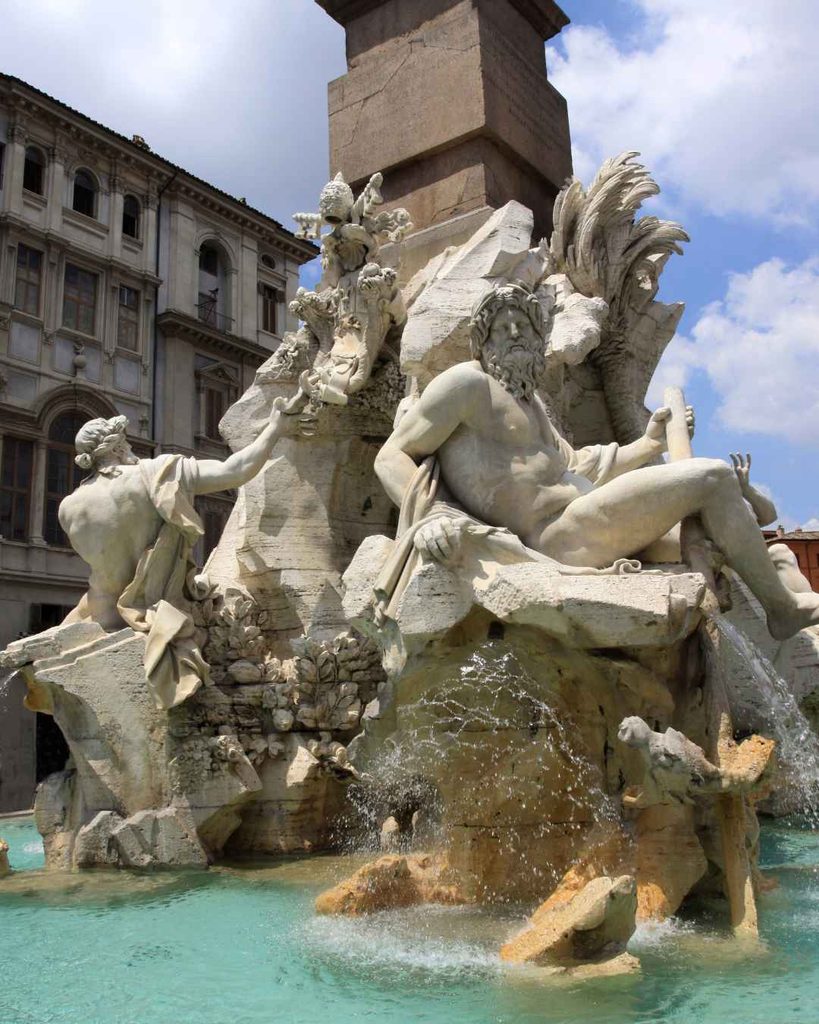
The Fountain of the Four Rivers, in Piazza Navona, is Bernini’s most famous fountain. It was commissioned by Pope Innocent X Pamphilj and completed between 1648 and 1651.
The fountain is crowned by an ancient Egyptian obelisk, which rises from a rocky base. Around the base are four colossal figures representing the great rivers of the world: the Danube, the Nile, the Ganges, and the Rio de la Plata.
Each figure is surrounded by plants and animals from its region. The Danube touches the pope’s coat of arms, representing the church’s dominion over the known world.
The Nile figure has a cloth over its head, representing the fact that the source of the Nile was unknown at the time. The Rio de la Plata figure is raising its hand, and some say it is shielding its eyes from the church of Sant’Agnese in Agone, which was designed by Bernini’s rival Borromini.
The Ganges holds a long oar, and the Danube gazes at the obelisk.
The fountain is in the center of Piazza Navona, one of the most beautiful squares in Rome. It is free to see, and it is particularly beautiful at night when it is lit up.
The fountain is a masterpiece of engineering as well as art. The water flows through the figures and the rock in a way that seems natural and effortless.
6. The Baldacchino
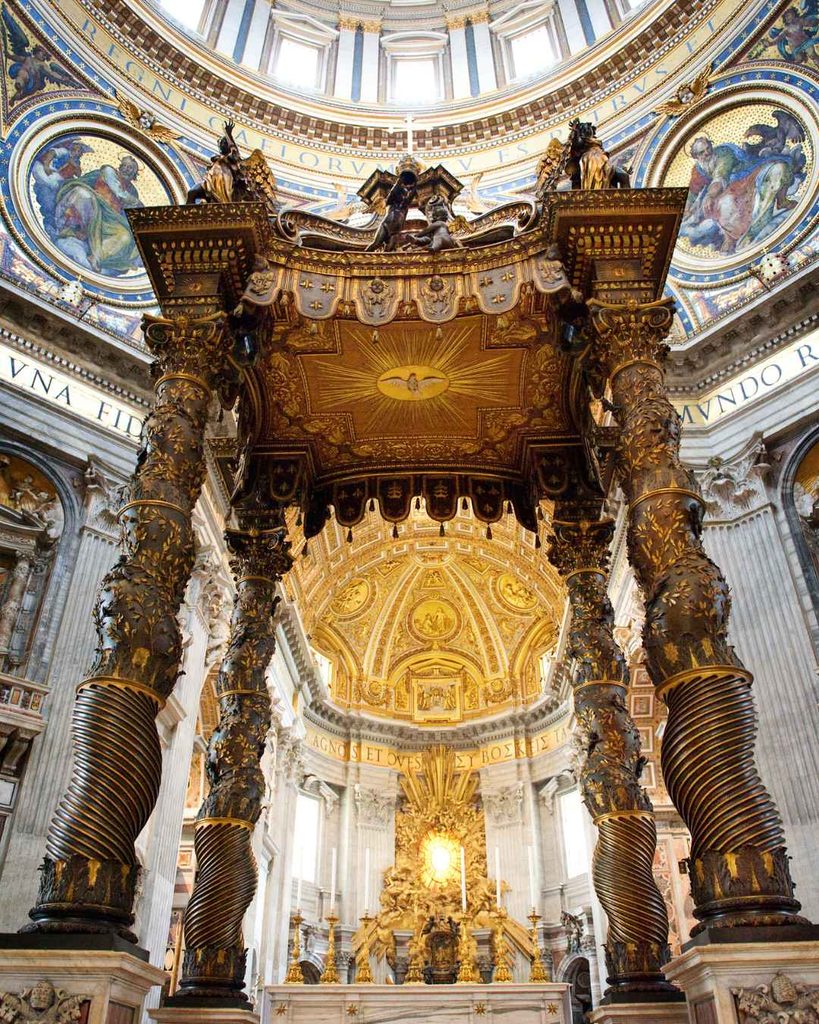
The Baldacchino, in St. Peter’s Basilica, is one of Bernini’s most important architectural works. It is a massive bronze canopy that stands over the main altar, marking the tomb of Saint Peter.
The Baldacchino was commissioned by Pope Urban VIII and completed in 1633. It is nearly thirty meters tall, and it is supported by four twisted columns. The columns are decorated with laurel leaves and bees, the symbols of the Barberini family. The canopy is topped with a cross, and it is decorated with angels and other figures.
The bronze for the Baldacchino was taken from the Pantheon, which inspired the Latin quip: “What the barbarians did not do, the Barberini did.” The canopy is a masterpiece of engineering and art, and it is one of the first things you see when you enter St. Peter’s.
The Baldacchino is also a statement of papal authority. It marks the tomb of Saint Peter, the first pope, and it stands at the center of the largest church in the world. It is a symbol of the church’s continuity and its power.
7. The Colonnade of St. Peter’s Square
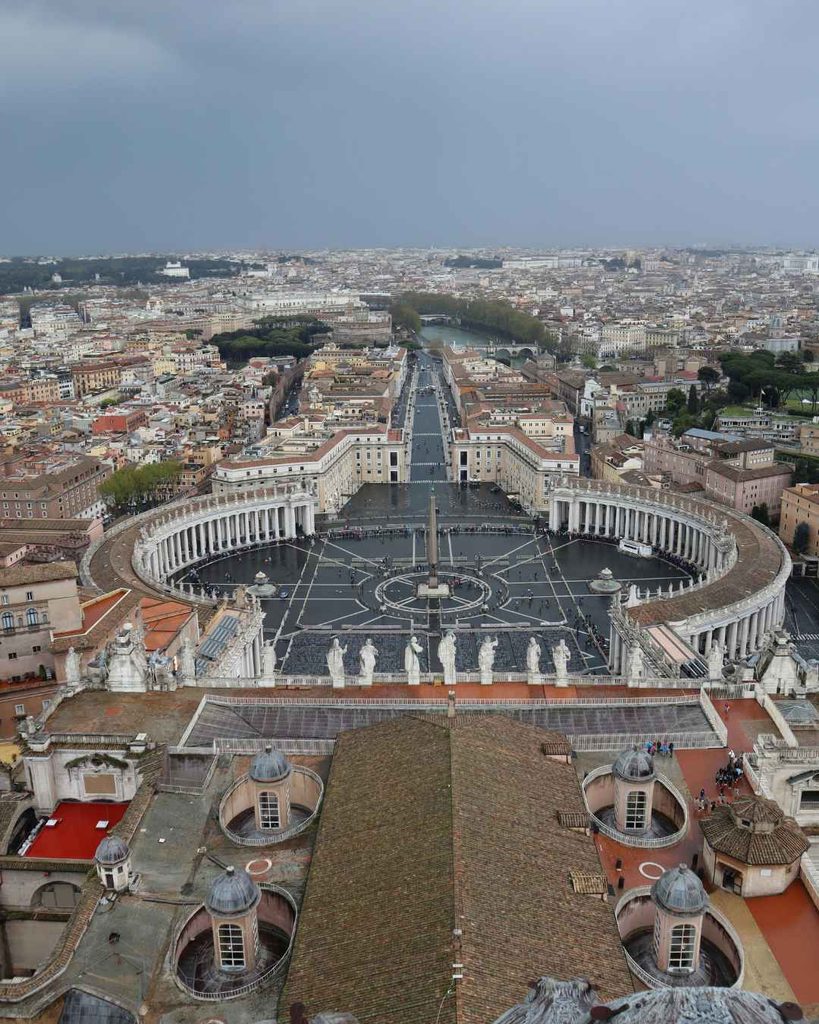
The colonnade in St. Peter’s Square is one of Bernini’s greatest achievements. It was designed to create a space that would embrace the faithful, and Bernini described it as the arms of the church reaching out to embrace Catholics and reinforce their belief.
The colonnade consists of four rows of columns, forming an oval shape around the square. There are 284 columns in total, and they are topped with 140 statues of saints. The colonnade was completed between 1656 and 1667.
The design is both practical and symbolic. It creates a monumental space that can hold hundreds of thousands of people, and it represents the church’s role as a mother, welcoming her children.
The statues on top of the colonnade are saints and martyrs, and they watch over the square. The effect is one of grandeur and intimacy at the same time.
8. Aeneas, Anchises, and Ascanius Fleeing Troy

This was Bernini’s first major mythological group, carved between 1618 and 1619, when he was barely twenty years old. It depicts the scene from Virgil’s Aeneid in which Aeneas carries his aging father Anchises on his shoulders while leading his young son Ascanius out of the burning city of Troy.
The sculpture is a study in motion and emotion. Aeneas’s body twists under the weight of his father, his muscles straining. Anchises holds a small statue of the household gods, the penates, which the family will carry to their new home. Ascanius walks beside them, carrying a lantern.
What makes the sculpture remarkable is the way Bernini handles the human form. Aeneas is not a classical hero, perfectly proportioned and serene.
He is a man carrying a heavy burden, and his body shows it. The sculpture also has a personal dimension: the image of Aeneas carrying his father was meant to represent Cardinal Borghese’s own piety and his support for his uncle, the pope. It is in the Galleria Borghese.
9. The Triton Fountain
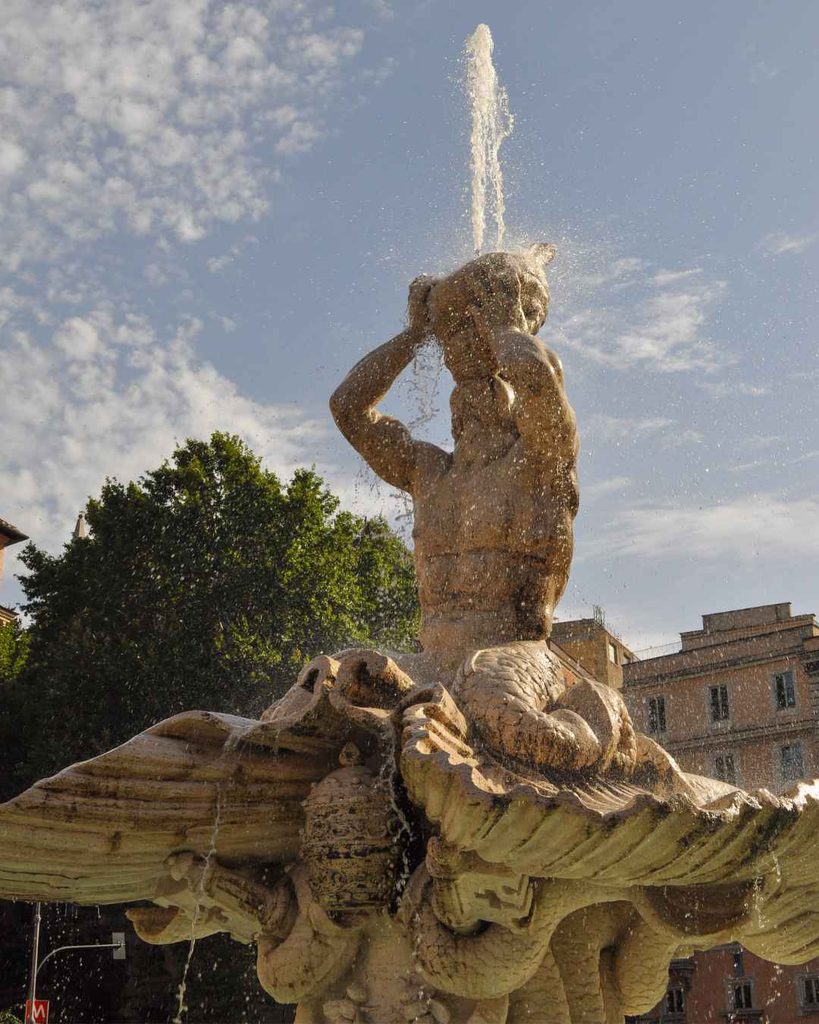
The Triton Fountain, in Piazza Barberini, was completed in 1643. It depicts Triton, the son of Neptune, kneeling on a large open shell held up by four dolphins. He is blowing a conch shell, and water shoots from it into the air.
The fountain is smaller than the Four Rivers, but it is equally charming. The dolphins are stylized and graceful, and the water flows in a constant, mesmerizing stream. The fountain was recently cleaned, and the travertine has been restored to its original color.
The Fountain of the Bees, also in Piazza Barberini, is a smaller companion piece. It is shaped like an open shell, with three bees, the symbol of the Barberini family, decorating it.
10. Sant’Andrea al Quirinale
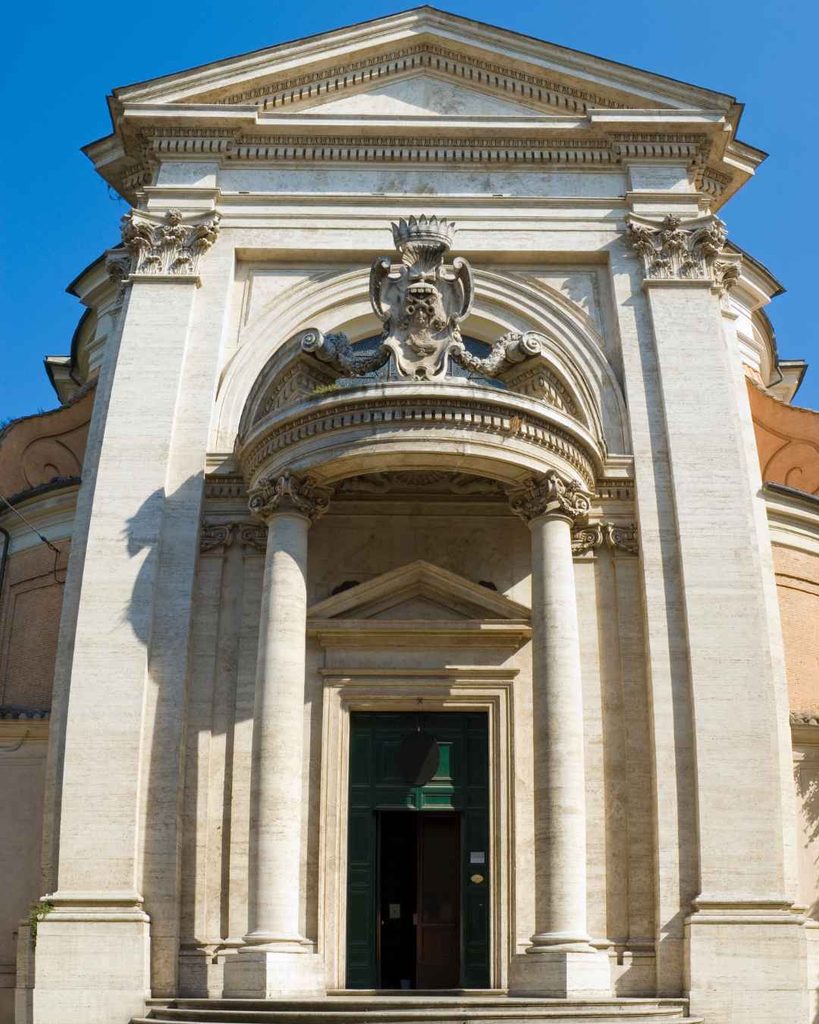
Sant’Andrea al Quirinale, completed between 1658 and 1670, is one of Bernini’s most important church designs. It has an elliptical plan, which creates a sense of intimacy and focus. The dome is coffered, and the interior is decorated with marble and stucco.
The church is dedicated to Saint Andrew, and the altarpiece depicts his martyrdom. The design is a masterful demonstration of Bernini’s ability to manipulate space and light to create a specific emotional effect. The oval shape of the church draws the eye toward the altar, and the light from the dome illuminates the space in a way that feels divine.
11. The Bust of Pope Urban VIII

Bernini was also a master of the portrait bust. He carved busts of popes, cardinals, and other important figures, and his portraits are known for their psychological depth and their ability to capture the character of the subject.
His bust of Pope Urban VIII is one of his most famous portraits. It is in the Galleria Nazionale d’Arte Antica in Palazzo Barberini. The bust captures the pope’s intelligence, his authority, and his humanity. The drapery of his robes is carved with the same dynamic energy that characterizes Bernini’s larger works.
Bernini also carved a bust of Costanza Buonarelli, his mistress, which is known for its intimacy and its emotional intensity. It is in the Contini Bonacossi Collection in Florence.
Bernini vs. Michelangelo: Two Approaches to Sculpture

Bernini and Michelangelo are the two greatest sculptors in the history of Rome, and they represent two entirely different eras of art.
Michelangelo worked in the Renaissance, in the early sixteenth century, when the goal was to capture the ideal human form. Bernini worked in the Baroque, in the seventeenth century, when the goal was to capture movement, emotion, and drama.
Michelangelo’s sculptures are calm, monumental, and self-contained. Think of the Pietà, where Mary holds Christ’s body with a stillness that feels eternal. Or the Moses, where the prophet sits in a state of barely contained anger.
Michelangelo carved marble as if it were flesh, but he always kept the figure within the boundaries of the block. His works feel solid, permanent, and restrained.
Bernini’s sculptures are the opposite. They twist, they turn, they reach into the space around them. His David is caught mid-swing, his Apollo and Daphne is caught mid-transformation, his Ecstasy of Saint Teresa is caught in a moment of divine rapture.
Bernini treated marble as if it were clay, and he used light, shadow, and theatrical settings to make his figures feel alive.
Where Michelangelo sought perfection, Bernini sought drama. Michelangelo carved figures that seemed to exist outside of time. Bernini carved figures that seemed to exist in a specific moment, caught between one action and the next. Both approaches are extraordinary, and both are essential to understanding Rome.
If you want to compare them in person, start with Michelangelo’s Pietà in St. Peter’s Basilica, then walk through the Vatican Museums to see the Apollo and Daphne and the David in the Galleria Borghese.
The contrast is immediate. Michelangelo will make you feel small in the presence of something eternal. Bernini will make you feel like you are watching a scene unfold in front of you.
Together, they tell the story of Rome’s artistic soul across two centuries. Michelangelo represents the Renaissance at its height, the belief that art could capture the ideal.
Bernini represents the Baroque at its most theatrical, the belief that art could capture life itself. You cannot understand Rome without understanding both.
How to See Bernini in Rome
Bernini’s works are scattered across Rome, and seeing them requires some planning. The Galleria Borghese is the essential destination, and it requires a reservation.
The Ecstasy of Saint Teresa is in a church that is free to enter. The fountains are in public squares and are always accessible. The Baldacchino and the Colonnade are in the Vatican, which requires a ticket for the basilica, though the basilica itself is free.
If you have limited time, prioritize the Galleria Borghese and the Cornaro Chapel. These are the works that best demonstrate Bernini’s genius. The fountains are also essential, and they are free.
Wear comfortable shoes. Rome is a walking city, and the cobblestones are hard on your feet. Book your Galleria Borghese tickets well in advance, especially in high season. The museum limits admission, and tickets sell out quickly.
Related Post: The Best Guide to Rome’s Borghese Gallery
Final Thoughts
Gian Lorenzo Bernini was the greatest sculptor of the Baroque, and he spent his life making marble do things that no one had ever made it do before.
He made it move, he made it feel, he made it burn with religious ecstasy and writhe with violence. He took the cold, hard stone that sculptors had worked with for centuries and turned it into something alive.
His works are everywhere in Rome. They are in the museums, the churches, the fountains, and the squares. They are part of the fabric of the city, and they are part of the reason Rome is the most beautiful city in the world.
If you go to Rome and you do not see Bernini, you have missed something essential. You have missed the artist who, more than any other, made Rome look like Rome.
So book your ticket to the Galleria Borghese. Walk into Santa Maria della Vittoria and stand in front of the Ecstasy of Saint Teresa. Find the Fountain of the Four Rivers in Piazza Navona. Look up at the Baldacchino in St. Peter’s.
And when you see the marble yield under Pluto’s fingers, or the light catch the angel’s arrow, or the water spill from Triton’s conch, you will understand. You will understand why Bernini was called the Michelangelo of the seventeenth century. And you will understand why Rome has never been the same since.
Again, feel free to go through the list below of my Italy recommendations that I have crafted after years of travel to this beautiful country:
- Packing List: Things Not to Go to Italy Without
- Must-Do Things: Unforgettable Experiences
- Where to Stay: Best Hotels in Italy.
- Where to Stay in Rome: Rome’s Best Neighborhoods
- Where to Stay in Florence: Picking the Best Area
- Where to Stay in Venice: Venice’s Best Districts
- Italy’s Cobblestone Streets: Best Shoes For the Job
- Backpack or Suitcase?: Italy Luggage Guide
- Travel Insurance: Always Be Covered
- E-Sim: Be Connected At All Times