
There is a particular kind of traveler who arrives in Tuscany with a list of hill towns and a limited number of nights. The list usually includes Siena and San Gimignano.
That is usually because they are the two names that appear in every guidebook, on every list of must-see destinations, and in every photograph of the region that has ever made you want to book a flight. The question is not whether to visit them.
The question is where to sleep.
This is a more consequential decision than it first appears. Siena and San Gimignano are only about forty-five minutes apart by car, and they are connected by bus routes that make day trips between them entirely feasible.
But they are fundamentally different places, with different scales, different atmospheres, and different rhythms. One is a living city with a university, a working economy, and a population that exists independent of tourism.
The other is a medieval village that has been preserved so perfectly that it sometimes feels like a stage set, beautiful and slightly hollow once the day-trippers leave.
The right choice depends on what you want from your Tuscan nights. This article covers both towns in detail, explains the trade-offs, and recommends specific hotels for each.
Before you read further, remember that Italy rewards travelers who come prepared. I’ve found a few things especially useful on an Italy trip, and they’re worth having and/or knowing beforehand. See the checklist here
The Case for Siena
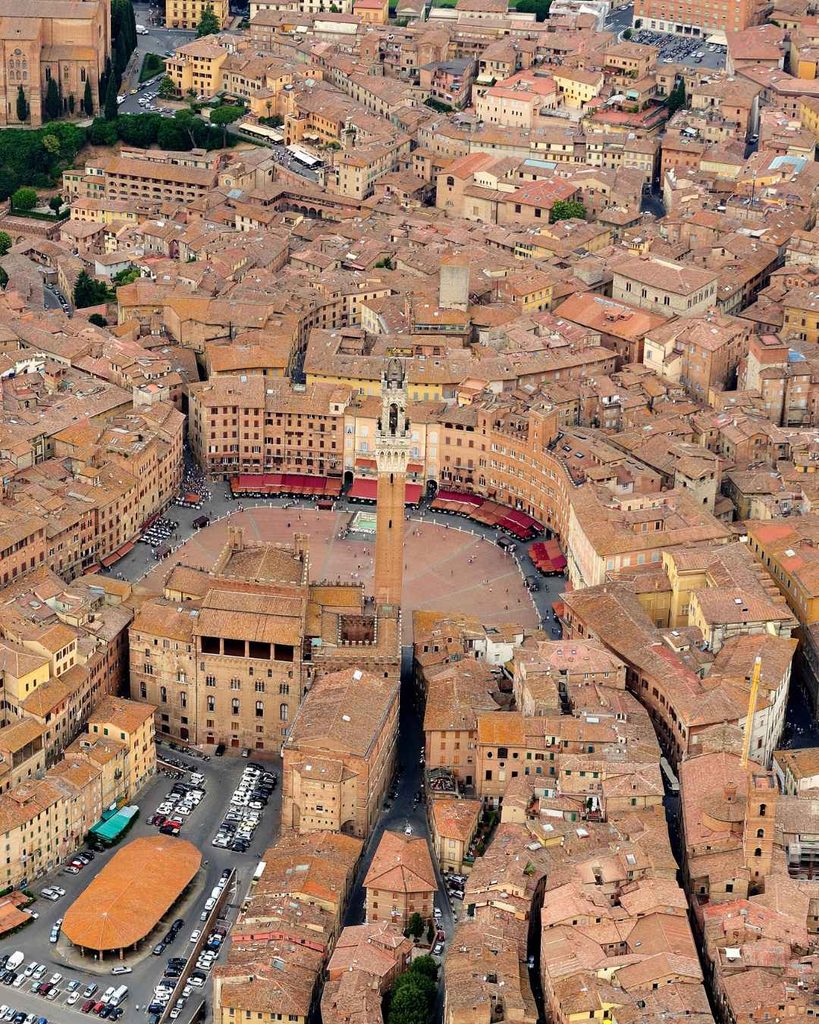
Siena is a city, not a village. It has a population of around fifty thousand people, a university that dates back to 1240, and a historic center that is one of the best-preserved medieval urban landscapes in Europe.
It is a UNESCO World Heritage Site, and it earned that designation not because of a single monument but because the entire city is a monument.
The heart of Siena is Piazza del Campo, the shell-shaped square that is widely considered one of the most beautiful public spaces in Italy.
It is paved with red brick in a herringbone pattern, divided into nine segments that radiate outward from the Palazzo Pubblico, the city hall that has anchored the square since the thirteenth century.
The Torre del Mangia rises from the Palazzo, and climbing its three hundred steps rewards you with a view that stretches across the rooftops and out into the Tuscan countryside.
Piazza del Campo is also the site of the Palio, the bareback horse race that takes place twice a year, on July 2 and August 16. The Palio is not a tourist attraction. It is a civic ritual that has been running for centuries, organized around the seventeen contrade, or districts, that divide the city.
Each contrada has its own church, its own museum, its own symbols, and its own fierce loyalty. If you are in Siena during the Palio, you will see a side of the city that most visitors never encounter.
The other essential sight in Siena is the Duomo, the cathedral that was intended to rival Florence’s and, in the opinion of some travelers, surpasses it. The exterior is striped black and white marble, and the interior is a cascade of frescoes, sculptures, and inlaid marble floors.
The floor is one of the most elaborate in Italy, with fifty-six scenes carved into the marble, but it is usually covered for protection and only fully revealed for a few weeks each year. The Piccolomini Library, off the left aisle, is a small room covered in frescoes by Pinturicchio that depict the life of Pope Pius II.
Beyond these two anchors, Siena rewards wandering. The city is built on three hills, and its streets wind and climb in ways that make getting lost a pleasure rather than a frustration.
There are churches, museums, and piazzas scattered throughout the historic center, and the neighborhoods away from the main tourist routes have a lived-in quality that feels increasingly rare in Tuscany.
The practical advantages of staying in Siena are significant. The city has a wide range of accommodation, from budget hostels to luxury hotels in historic palazzos. It has excellent restaurants at every price point.
It has a train station, which makes it accessible from Florence and other parts of Italy. And because it is a real city, it absorbs crowds in a way that smaller towns cannot. Even on the busiest days, you can find quiet corners of Siena that feel entirely your own.
The Case for San Gimignano
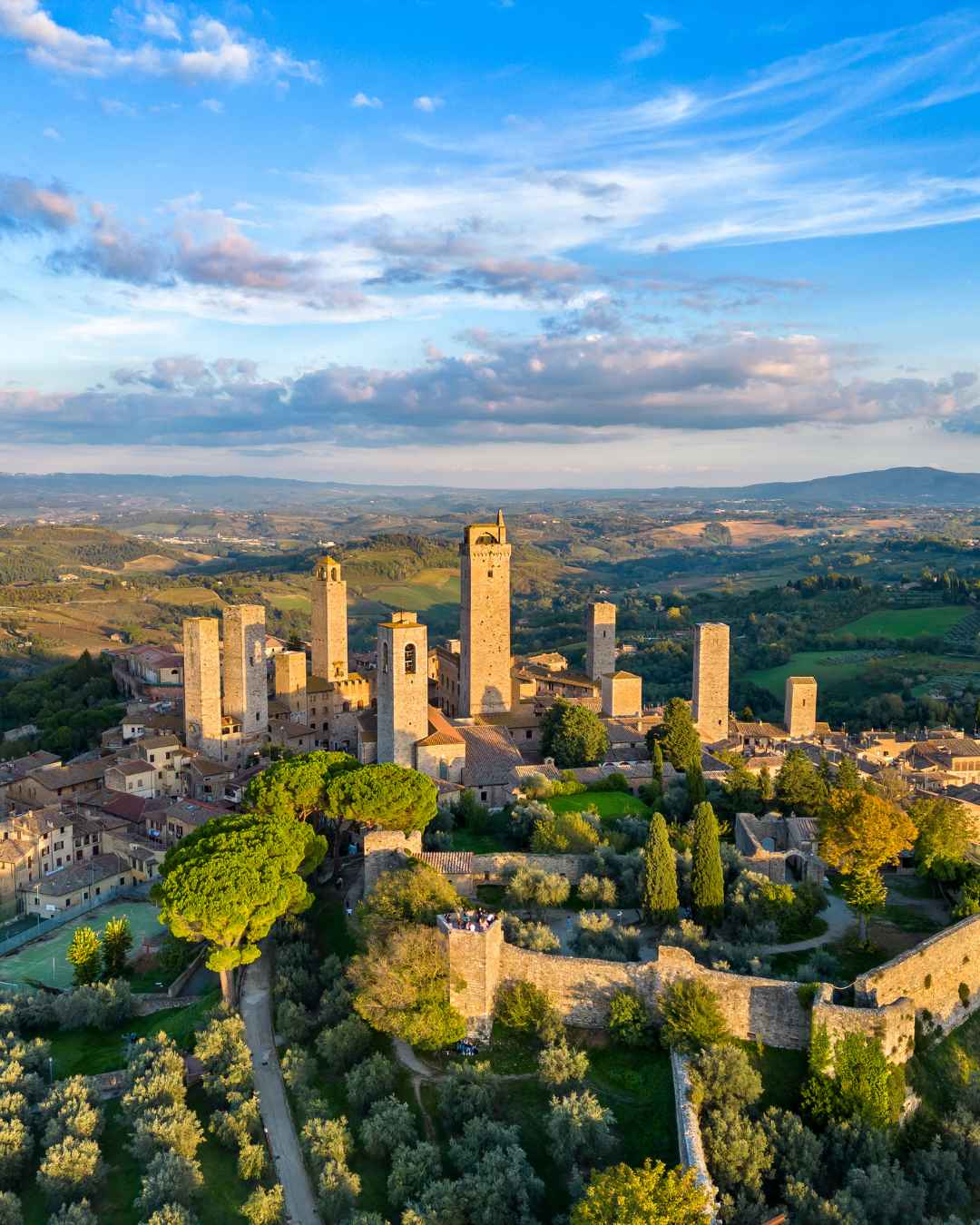
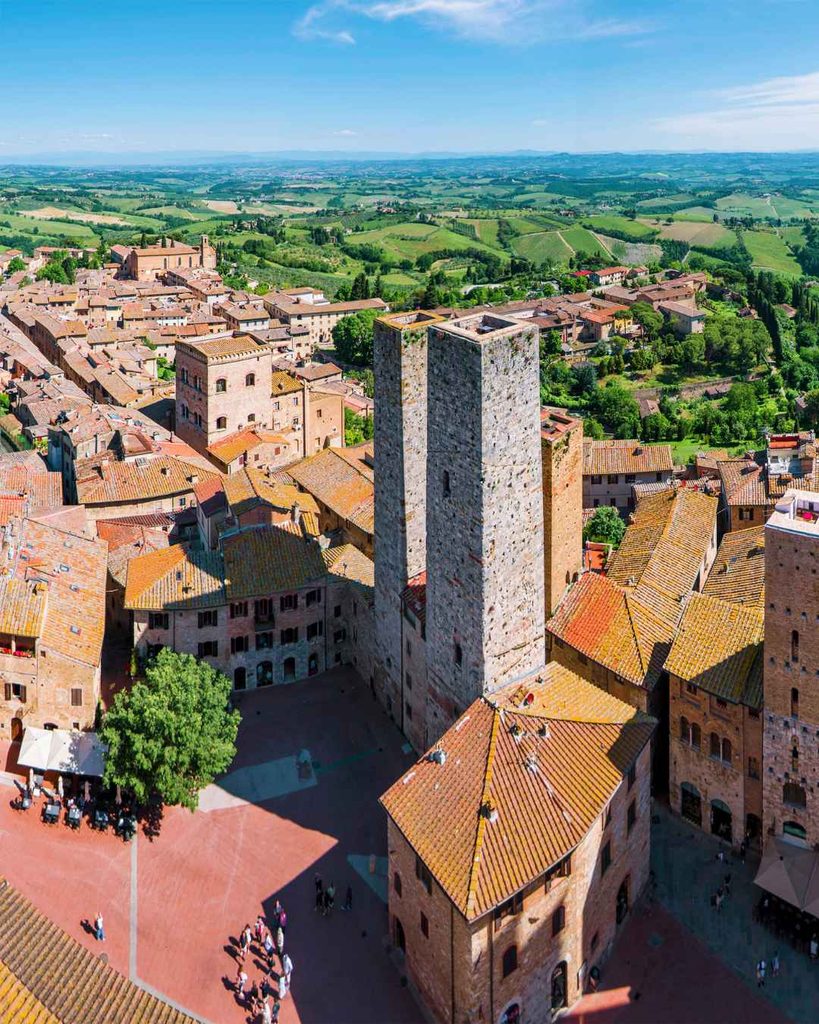
San Gimignano is a village, and its charm lies precisely in that fact. It sits on a hilltop in the Val d’Elsa, surrounded by vineyards and olive groves, and its skyline is dominated by towers.
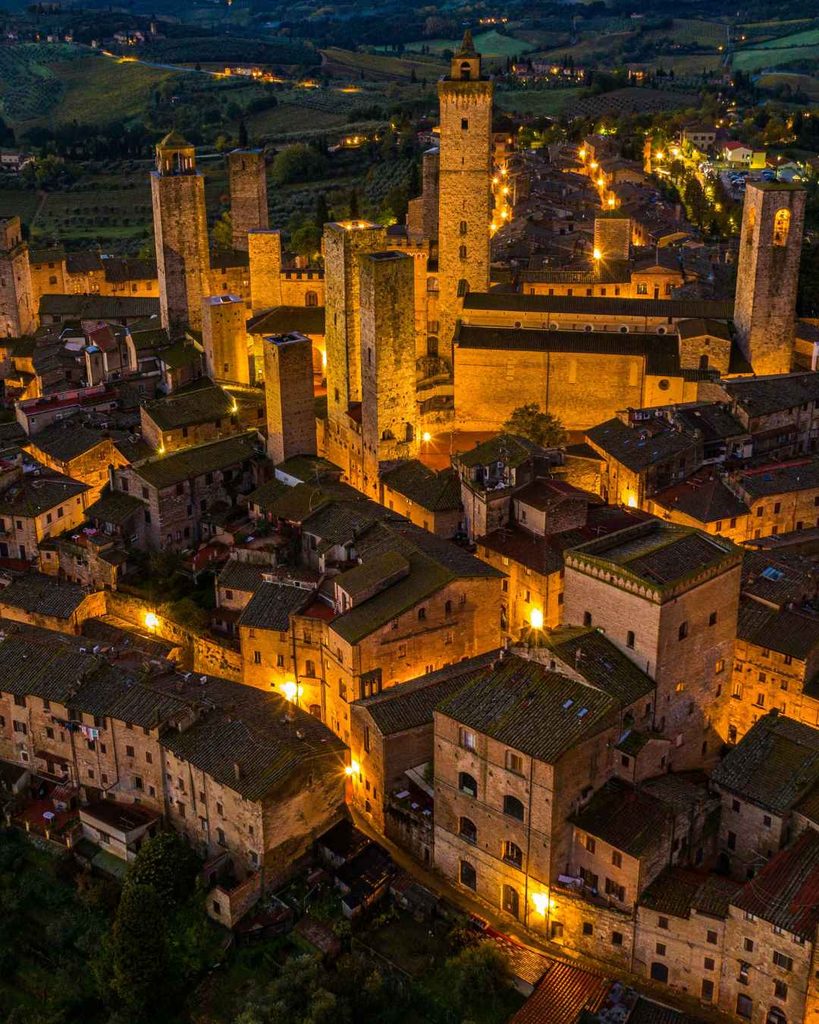
At its peak, the town had seventy-two towers, built by noble families as symbols of their wealth and power. Fourteen remain today, and they give the town a distinctive profile that has earned it the nickname “Medieval Manhattan.”
The town is small enough to walk end to end in fifteen minutes. Its two main squares, Piazza della Cisterna and Piazza del Duomo, are surrounded by medieval buildings, cafes, and shops.
The Collegiate Church, or Duomo, contains a cycle of frescoes that are among the best-preserved in Tuscany, depicting scenes from the Old and New Testaments as well as the life of Saint Fina, the town’s patron saint. The Palazzo Comunale houses the Torre Grossa, the tallest tower in town, which you can climb for views across the Val d’Elsa.
San Gimignano is also known for its wine. Vernaccia di San Gimignano was the first Italian white wine to receive DOCG status, and it is still produced in the vineyards surrounding the town. The wine is crisp, mineral, and slightly bitter, and it pairs well with the local food, which includes pecorino cheese, saffron, and wild boar.
The problem with San Gimignano is its popularity. It is one of the most visited towns in Tuscany, and between late morning and late afternoon, it is overrun with tour groups.
The narrow streets become crowded, the shops sell the same souvenirs you will find in every other hill town, and the atmosphere can feel more like a theme park than a living community.
The town’s population is small, and much of its economy depends on tourism, which means that when the day-trippers leave, the town can feel quiet to the point of emptiness.
This is why the advice to stay overnight in San Gimignano is so common. The town transforms in the evening, when the buses have gone, and the streets belong to the people who are staying there.
The light softens, the cafes set out their tables, and you can walk through the squares and alleys without jostling for space. It is a different place entirely, and for many travelers, it is the version of San Gimignano they remember.
So, Where Should You Stay?
When deciding where to spend the night, there are a few practical factors to weigh.
Time needed
Siena requires at least a full day to do justice to its major sights, and you could easily spend two or three days exploring its museums, churches, and neighborhoods. San Gimignano can be seen in half a day, or a full day if you climb the towers, visit the museums, and linger over a long lunch. If you have limited time in Tuscany, Siena offers more to fill it.
Crowds and timing
San Gimignano suffers more from day-tripper crowds than Siena, simply because it is smaller. If you stay overnight, you get the quiet hours in the morning and evening. Siena is larger and absorbs crowds better, so even during the day, you can find peaceful corners.
Accessibility
Siena has a train station, though it is located at the bottom of the hill and requires a bus or taxi to reach the historic center. San Gimignano has no train station. It is reached by bus from Siena or Florence, or by car. If you are traveling without a car, Siena is easier to reach and easier to use as a base for exploring the region.
Atmosphere
Siena feels like a living city. San Gimignano feels like a preserved village. Which one you prefer depends on whether you want to feel like you are visiting a place where people live and work, or a place that has been curated for visitors.
Food and dining
Siena has a wider range of restaurants, from casual trattorias to fine dining. San Gimignano has plenty of restaurants too, but they are more concentrated in the tourist areas and can be more expensive for what you get. Siena’s food scene is deeper and more varied.
Where to Stay in Siena
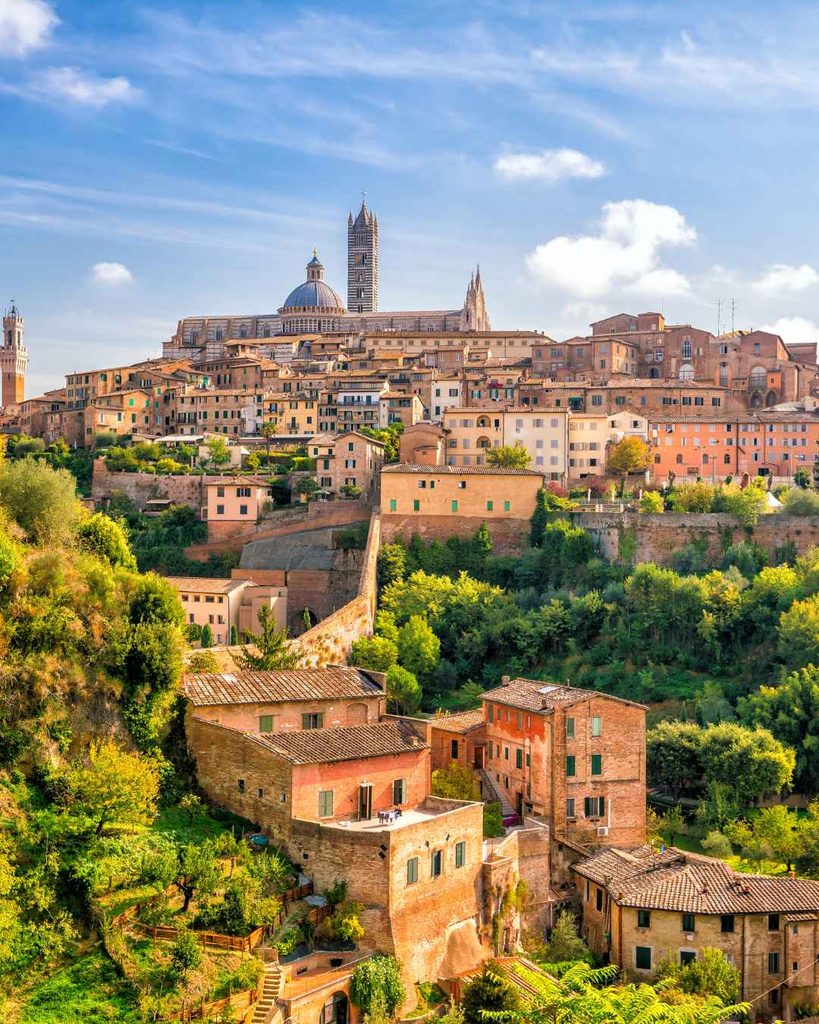
Siena has accommodation options for every budget, and the historic center has a good concentration of hotels in converted palazzos and historic buildings.
Grand Hotel Continental Siena
This is the most luxurious option in the city, a five-star hotel housed in a seventeenth-century palazzo on Via Banchi di Sopra, one of the main streets of the historic center.
The rooms are elegant and spacious, with frescoed ceilings in some cases, and the hotel has a restaurant and a bar that are popular with locals as well as guests. It is expensive, but if you want to treat yourself to a special stay in Siena, this is the place.
Hotel Alma Domus
A more affordable option with a great location near the Basilica of San Domenico, just a short walk from Piazza del Campo. The hotel is run by nuns, and the rooms are simple but comfortable.
Some rooms have views of the Duomo, and the atmosphere is quiet and peaceful. Breakfast is included, and the value for money is excellent.
Palazzetto Rosso
A boutique hotel in a restored medieval building, with individually decorated rooms and a focus on design. It is located in the historic center, within walking distance of all the major sights. The hotel is small and intimate, with a rooftop terrace that offers views across the city.
Hotel Italia
A comfortable three-star hotel just outside Porta Camollia, near the train station and the bus stops. It is a good choice for travelers arriving by public transport, and it is a twenty-minute walk from Piazza del Campo. The rooms are modern and clean, and the breakfast is generous.
Borgo Grondaie
A country house hotel just outside the city walls, with a pool and gardens. It is a good option for travelers with a car, or for anyone who wants a quieter stay with easy access to the city. The rooms are spacious, and the setting is peaceful.
For travelers on a budget, Siena has several hostels and guesthouses, including HostelCiompi, which is centrally located and has a friendly atmosphere.
Where to Stay in San Gimignano
Accommodation in San Gimignano is more limited than in Siena, and the best options book up quickly, especially in high season. The town has a handful of hotels and a larger number of B&Bs and guesthouses, many of them in historic buildings.
Hotel la Cisterna
The most famous hotel in San Gimignano, located right on Piazza della Cisterna. The hotel has been run by the same family for generations, and it has a restaurant with views of the square. The rooms are comfortable and traditional, and the location is unbeatable if you want to be in the heart of the town.
Leon Bianco
A charming hotel in a thirteenth-century building on Piazza della Cisterna. The rooms are decorated in a traditional Tuscan style, and some have views of the towers. The hotel has a terrace where breakfast is served in warm weather, and the staff is helpful and welcoming.
Hotel l’Antico Pozzo
A boutique hotel in a restored medieval building, with elegant rooms and a central location. The hotel has a courtyard garden and a breakfast room with frescoed walls. It is a good choice for travelers who want a bit more style and comfort without leaving the historic center.
B&B Il Fienile
A highly rated bed and breakfast just outside the town walls, with views of the towers and the surrounding countryside. The rooms are comfortable and well-appointed, and the hosts are known for their warmth and hospitality. It is a short walk from the historic center, which means you get the quiet of the countryside with easy access to the town.
Palazzo Mari
A small B&B in the heart of San Gimignano, steps from the Collegiate Church and the Archaeological Museum. The rooms are simple but comfortable, and the location is excellent for exploring the town on foot.
For travelers who want a more rural experience, there are several agriturismos and farm stays in the surrounding countryside, offering vineyards, olive groves, and views of the towers from a distance.
The Verdict
If you have to choose one place to spend the night, Siena is the safer bet. It has more to see, more to do, more places to eat, and a wider range of accommodation. It absorbs crowds better, it is easier to reach by public transport, and it has a genuine urban energy that San Gimignano lacks. You could spend three nights in Siena and not run out of things to do.
But San Gimignano has something that Siena does not: the experience of waking up in a perfectly preserved medieval village, with the towers rising above you and the streets quiet before the buses arrive. If you are willing to trade variety for intimacy, and if you are prepared to book your accommodation well in advance, San Gimignano can be magical.
The ideal solution, if your itinerary allows, is to spend two nights in Siena and one night in San Gimignano. Use Siena as your base for exploring the city and the surrounding region, and then move to San Gimignano for a night to experience the town at its quietest. The two are close enough that the transition is easy, and the contrast between them will make both stays more memorable.
Again, feel free to go through the list below of my Italy recommendations that I have crafted after years of travel to this beautiful country:
- Packing List: Things Not to Go to Italy Without
- Must-Do Things: Unforgettable Experiences
- Where to Stay: Best Hotels in Italy.
- Where to Stay in Rome: Rome’s Best Neighborhoods
- Where to Stay in Florence: Picking the Best Area
- Where to Stay in Venice: Venice’s Best Districts
- Italy’s Cobblestone Streets: Best Shoes For the Job
- Backpack or Suitcase?: Italy Luggage Guide
- Travel Insurance: Always Be Covered
- E-Sim: Be Connected At All Times