
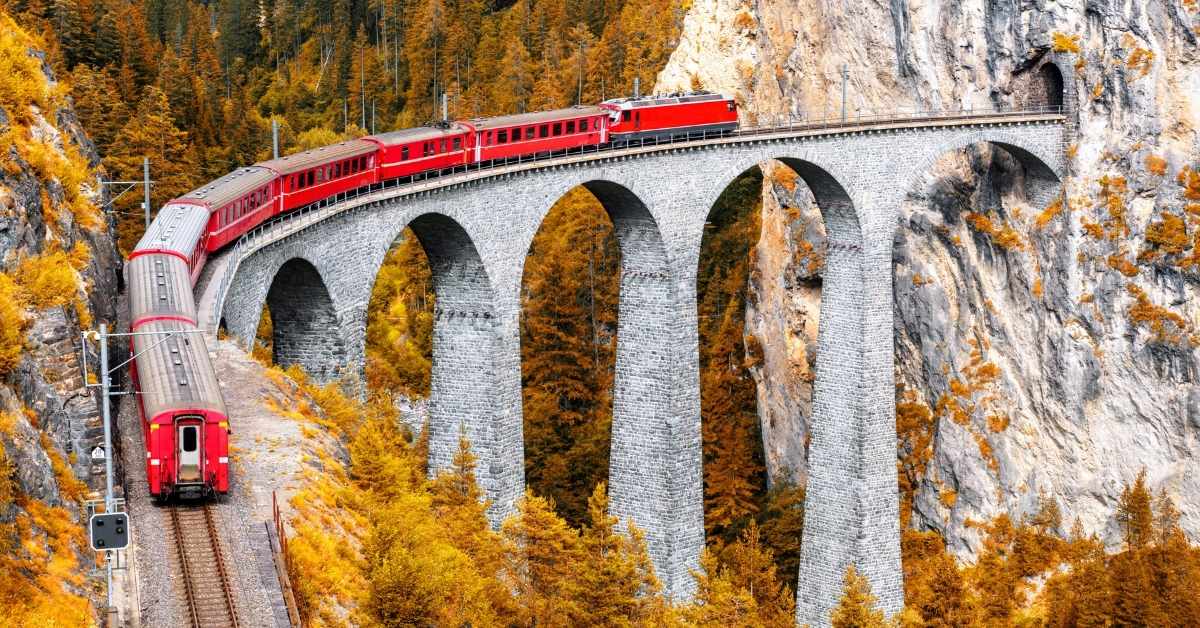
There are train journeys, and then there is the Bernina Express. This is the one that makes you forget about your phone, press your face against the glass like a child, and utter the same phrase over and over: “Look at that.” My wife, who usually spends long journeys with her nose in a book, didn’t turn a single page for the entire two-and-a-half-hour climb.
Maybe you are in Milan for a city break, perhaps you are exploring the lakes further north, or you want an escape that feels like stepping into an entirely different world. The Bernina Express delivers that. In a single day, you can travel from the gentle, sun-baked valleys of Lombardy up over the roof of the Alps and down into the rarified, glamorous air of St. Moritz.
Here is everything you need to know to make that day unforgettable.
Stop experiencing Italy like everyone else. Your trip is different because you are different. Tell me when you’re going, who you’re traveling with, where you want to go, what you absolutely want to see and do, your budget, and anything else that matters to you. I’ll put it all together into a tailor-made Italy itinerary that tells you where to go, where to stay, what to eat, and how to make the most of your time. Use this form
What Actually Is the Bernina Express?
The Bernina Express is not just a train; it is a moving observation deck that traverses one of the most spectacular railway lines on Earth. The route, which runs from Tirano in Italy to Chur in Switzerland, is a UNESCO World Heritage Site, and for good reason. It is the highest railway crossing of the Alps that does not use a rack-and-pinion system, a testament to the engineering genius of its builders.
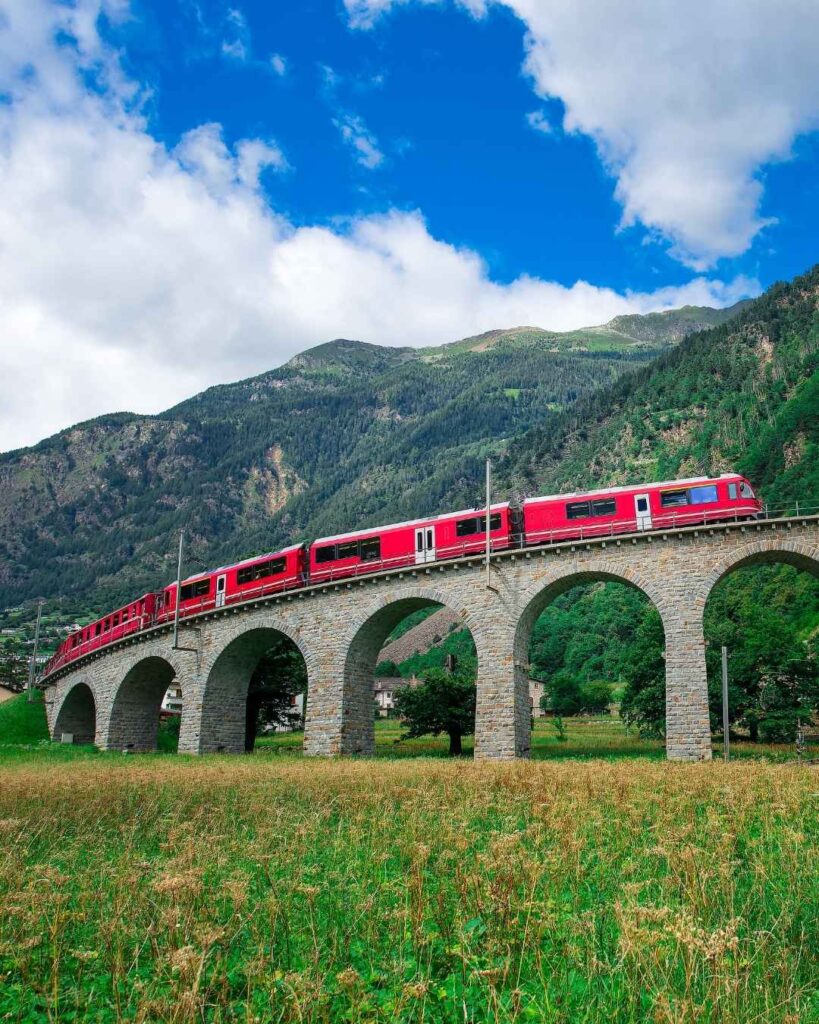
In its journey, the train crosses 196 bridges and passes through 55 tunnels, climbing from the 429 metres of Tirano to a breathtaking 2,253 metres at the Ospizio Bernina pass. The star of the show is undoubtedly the Brusio Spiral Viaduct, a 360-degree open loop that allows the train to gain altitude gracefully by circling back under its own track. You will know it is coming when everyone in the carriage suddenly falls silent and reaches for their cameras.
The Day Trip Experience: What to Expect
Most travellers from Italy do this as a long but rewarding day trip. The classic itinerary, like this one, which you will find offered by most tour operators, is a carefully choreographed dance between train and coach.
The day starts early. You will be picked up from a central point in Milan, often near the station, around 7:00 AM. After a two-and-a-half-hour drive north, you will arrive in Tirano, the Italian terminus of the Bernina line. There is not much time to explore the town itself; the real adventure begins on the platform. Boarding is usually around 10:30 AM.
The train ride itself is a steady, two-and-a-half-hour ascent through the Valtellina valley, past alpine villages, and up over the Bernina Pass. You will stop briefly for a photo opportunity at Alp Grüm, which is aptly known as the “balcony on the glaciers,” before arriving in St. Moritz around 1:30 PM. Then comes the turnaround.
You typically have about 90 minutes of free time in St. Moritz before boarding the coach for the return journey to Milan, which takes you back down through the Italian valleys. The entire day lasts around 12 to 13 hours.
Panoramic vs. Standard Carriages: The Big Decision
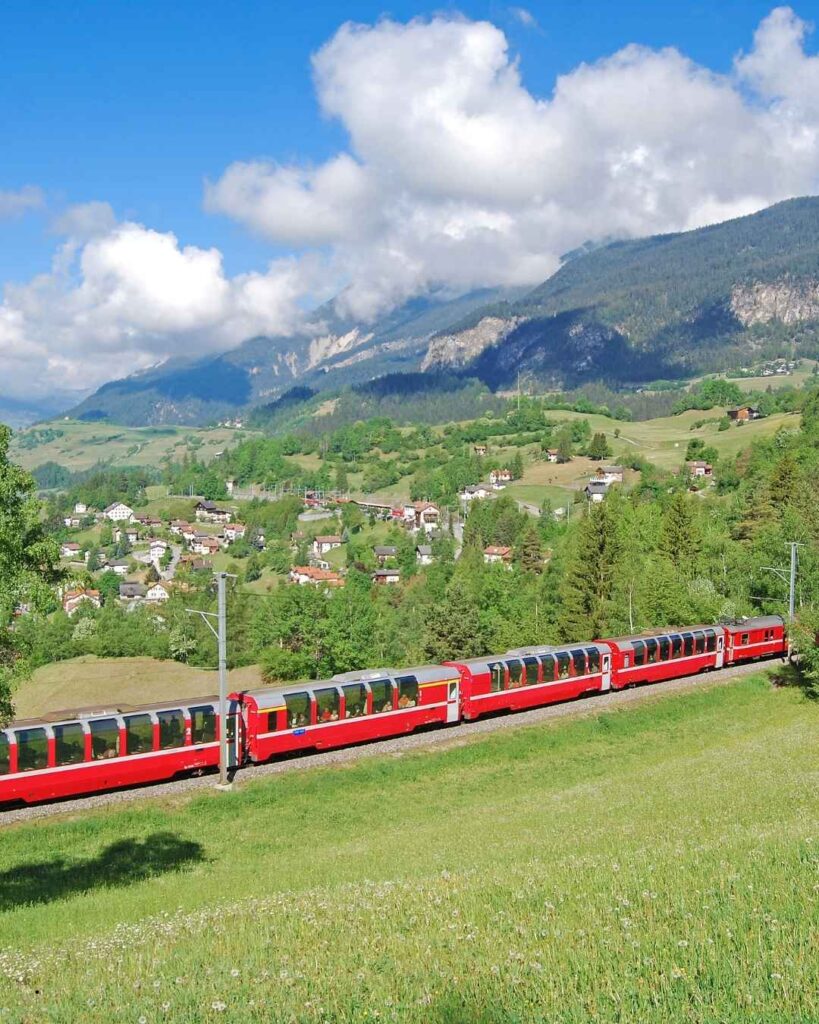
This is the most important decision you will make. There are two types of train carriages on the Bernina line, and the difference is significant.
The panoramic carriages are what you see in the glossy brochures. They feature huge, curved floor-to-ceiling windows that wrap up into the roof, giving you an almost uninterrupted view of the mountains above and the valleys below. Seats in these carriages are reserved, which is a blessing because it guarantees you a spot, especially during the busy summer months. Many tours advertise this as a premium upgrade.
The standard regional carriages run on the exact same tracks, but they are a different experience. They are the trains the Swiss locals use. The windows are normal-sized but can be lowered, which is a huge advantage for keen photographers. However, seats are not reserved, so it is a scramble to find a good spot.
Here is the honest truth: if you are making the effort to do this trip, the panoramic carriage is worth the extra cost. The difference in the experience is night and day. The unobstructed views are the whole point of the journey. If you choose a budget tour that uses the standard carriages, go in with your eyes open—you will be comfortable, but you will be craning your neck to see the peaks.
Best Seats for the Best Views
There is one question that dominates every forum and every travel group: “Which side of the train should I sit on?”
For the journey from Tirano to St. Moritz, the best views are from the left side. This will give you the most dramatic vistas of the mountains, the glaciers, and the valleys below. If you are travelling from St. Moritz back to Tirano, the opposite applies—the right side is your best bet.
If photography is your primary goal, consider sitting in the last carriage. This allows you to capture the train itself as it curves around the iconic viaducts, creating a classic shot of the red train snaking through the Alpine landscape
The Logistics: Tickets, Reservations, and Border Crossings
This is where many people get caught out. You cannot just show up and hop on the panoramic Bernina Express; you need a ticket and a seat reservation.
The ticket pays for your travel, but the seat reservation is mandatory for the panoramic carriages and is what guarantees your specific seat. You can book this directly through the official Rhaetian Railway website or through organised tours. Booking is essential, especially in summer. For a July or August trip, aim to book at least three to four weeks in advance to secure a spot on the panoramic carriage.
Since you are travelling from Italy to Switzerland, you are crossing an international border. A valid ID card or passport is non-negotiable. Do not bring a driving licence, as it is not accepted as a travel document. There are usually passport checks on the train, so have your documents ready.
If you want to book an organised tour, this is the best.
What the 90 Minutes in St. Moritz Actually Gives You
St. Moritz is legendary. It is one of the most exclusive and glamorous mountain resorts in the world, but on this day trip, you are just passing through.
With 90 minutes, you have just enough time for a whistle-stop tour. From the station, it is a ten-minute walk downhill to the lakefront. Here, you can do a quick loop along the south shore, which takes about 25 minutes, and grab a coffee and a pastry from one of the elegant cafes.
Then, it is a fifteen-minute uphill walk back to the station. And that is your visit. It is not a deep dive, but it is enough to get a taste of the place and say you have been there. The real magic, of course, was the journey itself.
What to Pack for the Day
Packing correctly can make or break this trip. The temperature difference between Milan and the Bernina Pass can be as much as 77 degrees Fahrenheit. In Milan, you might be in a t-shirt; at Ospizio Bernina, you could be shivering in a t-shirt if you have not packed wisely.
A warm, windproof jacket is essential, even in summer. The air is thin and cold at 2,200 metres, and the wind can bite during the photo stop at Alp Grüm. Sunscreen and sunglasses are also non-negotiable. The reflection of the sun off the snow is fierce, and you will feel it even through the train windows.
Bring a water bottle to stay hydrated and a power bank for your phone. Battery life drains faster at high altitudes, and the charging ports on the panoramic carriages are notoriously slow. On the standard carriages, they do not exist at all.
When to Go: The Seasonal Magic
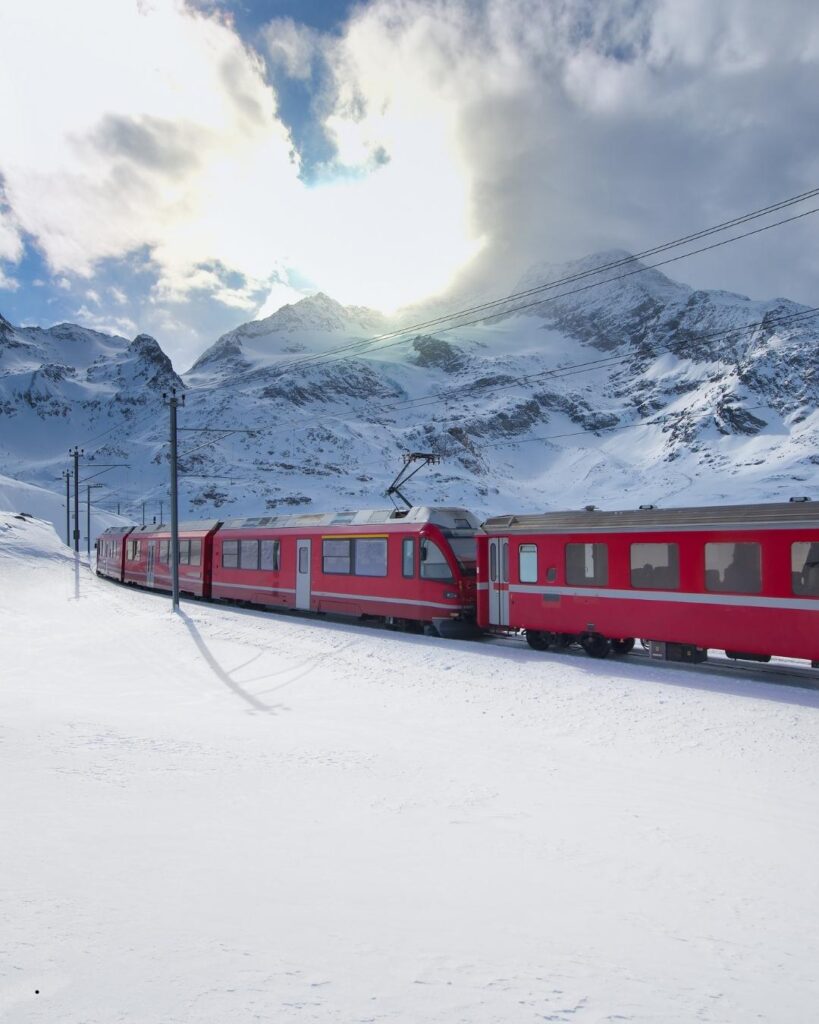
The Bernina Express is a different beast in every season, and choosing the right one depends on what you want to see.
Winter transforms the landscape into a fairy-tale scene of deep, pristine snow. The red of the train against the white of the Alps is the iconic image you have seen on postcards. The train runs reliably, and the snow makes the engineering feats like the Brusio Viaduct look even more dramatic.
Summer brings a different kind of magic. The valleys explode with alpine flowers, the glaciers are more visible, and the days are long. This is the most popular time to travel, which means crowds and the need to book well in advance.
If you want the best of both worlds, consider autumn. Late September and October see the larch trees turn a brilliant, fiery gold. The light is softer, the crowds have thinned, and the contrast between the yellow trees and the dark green of the conifers is a photographer’s dream. Spring is the shoulder season; you might get glorious sunshine, or you might get slushy snow at the pass. It is a gamble, but it is also a quieter time to travel.
Organized Tours vs. Going It Alone
You have two main options for this day trip: book a package tour or arrange everything independently.
Organized tours are by far the most popular choice for people based in Italy. They take all the hassle out of the day. A typical tour includes round-trip coach transport from Milan to Tirano, your Bernina Express ticket, and a guide to explain what you are seeing. The price usually falls between 120 and 180 euros per person. The main drawback is the fixed schedule. You are on their timetable, and you get what you pay for in terms of carriage type.
Booking independently gives you more flexibility. You can choose your departure time, decide whether to take the panoramic or regional train, and even combine both. You might take the regional train up, hopping off for photos and a walk, and take the panoramic carriage back. However, this requires more planning and a willingness to manage your own connections and bookings.
For most first-timers, the organised tour is the safer bet. It is simple, efficient, and you can just sit back and enjoy the ride without worrying about timetables. Check it out here
The Must-See Highlights Along the Route
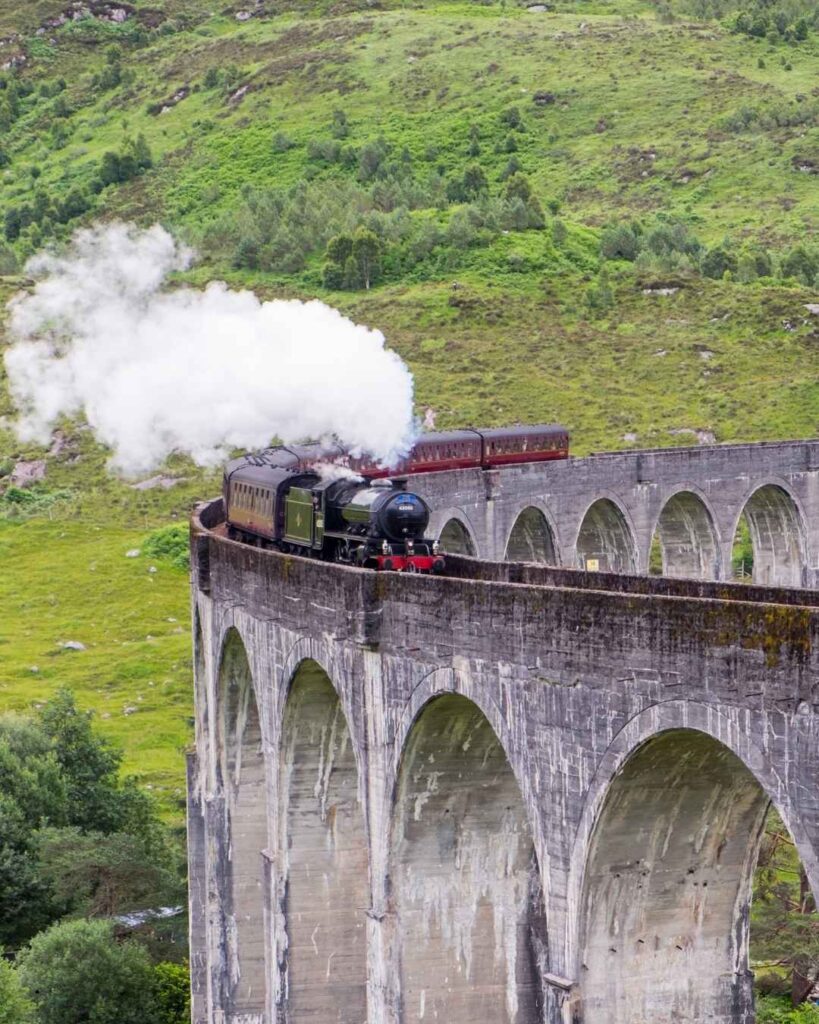
While the entire journey is a highlight reel, there are a few moments that stand out above the rest.
The Brusio Spiral Viaduct is the undisputed star. Seeing the train curl around itself in a full circle is a moment of pure wonder. Pay attention just after leaving Tirano; this is where the engineering magic begins.
Alp Grüm is where the train stops for a few minutes, and you should definitely get off. Step onto the platform and look up. The view of the Palü Glacier from here is staggering, and it is the first time you truly feel the scale of the Alps.
Lago Bianco, the White Lake, sits at the highest point of the journey. Its turquoise waters are fed by glaciers, and on a clear day, the reflection of the surrounding peaks is mesmerising. Further along, the Morteratsch Glacier comes into view, one of the largest glaciers in the Eastern Alps, its massive tongue of ice descending into the valley.
Finally, do not ignore the Poschiavo Valley. After the stark beauty of the high pass, the train descends into a lush, green valley that looks like it belongs in a Swiss postcard. The contrast is part of what makes this journey so special.
Common Pitfalls to Avoid
A few small mistakes can turn a dream day into a frustrating one.
Forgetting to book your seat reservation is the most common error. Without it, you cannot board the panoramic carriages, and you will be left scrambling for a spot on the regional train. Booking too late is another trap. Summer panoramic carriage spots can sell out weeks in advance.
Many people also underestimate the length of the day. It is a 12-hour commitment, and the coach ride back to Milan can feel long after the excitement of the train. Bring a neck pillow for the bus. And do not, under any circumstances, forget to bring your passport or ID card. The border control is real, and a driving licence will not cut it.
Finally, do not mistake the regional trains for the Bernina Express. They run on the same tracks, but they are different experiences. The regional trains are for commuters; the Bernina Express is for the views. If you book a cheap tour that uses regional carriages, go in knowing exactly what you are getting.
Beyond the Day Trip: Stretching the Adventure
If you have more time, consider turning this day trip into a longer adventure.
The Bernina Express Bus extends the journey from Tirano to Lugano via the beautiful shores of Lake Como, offering a completely different perspective of the region. You can also combine the Bernina Express with the Glacier Express, another legendary Swiss train, for the ultimate Alpine rail experience.
Alternatively, skip the return coach and spend a night in St. Moritz. This gives you the chance to properly explore the town, enjoy a proper dinner, and take a more relaxed return journey the next day. For hikers, an overnight stay in Poschiavo allows you to explore the valley’s trails before continuing your journey. The beauty of the Bernina line is that it is not just a journey; it is a gateway to a whole region of Alpine wonders.
NOTE BEFORE YOU GO: Italy rewards travelers who go prepared. And it is easy to ruin your trip. I have a checklist for you of things you should never go to Italy without. CHECK IT OUT HERE. I have also curated a list of some of the best hotels in Italy. I would highly recommend checking them out before booking. THESE ARE THE BEST HOTELS IN ITALY. And for unique experiences, attractions, and tours, don’t book before CHECKING THIS OUT. Thank me later!