
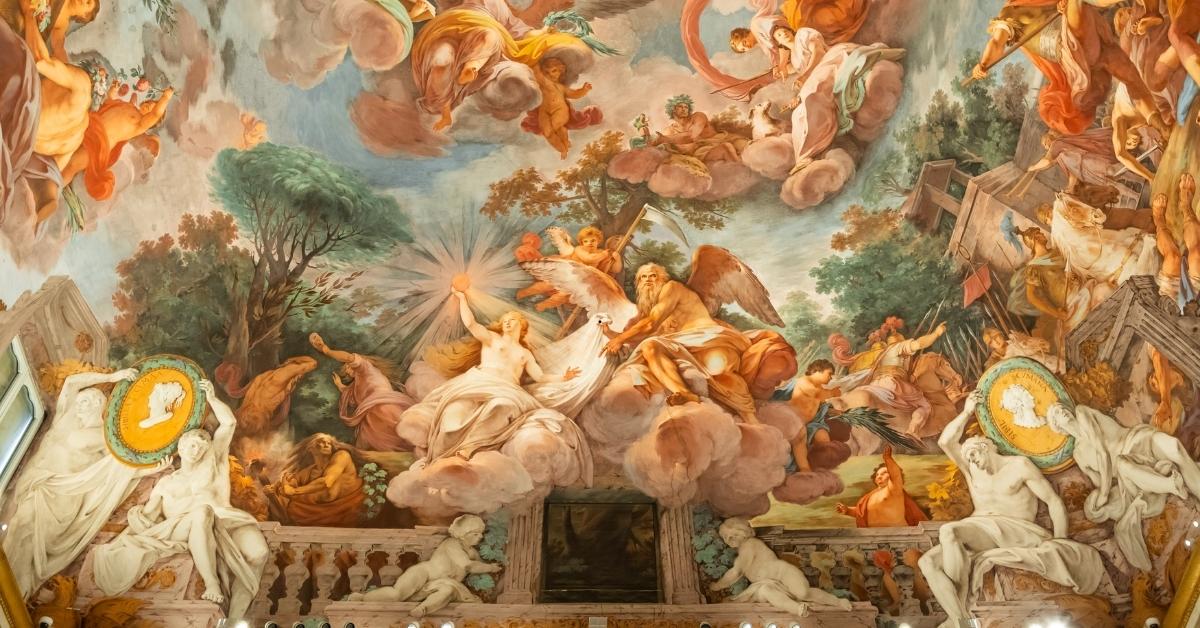
The Vatican Museums, for all their glory, can leave you shell-shocked, shuffling through endless corridors with a thousand other travelers. The Borghese Gallery is the opposite of that. It’s intimate, curated, and feels almost like a secret—even though it houses one of the world’s greatest art collections.
Built as a lavish party villa for a powerful cardinal, this jewel box of a museum offers a two-hour immersion into Baroque brilliance. You won’t find crowds elbowing for a view here.
The gallery limits entry to just a few hundred people at a time, and you’re given a strict two-hour window to explore. It forces you to slow down, to actually look. When I visited with my wife, that time limit felt less like a constraint and more like a gift—it kept us focused, present, and made every moment in those opulent rooms count.
Here’s everything you need to know to plan the perfect visit.
Before you read further, remember that Italy rewards travelers who go prepared. I have prepared a checklist of things you must have when visiting Italy if you want to have an unforgettable trip. See the checklist here.
The Man Behind the Masterpieces
To understand the gallery, you have to understand Cardinal Scipione Borghese. He was the nephew of Pope Paul V, a man who wielded immense power and used it ruthlessly to build one of the most staggering art collections in history.
He was Bernini’s first major patron and an early champion of Caravaggio. But Scipione wasn’t above a little creative acquisition. He had Raphael’s Deposition secretly removed from a church in Perugia and replaced with a copy. He even imprisoned an artist to get his hands on a painting he wanted. He was a collector with a passion bordering on obsession.
The villa itself was built between 1613 and 1616 as a suburban retreat—a place to showcase his treasures and throw legendary parties.
Over the centuries, the collection changed hands, was added to, and in 1807, a significant portion of the family’s antiquities were sold to Napoleon, which is why you’ll find Borghese pieces in the Louvre.
The Italian state finally acquired the building and its remaining collection in 1902, opening it to the public as a national museum.
The Stars of the Show
The Borghese Gallery is spread across two floors, and both are filled with some of the finest works of art you will encounter anywhere in Italy.
The ground floor is largely devoted to sculpture, while the upper floor houses an extraordinary collection of paintings. If you love Renaissance and Baroque art, give yourself plenty of time here. Rushing through the rooms would mean missing some remarkable details.
Ground Floor: Bernini’s Extraordinary Sculptures
The ground floor is where Gian Lorenzo Bernini truly steals the show. He was barely in his twenties when he created some of the sculptures that made him famous, and the level of detail and movement is astonishing.
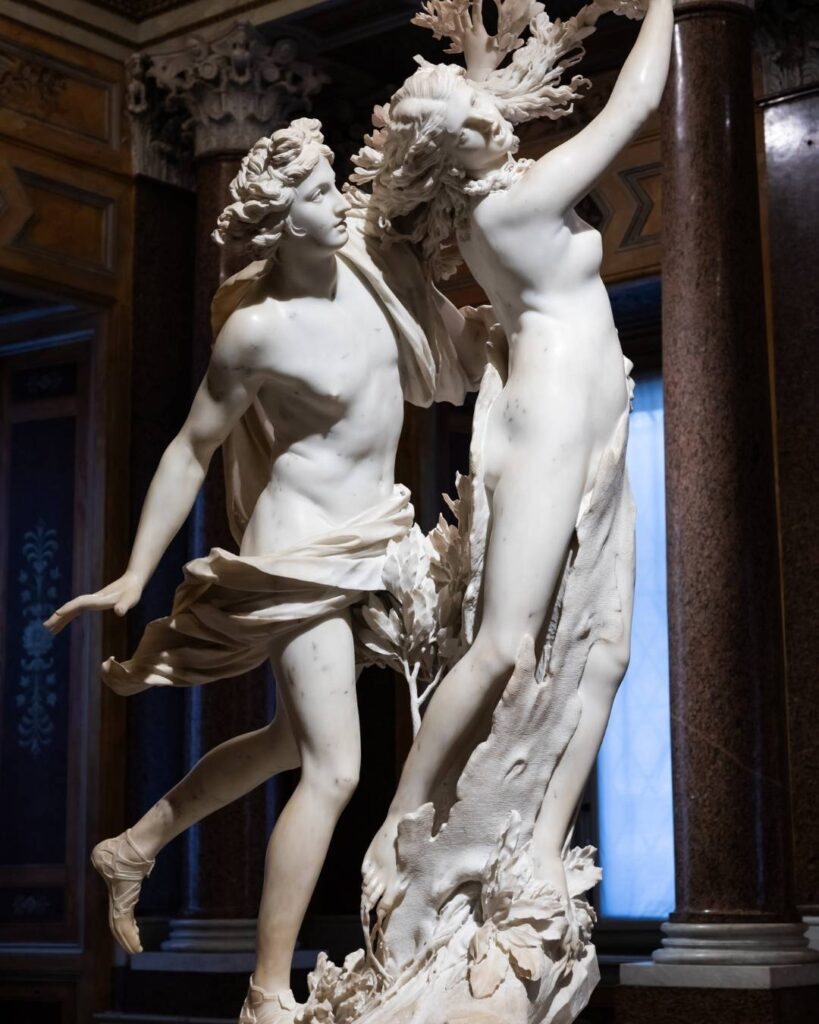
His Apollo and Daphne is perhaps the gallery’s greatest spectacle. It captures the exact moment the nymph Daphne transforms into a laurel tree to escape Apollo.
Her fingers are already sprouting leaves, bark is spreading across her body, and roots are beginning to form around her feet. Walk around the sculpture and watch how Bernini manages to make a block of marble appear to change before your eyes.
Another masterpiece you should not miss is The Rape of Proserpina, depicting Pluto carrying Proserpina away to the underworld. The drama is extraordinary.
Proserpina struggles desperately to escape, her face showing terror as Pluto’s powerful hands press into her thigh and waist. The marble seems almost impossibly soft beneath his fingers. Bernini’s David is equally fascinating.
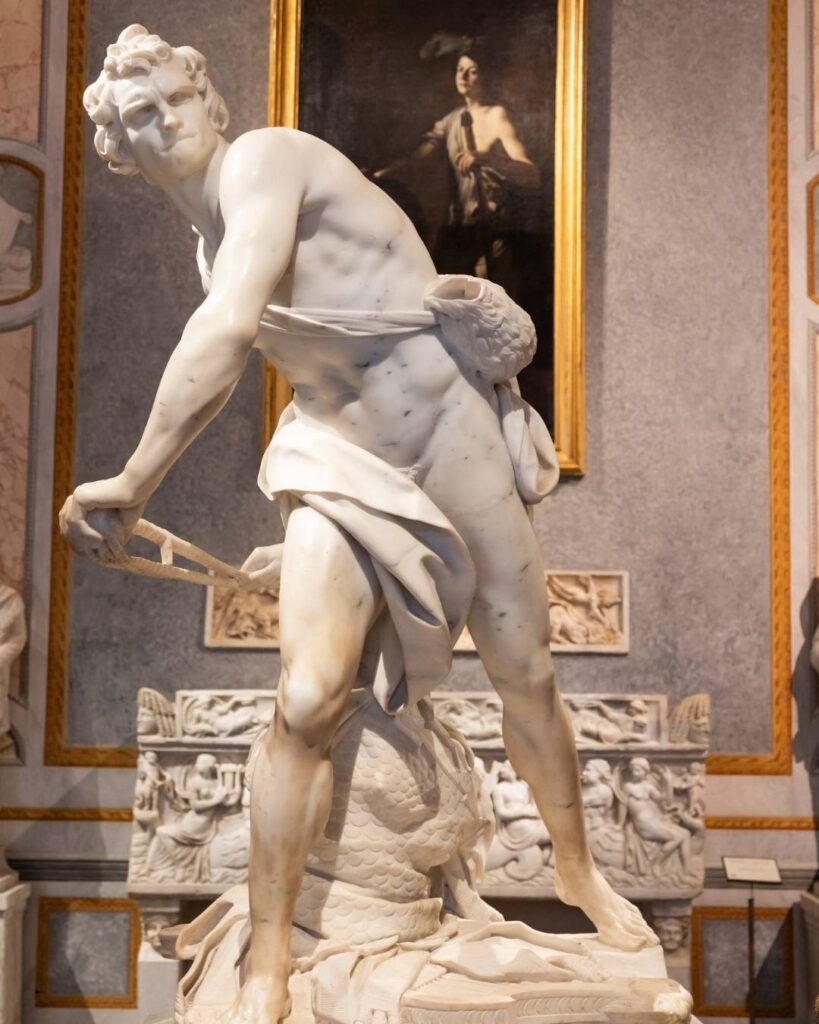
Unlike Michelangelo’s famous version, which shows David contemplating his next move, Bernini captures him in the middle of the action, his body twisted, muscles tense and face concentrated as he prepares to release his sling.
Upper Floor: Caravaggio and the Great Renaissance Masters
Upstairs, the focus shifts to painting, with Caravaggio taking centre stage. The Borghese Gallery has an exceptional collection of his works, including Boy with a Basket of Fruit, an early painting that demonstrates his remarkable ability to make ordinary subjects look extraordinary.
Look closely at the fruit, the leaves, and the boy’s expression. His later Madonna and Child with St. Anne and David with the Head of Goliath reveal his revolutionary use of light and shadow, known as chiaroscuro.
In these paintings, figures emerge dramatically from almost complete darkness, creating an intensity that became one of the defining features of Baroque painting.
But don’t spend all your time with Caravaggio. Raphael’s Deposition is a deeply emotional painting depicting the transportation of Christ’s body after the Crucifixion, while Titian’s Sacred and Profane Love remains one of the gallery’s most intriguing works.
Its two female figures, one richly dressed and the other partially nude, have inspired centuries of debate about the painting’s meaning. Finally, look out for Antonio Canova’s Pauline Bonaparte as Venus Victrix.
This extraordinary neoclassical sculpture portrays Napoleon’s sister reclining on a couch as Venus, the Roman goddess of love. The polished marble, graceful pose, and remarkable attention to anatomical detail make it one of the gallery’s most memorable works.
Planning Your Visit
Here’s where most people stumble. You cannot just show up. The Borghese Gallery has a strict timed-entry policy to protect the art and the experience. You must book a ticket in advance for a specific time slot.
Tickets generally cost around 16 euros plus a 2-euro reservation fee, with discounts for EU youth and free entry for children under 18.
The official website is your best bet for booking. And remember, you have exactly two hours from your entry time. It’s enforced. The gallery staff will gently encourage you to exit on time. It sounds strict, but with the limited entry, it means the rooms never feel crowded.
The gallery is open Tuesday through Sunday from 9:00 AM to 7:00 PM, and it’s closed on Mondays, Christmas Day, and New Year’s Day. If you can snag that 9:00 AM time slot, you’ll have the place at its quietest. Summer weekends are chaos everywhere in Rome, so aim for a weekday morning if your schedule allows.
Getting there is straightforward. The address is Piazzale Scipione Borghese, and the nearest metro stop is Flaminio on Line A. From there, it’s a pleasant walk through the Villa Borghese gardens.
You can also take buses that stop near Piazza di Siena. The approach through the park is part of the experience—you’ll pass by fountains, shady paths, and locals enjoying their afternoon, which builds anticipation nicely.
Note: If you need a guided tour, which I highly recommend, this is the best place to book. It is also easier to find tickets there than on the official website.
Insider Tips for the Perfect Visit
Remember that two-hour limit. It goes by faster than you think, so have a plan. Decide on your top five or six must-see pieces before you walk in, and make a beeline for them. You can always circle back for the rest, but if you wander, you’ll find yourself rushing through Bernini’s room with only minutes to spare.
There’s a free cloakroom for small bags, umbrellas, and any sharp objects. Take advantage of it—you don’t want to be lugging a bulky backpack through those narrow corridors. Photography is allowed without flash in most rooms, but always check for signs indicating restrictions.
Wear comfortable shoes, like these ones. The floors are marble, and you’ll be standing and walking for two solid hours. As for dress code, it’s not as strict as the Vatican, but smart-casual is always a safe bet. Leave the beachwear for the coast.
Once your two hours are up, don’t rush off. The Villa Borghese gardens are right there, sprawling across nearly two hundred acres.
It’s the perfect spot for a picnic, a lazy stroll, or just sitting on a bench and processing everything you just saw. The view from the Pincio Terrace overlooking Piazza del Popolo is one of the best in Rome.
Frequently Asked Questions
Is the Borghese Gallery worth it? Without question. If you love art, history, or just beautiful spaces, it’s non-negotiable. Many travelers rank it above the Vatican Museums simply because the experience is so personal and unhurried.
Can you buy tickets at the door? Technically no. The gallery only admits around three hundred sixty people at a time, and those slots fill up days or even weeks in advance. Booking online is mandatory.
Are guided tours available? Yes, and they’re highly recommended. The stories behind these works are as compelling as the art itself, and a good guide brings them to life in a way that a placard never can. You can book tours through the official site or through third-party companies. This is the one I recommend.
How long does the visit take? Exactly two hours. That’s the maximum time allowed, and it’s plenty to see the highlights with focus.
Is there Wi-Fi? Yes, free Wi-Fi is available throughout the gallery.
Final Thoughts
The Borghese Gallery is Rome at its finest. It’s a place where the art, the architecture, and the history all converge into something unforgettable. The strict entry policy, the two-hour limit, the reservation system—it all sounds like a hassle until you’re standing in front of Bernini’s Apollo and Daphne with hardly anyone else in the room. Then it makes perfect sense.
So here’s my advice. Book your tickets as soon as you know your travel dates. Slots disappear quickly, especially during peak season. Plan your route. Wear comfortable shoes. And when you’re standing in that stunning room, surrounded by marble that looks like it’s about to breathe, take a moment to appreciate that you’re experiencing one of the great treasures of the Western world—without the chaos.
My wife and I still talk about that visit. It was the highlight of our Roman holiday, and I suspect it will be yours too.
Again, feel free to go through the list below of my Italy recommendations that I have crafted after years of travel to this beautiful country:
- Packing List: Things Not to Go to Italy Without
- Must-Do Things: Unforgettable Experiences
- Where to Stay: Best Hotels in Italy.
- Where to Stay in Rome: Rome’s Best Neighborhoods
- Where to Stay in Florence: Picking the Best Area
- Where to Stay in Venice: Venice’s Best Districts
- Italy’s Cobblestone Streets: Best Shoes For the Job
- Backpack or Suitcase?: Italy Luggage Guide
- Travel Insurance: Always Be Covered
- E-Sim: Be Connected At All Times