
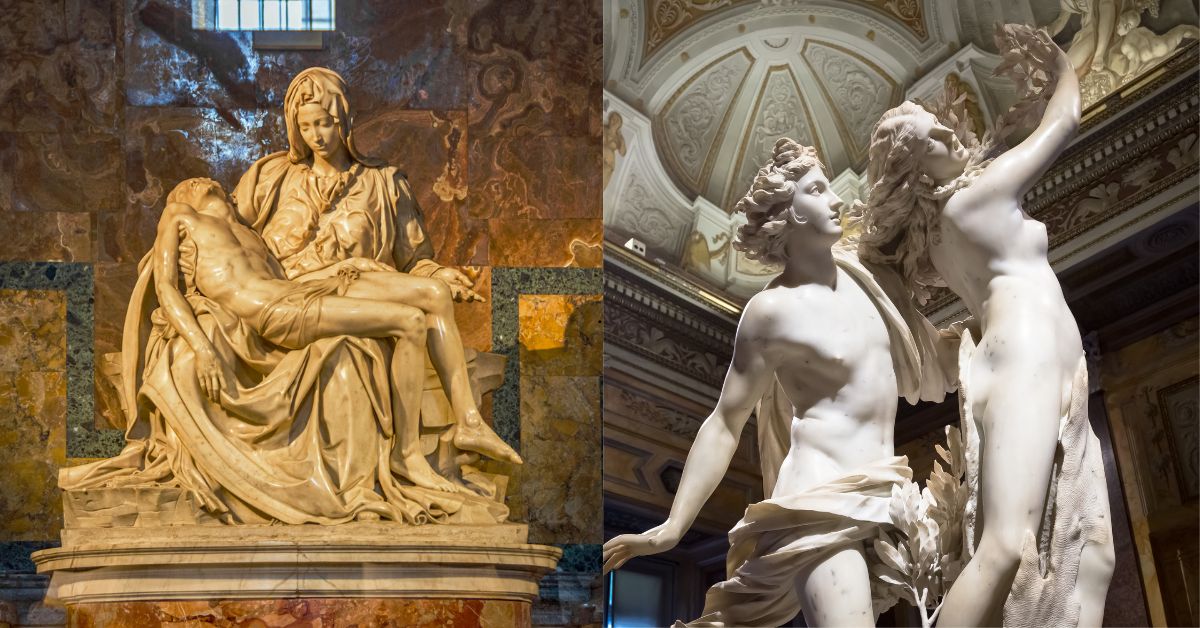
We’ve all had that impossible dinner-party question dropped in our lap: Beatles or Stones? Ford vs. Ferrari? Pizza in Naples or pizza in Rome?
For art lovers in Italy, the heavyweight title fight comes down to two sculptors who worked about 150 years apart—Michelangelo and Bernini. Both were geniuses. Both changed marble from a cold rock into something that breathes. But when you’re standing in front of their work, exhausted from too much gelato and museum stairs, you start to wonder: Who actually did it better?
I dragged my wife through Rome and Florence to find out. She rolled her eyes when I pulled out a notebook. But by the end, even she admitted—this is a fight worth having.
The Tale of the Tape: Two Titans, Two Centuries
Let’s set the stage.
Michelangelo Buonarroti (1475–1564) was the lone wolf of the High Renaissance. He carved like he was wrestling God’s own nightmares into stone. He believed sculpture was the supreme art—painting was for amateurs (sorry, Sistine Chapel fans). His figures are colossal, calm, and coiled with tension just below the surface.
Gian Lorenzo Bernini (1598–1680) was the showman of the Baroque. While Michelangelo worked alone, Bernini ran a workshop and knew how to work a crowd. His marble figures don’t just stand there—they act. Clothes fly. Faces scream. Skin dimples. Bernini wanted to grab you by the collar and say, “Feel this.”
Michelangelo makes you stop and think. Bernini makes you gasp.
Round One: David vs. David
You can’t compare these guys without looking at their Davids. They carved the same Bible hero, 150 years apart, and got totally different results.
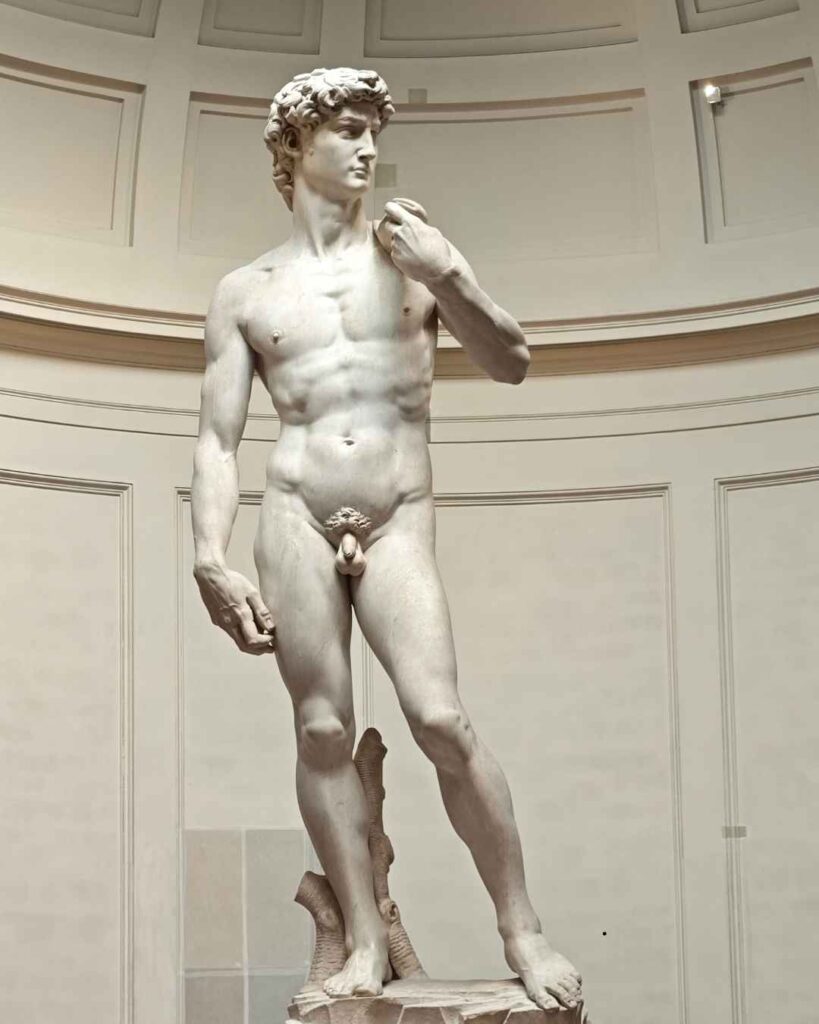
Michelangelo’s David (1504) lives in Florence’s Accademia Gallery. He’s 17 feet tall, naked as a jaybird, and staring down Goliath with the calm of a man who’s already won. His sling rests lazily over one shoulder. His brow is furrowed, but his body is relaxed. This is the moment before action—the psychological pregame. Michelangelo once said sculpture was about “releasing” the figure trapped inside the stone. Here, David emerges like a philosopher-king.
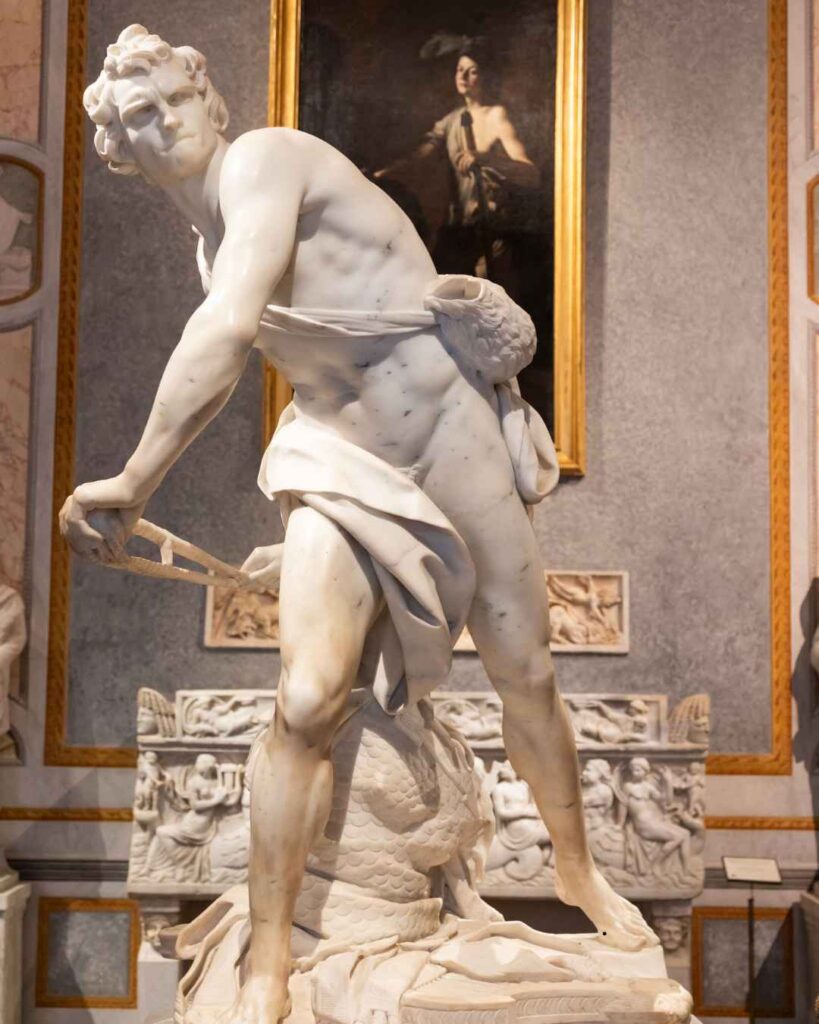
Now, Bernini’s David (1624) in Rome’s Borghese Gallery. Completely different animal. Bernini’s David is mid-throw, twisted like a corkscrew, lips bitten in effort. His sling is stretching. His chest is strained. You can almost hear the grunt. Bernini forces you to walk around the statue because every angle shows a new piece of the action—the twist of the torso, the toes gripping the ground, the face of a kid about to kill or be killed.
Winner: Bernini, for sheer drama. But here’s the catch—my wife said, “I’d rather live with Michelangelo’s David. He just has too much aura”!
Round Two: Pietàs—Grief in Marble
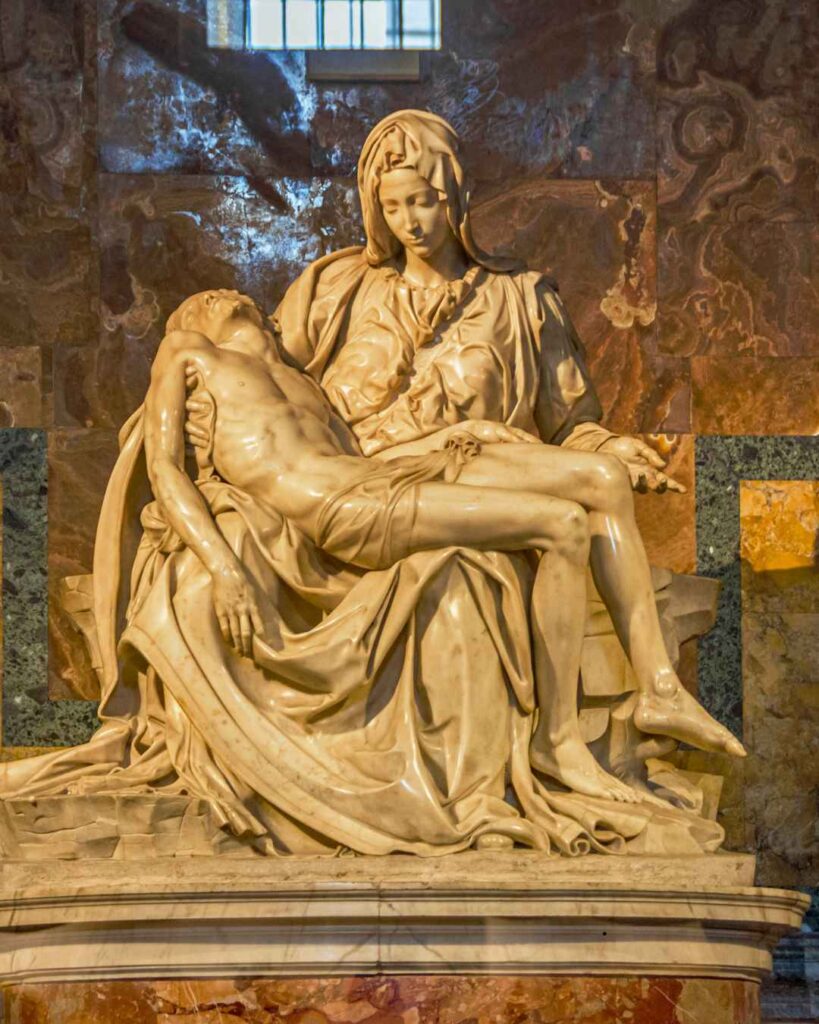
Michelangelo carved his Pietà when he was only 24. It sits in St. Peter’s Basilica, behind bulletproof glass after a vandal attack in 1972. Mary holds the dead Christ across her lap. Her face is young—eerily young—because Michelangelo said pure women don’t age. Christ’s body hangs with a limp, heavy weight. You can almost feel the chill of death in the marble.
The detail is insane: the folds of Mary’s robe look soft as cotton, and Christ’s wounds are barely visible—this isn’t gore, it’s poetry.
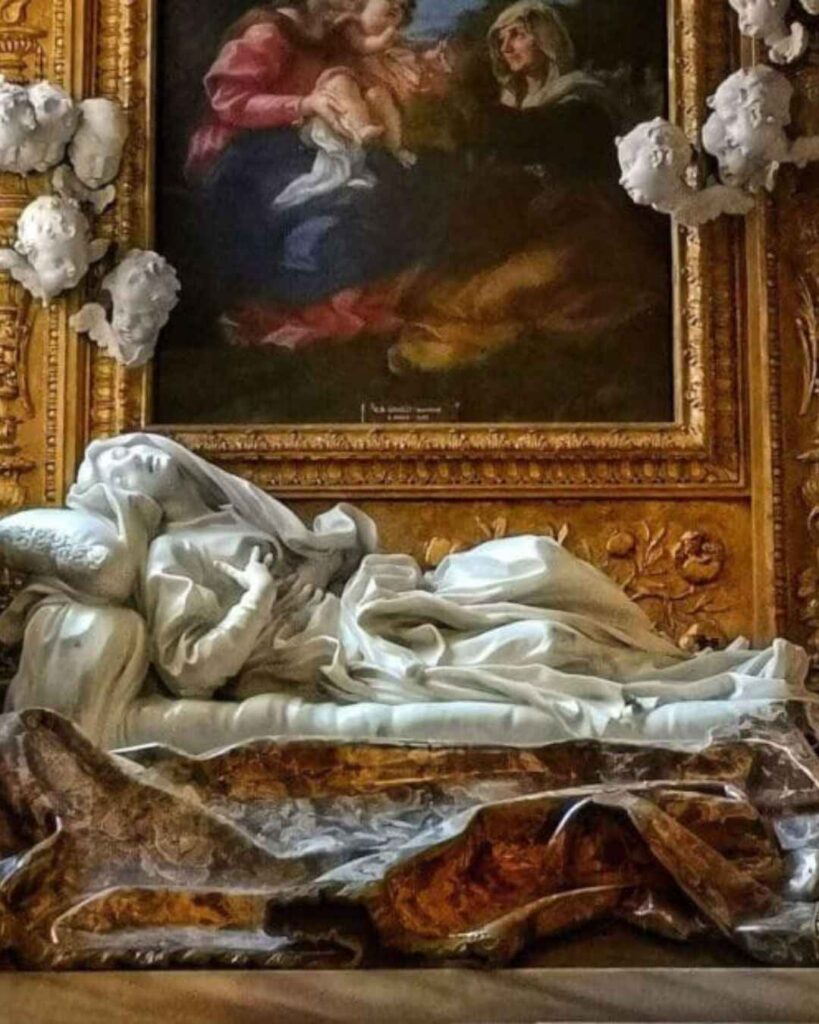
Bernini’s answer came later in his career: the Blessed Ludovica Albertoni (1674) in Rome’s San Francesco a Ripa. It’s not a traditional Pietà, but it’s Bernini’s take on holy suffering. Ludovica lies on her deathbed, convulsed in ecstasy and agony. Her robe bunches like wet laundry. Her hand presses her heart. The light from a hidden window hits her face just so. It’s raw, almost uncomfortable to watch.
Michelangelo’s Pietà makes you weep quietly. Bernini’s makes you squirm.
Winner: Michelangelo, and here’s why—his Pietà is universal. You don’t need to be Catholic to feel it. Bernini’s Ludovica is a masterpiece, but it’s a Baroque fever dream. My wife, who isn’t an art history nerd, stared at Michelangelo’s Pietà for ten minutes in silence. She looked at Bernini’s for two and said, “That’s… intense.”
Round Three: The Ecstasy vs. The Prisoners
Now let’s talk unfinished business.
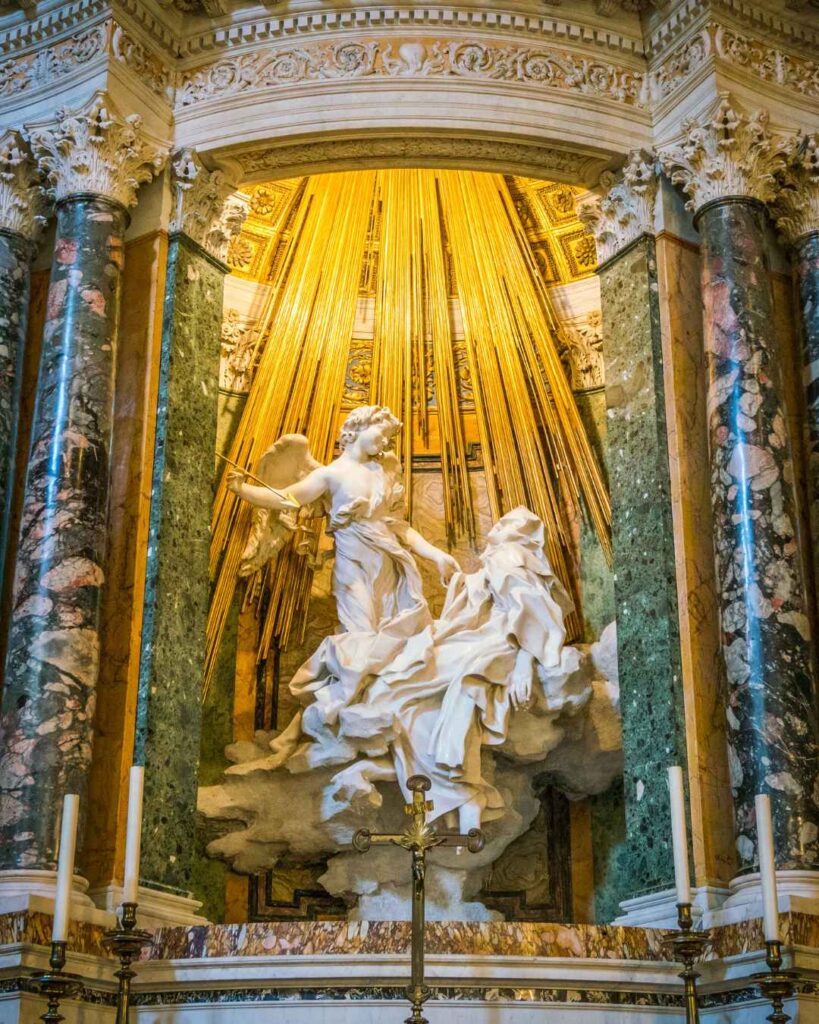
Bernini’s Ecstasy of Saint Teresa (1652) in Rome’s Santa Maria della Vittoria is his greatest hit. Teresa swoons on a cloud, an angel aiming a golden arrow at her heart. Her mouth is open. Her eyes are rolled back. Bernini carved her robe not as cloth but as flames—it crackles and folds like burning paper. Above, hidden windows let in real golden light. This isn’t just a statue; it’s a theater set, a spiritual orgasm in marble.
Critics call it religious. I call it the sexiest statue in Christendom.
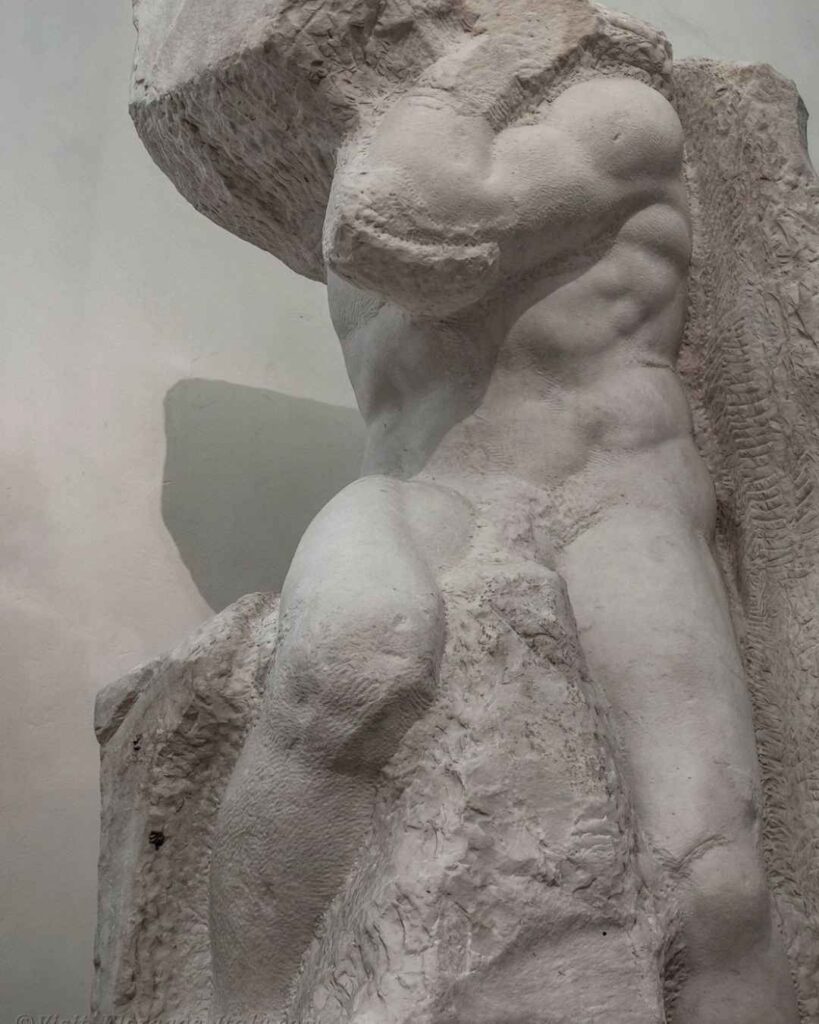
Michelangelo’s Prisoners (Slaves) (c. 1520s) in Florence’s Accademia are the opposite of finished. These four hulking figures look like they’re trying to claw their way out of the block—because they are. Michelangelo left them half-carved on purpose. One man’s torso emerges from rough stone. Another’s face twists, buried up to the chin. They’re not sculptures of struggle; they are struggle.
Winner: Tie, but let me explain. Bernini’s Teresa is a fireworks show—you’ll never forget it. Michelangelo’s Prisoners are a quiet gut punch. My wife said, “Teresa is the one I’d post on Instagram. But the Prisoners are the ones I’d dream about.” I think she nailed it.
Technique: Who Handled Marble Better?
Michelangelo carved as if marble was soap. He worked alone, by candlelight, with a vocabulary of chisels. His surfaces are smooth and polished to a near-sheen. He loved the non-finito—leaving parts rough to suggest the block’s original life.
Bernini was a virtuoso of texture. Look at Apollo and Daphne in the Borghese Gallery: Daphne’s fingers turn to leaves, her toes root into bark, and Apollo’s hand sinks into her soft waist. Bernini carved tree bark, human skin, and flowing hair from the same piece of stone. He also understood that sculpture should move—literally. Some of his fountains in Rome (like the Four Rivers in Piazza Navona) use water as part of the art.
On pure technical difficulty? Bernini wins. But Michelangelo would probably scoff and say, “Anyone can make marble look like bark. Try carving a soul.”
The Legacy: Who Matters More Today?
Michelangelo changed how we see the human body. Every sculptor after him had to deal with his ghost. Even Bernini studied Michelangelo obsessively as a young man. But Bernini changed how we experience sculpture—he made it cinematic, emotional, and interactive.
Walk around Rome: Bernini’s fountains spray you. His saints reach out from chapels. His colonnade at St. Peter’s Square wraps around you like giant arms. Michelangelo’s Rome is quieter—the Pietà behind glass, the Moses in a small church, the dome of St. Peter’s that he designed but never saw finished.
If you want nobility, go see Michelangelo. If you want drama, see Bernini.
Related Post: The 11 Most Stunning Statues in Italy
Final Verdict
Here’s where my wife cut in for the last time. We were sitting on a bench outside the Borghese, feet aching. I asked her straight: “Bernini or Michelangelo?”
She thought for a second and said, “Michelangelo makes me feel small in a beautiful way. Bernini makes me feel like I’m at the movies. I don’t think one is better. I think one is for your head, and one is for your gut.”
I couldn’t argue. So here’s my official, not-very-official answer:
Michelangelo did quiet, eternal, soul-shaking work. Bernini did loud, messy, unforgettable theater. If you put a gun to my head, I’d pick Bernini—because he’s more fun to talk about over a glass of Chianti. But my wife, who has better taste than me, said she’d take Michelangelo’s Pietà on a desert island.
So you decide. And when you’re in Italy, see both. Then argue about it with your own travel companion. Just don’t forget to buy them gelato afterward. That’s the real art.
NOTE BEFORE YOU GO: Italy rewards travelers who go prepared. And it is easy to ruin your trip. I have a checklist for you of things you should never go to Italy without. CHECK IT OUT HERE. I have also curated a list of some of the best hotels in Italy. I would highly recommend checking them out before booking. THESE ARE THE BEST HOTELS IN ITALY. And for unique experiences, attractions, and tours, don’t book before CHECKING THIS OUT. Thank me later!