

I have stood in front of some of the most famous paintings in the world, and I have felt admiration. But standing before a truly great statue in Italy is a different thing entirely. There is something about walking around a figure carved from a single block of marble that feels almost like a conversation. The light changes, the angle shifts, and the stone suddenly breathes.
Italy is the undisputed capital of sculpture. From ancient Roman copies of Greek bronzes to the revolutionary works of Michelangelo and the theatrical magic of Bernini, this country has more masterpieces in public squares and quiet chapels than most nations have in their best museums. My wife and I have spent years hunting them down, often getting lost on purpose just to find the next one.
After dozens of trips and hundreds of statues, here are the eleven that stopped me cold. These are the ones that made me forget to take a picture because I was too busy staring.
1. The Pietà by Michelangelo at St. Peter’s Basilica, Vatican City

I will never forget the first time I saw the Pietà. You walk into the right aisle of St. Peter’s, and there it is behind a protective glass panel. Even with the glare and the crowd of tourists shuffling past, the statue reaches out and grabs you by the throat.
Michelangelo carved this masterpiece when he was only twenty-four years old. Let that sink in. A young man in his early twenties took a single block of Carrara marble and created the most heartbreaking depiction of grief ever made. The sculpture shows the Virgin Mary holding the body of Jesus Christ after the crucifixion. But nothing about it feels static or cold.
What makes the Pietà so stunning is the contradiction at its heart. Mary looks impossibly young for a woman holding her adult son. Michelangelo explained that he wanted to show her purity and eternal virginity, so he made her face youthful and serene. But her expression is not joyful or peaceful. It is the face of someone who understands what has happened but has moved beyond screaming. The grief is internal, quiet, and therefore more powerful.
Look closely at the folds of her dress. They fall in heavy, complex patterns that seem to flow like water. Then look at Christ’s body. He looks heavy, limp, and completely dead. No other sculptor has ever made marble feel so much like lifeless flesh. Mary’s right hand is open beneath his ribs. Her left hand is raised, almost asking a question that has no answer.
Michelangelo famously overheard someone attributing the work to another sculptor, so he sneaked into the church at night and carved his name across Mary’s sash. It was the only work he ever signed. Today, the statue sits behind bulletproof glass because a mentally disturbed man attacked it with a hammer in 1972, damaging Mary’s arm and nose. The restoration was so perfect that you would never know unless someone told you.
When my wife and I visited, we sat on a bench for almost twenty minutes just watching the light move across Mary’s face. That is the power of the Pietà. It makes you sit down and be quiet.
2. David by Michelangelo at the Galleria dell’Accademia, Florence
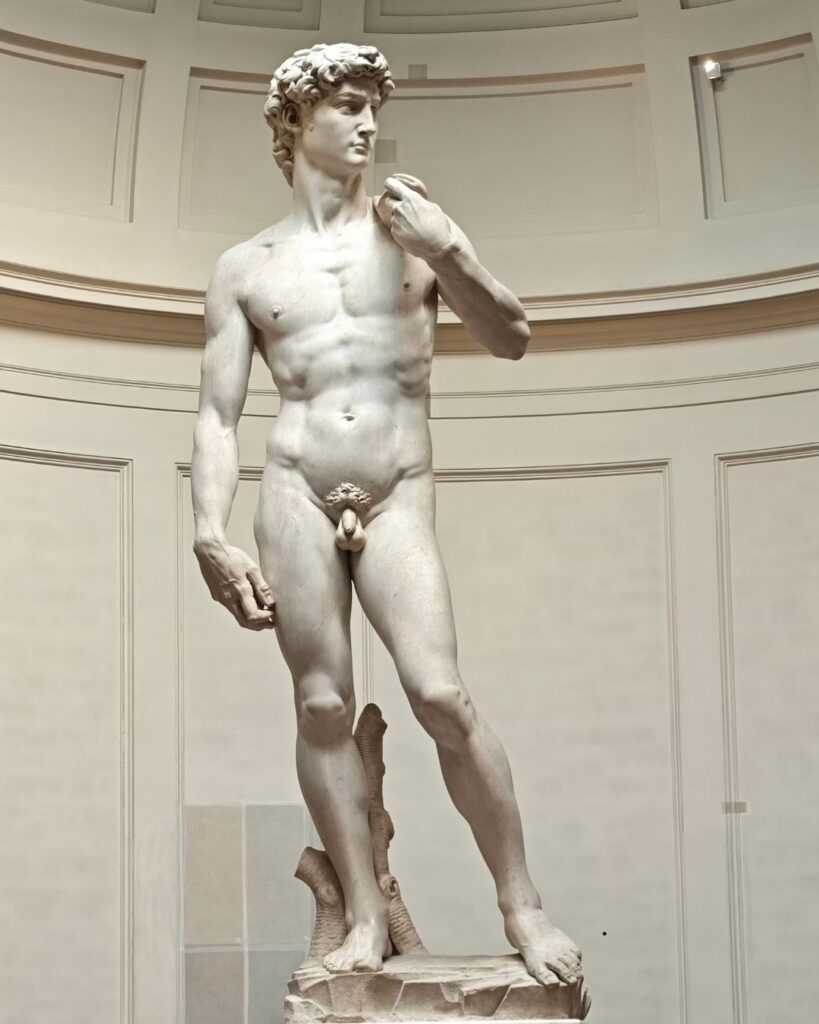
From one Michelangelo to another, but this time we travel to Florence. I have heard people say that David is overrated because it appears on so many postcards and souvenirs. Those people have never stood at the foot of the real thing.
The statue is seventeen feet tall. That is the first surprise. Photographs make him look human-sized, but in person, David towers over you like a giant. Michelangelo carved him from a block of marble that two other sculptors had already rejected as too flawed and too difficult. The artist saw something in that imperfect stone that no one else could see.
Unlike earlier statues of David that show the boy after his victory with Goliath’s head at his feet, Michelangelo shows us the moment before the fight. David’s brow is furrowed. His knuckles are clenched around the sling. His veins bulge in his right hand. Every muscle in his body is tense and ready. This is not a peaceful shepherd. This is a killer about to act.
The anatomical detail is almost absurd. You can see the tendons in his neck, the ribs beneath his chest, and the subtle twist of his torso that creates that perfect contrapposto stance. His eyes are carved with such precision that one pupil seems dilated while the other looks focused and distant. Some art historians believe Michelangelo carved the eyes to look slightly different on purpose, giving David a haunted, intense expression.
Florence placed the statue outside the Palazzo Vecchio as a symbol of the republic’s defiance against larger enemies. Today, the original stands protected inside the Accademia, but its power has not diminished at all. I have seen it three times, and every time I find something new. Last visit, I noticed the veins on the back of his left hand for the first time.
3. The Ecstasy of Saint Teresa by Gian Lorenzo Bernini at Santa Maria della Vittoria, Rome
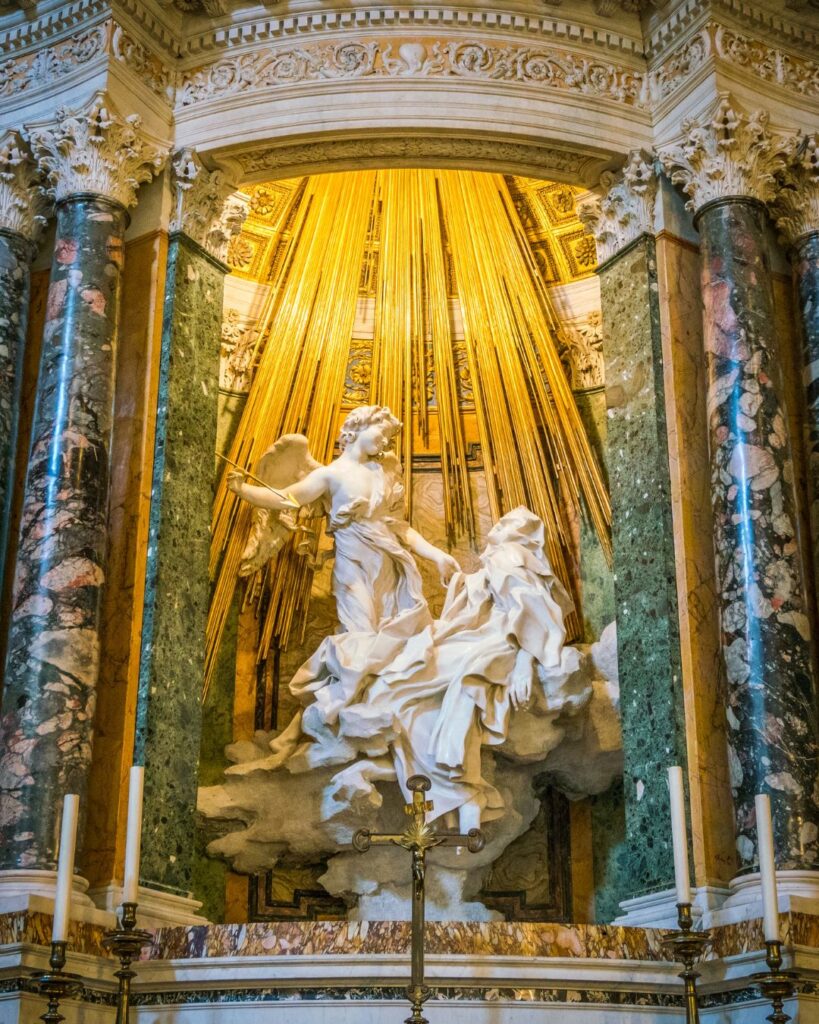
If Michelangelo represents the perfection of the Renaissance, Bernini is the master of the Baroque. And no work shows his genius better than The Ecstasy of Saint Teresa in a small, unassuming church in Rome.
You could walk past Santa Maria della Vittoria without a second glance. But inside, Bernini created a theater of marble. The statue shows Saint Teresa of Ávila in a moment of religious ecstasy. An angel stands over her, holding a golden arrow pointed at her heart. Her head falls back. Her eyes are closed. Her mouth hangs open slightly, and her robes twist and tumble around her body as if caught in a divine wind.
What makes this statue so stunning is how Bernini blurs the line between the physical and the spiritual. Teresa described her vision as a sweet pain caused by the angel piercing her heart with God’s love. Bernini carved that description into marble so convincingly that you almost feel uncomfortable watching her. Is this religious devotion or something more earthly? That tension is exactly what Bernini wanted.
Look at the angel’s smile. It is knowing and almost mischievous. Look at Teresa’s lips, parted as if she is gasping. Her foot dangles over the edge of the cloud beneath her, completely relaxed because she has surrendered to the experience. Bernini even designed a hidden window above the statue that casts real golden light down onto the marble, so the divine rays feel physically real.
I have seen this statue at different times of day, and it changes completely. In the morning, the light is softer and the mood feels peaceful. In the afternoon, the shadows grow sharper, and the ecstasy looks almost violent. Bring a few euros for the light switch near the entrance. Trust me on this.
4. Apollo and Daphne by Gian Lorenzo Bernini at the Galleria Borghese, Rome

Bernini appears multiple times on this list because the man was simply unbeatable. The Galleria Borghese in Rome holds several of his greatest works, and Apollo and Daphne might be the most technically astonishing thing I have ever seen with my own eyes.
The statue tells the story from Ovid’s Metamorphoses. Apollo, struck by Cupid’s golden arrow, chases the nymph Daphne, who has been struck by a lead arrow that makes her reject love completely. To save her from Apollo’s grasp, Daphne’s father turns her into a laurel tree. Bernini shows the exact moment of transformation.
Apollo’s hand touches Daphne’s hip just as bark begins to grow over her skin. Her fingers stretch out and become twigs and leaves. Her toes root into the earth. Her mouth opens in a silent scream. Her hair blows backward, and some strands have already turned into foliage.
The miracle of this statue is that Bernini carved it from a single block of marble. There is no glue, no separate pieces added later. One piece of stone contains running figures, tree bark, leaves, hair, skin, and fabric, all at different stages of transformation. When I walked around the back of the statue, I almost laughed out loud because I could not believe a human hand had made it.
Apollo’s other arm reaches forward, and his hand has just begun to close around Daphne’s waist. She is already slipping away from him. The tragedy is frozen forever.
5. Laocoön and His Sons at the Vatican Museums, Rome
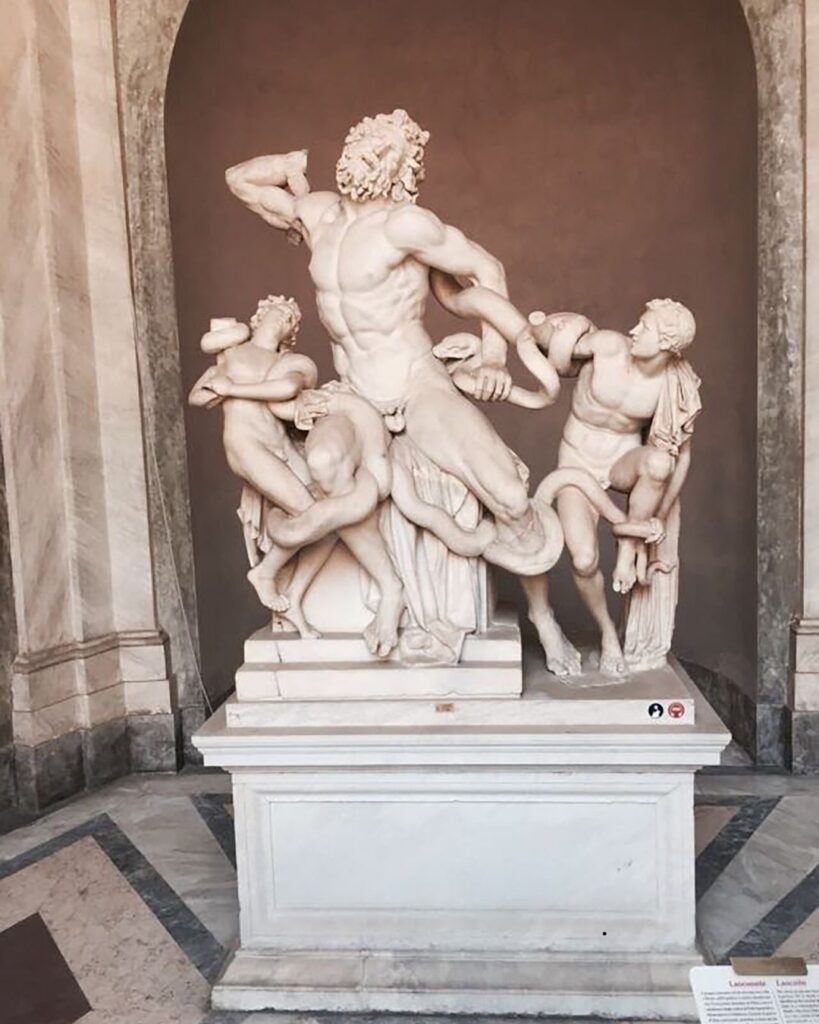
We jump back more than two thousand years for this one. The Laocoön is an ancient Hellenistic statue that was discovered in Rome in 1506. When it emerged from the ground, Michelangelo was one of the first people on the scene. He recognized its importance immediately.
The statue shows a Trojan priest named Laocoön and his two sons being attacked by giant sea serpents sent by the gods. Laocoön had warned his people not to trust the wooden horse left by the Greeks, and the gods punished him for interfering with their plan. The serpents wrap around the three figures, biting and crushing them.
What makes this statue so stunning is the pure, unfiltered agony on every face. Laocoön’s mouth hangs open in a scream that you can almost hear. His muscles bulge as he tries to pull the serpent away from his hip. One son looks at his father with terrified eyes while the snake bites his side. The other son has given up, his head tilted back in despair, waiting for death.
The Laocoön changed the Renaissance because it showed artists that ancient sculptors had achieved levels of emotion and anatomical realism that they had not yet matched. Michelangelo borrowed the twisting pose for many of his own figures.
The statue is missing some pieces, including Laocoön’s right arm. For centuries, scholars argued about whether the original arm was straight or bent. When the correct bent arm was discovered in 1906, it matched a sketch by Michelangelo from four hundred years earlier. He had guessed correctly.
6. The Rape of Proserpina by Gian Lorenzo Bernini at the Galleria Borghese, Rome
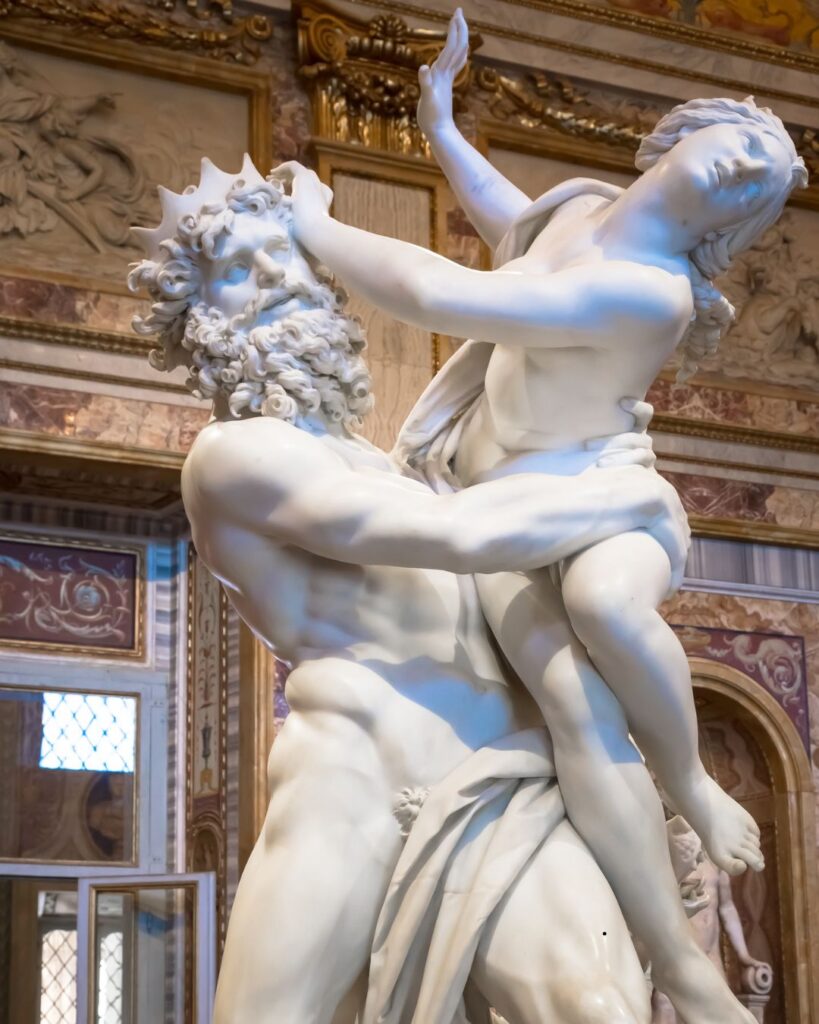
Yes, another Bernini. I am sorry, but I cannot leave this one out. He carved The Rape of Proserpina when he was only twenty-three years old. Twenty-three. Most artists at that age are still learning how to mix paint or shape clay. Bernini was already inventing new ways to carve marble.
The statue shows the god Pluto grabbing Proserpina and dragging her down to the underworld to become his wife. A three-headed dog named Cerberus snarls at their feet. Proserpina fights back. Her body twists away from Pluto. Her hair whips around her face. A single tear rolls down her cheek.
But the detail that makes everyone gasp is Pluto’s hands. Look at his right hand wrapped around Proserpina’s thigh. His fingers sink into her flesh. The marble looks soft, like skin being pressed. Look at his left hand gripping her side. You can see the indentations where his palm pushes against her ribs.
This illusion is so perfect that it tricks your brain. You know you are looking at stone, but you cannot stop seeing fingers squeezing flesh. Bernini achieved this by carving deeper grooves where the fingers meet the body and polishing the skin areas to a high shine while leaving the shadows deeper and rougher. It is a magic trick made of marble.
My wife grabbed my arm when we saw this one and whispered, “That is not possible.” That is the correct response to a twenty-three-year-old genius showing off.
7. The Four Rivers Fountain by Gian Lorenzo Bernini at Piazza Navona, Rome
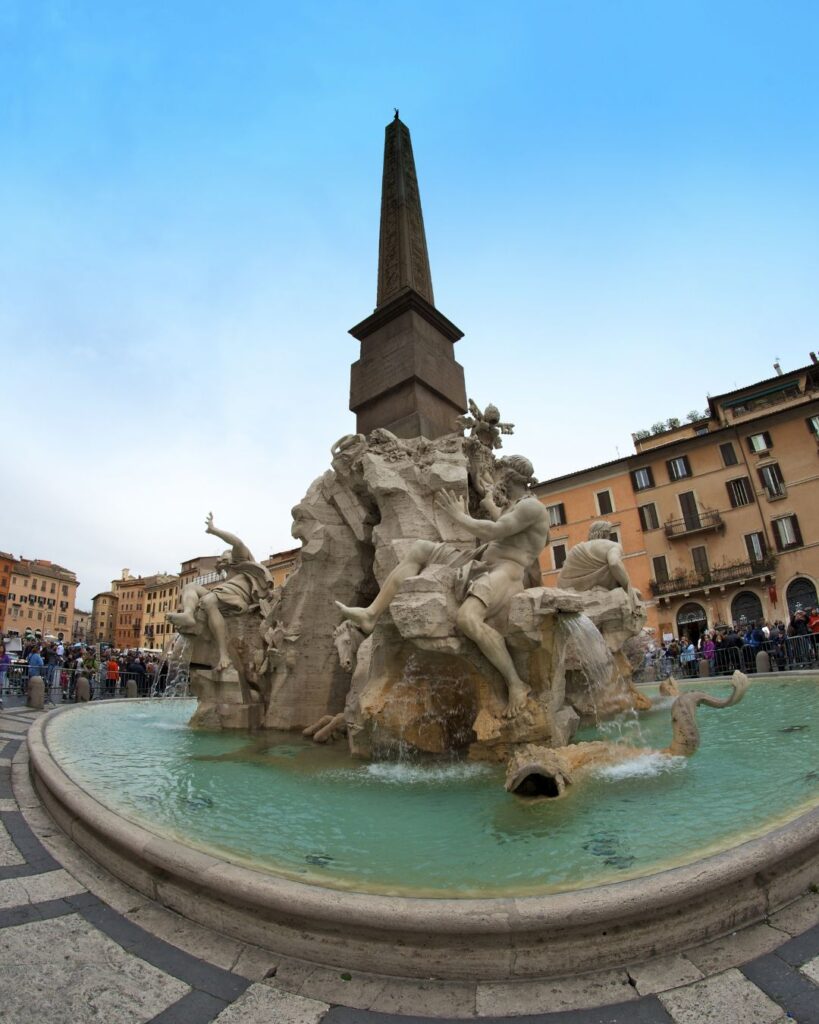
Bernini did not just work indoors. Some of his greatest statues live in the open air, exposed to weather and crowds and pigeons. The Four Rivers Fountain in the center of Piazza Navona is probably the most famous fountain in Rome after the Trevi, and it is a statue first and a fountain second.
Bernini carved four giant figures representing the major rivers of four continents. The Danube represents Europe, the Ganges represents Asia, the Nile represents Africa, and the Rio de la Plata represents the Americas. Each figure reclines around a tall Egyptian obelisk that rises from the center of the fountain.
What makes this work so stunning is the personality Bernini gave to each figure. The Danube touches the papal coat of arms because Europe was the seat of the church. The Ganges carries an oar because the river was navigable.
The Nile covers its head with a cloth because no one knew the source of the river at the time. The Rio de la Plata sits on a pile of coins because the Americas offered great wealth, and the figure seems to recoil from the obelisk as if afraid.
Look for the little details hidden in the stone. A horse and a lion emerge from the rocks beneath the Danube. A palm tree leans behind the Ganges. The whole fountain feels like a crowded stage where every character is doing something interesting at once. And the water flows over everything, catching the Roman sun and making the marble shimmer.
8. Equestrian Statue of Bartolomeo Colleoni by Andrea del Verrocchio in Venice
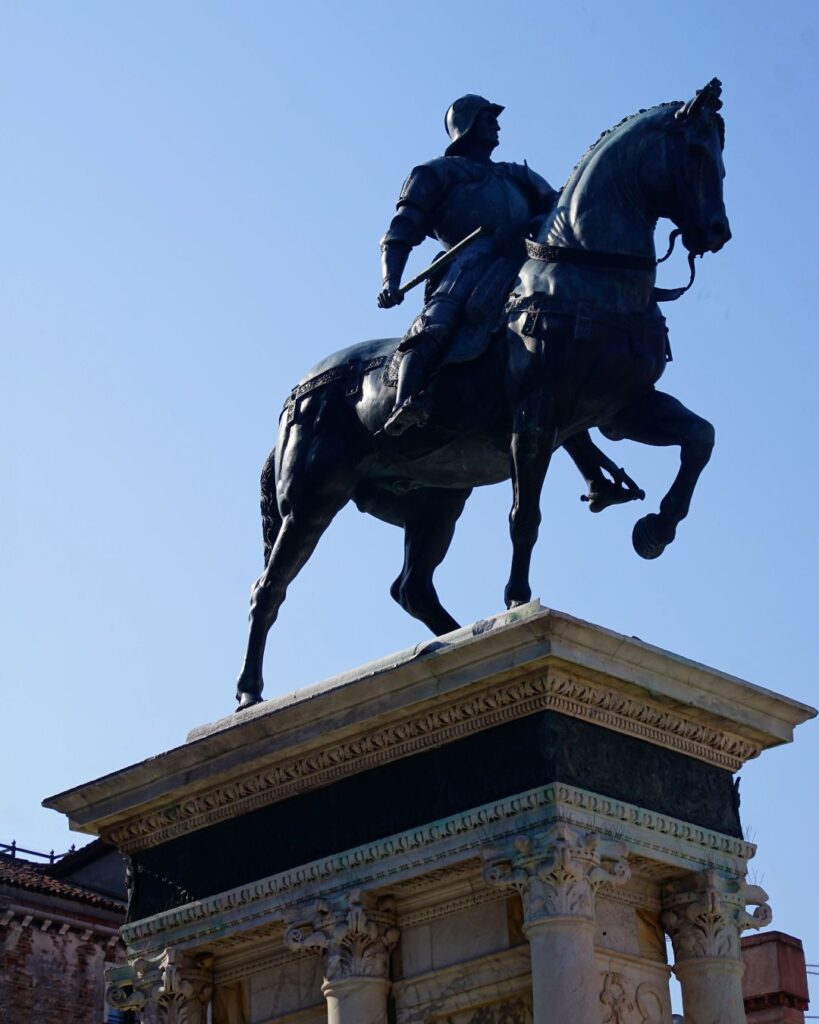
Most tourists in Venice spend their time looking at canals and gondolas. That is fine, but they are missing the single greatest equestrian statue of the Renaissance. The statue of the mercenary captain Bartolomeo Colleoni stands in a small square near the Basilica di Santi Giovanni e Paolo, and it is a masterpiece of bronze casting and sheer aggression.
Verrocchio, who was Leonardo da Vinci’s teacher, worked on this statue for years but died before finishing it. Another artist completed the casting, but the design is all Verrocchio. And the design is furious.
Colleoni sits on a massive horse that seems ready to charge. Both figures lean forward into motion. The horse’s front legs lift off the ground while the back legs gather power. Colleioni stands in his stirrups, his face twisted into a snarl, his baton raised like a weapon. He looks less like a commander giving orders and more like a man about to personally kill someone.
Earlier equestrian statues, like Donatello’s famous Gattamelata in Padua, show calm, dignified leaders. Verrocchio gave us a warrior at the moment of attack. When you stand beneath this statue, which sits on a very high pedestal, you have to crane your neck upward. Colleoni looks down at you from above, and he does not look friendly.
9. Penitent Magdalene by Donatello at the Museo dell’Opera del Duomo, Florence
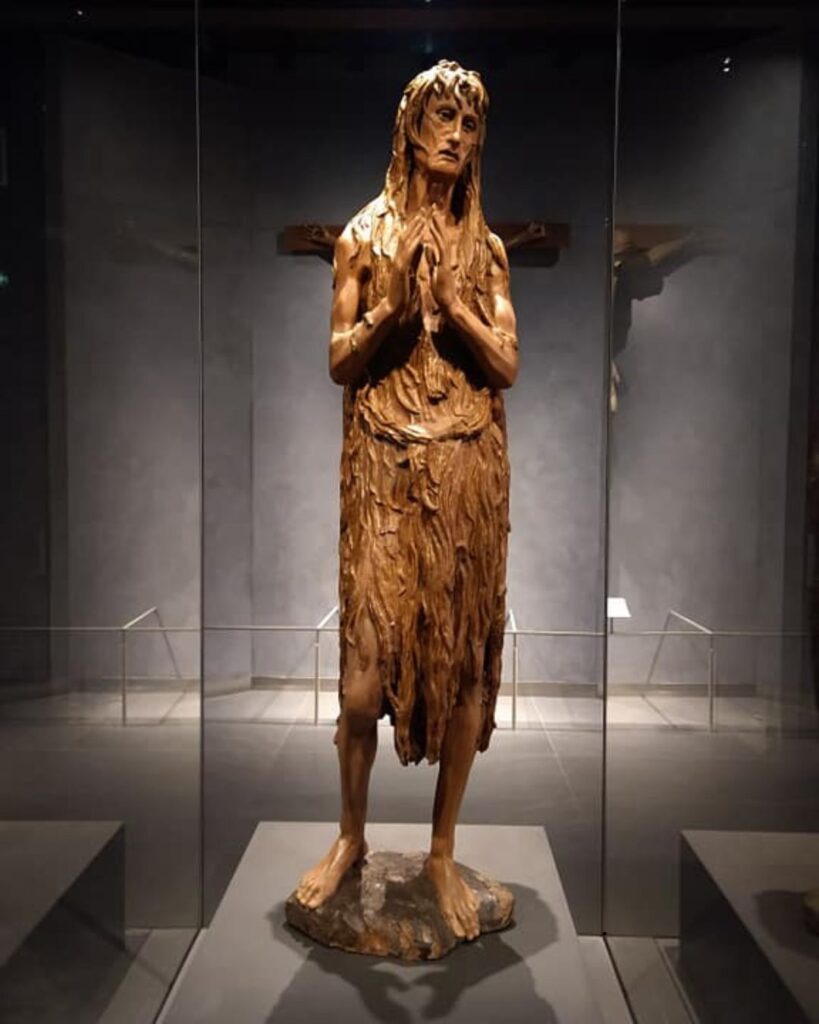
After all the polished marble and heroic figures, we need something raw and uncomfortable. Donatello’s Penitent Magdalene is a wooden sculpture of Mary Magdalene at the end of her life, living as a hermit in the desert, consumed by fasting and prayer.
This statue is not beautiful in any traditional sense. Mary Magdalene is emaciated. Her ribs show through her skin. Her face is gaunt and sunken. Her hair, which legend says grew to cover her naked body after she gave away all her clothes, hangs down in wild, matted tangles. Her mouth is open, and her hands are raised in prayer or perhaps in despair.
Donatello carved this from white poplar wood and then painted it with realistic skin tones and traces of gold. The effect is shocking even today, and it must have been overwhelming in the fifteenth century when most religious art showed saints as graceful and idealized figures. This Magdalene looks like someone who has suffered terribly and is still suffering.
What makes this statue stunning is its honesty. Donatello refused to make Mary Magdalene pretty or comfortable. He wanted viewers to understand the physical cost of extreme devotion. Her eyes are hollow. Her cheeks are caves. And yet there is something noble in her posture. She keeps praying even though her body is failing.
I stood in front of this statue for a long time without saying anything. There are no tricks or illusions here, just raw wood and raw emotion. It is the most human statue on this list because it shows a person falling apart and still holding on.
10. Pauline Bonaparte as Venus Victrix by Antonio Canova at the Galleria Borghese, Rome
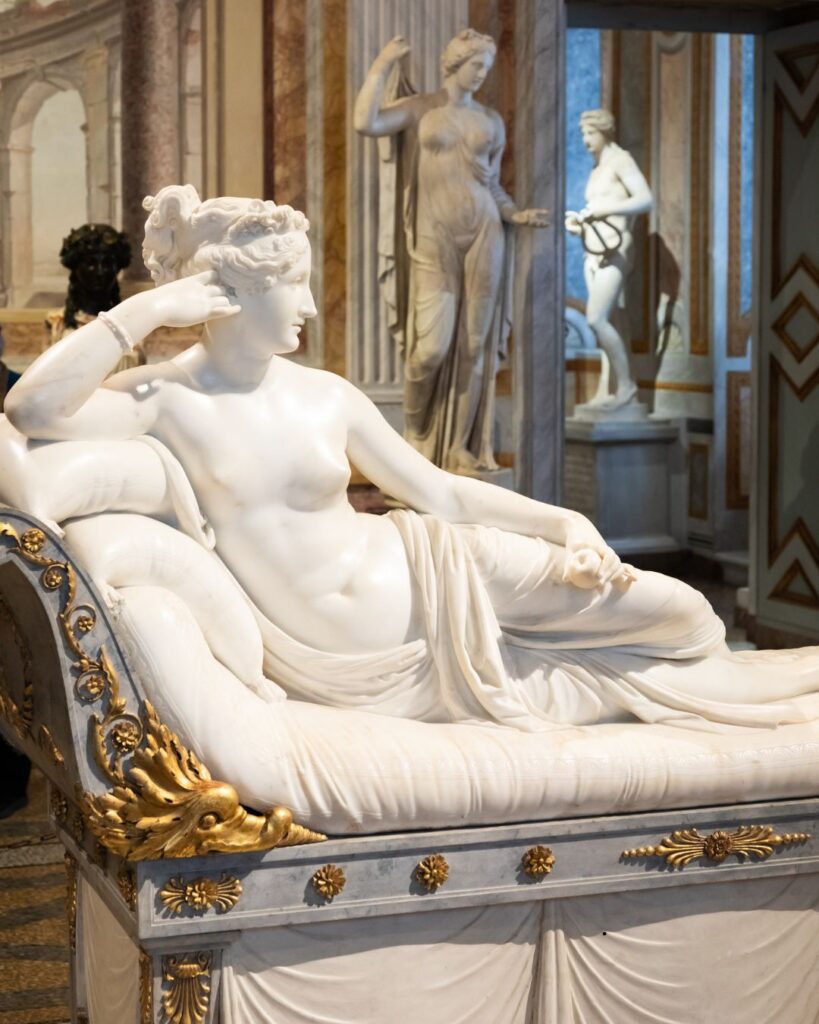
After the suffering of Donatello’s Magdalene, Canova’s statue of Napoleon’s sister feels like a breath of clean, cool air. This is Neoclassical sculpture at its finest. Canova depicted Pauline Bonaparte reclining on a couch as the goddess Venus, holding the golden apple she won from Paris.
Pauline was famously beautiful and famously scandalous. She posed nude for this statue, which was shocking enough for an aristocratic woman in the early 1800s. When someone asked her how she could bear to sit for such a work, she reportedly replied that the studio was heated and there was no draft. Whether or not the story is true, it captures her personality perfectly.
Canova carved the marble with such skill that the couch cushions look soft enough to sink into. The metal frame of the couch is actually marble painted to look like bronze. Pauline’s skin is polished to a perfect smoothness that contrasts with the rougher finish of the pillow beneath her head. She holds the apple loosely, as if she has already won everything she wanted.
The statue originally sat on a wooden base that could rotate, so visitors could walk around and admire Pauline from every angle. That sense of performance and vanity is built into the work. She knows you are looking, and she does not mind at all. This is not a woman running from Apollo. This is a woman who expects to be admired.
11. The Fountain of Neptune by Giambologna in Bologna
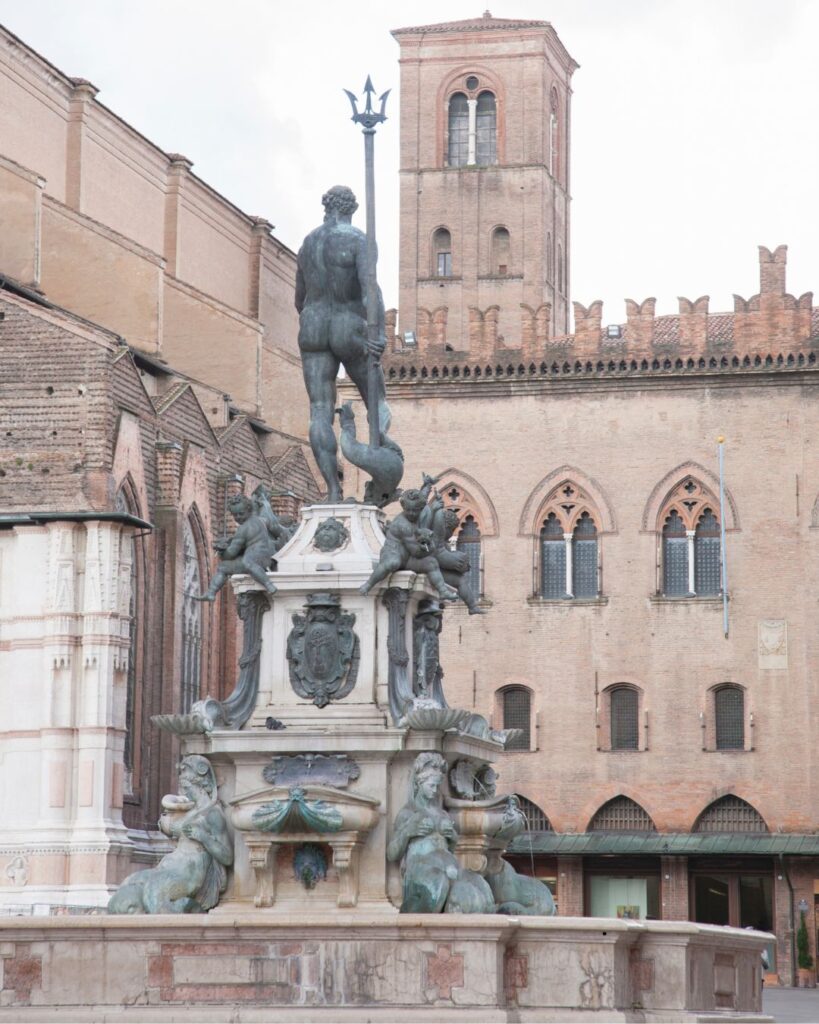
We end in Bologna, a city that tourists often skip on the way from Florence to Venice. That is a mistake, because Bologna has one of the most imposing statues in all of Italy. Giambologna’s Fontana del Nettuno, or the Fountain of Neptune, dominates the main square with a massive bronze god of the sea.
Neptune stands on a tall pedestal surrounded by sea creatures and cherubs. He holds his trident upward, and water pours from every corner of the fountain. But the real story is Neptune himself. He is huge, muscular, and entirely confident. The locals call him il Gigante, the giant, because he towers over the square.
What makes this statue so stunning is Neptune’s gesture. He raises his trident to calm the waters, but his body language suggests something more. His left hand reaches out, palm slightly raised, as if he is telling the entire city to be still and listen. There is absolute authority in his face and posture. This is not a god asking politely. This is a god commanding.
Giambologna was primarily a sculptor for the Medici family in Florence, but he gave Bologna something special with this fountain. The smaller figures around the base, including cherubs and sea horses, are charming and playful. But Neptune himself is deadly serious. The contrast between the playful details and the massive central figure makes the whole fountain feel alive.
Visit this fountain at night if you can. The lighting makes the bronze glow, and the sound of the water fills the square. It is the perfect way to end a journey through Italy’s most stunning statues. A god of the sea standing in the middle of a city, holding back chaos with one raised hand.
Final Words
Italy has given the world many things, but its statues are something else entirely. They are not just art. They are frozen arguments between genius and stone. Every one of these eleven works forced me to stop, to look closer, and to remember that a person made this by hand. No machine. No shortcuts. Just hours and days and years of cutting away everything that was not beautiful or painful or true.
If you ever get the chance to stand before any of these statues, do not rush. Walk around them. Watch the light change. Notice the small details that no postcard will ever show you. And when you finally walk away, you will carry something with you. That is what great sculpture does. It follows you home.
NOTE BEFORE YOU GO: Italy rewards travelers who go prepared. And it is easy to ruin your trip. I have a checklist for you of things you should never go to Italy without. CHECK IT OUT HERE. I have also curated a list of some of the best hotels in Italy. I would highly recommend checking them out before booking. THESE ARE THE BEST HOTELS IN ITALY. And for unique experiences, attractions, and tours, don’t book before CHECKING THIS OUT. Thank me later!
You left out the Veiled Christ by Sanmartino in Sansevo chapel in Naples
I agree. This masterpiece should be on this list. The marble looks almost transparant.
These are magnificent pieces. Yet, in my opinion equally magnificent and perhaps technically more wondrous is Cristo Velato by Giuseppe Sanmartino, 1753 and Disinganno by Francesco Queirolo, 1753-1754, both at Museo Cappella Sansevero -Napoli.